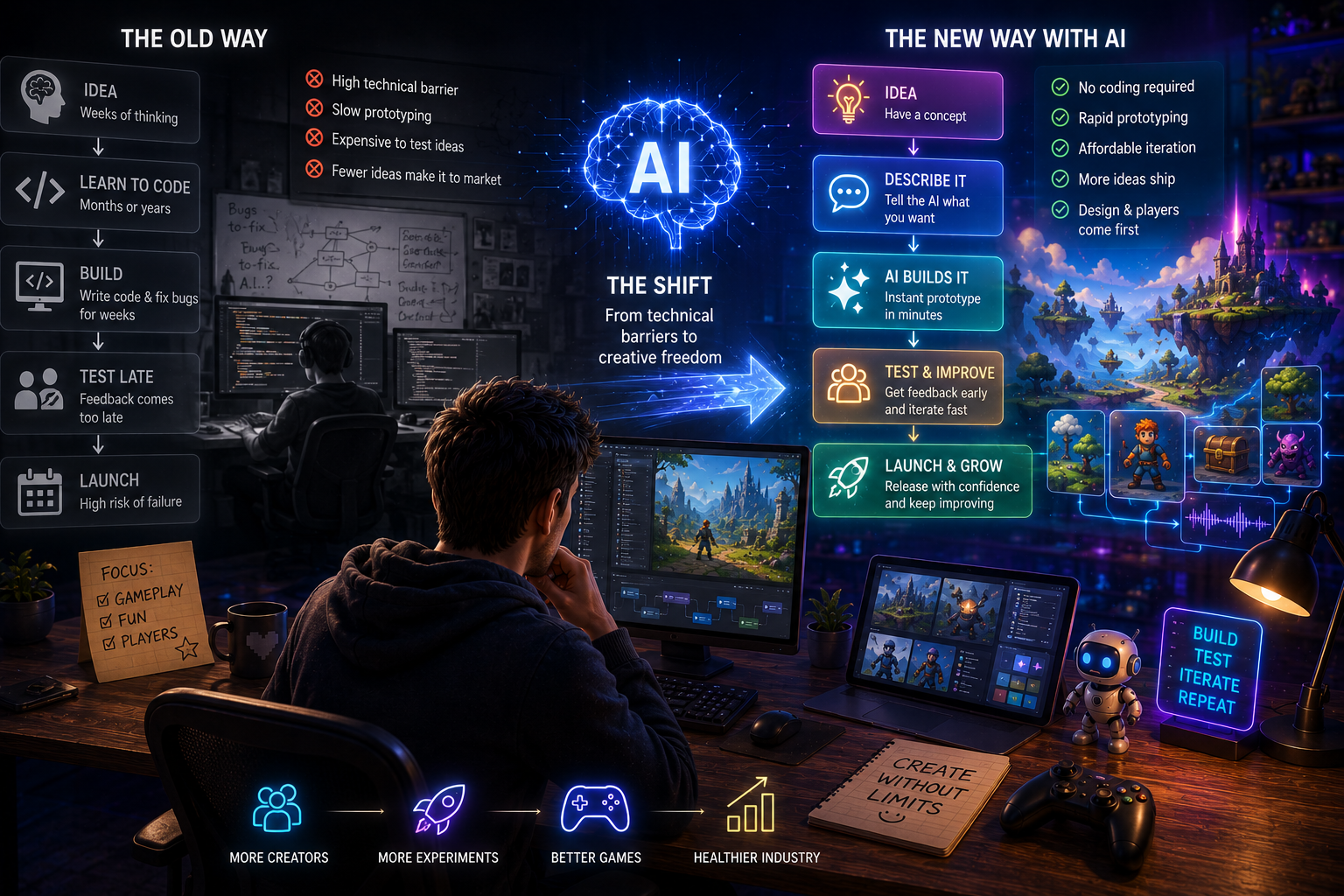
Every generation of game development tools has changed what was possible to build. AI is doing something slightly different: it’s changing who gets to build, how fast ideas get tested, and what a normal development timeline actually looks like. That’s a deeper shift than a new engine feature or a better rendering pipeline, and it’s worth understanding clearly rather than dismissing as another passing trend.
The Old Relationship Between Idea and Execution
For most of game development’s history, a good idea meant very little without the technical skill to build it, or the resources to hire someone who had that skill. Execution was the bottleneck, and it filtered the field toward people with programming backgrounds, regardless of whether they had the strongest creative instincts for what makes a game fun.
That relationship, idea constrained by execution ability, shaped nearly everything about how games got made: who made them, how long projects took, and how many ideas were tested before one actually shipped.
What AI Has Actually Changed About That Relationship
Execution No Longer Requires Years of Learning
Describing a concept in plain language and getting back a working version removes the multi-year learning curve that used to stand between an idea and testing it. This doesn’t mean execution has become worthless, it means the specific requirement of knowing how to code has stopped being the primary filter for who gets to act on a creative idea.
Testing Ideas Has Become Cheap Instead of Expensive
When prototyping a concept used to cost weeks of implementation time, most creators only tested their most confident ideas. Now that a rough version can come together quickly, testing several directions before committing has become realistic, which changes the overall quality of decisions being made across the industry, not just the speed at which they’re made.
Iteration Has Become the Default Mode of Development
Making games increasingly means generating a version, playing it, adjusting, and repeating, rather than committing to a single planned direction and executing it in full before ever testing it. That iterative default produces better-tuned results because more genuine comparison happens throughout development instead of at a single decision point early on.
Where the Change Shows Up Most Clearly
Solo Creators Producing Complete, Polished Games
A single person covering programming, art, and design simultaneously used to be a serious limitation. AI-assisted tools reduce that load enough that solo creators can now produce complete, genuinely satisfying games. Titles like Era.io reflect what that kind of individually-driven, iteration-heavy process can achieve, a tight, well-tuned core loop that came together through repeated refinement rather than a large team catching every issue along the way.
Small Teams Competing With Larger Studios
Content volume and production value used to scale closely with team size. AI-assisted asset generation and rapid prototyping have narrowed that gap considerably, letting small teams compete more directly on design quality without needing to match a larger studio’s raw output capacity.
Faster Discovery of What Doesn’t Work
Finding out a mechanic isn’t fun used to happen late, often after significant investment in surrounding content. Faster prototyping means that discovery happens early, within the first session in many cases, which saves enormous time and avoids the sunk-cost pressure that makes early mistakes so expensive to correct later.
Why This Isn’t Just About Speed
The Real Value Is in What Speed Enables
Faster implementation on its own would be a modest improvement. What actually matters is what creators do with the time that speed frees up: more playtesting, more comparison between variations, more attention paid to the judgment calls that determine whether a game is genuinely good. Speed is the mechanism. Better decisions are the result.
Creative Judgment Becomes More Central, Not Less
As technical execution becomes accessible to nearly everyone, what separates a great game from a mediocre one increasingly comes down to design sense and taste rather than implementation skill. AI hasn’t reduced the importance of creative judgment, it’s made that judgment the primary differentiator instead of one factor among several.
The Definition of a Developer Has Genuinely Broadened
Someone with no programming background who builds and ships a well-received game deserves the title of developer just as legitimately as someone with a computer science degree. That’s not a lowering of standards, it’s a recognition that technical skill was never actually the core of what makes someone good at making games.
What Hasn’t Changed and Isn’t Likely To
Vision Still Has to Come From a Person
AI can execute a described idea efficiently, but it doesn’t generate the underlying reason a game is worth making in the first place. That spark remains entirely human, and there’s no sign of that changing regardless of how much further these tools advance.
Balancing and Tuning Still Require Real Observation
Knowing whether a difficulty curve feels fair or a reward system feels satisfying still depends on watching real players and making judgment calls based on what you see. No tool replaces that observational, human process.
Highly Technical Projects Still Need Deep Expertise
Genuinely novel technical systems, competitive netcode, complex simulation, deeply custom rendering, still often require direct engineering expertise that AI-assisted tools handle less reliably than common, well-established patterns.
What This Means Going Forward
Adaptability Matters More Than Mastering One Specific Tool
The platforms will keep evolving. What matters longer-term is the habit of using fast iteration well: testing deliberately, watching real player behavior, and reinvesting saved time into better decisions rather than just producing more output.
The Barrier to Entry Isn’t Coming Back
Unlike some technology shifts that prove temporary, the move toward accessible, AI-assisted development looks structural. The technical barrier that used to gate who could act on a good idea has been removed in a way that doesn’t appear reversible.
Design Skill Is Becoming the New Competitive Edge
As implementation speed becomes broadly available, the creators and teams who stand out will increasingly be the ones with the sharpest design instincts and the most disciplined iteration process, not necessarily the ones with the deepest technical background.
Final Thoughts
AI is changing the way games are made not by replacing the creativity and judgment that’s always driven good games, but by removing the technical execution barrier that used to determine who got a real shot at building one, and by compressing the time between having an idea and knowing whether it actually works.
That shift reaches further than just faster development. It’s reshaping who participates in game creation, what skills actually matter most, and how much genuine iteration goes into a finished product before it ever reaches a player. The tools will keep changing. That underlying shift looks like it’s here to stay.
About the Author