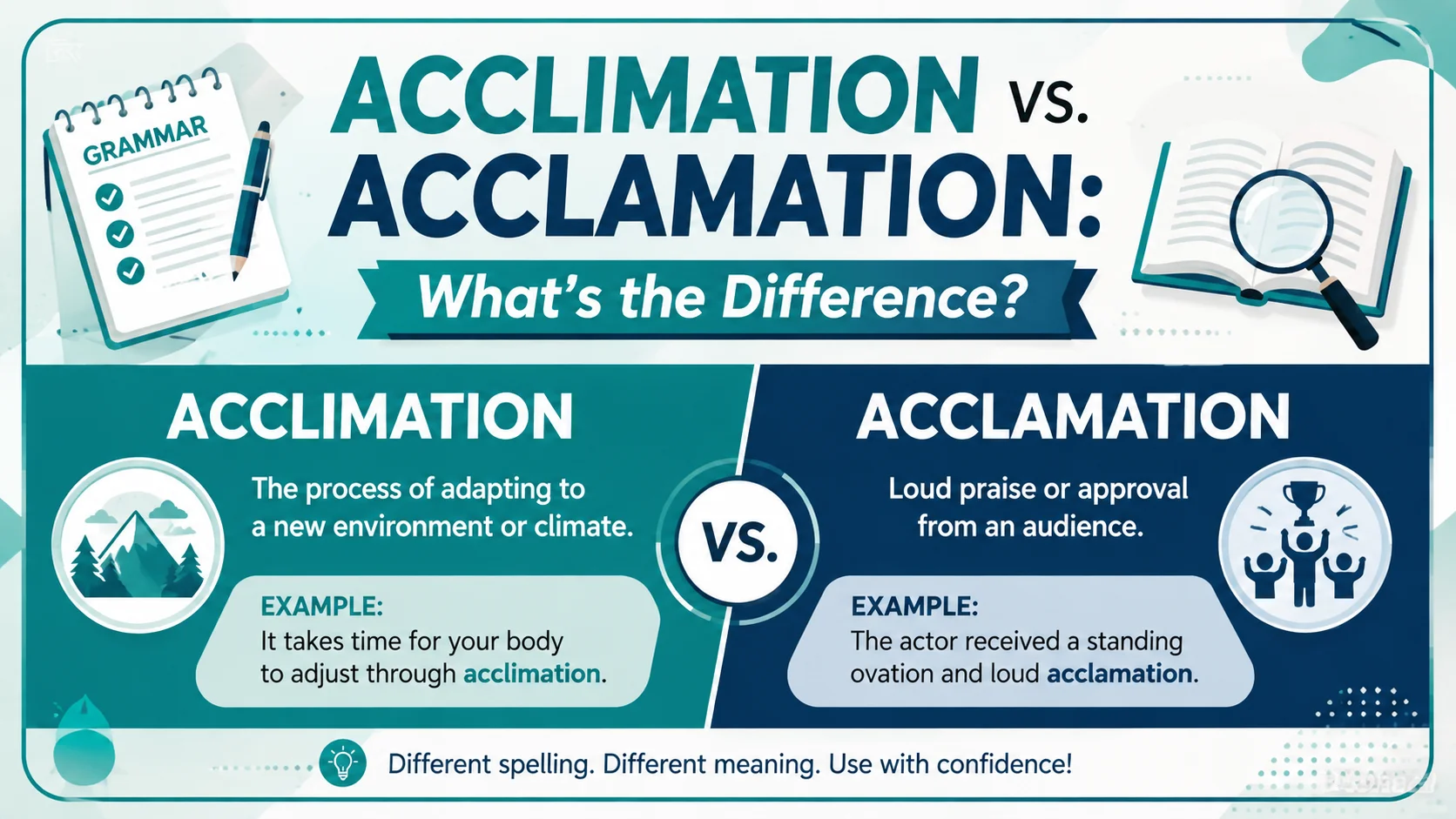
Acclimation vs Acclamation may look and sound nearly the same, but they point to very different ideas. Acclimation describes the process of adjusting to new environmental conditions. For example, your body may need time to acclimate to a different temperature, climate, or altitude. If you enter unfamiliar surroundings, acclimation helps you become comfortable with the new conditions.
Acclamation, on the other hand, refers to enthusiastic praise, approval, or public recognition. Picture a mountain climber reaching the summit after a difficult climb. The climber may need acclimation before and during the journey as the body adjusts to high altitude. When the climber reaches the top, the cheers and praise they receive from the public can represent acclamation. This simple contrast makes the difference easier to remember.
From an English writing perspective, understanding this distinction can improve your confidence and precision. The tiny spelling difference can completely change the meaning of a sentence, even though the words seem nearly identical. Think of acclimation as becoming comfortable with a new setting, while acclamation means receiving strong support or praise. With clear examples, smooth transitions, and natural phrasing, you can keep these two easily confused terms separate.
Quick Answer: Acclimation vs. Acclamation
Acclimation means adjustment to new environmental conditions. It often appears in discussions of biology, climate, altitude, temperature, and physical training.
Acclamation means enthusiastic approval, praise, or public recognition. It can also describe an election or decision made through overwhelming public agreement rather than a formal ballot.
| Word | Meaning | Common Context | Example |
| Acclimation | Adjustment to new conditions | Climate, altitude, biology, training | The climber needed time for acclimation. |
| Acclamation | Praise or enthusiastic approval | Awards, politics, public recognition | The performer received widespread acclamation. |
The easiest rule to remember is:
- Acclimation = adjustment
- Acclamation = approval
- Acclimation = environment
- Acclamation = applause
If you’re describing getting accustomed to conditions, choose acclimation. If you’re describing strong praise or approval, choose acclamation.
What Does Acclimation Mean?
Acclimation describes the process of adjusting to changed environmental conditions. The adjustment can involve physical or physiological responses that help an organism function under its new circumstances.
For example, imagine someone who lives near sea level and travels to a high mountain. The thinner air may initially make physical activity more difficult. After spending time at the higher elevation, the person’s body can adjust to the conditions.
That adjustment is called acclimation.
The word commonly appears in scientific and practical discussions involving:
- Altitude
- Temperature
- Climate
- Humidity
- Light exposure
- Water temperature
- Physical training
- Environmental changes
You may also see the word used more broadly when someone becomes accustomed to a new environment.
Acclimation Examples in Everyday and Scientific Contexts
Here are several situations that illustrate the meaning clearly:
- A runner gradually adjusts to exercising in extreme heat.
- A mountain climber becomes accustomed to high altitude.
- A fish adjusts to a new water temperature.
- A plant becomes accustomed to different light conditions.
- An animal adjusts to changes in its surrounding temperature.
- An athlete prepares for competition in a dramatically different climate.
Consider this sentence:
The runners needed several days of acclimation to the hot weather.
The runners aren’t receiving praise. They’re adjusting to an environmental condition.
Another example:
The fish underwent gradual acclimation to the colder water.
Again, the central idea is adjustment.
Acclimation in Biology and Environmental Science
In biology, acclimation has a more specific meaning than simply becoming comfortable with something.
An organism can make physiological or functional adjustments during its lifetime when environmental conditions change. Those adjustments can improve its ability to function under the new conditions.
For example, an animal exposed to a different temperature may experience physiological changes that help it tolerate that temperature more effectively.
This distinction becomes especially important when comparing acclimation with adaptation.
| Term | Basic Meaning | Typical Time Scale |
| Acclimation | Adjustment to changed environmental conditions | During an individual’s lifetime |
| Acclimatization | Adjustment to environmental conditions, often in natural settings | During an individual’s lifetime |
| Evolutionary adaptation | Heritable characteristics that become common through evolution | Across generations |
The terms acclimation and acclimatization sometimes overlap. Scientists may distinguish them based on the setting or type of environmental change, while different fields can use them somewhat differently.
Evolutionary adaptation is different. It involves inherited characteristics that develop across generations rather than an individual’s temporary or lifetime adjustment.
That distinction matters in scientific writing.
What Does Acclamation Mean?
Acclamation has nothing to do with climate or environmental adjustment.
Instead, it means enthusiastic approval, praise, recognition, or public support.
Think about an audience standing and cheering after an outstanding performance. That enthusiastic response can be described as acclamation.
For example:
The singer received widespread acclamation after her performance.
The singer isn’t adjusting to an environment. She’s receiving public praise.
Acclamation can appear in several areas, including:
- Politics
- Sports
- Entertainment
- Awards
- Public events
- Organizations
- Formal meetings
The expression “by acclamation” has a more specific use. It can describe a decision or election supported by an overwhelming public expression of approval instead of a regular ballot.
Acclamation Examples in Real-World Writing
Here are some natural examples:
The actor received widespread acclamation for his performance.
The team returned home to enormous public acclamation.
Her charitable work earned international acclamation.
The candidate was elected by acclamation.
The proposal passed by acclamation after receiving unanimous support.
Notice the pattern. Each example involves approval, praise, or agreement.
That’s the heart of acclamation.
Acclimation vs. Acclamation: Key Differences
The biggest difference is simple:
Acclimation involves adjustment. Acclamation involves approval.
Although the words look similar, they belong to very different semantic areas.
| Feature | Acclimation | Acclamation |
| Meaning | Adjustment to new conditions | Enthusiastic praise or approval |
| Main idea | Becoming accustomed | Expressing support |
| Common fields | Biology, climate, altitude, training | Politics, sports, entertainment, public events |
| Related verb | Acclimate | Acclaim |
| Typical subject | Person, animal, plant, organism | Person, achievement, performance, decision |
| Memory word | Adjust | Applaud |
Here’s an easy way to picture the difference.
Imagine a runner preparing for a marathon in a very hot city.
During training, the runner gradually becomes accustomed to the heat. That’s acclimation.
After finishing the race and breaking a record, the crowd cheers loudly. That’s acclamation.
The same person can experience both, but the words describe completely different things.
Acclimation vs. Acclamation Pronunciation
Pronunciation can make these words especially confusing because they sound remarkably similar.
Acclimation is commonly pronounced roughly like:
ak-luh-MAY-shun
Acclamation is commonly pronounced roughly like:
ak-luh-MAY-shun
Because the pronunciation is so close, listening alone may not help you identify the correct spelling.
Instead, connect each word to a related term:
- Acclimation → acclimate
- Acclamation → acclaim
That connection makes the difference easier to remember.
If you hear a sentence about someone adjusting to heat, altitude, or climate, think acclimation.
If you hear a sentence about praise, applause, or public approval, think acclamation.
Acclimation vs. Acclimatization vs. Adaptation
These three words often appear in the same scientific conversations, but they aren’t interchangeable in every context.
Acclimation
Acclimation generally describes an individual’s adjustment to changed environmental conditions.
For example:
The athlete underwent heat acclimation before competing.
The athlete is adjusting during their own lifetime.
Acclimatization
Acclimatization also describes adjustment to environmental conditions. In some scientific contexts, it specifically refers to adjustments that occur under natural environmental conditions.
For example, a person gradually becoming accustomed to the conditions at high altitude may undergo acclimatization.
The distinction between acclimation and acclimatization varies somewhat across scientific disciplines, so context matters.
Adaptation
Adaptation has a broader meaning.
In evolutionary biology, an adaptation is a heritable trait that helps organisms survive and reproduce in particular environments.
For example, certain animals possess physical characteristics that help them survive in extremely cold environments. Those traits developed across generations rather than appearing because one individual simply spent more time in the cold.
A useful shortcut is:
Acclimation happens within an individual’s lifetime. Evolutionary adaptation occurs across generations.
Acclamation vs. Acclaim: Are They the Same?
Acclamation and acclaim are closely related.
The noun acclaim means enthusiastic praise or approval.
For example:
The novel received widespread acclaim.
The word can also function as a verb:
Critics acclaimed the director’s latest film.
Acclamation, however, functions as a noun.
For example:
The performer received enthusiastic acclamation.
The two words share the same general idea of praise, but acclaim is often more common in ordinary modern writing.
| Word | Grammatical Role | Example |
| Acclaim | Noun | The film received critical acclaim. |
| Acclaim | Verb | Critics acclaimed the performance. |
| Acclamation | Noun | The performer received public acclamation. |
There’s also an important expression:
Elected by acclamation
This means a person receives overwhelming approval in an election or formal selection process, often without a contested ballot.
How to Use Acclimation in a Sentence
Acclimation works naturally when your sentence focuses on adjustment.
Examples include:
The climbers allowed several days for acclimation to the altitude.
The athlete’s training included heat acclimation.
The fish required gradual acclimation to the new water temperature.
Moving to the desert required considerable acclimation to the dry climate.
The plants need careful acclimation before exposure to direct sunlight.
The team scheduled a period of acclimation before beginning intensive training.
Each sentence centers on adjustment to conditions.
How to Use Acclamation in a Sentence
Use acclamation when the sentence focuses on praise, approval, or public support.
Examples include:
The author received international acclamation after the book won the award.
The athlete earned widespread acclamation after breaking the record.
Her humanitarian work brought her considerable acclamation.
The proposal passed by acclamation.
The performer was greeted with enthusiastic acclamation.
The candidate was selected by acclamation.
The common thread is enthusiastic approval.
Acclimation vs. Acclamation in Academic and Professional Writing
Choosing the correct word becomes especially important in formal writing.
Scientific articles may use acclimation when discussing physiological responses to environmental changes. You might encounter terms such as heat acclimation, cold acclimation, or thermal acclimation.
Meanwhile, reviews, news reports, biographies, and cultural writing may use acclamation when discussing public recognition.
Compare these two sentences:
Researchers examined the effects of thermal acclimation on the species.
The scientist received international acclamation for the discovery.
The first sentence belongs to environmental or biological science.
The second belongs to recognition and public praise.
Replacing one word with the other wouldn’t create a minor spelling issue. It would produce a completely different meaning.
Case Study: One Athlete, Two Different Words
Consider a marathon runner preparing for a race in an extremely hot location.
During the weeks before the competition, the runner trains in increasingly warm conditions. The body gradually adjusts to the heat.
That process involves heat acclimation.
On race day, the runner performs exceptionally well and wins the event. Spectators cheer, journalists praise the achievement, and the runner receives awards.
That response represents acclamation.
| Situation | Meaning | Correct Term |
| Preparing for extreme heat | Adjusting to environmental conditions | Acclimation |
| Winning the race | Achieving success | — |
| Receiving cheers and praise | Public approval | Acclamation |
This example makes the distinction easy to visualize.
Acclimation happens during preparation. Acclamation can follow achievement.
Quick Comparison: Acclimation or Acclamation?
When you’re stuck between the two spellings, look at the surrounding context.
Choose Acclimation When the Sentence Mentions:
- Climate
- Temperature
- Altitude
- Environment
- Physical adjustment
- Biological responses
- Heat or cold
- Training conditions
- Becoming accustomed
Choose Acclamation When the Sentence Mentions:
- Praise
- Applause
- Recognition
- Approval
- Public support
- Awards
- Celebration
- Enthusiastic agreement
- Election by overwhelming approval
Test Your Understanding
The hikers needed several days of ______ before reaching the summit.
Answer: acclimation
The actor received widespread ______ for the performance.
Answer: acclamation
The candidate was elected by ______.
Answer: acclamation
The plants needed gradual ______ to the new temperature.
Answer: acclimation
Here’s the quickest mental test:
Conditions? Acclimation. Approval? Acclamation.
The Origins of Acclimation and Acclamation
Their similar spelling can make the words seem historically connected. Their origins, however, developed along different paths.
Acclimation comes from the word acclimate, which entered English through French. The word ultimately connects with the idea of climate and adapting to environmental conditions.
Acclamation has a different history. It comes through French from Latin acclamare, associated with shouting or calling out approval.
Their histories help explain their meanings:
- Acclimation → climate and environmental adjustment
- Acclamation → calling out, cheering, and approval
The words may look like linguistic twins, but they’re really distant cousins with very different jobs.
Conclusion
Acclimation vs Acclamation may look almost identical, but their meanings are completely different. Acclimation involves adjusting to new conditions, such as a different climate, temperature, or altitude. Acclamation refers to enthusiastic praise, approval, or public recognition. Remembering this simple difference can help you choose the right word and make your English writing clearer.
FAQs
Q1. What does acclimation mean?
Acclimation means adjusting to a new environment or condition. For example, your body may need acclimation when you move to a higher altitude.
Q2. What does acclamation mean?
Acclamation means enthusiastic approval, praise, or public recognition. Loud cheers for a successful performer can be a form of acclamation.
Q3. Are acclimation and acclamation pronounced the same?
No. They sound similar, but their pronunciation differs slightly. Acclimation relates to adjustment, while acclamation relates to praise.
Q4. What is the main difference between acclimation and acclamation?
The key difference is their meaning. Acclimation means adapting to new conditions, whereas acclamation means receiving enthusiastic approval or praise.
Q5. How can I remember the difference?
Connect acclimation with climate and adjustment. Think of acclamation as clapping and praise. This quick association makes the distinction easier to remember.
About the Author