tear tare
English contains many words that look or sound similar but have completely different meanings. These words can confuse students, writers, and even fluent English speakers. One common example is tear tare, a keyword that brings together two English words with different definitions, pronunciations, and uses. Although the words look nearly identical, understanding the difference between them can help you improve your spelling, vocabulary, reading comprehension, and everyday communication.
The word “tear” has more than one meaning and pronunciation, while “tare” is mainly used in weighing, packaging, and measurement. Learning when to use each word is important for writing accurately and understanding English in different situations.
In this article, we will explore the meaning of tear and tare, explain their differences, provide practical examples, and share simple techniques to help you remember which word belongs in each context.
What Does Tear Tare Mean?
The phrase “tear tare” is not a standard English expression with one fixed definition. Instead, it usually refers to the comparison between the words “tear” and “tare.” These words are useful examples of how English spelling and pronunciation can create confusion.
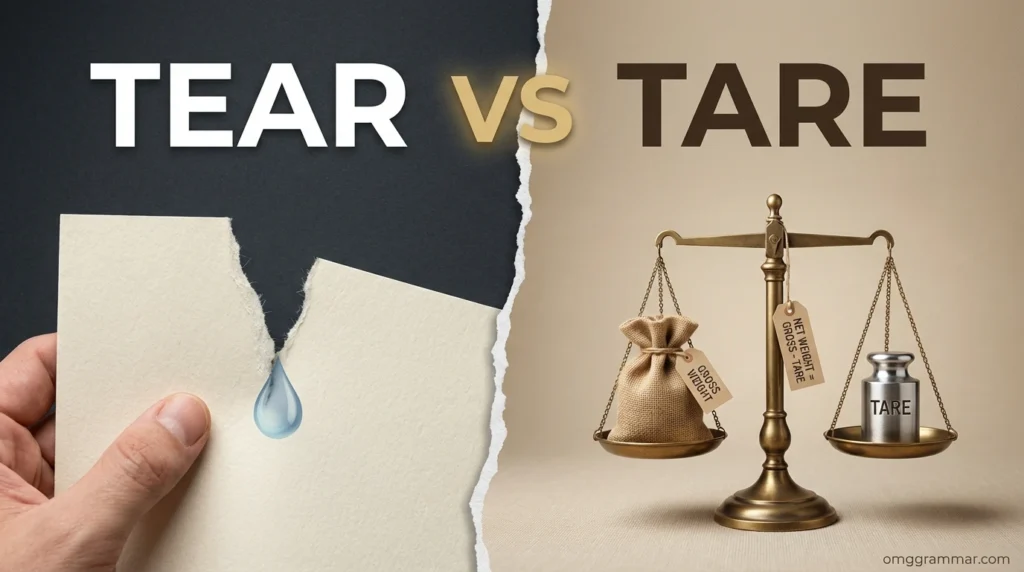
“Tear” can refer to a drop of liquid that comes from the eyes or the action of ripping something apart. The pronunciation changes depending on the meaning. When it refers to liquid from the eyes, it sounds like “teer.” When it means to rip or damage something, it sounds like “tair.”
“Tare,” on the other hand, is generally pronounced like the second meaning of “tear.” It refers to the weight of a container or packaging that must be deducted from the total weight of a product to determine the product’s actual weight.
For example, if a container holding rice weighs 1.5 kilograms in total and the empty container weighs 0.2 kilograms, the tare weight is 0.2 kilograms. The rice itself weighs 1.3 kilograms.
Understanding these differences makes it easier to select the correct word when writing sentences or discussing measurements.
What Is the Meaning of Tear?
The word “tear” is commonly used in everyday English. Its meaning depends on how it is pronounced and the context in which it appears.
Tear as a Drop of Liquid From the Eye
A tear is a small drop of liquid produced by the eyes. Tears help keep the eyes moist, remove irritants, and protect the surface of the eye. They can also appear when someone experiences strong emotions.
People may cry tears because of sadness, happiness, pain, frustration, or relief. Tears can also develop naturally when smoke, dust, or other irritants affect the eyes.
Examples include:
- A tear rolled down her cheek when she heard the news.
- He wiped a tear from his eye during the emotional speech.
- Tears filled the child’s eyes after the unexpected surprise.
- She smiled through her tears at the wedding.
In these sentences, “tear” refers to liquid produced by the eyes. It is pronounced “teer.”
Tear as the Action of Ripping Something
The verb “tear” means to pull, rip, or separate something by force. It can describe damage to paper, clothing, fabric, or other materials.
This meaning is pronounced “tair,” which sounds the same as “tare.”
For example:
- Be careful not to tear the paper.
- He accidentally tore his shirt on a sharp branch.
- The children tore open their gift packages.
- Please do not tear the important document.
The word can also describe damage that occurs accidentally. For instance, someone might tear a page while turning it too quickly.
“Tear” has several grammatical forms. The present tense is “tear,” the past tense is “tore,” and the past participle is “torn.”
Examples include:
- Present: I tear the paper into small pieces.
- Past: I tore the paper yesterday.
- Past participle: I have torn the paper.
Knowing these forms helps you use the verb correctly in different tenses.
What Does Tare Mean?
“Tare” is a noun or verb most commonly associated with weighing objects and calculating their net weight. It is especially useful in shipping, grocery stores, laboratories, manufacturing, and cooking.
Tare as the Weight of a Container
Tare weight is the weight of an empty container or packaging. When a product is weighed inside that container, the tare weight is subtracted from the total weight to calculate the weight of the product alone.
For example, imagine that a jar filled with honey weighs 800 grams. The empty jar weighs 150 grams. The tare weight is 150 grams, and the net weight of the honey is 650 grams.
The calculation is straightforward:
Net weight = Gross weight − Tare weight
Using the example above:
800 grams − 150 grams = 650 grams.
This calculation is important because customers and businesses need accurate measurements of the actual product rather than the product combined with its packaging.
Tare in Grocery Stores and Markets
Tare weight is particularly useful when buying products sold by weight. Some stores use containers, bags, or trays to hold goods while weighing them.
If the container’s weight is not deducted, the displayed measurement may include packaging that the customer is not purchasing as a product.
For instance, a shopkeeper might place vegetables in a reusable basket. By accounting for the basket’s weight, the shopkeeper can calculate the weight of the vegetables alone.
This process supports accurate pricing and fair transactions.
Tare in Digital Scales
Many digital scales include a button labeled “TARE.” This feature allows the user to reset the displayed weight to zero while an empty container remains on the scale.
Suppose you want to weigh flour in a mixing bowl. First, place the empty bowl on the scale. Next, press the tare button. The display returns to zero, even though the bowl remains on the weighing platform.
You can then add flour and read the flour’s weight without manually subtracting the bowl’s weight.
The tare function is useful in kitchens, laboratories, warehouses, and industrial environments because it saves time and reduces calculation errors.
Key Differences Between Tear and Tare
Although “tear” and “tare” can sound identical when referring to ripping something, they have different meanings and grammatical uses.
The following comparison makes their differences easier to understand.
| Feature | Tear | Tare |
|---|---|---|
| Main meaning | A drop from the eye or the act of ripping | The weight of an empty container |
| Pronunciation | “Teer” or “tair” | “Tair” |
| Part of speech | Noun or verb | Mainly a noun; also a verb |
| Common context | Emotions, crying, damage, ripping | Weighing, packaging, measurement |
| Example | Do not tear the paper. | Enter the tare weight into the scale. |
The most important distinction is meaning. If you are discussing crying or ripping, “tear” is usually the correct choice. If you are discussing the weight of packaging, “tare” is generally the correct word.
Tear vs. Tare: Example Sentences
One of the easiest ways to understand similar words is to examine them in complete sentences. The context often makes the intended meaning clear.
Examples Using Tear
- She brushed away a tear after watching the sad movie.
- Please do not tear the pages of this book.
- The dog managed to tear a hole in the cushion.
- He felt a tear running down his face.
- I accidentally tore my jacket while climbing the fence.
- The paper is too delicate, so handle it carefully to avoid a tear.
- The child began to cry, and a tear appeared in each eye.
- They have torn down the old posters from the wall.
Notice that the pronunciation changes in the first, fourth, and seventh examples compared with the examples about ripping.
Examples Using Tare
- The tare weight of the box is 250 grams.
- Press the tare button before adding the ingredients.
- The laboratory technician recorded the tare weight of the container.
- We subtracted the tare weight to determine the net weight of the package.
- The digital scale can automatically calculate the tare.
- Make sure the tare setting is correct before weighing the material.
- The container’s tare weight was printed on the packaging.
- The operator adjusted the scale to account for the tare.
In these sentences, the context involves containers, scales, or measurements. Therefore, “tare” is the appropriate word.
Why Do People Confuse Tear and Tare?
There are several reasons why English learners and native speakers sometimes confuse these words.
Similar Pronunciation
The word “tear,” when it means to rip, sounds exactly like “tare” in many English accents. This similarity makes it difficult to distinguish them by listening alone.
For example, the sentences “Do not tear the label” and “The tare weight is recorded” contain words that sound similar but communicate different ideas.
The surrounding words provide the clues needed to understand the intended meaning.
Similar Spelling
Both words contain four letters and begin with the letter “t.” Their similar appearance can make them easy to mix up while typing or writing quickly.
However, their spelling differences are meaningful. The word “tear” contains “ear,” while “tare” contains “are.” Remembering their typical contexts can help you select the correct spelling.
Different Meanings in Different Situations
English includes many words whose meanings depend on context. “Tear” is particularly interesting because it has two common meanings and two different pronunciations.
A person reading the sentence “There was a tear in the paper” understands that the paper has been ripped. However, in the sentence “A tear fell from her eye,” the same spelling describes liquid from the eye.
“Tare” does not share these two common meanings. It primarily relates to weight and measurement.
How to Remember the Difference Between Tear and Tare
You do not need to memorize complicated grammar rules to distinguish these words. A few simple techniques can make the difference easier to remember.
Associate Tear With Tearing Paper
Imagine ripping a sheet of paper. The action is called “tearing,” and the word is spelled “tear.”
You can remember the past tense by thinking of this sequence:
- Tear the paper.
- Tore the paper yesterday.
- Have torn the paper already.
This association helps you remember the spelling and grammatical forms of the verb.
Associate Tare With a Scale
Think of a digital scale with a button labeled “TARE.” The button helps remove the weight of the container from the displayed measurement.
Whenever you see “tare,” think about containers, packaging, and weighing objects.
This mental connection is particularly useful for people who work with measurements or study science and mathematics.
Use Context Clues
Before choosing a word, ask yourself what the sentence is describing.
If the sentence discusses crying, eye moisture, ripping, or damaged material, “tear” is likely the correct choice.
If it discusses the weight of a box, bottle, basket, or other container, “tare” is likely correct.
Context clues are often more reliable than pronunciation because some words sound alike even though their meanings differ.
Common Mistakes When Using Tear and Tare
Several mistakes can occur when these words are used incorrectly.
One common error is writing “tare” when describing damaged clothing. For example, “I tare my shirt” is incorrect if the intended meaning is that the shirt is being ripped. The correct sentence is “I tear my shirt,” although the sentence’s exact meaning may depend on context.
Another mistake is writing “tear weight” instead of “tare weight.” In measurement terminology, “tare weight” is the standard expression for the weight of an empty container or packaging.
A third mistake involves using “tear” when referring to a scale’s tare function. For example, “Press the tear button on the scale” is incorrect when the button is intended to reset the displayed weight. The correct sentence is “Press the tare button on the scale.”
Writers can avoid these mistakes by checking the meaning of the sentence before deciding which spelling to use. Reading the entire sentence rather than focusing on a single word often makes the correct choice obvious.
Tear and Tare in Everyday Life
These words appear in different parts of everyday life, which is another reason it is useful to understand their meanings.
“Tear” frequently appears in conversations about emotions, accidents, clothing, paper, and household objects. People may discuss tears after an emotional event or explain that something has torn during an activity.
“Tare” is more likely to appear in technical or practical situations. Someone preparing a recipe may use a kitchen scale’s tare function. A warehouse worker may calculate tare weight when checking a shipment. A scientist may account for the weight of laboratory equipment before measuring a sample.
Although the words are used in different contexts, both demonstrate how precise vocabulary improves communication.
Using the correct word prevents confusion and helps readers understand whether a sentence concerns damage, emotions, or measurements.
Practice Exercise: Tear or Tare?
Test your understanding by choosing the correct word for each sentence.
- A single ___ rolled down his cheek.
- Please do not ___ the envelope.
- The empty container’s ___ weight is 100 grams.
- Press the ___ button before adding the flour.
- She accidentally ___ the paper while opening the package.
- The technician recorded the ___ weight of the bottle.
Answers:
- Tear
- Tear
- Tare
- Tare
- Tore
- Tare
The fifth answer uses “tore” because the sentence describes an action that happened in the past. This example also demonstrates why learning the different forms of “tear” is important.
Frequently Asked Questions
Is tear tare a correct English phrase?
“Tear tare” is not a conventional phrase with one established meaning. It is better understood as a comparison of two English words that have different definitions and uses.
Do tear and tare sound the same?
Sometimes. “Tear,” when it means to rip, and “tare” are pronounced alike in many accents. However, “tear,” when referring to liquid from the eye, has a different pronunciation.
What is tare weight?
Tare weight is the weight of an empty container or packaging. It is subtracted from the gross weight to calculate the net weight of the contents.
How do you use tear in a sentence?
You can use “tear” as a noun or verb. For example, “A tear fell from her eye” uses the noun, while “Do not tear the paper” uses the verb.
Is it tare weight or tear weight?
The correct expression in weighing and measurement is “tare weight.” It refers to the weight of the empty container or packaging.
What is the past tense of tear?
When “tear” means to rip something, its past tense is “tore,” and its past participle is “torn.” For example, “I tore the paper yesterday” and “I have torn the paper.”
Conclusion
Understanding tear tare means recognizing the difference between two English words that may sound alike but serve different purposes. “Tear” can describe a drop of liquid from the eye or the action of ripping something apart. “Tare” usually refers to the weight of an empty container and plays an important role in weighing and measurement.
The easiest way to remember the distinction is to associate “tear” with crying or ripping and “tare” with scales and containers. Pay attention to the context of a sentence, learn the different pronunciations of “tear,” and practice using both words in everyday examples.
With regular practice, you can avoid common spelling mistakes, strengthen your English vocabulary, and communicate more accurately in writing and conversation.
About the Author