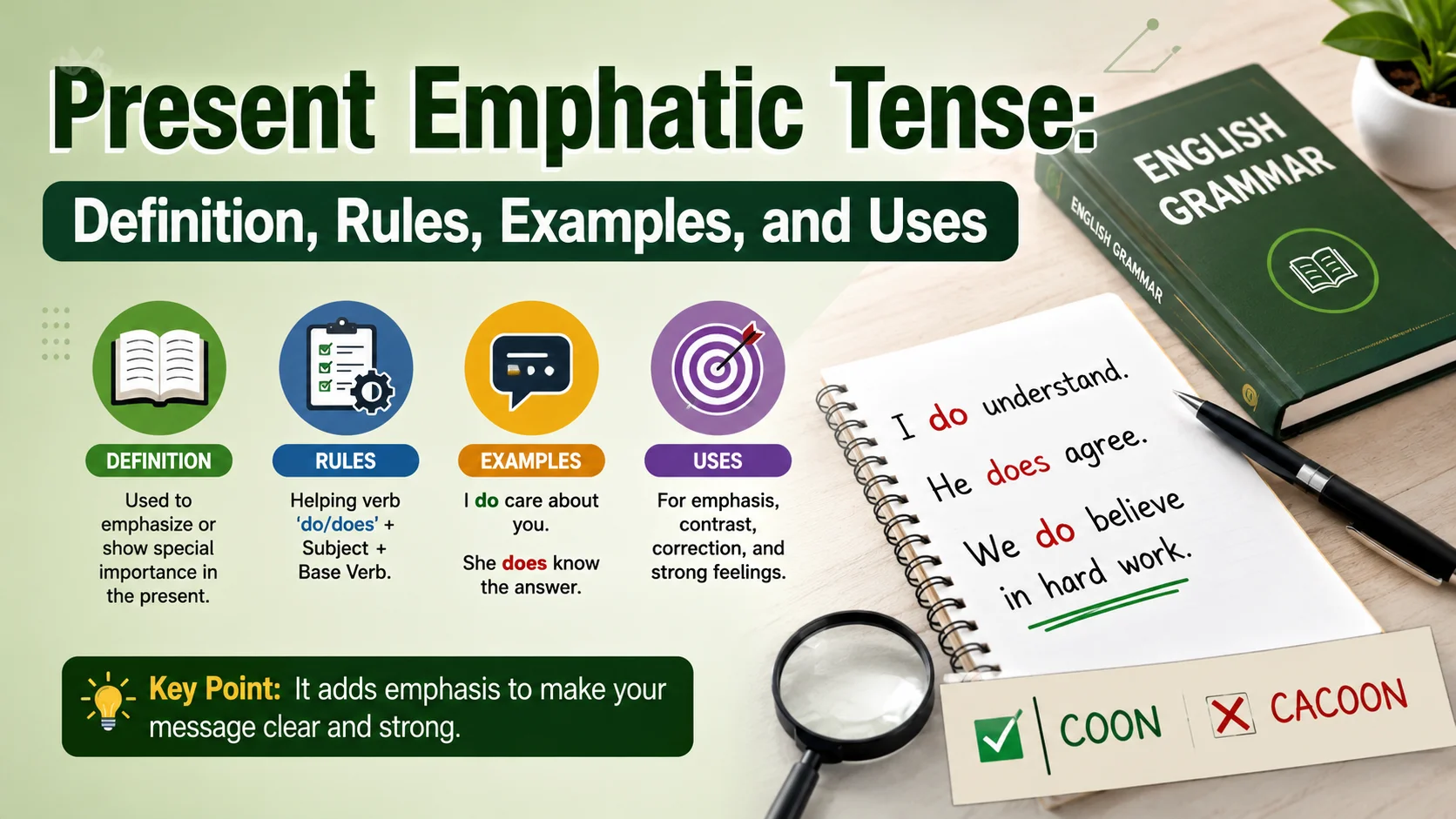
The Present Emphatic Tense helps you stress the importance of an action and make an affirmative statement sound stronger in English. To form it, use do or does with the base form of the verb. We do with I, you, we, and they, while doing work with he, she, and it.
This construction adds emphasis and can show strong affirmation or denial. For example, “I do agree” gives more force than “I agree,” especially when the speaker wants to correct someone or clear doubts.
The present emphatic form follows a clear pattern, but learners sometimes confuse it with questions or negative sentences because do and does commonly appear there too. The key rules and examples become easier to understand when you remember that this form mainly adds emphasis to an affirmative sentence.
Quick Answer: What Is the Present Emphatic Tense?
The present emphatic tense is an affirmative present-tense construction that uses do or does before the base form of a verb to add emphasis.
The basic formula is:
Subject + do/does + base verb + rest of sentence
Examples:
- I do understand your point.
- You do need more practice.
- She does know the answer.
- He does care about his work.
- They do appreciate your help.
Use do with I, you, we, and they.
Use does with he, she, it, and singular nouns.
The main verb stays in its base form after do or does. Therefore, you say “She does know”, not “She does knows.”
The construction works especially well when you want to correct, confirm, contradict, or strongly emphasize something.
Present Emphatic Tense Definition
The present emphatic tense adds emphasis to a statement that would otherwise use the simple present tense.
Consider this example:
I like this restaurant.
This sentence simply states a preference. Now add do:
I do like this restaurant.
The second sentence sounds more forceful. Perhaps someone assumed you didn’t like the restaurant. Maybe you want to make your preference completely clear.
That extra force comes from do.
The same principle applies to does:
She likes the book.
becomes:
She does like the book.
The tense itself doesn’t change. The action still belongs to the present. The auxiliary does simply gives the statement additional emphasis.
Why Is It Called “Emphatic”?
The word emphatic relates to emphasis. In grammar, emphasis means giving extra strength or importance to a particular idea.
Think of it as putting a verbal highlighter over a statement.
Compare:
- I believe you.
- I do believe you.
The first sentence sounds neutral. The second one draws attention to the speaker’s belief.
This difference becomes especially noticeable when the sentence responds to another person’s doubt or disagreement.
Present Emphatic Tense Formula
The structure looks simple once you break it down.
Subject + do/does + base verb + object or complement
Here are the main patterns:
| Subject | Auxiliary | Base Verb | Example |
| I | do | understand | I do understand. |
| You | do | deserve | You do deserve it. |
| We | do | agree | We do agree. |
| They | do | care | They do care. |
| He | does | know | He does know. |
| She | does | want | She does want help. |
| It | does | work | It does work. |
The most important rule is simple:
After do or does, always use the base form of the main verb.
For example:
- She does know the answer.
- He does understand the problem.
- They do want to help.
Not:
- She does knows the answer.
- He does understands the problem.
- They do wants to help.
The auxiliary already carries the grammatical marking. The main verb doesn’t need another -s ending.
Rules of the Present Emphatic Tense
Understanding a few core rules will help you form these sentences correctly.
Use “Do” With I, You, We, and They
Use do with the first-person and second-person subjects as well as plural subjects.
Examples:
- I do remember that conversation.
- You do look familiar.
- We do appreciate your support.
- They do understand the situation.
The pattern stays consistent regardless of the main verb.
Use “Does” With He, She, and It
Use does with third-person singular subjects.
Examples:
- He does work hard.
- She does speak clearly.
- It does make sense.
- The computer does function properly.
Singular nouns also take does:
The new system does work better.
Use the Base Verb After “Does”
This rule causes many mistakes.
In a normal simple present sentence, you might write:
She knows the answer.
After does, remove the -s from the main verb:
She does know the answer.
The same pattern applies to other verbs:
| Simple Present | Present Emphatic |
| He likes it. | He does like it. |
| She understands. | She does understand. |
| It works. | It does work. |
| He wants help. | He does want help. |
Don’t Use Emphasis Everywhere
The present emphatic construction isn’t required for every affirmative sentence.
If you’re simply stating a fact, the simple present often sounds better:
I know the answer.
You would normally use:
I do know the answer.
only when the context gives you a reason to emphasize the statement.
This distinction matters because excessive emphasis can make ordinary writing sound unnatural.
Present Emphatic Tense Examples
The easiest way to understand this tense is to see it in realistic situations.
Examples With “I”
- I do understand your concern.
- I do remember his name.
- I do want to help.
- I do believe you’re right.
- I do appreciate your honesty.
Examples With “You”
- You do deserve another chance.
- You do look tired today.
- You do have enough experience.
- You do make a good point.
- You do understand the rules.
Examples With “He” and “She”
- He does know the answer.
- She does care about her students.
- He does need more time.
- She does understand the instructions.
- He does want to join us.
Examples With “We” and “They”
- We do appreciate your patience.
- We do agree with your suggestion.
- They do understand the risks.
- They do need additional support.
- We do believe this approach will work.
Examples With Things and Animals
The construction also works with singular nouns and animals:
- The machine does work correctly.
- The plan does make sense.
- The dog does respond to commands.
- This method does produce better results.
When Do You Use the Present Emphatic Tense?
The present emphatic tense becomes most useful when ordinary wording doesn’t carry enough force.
To Correct Someone
Imagine someone says:
“You don’t understand the problem.”
You can respond:
“I do understand the problem.”
Here, do directly challenges the negative assumption.
To Confirm Something
Suppose someone asks whether your friend really knows the answer.
“Does Sarah know the answer?”
You might reply:
“She does know the answer.”
The word does reinforces your confirmation.
To Contradict a Statement
Consider this conversation:
“Mark doesn’t care about the project.”
A strong response could be:
“He does care about the project.”
The emphatic form makes the contrast obvious.
To Show Insistence
Sometimes you want to make your position unmistakable.
“I do believe this is the right decision.”
The speaker isn’t merely sharing a neutral opinion. The sentence carries conviction.
To Add Emotional Force
The construction can also express feelings such as frustration, reassurance, confidence, or determination.
For example:
“I do appreciate everything you’ve done.”
Here, the emphasis can make gratitude sound more heartfelt.
Present Emphatic Tense vs. Simple Present
The simple present and present emphatic tense describe the same general time frame. The difference lies mainly in emphasis.
| Simple Present | Present Emphatic | Main Effect |
| I know him. | I do know him. | Strong confirmation |
| She likes coffee. | She does like coffee. | Emphasis |
| We understand. | We do understand. | Reassurance |
| He cares. | He does care. | Contradiction |
| They need help. | They do need help. | Strong confirmation |
The simple present sounds neutral.
The emphatic form says, in effect, “Pay attention to this statement because I particularly want to make it clear.”
A Simple Context Comparison
Imagine a teacher asks:
“Do you understand the lesson?”
A student might say:
“Yes, I understand.”
That’s neutral.
If the teacher doubts the student, the student might respond:
“I do understand the lesson.”
Now the sentence carries a stronger sense of reassurance or insistence.
Present Emphatic Tense in Spoken English
The present emphatic construction becomes especially noticeable in conversation because speakers can put stress on do or does.
For example:
“I DO understand.”
The speaker’s voice can make the emphasis even stronger.
In ordinary speech, this construction often appears during disagreement or correction.
Consider this short exchange:
“You don’t like the new design.”
“I do like it. I just think it needs a few changes.”
That second sentence is more natural than simply repeating:
“I like it.”
The speaker isn’t merely expressing a preference. They’re correcting an assumption.
Present Emphatic Tense in Formal and Informal Writing
You can use the present emphatic form in both casual and formal contexts. However, the context determines whether it sounds appropriate.
Informal Conversation
It works naturally when people respond to one another:
“You don’t listen to me.”
“I do listen to you.”
Professional Communication
It can also appear in professional writing when you need to emphasize a point:
“We do recognize the concerns raised by customers.”
Still, don’t use the construction simply to make writing sound more sophisticated. A straightforward sentence often communicates more effectively.
Academic Writing
Academic writing generally favors precision over unnecessary emphasis. If the context doesn’t require contrast or confirmation, the simple present may be cleaner.
Instead of:
“Research does show that regular practice improves performance.”
you might simply write:
“Research shows that regular practice improves performance.”
The emphatic version becomes useful when you’re responding to a competing claim:
“Contrary to the assumption that practice has little effect, research does show measurable improvement.”
Context gives the emphasis a purpose.
Common Verbs Used With the Present Emphatic Tense
Certain verbs appear frequently in emphatic statements because people often use them to express opinions, knowledge, needs, or agreement.
| Verb | Simple Present | Emphatic Present |
| know | I know. | I do know. |
| understand | We understand. | We do understand. |
| believe | I believe you. | I do believe you. |
| like | She likes it. | She does like it. |
| want | He wants help. | He does want help. |
| need | They need time. | They do need time. |
| appreciate | We appreciate it. | We do appreciate it. |
| care | She cares. | She does care. |
| agree | I agree. | I do agree. |
| remember | I remember. | I do remember. |
These verbs aren’t special grammar exceptions. They’re simply common verbs that fit naturally into situations involving confirmation or disagreement.
Present Emphatic Tense and Negative Sentences
It’s important to distinguish emphatic affirmative statements from ordinary negative sentences.
Compare:
I don’t know.
This is a negative simple present construction.
Now compare:
I do know.
This is an affirmative emphatic construction.
Together, they can create a sharp contrast:
“You don’t know the answer.”
“I do know the answer.”
The second sentence doesn’t simply provide information. It pushes back against the previous claim.
The auxiliary do can also appear in negative sentences:
I do not know.
However, in that sentence do primarily functions as the auxiliary needed to form the negative. It isn’t the same affirmative emphatic pattern as I do know.
Can “Do” and “Does” Appear in Questions?
Yes. However, do and does don’t automatically make a sentence emphatic.
For example:
Do you know the answer?
This is a standard present-tense question.
Compare it with:
You do know the answer.
This is an affirmative emphatic statement.
A question can contain additional emphasis:
Do you really know the answer?
Yet that doesn’t make every question containing do an example of the present emphatic tense.
The function and structure matter.
Present Emphatic Tense vs. Present Continuous
These two constructions serve completely different purposes.
The present emphatic tense uses do/does + base verb to add emphasis.
I do understand you.
The present continuous uses am/is/are + verb-ing to describe an action or situation in progress.
I am studying now.
Here’s a useful comparison:
| Present Emphatic | Present Continuous |
| I do work here. | I am working here today. |
| She does understand. | She is studying now. |
| They do need help. | They are looking for help. |
One emphasizes a present-tense statement. The other normally describes something happening around the present time.
When Not to Use the Present Emphatic Tense
Knowing when not to use a construction is just as useful as knowing when to use it.
If you’re simply giving a neutral fact, the simple present usually works better.
For example:
The Earth revolves around the Sun.
There’s no obvious need for emphasis.
Writing:
The Earth does revolve around the Sun.
is grammatically possible in a suitable context. However, without a reason for the emphasis, it sounds unnecessarily forceful.
The emphatic form becomes natural when someone challenges the statement:
“Some people still claim that the Earth doesn’t revolve around the Sun.”
“It does revolve around the Sun.”
Context turns an unusual sentence into a purposeful one.
Case Study: How Context Changes the Meaning
Consider three versions of the same idea.
Situation One: Neutral Statement
I trust him.
The speaker simply states a belief.
Situation Two: Someone Questions the Belief
“You don’t trust him.”
“I do trust him.”
Now do carries contrast and correction.
Situation Three: Strong Emotional Confirmation
“You keep saying you trust him, but your actions suggest otherwise.”
The response:
“I do trust him. I just don’t agree with every decision he makes.”
Here, the emphatic construction reinforces the speaker’s position while allowing room for a more nuanced explanation.
This illustrates an important point: grammar doesn’t work in isolation. Context determines how strongly a construction feels.
Common Mistakes With the Present Emphatic Tense
One common mistake is using do, does, or don’t incorrectly with the main verb. Remember that after these helping verbs, the main verb stays in its base form, such as “She does like” rather than “She does likes.” Another mistake is using the emphatic form when simple present would be more natural.
Mistake: Adding “-s” After “Does”
Incorrect:
She does knows the answer.
Correct:
She does know the answer.
The word does already carries the third-person singular marking.
Mistake: Using “Do” With a Singular Third-Person Subject
Incorrect:
He do understand the problem.
Correct:
He does understand the problem.
Mistake: Using “Does” With a Plural Subject
Incorrect:
They does understand the issue.
Correct:
They do understand the issue.
Mistake: Using the Wrong Verb Form
Incorrect:
I do understands.
Correct:
I do understand.
Remember the shortcut:
Do/does + base verb
Mistake: Adding Emphasis Without a Reason
A sentence such as:
I do eat breakfast every morning.
can sound strange if no one has questioned your breakfast habits.
If you’re simply describing a routine, say:
I eat breakfast every morning.
The emphatic form becomes natural when there’s a reason to stress the claim.
How to Identify the Present Emphatic Tense
Use this quick checklist when analyzing a sentence.
- Does the sentence make an affirmative statement?
- Does it contain do or does?
- Does the main verb appear in its base form?
- Does the auxiliary add emphasis or contrast?
- Could the sentence be rewritten as an ordinary simple present statement?
For example:
She does understand the instructions.
The answer is yes to all five points. Therefore, the sentence uses the present emphatic construction.
Quick Reference Table for Present Emphatic Tense
| Feature | Rule | Example |
| I/You/We/They | Use do | They do agree. |
| He/She/It | Use does | She does agree. |
| Main verb | Use base form | He does know. |
| Main purpose | Add emphasis | I do believe you. |
| Common use | Correction or confirmation | She does care. |
| Neutral alternative | Simple present | She cares. |
Present Emphatic Tense Practice Exercises
Choose “Do” or “Does”
Complete each sentence with do or does.
- I ___ understand your concern.
- She ___ know the answer.
- They ___ appreciate your help.
- He ___ want another opportunity.
- We ___ believe your explanation.
- It ___ work properly.
- You ___ deserve better.
- The teacher ___ understand the problem.
Correct the Errors
Find and correct the mistake in each sentence.
- She does knows the answer.
- They does understand the lesson.
- He do care about his team.
- I does remember that day.
- We do agrees with you.
Answers
- I do understand your concern.
- She does know the answer.
- They do appreciate your help.
- He does want another opportunity.
- We do believe your explanation.
- It does work properly.
- You do deserve better.
- The teacher does understand the problem.
Corrections:
- She does know the answer.
- They do understand the lesson.
- He does care about his team.
- I do remember that day.
- We do agree with you.
Conclusion
The Present Emphatic Tense is a useful English structure for giving extra strength to an affirmative statement. By using do or does before the base form of a verb, you can show strong agreement, correct a misunderstanding, confirm a fact, or make your meaning clearer. For example, “I do understand” sounds more forceful than “I understand.”
The main rule is simple: use do with I, you, we, and they, and use does with he, she, and it. The main verb stays in its base form after do or does. Once you understand this pattern, you can use emphatic statements naturally in everyday English.
FAQs
Q1. What is the Present Emphatic Tense?
The Present Emphatic Tense uses do or does before a base verb to add emphasis to an affirmative statement.
Q2. What is the formula for the Present Emphatic Tense?
The basic formula is subject + do/does + base form of the verb + rest of the sentence.
Q3. When do we use “do” in the Present Emphatic Tense?
Use do with I, you, we, and they to make an affirmative statement stronger.
Q4. When do we use “does” in the Present Emphatic Tense?
Use does with he, she, and it when you want to emphasize an affirmative statement.
Q5. Does the main verb change after “does”?
No. The main verb stays in its base form after “does,” such as “She does work,” not “She does work.”
Q6. Why is the Present Emphatic Tense used?
It can emphasize a fact, correct someone, confirm information, or show strong agreement or denial.
Q7. Is “I do know” grammatically correct?
Yes. “I do know” is grammatically correct when you want to give extra emphasis to the statement.
Q8. Is the Present Emphatic Tense used in negative sentences?
Its main use is to emphasize affirmative statements. Negative sentences normally use do not or does not for negation.
Q9. What is the difference between “I know” and “I do know”?
“I know” is a normal statement, while “I do know” adds emphasis and makes the speaker’s certainty or insistence stronger.
Q10. What is the easiest way to remember this tense?
Remember: do/does + base verb adds emphasis. Use do for I, you, we, and they, and does for he, she, and it.
About the Author