
re evaluate or reevaluate
English spelling can sometimes be confusing, especially when a word begins with a prefix. One common example is re evaluate or reevaluate. Both forms appear in written communication, online articles, educational materials, and professional documents. However, understanding which spelling is preferred can help you write more clearly and confidently.
The word reevaluate means to evaluate something again, reconsider a decision, or examine a situation with fresh attention. People often use it when circumstances change, new information becomes available, or an earlier judgment needs another look. Although the meaning is straightforward, the spelling raises an important question: should you write re evaluate, reevaluate, or re-evaluate?
In this article, we will explore the differences between these spellings, explain which form is generally recommended, provide practical examples, and discuss how to use the word correctly in everyday and professional writing.
Re Evaluate or Reevaluate: Which One Is Correct?
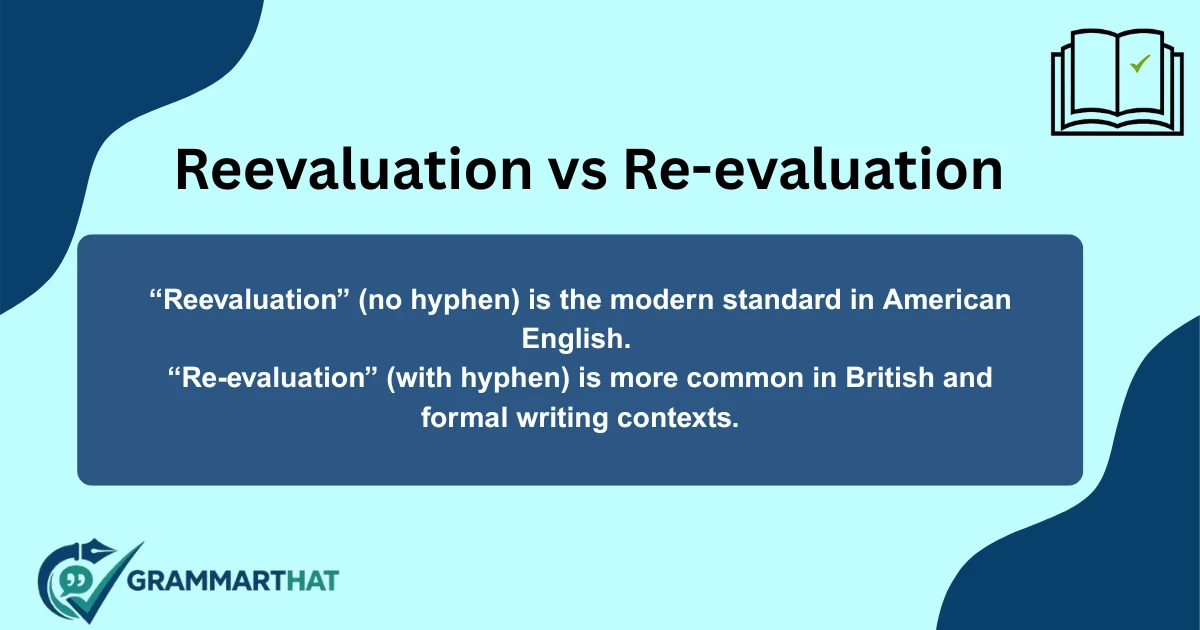
The most widely accepted modern spelling in American English is re evaluate or reevaluate, written as one word without a space or hyphen. It combines the prefix re- with the verb evaluate to describe the action of evaluating something again.
For example:
- Correct: We need to reevaluate our marketing strategy.
- Less standard: We need to re evaluate our marketing strategy.
- Also accepted in many contexts: We need to re-evaluate our marketing strategy.
The spelling re-evaluate is an established alternative, particularly in British English and publications that prefer hyphenated forms for readability. However, re evaluate, written as two separate words without a hyphen, is generally not the preferred spelling when the intended meaning is to evaluate again.
Therefore, if you are unsure which form to choose, reevaluate is an excellent default for contemporary English writing, particularly in American English.
What Does Reevaluate Mean?
To understand the spelling, it helps to examine the meaning of the word.
Reevaluate is a verb that means to evaluate, assess, or consider something again. It involves looking at an existing decision, opinion, plan, situation, or piece of information to determine whether the original judgment remains appropriate.
The prefix re- commonly means again. When combined with evaluate, it creates a word that expresses the idea of performing an evaluation another time.
For example, a business might reevaluate its expenses after experiencing a decline in revenue. A student might reevaluate a study plan after receiving disappointing examination results. Similarly, an individual might reevaluate a personal goal after discovering that their priorities have changed.
In each situation, reevaluation involves taking another look rather than automatically accepting the original conclusion.
The word can also suggest a deeper review. Someone who reevaluates a decision may consider new evidence, identify mistakes, compare alternatives, and make a more informed choice.
Why Is Reevaluate Usually Written as One Word?
Many English words are formed by adding prefixes to existing words. Common examples include rewrite, reconsider, reorganize, and reexamine. In these cases, the prefix and the base word are combined into a single word.
The same principle applies to reevaluate.
The prefix re- is attached to evaluate, creating a new verb that means to evaluate again. Because the combined form is clear and widely recognized, a space is generally unnecessary.
Writing the word as re evaluate separates the prefix from the verb in a way that does not follow the standard spelling of this expression.
Compare these examples:
- Rewrite: Write something again.
- Reconsider: Consider something again.
- Reorganize: Organize something again.
- Reevaluate: Evaluate something again.
These examples demonstrate a useful spelling pattern. When re- expresses repetition and the resulting word is established as a single term, it is generally written without a space.
Nevertheless, English spelling does not follow every prefix rule without exceptions. Hyphens sometimes improve readability or distinguish between different meanings, so it is helpful to consider established usage rather than relying on a rule alone.
Is Re-Evaluate Also Correct?
Yes. The hyphenated spelling re-evaluate is an established form of the word. It appears in British English and in various publications, professional documents, and editorial styles.
The difference between reevaluate and re-evaluate is primarily a matter of spelling convention and editorial preference rather than meaning. Both forms generally communicate the same idea: to evaluate something again.
For example:
Using reevaluate:
The management team decided to reevaluate its hiring policy.
Using re-evaluate:
The management team decided to re-evaluate its hiring policy.
Both sentences are understandable and grammatically acceptable.
However, consistency matters. If your organization follows a particular style guide, use the spelling that guide recommends. If you are writing for an American audience without a specific style requirement, reevaluate is usually a sensible choice. If you are following a British publication’s conventions, re-evaluate may be preferred.
The important point is to avoid switching randomly between spellings within the same document.
Re Evaluate or Reevaluate in American English
American English generally favors closed compounds when a prefix can be attached clearly to a base word. Consequently, reevaluate is commonly preferred in American writing.
This spelling is suitable for academic assignments, business reports, emails, website content, presentations, and general communication.
Consider the following examples:
- The company must reevaluate its customer service procedures.
- I decided to reevaluate my priorities after graduating.
- The committee will reevaluate each application next month.
- We should reevaluate the proposal before approving the budget.
- The teacher encouraged the student to reevaluate the argument.
In all five sentences, reevaluate means to examine or assess something again.
For American writers, using the single-word form provides a straightforward approach and aligns with common contemporary usage.
Re Evaluate or Reevaluate in British English
British English also uses reevaluate, but re-evaluate is a familiar and established spelling in British publications.
British English often retains hyphens in certain prefixed words, although its conventions vary by publisher, dictionary, and style guide. There is no universal rule requiring every British writer to use the hyphenated version.
For example:
- The government plans to re-evaluate its education policy.
- The researcher will reevaluate the available evidence.
- The manager needs to re-evaluate the project’s objectives.
These examples illustrate that both spellings can occur in British writing.
If you are preparing content for a British audience, consider the publication’s spelling preferences and follow them consistently. If no specific convention applies, either established form may be suitable.
The key is to distinguish a legitimate hyphenated spelling from the less standard two-word form re evaluate.
Examples of Reevaluate in Everyday Sentences
Understanding a word becomes easier when you see how people use it in realistic situations. The following examples show how reevaluate works in everyday English.
1. In Personal Life
People often reevaluate their goals, habits, relationships, and priorities as their circumstances change.
Examples:
- I need to reevaluate my daily routine because I am always running out of time.
- She decided to reevaluate her career goals after completing her degree.
- He began to reevaluate his spending habits after reviewing his bank statements.
- We should reevaluate our plans before making a final decision.
In these sentences, the word describes a thoughtful review of an existing situation.
2. In Business and Management
Businesses regularly reevaluate their strategies to respond to customer needs, competition, and changing economic conditions.
Examples:
- The company will reevaluate its pricing strategy next quarter.
- Management needs to reevaluate the project’s financial risks.
- The sales team decided to reevaluate its advertising campaign.
- We must reevaluate our hiring process to improve efficiency.
In professional writing, reevaluate communicates a careful review without requiring a lengthy explanation.
3. In Education
Students and teachers may reevaluate study methods, learning objectives, assignments, and academic performance.
Examples:
- The student decided to reevaluate her preparation strategy.
- Teachers should reevaluate their lesson plans when students struggle.
- The professor asked the class to reevaluate its interpretation of the text.
- I need to reevaluate my approach to solving mathematical problems.
These examples show how reevaluation can help people identify weaknesses and develop better methods.
4. In Decision-Making
Sometimes, an initial decision seems reasonable but becomes less appropriate when new information emerges.
Examples:
- We should reevaluate the proposal before signing the agreement.
- The committee agreed to reevaluate its decision after reviewing the new evidence.
- I had to reevaluate my opinion when I learned the complete story.
- The team will reevaluate its options before choosing a supplier.
In these situations, reevaluating does not necessarily mean that the original decision was wrong. It simply means that another review may be useful.
What Is the Difference Between Evaluate and Reevaluate?
Although the two words are closely related, they describe slightly different actions.
Evaluate means to assess, judge, or determine the value, quality, effectiveness, or importance of something. It does not necessarily imply that an earlier evaluation has taken place.
Reevaluate means to perform that assessment again or reconsider an earlier judgment.
Consider these examples:
Evaluate: The manager will evaluate the employee’s performance.
This sentence describes an assessment that may be taking place for the first time.
Reevaluate: The manager will reevaluate the employee’s performance after receiving additional feedback.
This sentence suggests that the performance has already been assessed or considered and will receive another review.
The distinction is useful because it communicates the purpose of an action more precisely. If you are conducting an initial assessment, use evaluate. If you are returning to an existing assessment, use reevaluate.
What Is the Difference Between Reevaluate and Reassess?
The words reevaluate and reassess have similar meanings and can often be used interchangeably.
Reevaluate emphasizes evaluating something again, while reassess emphasizes assessing or reviewing it again. In practical writing, the distinction is usually small.
For example:
- We need to reevaluate our business strategy.
- We need to reassess our business strategy.
Both sentences communicate that the strategy requires another review.
However, context may influence which word sounds more natural. Reassess is frequently used when reviewing risks, needs, priorities, or circumstances. Reevaluate can be especially appropriate when reconsidering value, quality, effectiveness, or a previous judgment.
Other related words include reconsider, review, reexamine, and rethink. Each can express a similar idea, but the most appropriate choice depends on the intended meaning.
Common Mistakes When Using Reevaluate
Even though reevaluate is relatively simple, writers sometimes make spelling or grammatical mistakes. Recognizing these errors can improve the quality of your writing.
Mistake 1: Writing Re Evaluate as Two Words
A common error is separating the prefix from the verb.
Incorrect: We need to re evaluate the situation.
Preferred: We need to reevaluate the situation.
The single-word form is the usual modern spelling in American English.
Mistake 2: Using Different Spellings in One Document
A writer might use reevaluate in one paragraph and re-evaluate in another without a reason.
Although both forms are established, inconsistent spelling can make an article or report look poorly edited.
Choose one form based on your preferred dictionary or style guide, then use it throughout the document.
Mistake 3: Confusing Reevaluate With Evaluate
Some writers use reevaluate even when they mean to conduct an assessment for the first time.
For example, if a company has never reviewed a proposal, saying that it will evaluate the proposal is generally more accurate. If the company has already reviewed it and intends to conduct another assessment, reevaluate the proposal is appropriate.
Mistake 4: Forgetting the Correct Verb Form
The verb can change according to the sentence’s tense and grammatical structure.
Examples:
- Present: I reevaluate my goals regularly.
- Past: I reevaluated my goals last year.
- Future: I will reevaluate my goals next month.
- Present continuous: I am reevaluating my goals.
- Perfect tense: I have reevaluated my goals.
These forms allow you to use the word naturally in different contexts.
How to Use Reevaluate in Professional Writing
Professional writing often requires clear language that communicates decisions and actions efficiently. Reevaluate is useful when explaining why an existing plan, procedure, or judgment needs another review.
For example, a project manager might write:
“We should reevaluate the project timeline because several tasks are taking longer than expected.”
This sentence identifies both the action and the reason behind it.
Similarly, a business report might state:
“The organization will reevaluate its operational procedures to identify opportunities for improvement.”
In an academic setting, a researcher might write:
“These findings suggest that previous assumptions should be reevaluated in light of the new evidence.”
The word is also appropriate in workplace emails:
“Before moving forward, I recommend that we reevaluate the proposed budget.”
These examples demonstrate that reevaluate is useful across a variety of professional situations. It conveys a deliberate review and can help explain why a change in direction may be necessary.
Why Reevaluation Is Important
Reevaluation is more than a spelling question. It is also an important part of learning, problem-solving, and decision-making.
People sometimes make decisions using incomplete information, limited experience, or assumptions that later prove inaccurate. Reviewing those decisions can reveal problems that were not obvious initially.
In business, reevaluation may help organizations identify inefficient processes, respond to changing customer expectations, or improve financial planning. In education, it may help students recognize ineffective study habits and develop better strategies.
In personal life, reevaluation can encourage people to reflect on their goals and decide whether their current choices still align with their priorities.
However, reevaluating everything constantly can become unproductive. Not every decision needs to be reconsidered repeatedly. A useful reevaluation should have a purpose, such as new information, a meaningful change in circumstances, or evidence that the existing approach is not working.
The goal is not simply to question previous choices. It is to make better-informed decisions when there is a good reason to review them.
Frequently Asked Questions
Is Re Evaluate One Word or Two?
The preferred modern spelling is generally reevaluate, written as one word. The hyphenated form re-evaluate is also established, but re evaluate is usually not the standard choice for this meaning.
Is Reevaluated a Correct Word?
Yes. Reevaluated is the simple past tense and past participle of reevaluate.
Example: The board reevaluated the proposal before making its final decision.
Is Reevaluating Correct?
Yes. Reevaluating is the present participle and gerund form of reevaluate.
Example: We are reevaluating our options before committing to a new plan.
Is Re-Evaluate Grammatically Correct?
Yes. Re-evaluate is a recognized spelling. Its use depends on the spelling conventions or editorial style you follow. The unhyphenated form reevaluate is commonly preferred in American English.
What Is the Noun Form of Reevaluate?
The noun form is reevaluation, which means the act or process of evaluating something again. The hyphenated spelling re-evaluation is also used.
Example: The project requires a complete reevaluation before work can continue.
Should I Use Reevaluate in an SEO Article?
Yes, if reevaluate is the natural and grammatically correct word for your topic. For an article specifically targeting the keyword “re evaluate or reevaluate,” you can include that exact phrase in the title and discuss the spelling differences in the body. However, the rest of the article should use standard spelling naturally rather than repeating the keyword unnecessarily.
Conclusion
The question of re evaluate or reevaluate has a straightforward answer for most modern writing: reevaluate is generally the preferred spelling, especially in American English. The hyphenated alternative, re-evaluate, is also established and may be appropriate depending on your audience and style guide. The two-word spelling re evaluate is usually not recommended when you mean to evaluate something again.
Remember that reevaluate means to examine, assess, or reconsider something for a second time. It is useful in everyday conversations, academic assignments, business reports, and professional communication.
To write accurately, choose the spelling that suits your preferred English convention, remain consistent throughout your document, and use the word when another assessment is genuinely intended. By understanding the difference between evaluate and reevaluate, you can communicate your ideas more precisely and make more confident spelling choices.
About the Author