on in street
Introduction
English prepositions can sometimes be confusing, especially when several words appear to have similar meanings. Expressions such as “on the street,” “in the street,” and “on in street” may look simple, but choosing the correct phrase depends on the context. Many English learners search for “on in street” because they want to understand which preposition is appropriate when describing a location, giving directions, or talking about everyday activities.
The good news is that understanding these expressions does not require advanced grammar knowledge. By learning the basic differences between “on” and “in,” you can improve your writing, speak more naturally, and avoid common grammatical mistakes.
In this article, we will explain the meaning of “on in street,” explore the correct use of street-related expressions, provide practical examples, and share helpful tips for remembering the rules.
What Does On In Street Mean?
The phrase “on in street” is not a standard grammatical expression in English. It combines two prepositions, “on” and “in,” without the structure normally required to make the sentence correct. However, people may use this phrase when searching for information about whether to say “on the street” or “in the street.”
Both “on the street” and “in the street” are correct expressions, but they can communicate slightly different ideas.
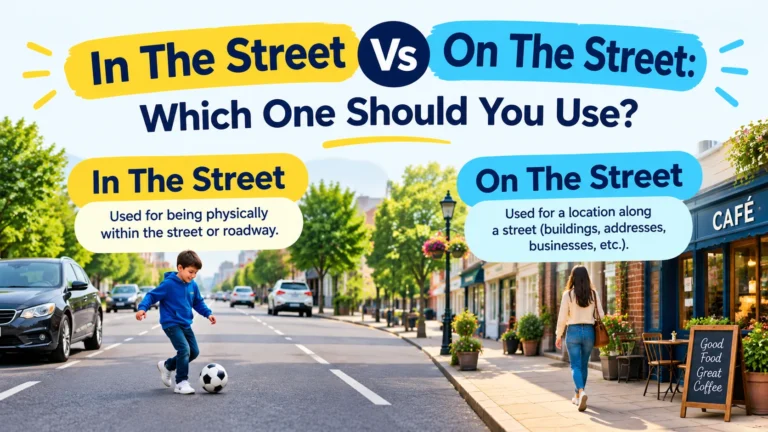
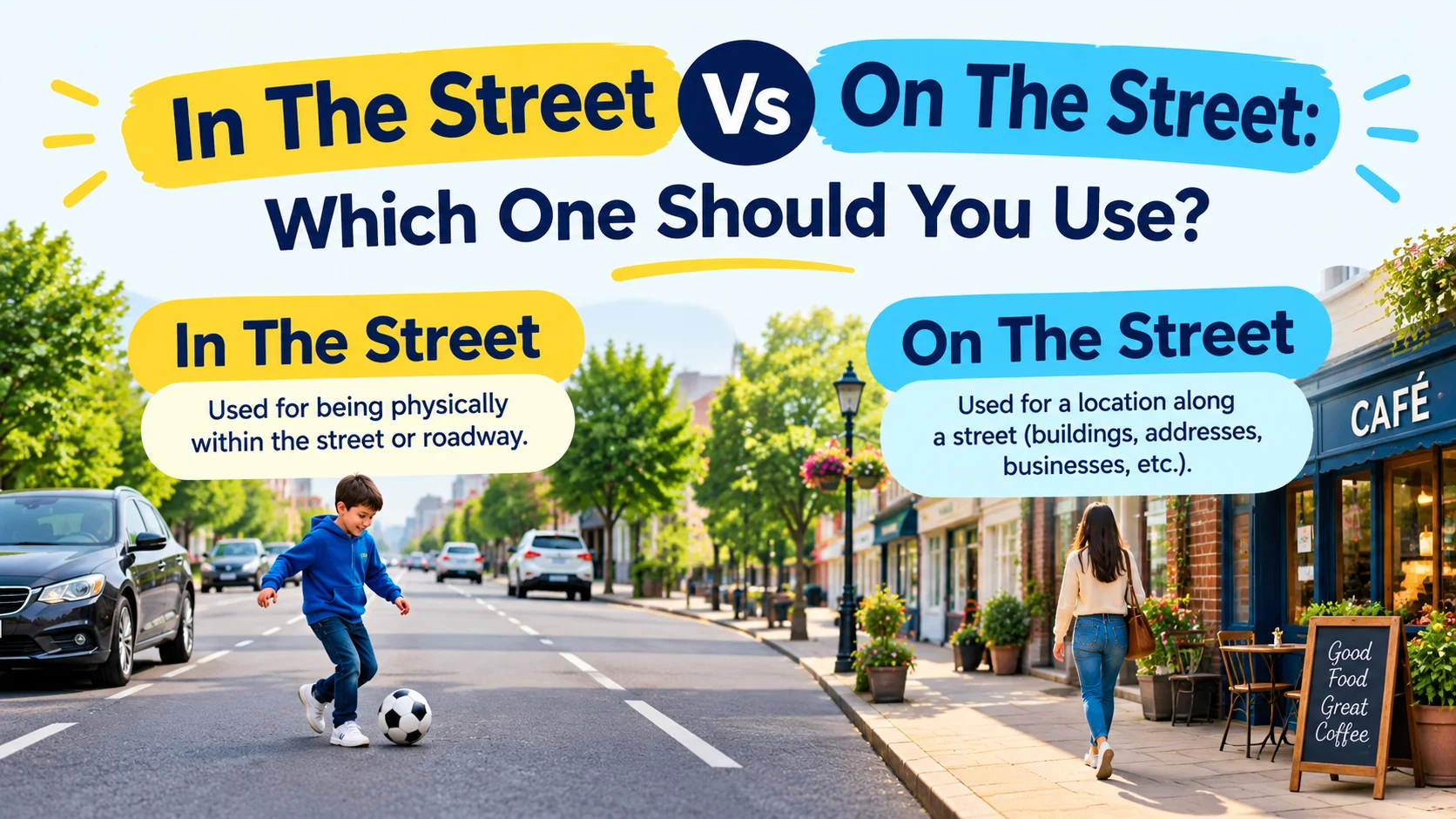
“On the street” commonly refers to a location along a particular street. It can describe where a building, business, or person is located. For example, someone might say, “The bookstore is on Green Street.”
“In the street” often refers to being physically within the street itself, particularly in the roadway where vehicles travel. For example, “The children were playing in the street” suggests that the children were playing in the road.
Although these differences are useful, everyday English sometimes allows the expressions to overlap. The intended meaning and the variety of English being used can influence which phrase sounds most natural.
Understanding the Meaning of “On the Street”
The expression “on the street” is widely used in everyday conversations. It usually describes a location along a street, an activity taking place there, or a person’s situation.
1. Describing a Location
One of the most common uses of “on the street” is identifying where something is located. When you mention a shop, restaurant, house, or office, this expression can help someone understand its position.
For example:
- The pharmacy is on Main Street.
- My friend lives on Oak Street.
- There is a small restaurant on this street.
- The new office is on the opposite side of the street.
In these sentences, “on” connects the place or building to the street where it can be found.
In American English, people commonly use “on” with street names when giving addresses or describing locations. British English also uses “on the street,” although other expressions may be preferred depending on the situation.
2. Describing Activities Along a Street
“On the street” can also describe activities that happen in public areas along a road.
For instance, a person might say, “Street musicians were performing on the street.” This sentence describes musicians performing in a public street environment.
Other examples include:
- Vendors were selling fruit on the street.
- People gathered on the street to watch the parade.
- Workers were repairing the pavement on the street.
- Several artists displayed their paintings on the street.
These examples demonstrate how the phrase can describe activities connected to a public street.
3. Describing Homelessness
The expression “on the street” has another important meaning. It can describe someone who does not have a stable place to live.
For example, “The charity provides meals for people living on the street.”
In this context, the phrase does not simply identify a person’s physical location. Instead, it refers to homelessness or living without secure housing.
However, it is important to remember that homelessness affects people in different circumstances. Some people sleep outdoors, while others stay in shelters, temporary accommodation, or with friends and relatives.
Understanding the Meaning of “In the Street”
The phrase “in the street” usually emphasizes being inside the street area itself rather than simply being located along it.
1. Being in the Roadway
One of the clearest uses of “in the street” involves a person or object occupying the roadway.
Consider this example: “A fallen tree was lying in the street.”
The sentence indicates that the tree was physically blocking or occupying part of the road.
Here are additional examples:
- The ball rolled into the street.
- A car stopped in the middle of the street.
- The workers found a damaged sign in the street.
- The children were playing in the street.
These sentences focus on the physical space occupied by a person or object.
2. Talking About Street Conditions
“In the street” is also useful when discussing conditions or events occurring within a roadway.
For example, “There was a large amount of water in the street after the storm.”
This statement emphasizes the water’s presence in the road rather than simply saying that the street was wet.
Other examples include:
- The police found debris in the street.
- A delivery truck was parked in the street.
- There was broken glass in the street.
- The parade brought traffic to a stop in the street.
The distinction is especially helpful when describing accidents, road hazards, or temporary obstructions.
3. Understanding Regional Differences
English usage is not identical in every country. In some varieties of English, “in the street” is commonly used when referring to activities or people within a public street area. In other situations, speakers may use “on the street” for similar meanings.
For example, both “The children are playing in the street” and “The children are playing on the street” may be understood. However, the first expression often emphasizes the roadway, while the second may sound more natural in some regional varieties or contexts.
The most important principle is to consider what you want to communicate rather than memorizing a rigid rule that applies to every sentence.
On the Street vs. In the Street: Key Differences
Understanding the difference between these expressions becomes easier when you compare their common uses.
| Expression | Common meaning | Example |
|---|---|---|
| On the street | Located along a street | The bank is on King Street. |
| In the street | Physically within the roadway | A bicycle was lying in the street. |
| Across the street | On the opposite side | The café is across the street. |
| Along the street | Following the length of a street | Trees grow along the street. |
| At the street corner | Located where streets meet | We met at the street corner. |
| Down the street | Farther along the street | The supermarket is down the street. |
Each expression serves a different purpose. Choosing the right one helps your listener understand the location more accurately.
Is “On In Street” Grammatically Correct?
In ordinary English, “on in street” is not grammatically complete. It places two prepositions together without the words or sentence structure needed to connect them properly.
For example, the sentence “My house is on in street” is incorrect because the prepositions are being used incorrectly.
Depending on the intended meaning, you could correct it in several ways:
- Incorrect: My house is on in street.
- Correct: My house is on the street.
- Correct: My house is in the street. This is grammatically possible, but it usually suggests the house is physically situated within the street area, so it is not the normal way to describe a home’s address.
- Correct: My house is on Green Street.
The last example is especially useful when providing a street name.
If you want to describe a location without mentioning the exact street name, you can say, “My house is on this street.”
The correct choice depends on whether you are identifying a street address, describing a position along a road, or explaining that something is physically in the roadway.
Common Mistakes When Using Street Prepositions
English learners often make mistakes with prepositions because the rules do not always translate directly from one language to another.
Mistake 1: Combining “On” and “In” Unnecessarily
A common error is using both prepositions before the same noun.
Incorrect: The shop is on in the street.
Correct: The shop is on the street.
The corrected sentence uses one preposition to express the location clearly.
Mistake 2: Forgetting the Article “The”
When referring to a particular street without giving its name, English usually uses the article “the.”
Incorrect: The children are playing in street.
Correct: The children are playing in the street.
However, when a street name is used, the article is generally unnecessary in common American address usage.
For example, “The store is on Market Street” is natural English.
Mistake 3: Using “In” for Every Location
Some learners assume that “in” should always be used when describing where something is located. However, English uses different prepositions depending on the type of location.
For example:
- Correct: She lives on Park Avenue.
- Correct: She lives in London.
- Correct: She is at the street entrance.
The preposition changes because each sentence describes a different kind of location.
Mistake 4: Ignoring the Intended Meaning
Sometimes both “on the street” and “in the street” are grammatically possible, but one communicates the intended meaning more clearly.
For example, “The restaurant is on the street” usually describes the restaurant’s location. By contrast, “A restaurant sign was lying in the street” suggests that the sign was physically in the roadway.
Thinking about the relationship between the object and the street can help you choose the appropriate expression.
Everyday Examples of On and In Street
The best way to learn prepositions is to see how people use them in ordinary situations.
Examples Related to Addresses
- My dentist has an office on Pine Street.
- The grocery store is on the next street.
- Their apartment is on a quiet street.
- We found a hotel on the main street.
- The school is on the same street as the library.
These sentences use “on” to connect buildings and locations with a street.
Examples Related to Road Safety
- Never stand in the street when traffic is moving.
- The driver noticed a dog in the street.
- A broken branch was lying in the street.
- The children moved out of the street when a car approached.
- The workers placed warning signs in the street.
These examples emphasize the roadway itself. In real situations, pedestrians should use sidewalks and designated crossings whenever available and follow local traffic rules.
Examples Related to Giving Directions
- Walk down the street until you reach the traffic lights.
- The pharmacy is on your left.
- The bus stop is across the street.
- Turn right at the street corner.
- The bakery is farther down the street.
These expressions are useful for giving clear directions to visitors, friends, or customers.
How to Remember the Correct Expression
If you frequently confuse “on the street” and “in the street,” a few simple learning techniques can help.
First, remember that “on” is commonly used to connect a building or address to a street. When describing where a restaurant, school, or shop is located, “on” is often the natural choice.
Second, think of “in” as emphasizing the space inside the roadway. If a ball, fallen branch, or vehicle is occupying the road, “in the street” may be appropriate.
Third, learn complete phrases instead of memorizing individual prepositions. Practicing sentences such as “The shop is on Main Street” and “The ball is in the street” helps you recognize common patterns.
Finally, read English articles, listen to conversations, and practice writing your own examples. Repeated exposure makes these expressions easier to understand and use naturally.
Why Street Prepositions Matter in English
Prepositions may be small words, but they can significantly influence the meaning of a sentence. Using them correctly helps you describe places, communicate directions, and explain where people or objects are located.
For students, accurate preposition usage can improve grammar exercises, essays, and spoken English. For professionals, it can make directions, delivery instructions, and location descriptions easier to understand.
Even native English speakers sometimes use different expressions depending on their region or conversational style. Therefore, learning the most common patterns is more useful than assuming that every situation has only one possible expression.
When writing for a general audience, choose the phrase that expresses your meaning clearly and naturally. If you are describing a building’s address, “on the street” is usually a good starting point. If you are describing something physically occupying a roadway, “in the street” is often more precise.
Frequently Asked Questions
1. What does “on in street” mean?
“On in street” is not a standard English phrase. People may use it when searching for the difference between “on the street” and “in the street.” The correct expression depends on the intended meaning.
2. Should I say “on the street” or “in the street”?
Use “on the street” when describing a location along a street, such as a shop on a particular road. Use “in the street” when emphasizing something physically within the roadway. Some everyday uses overlap.
3. Is “on the street” correct English?
Yes. It is a common expression used for street locations, public activities, and certain situations involving homelessness.
4. Is “in the street” grammatically correct?
Yes. It is grammatically correct when the context supports the meaning. For example, “A bicycle was left in the street” describes a bicycle occupying the roadway.
5. Can I use “on” before a street name?
Yes. In common American English, you would normally say, “The office is on Washington Street.” This is a standard way to describe an address or location.
6. What is the difference between “in the street” and “on the road”?
Both expressions can refer to a roadway, but their natural usage depends on the context and regional variety of English. “On the road” can also refer to traveling or spending time away from home, while “in the street” often emphasizes a physical location within a street.
7. How can I improve my use of English prepositions?
Practice complete sentences, read reliable English-language material, and pay attention to how prepositions connect people, places, and objects. Reviewing examples regularly can help you recognize natural expressions.
Conclusion
Understanding “on in street” begins with recognizing that it is not a standard English expression. In most situations, the intended phrase is either “on the street” or “in the street,” and each has its own common uses.
“On the street” generally describes a location along a street, such as a shop on a particular road. “In the street” often emphasizes the roadway itself, particularly when describing people or objects physically occupying that space.
Although these expressions can overlap in everyday conversation, choosing the most appropriate one makes your English clearer and more natural. By studying examples, practicing common phrases, and considering the meaning you want to communicate, you can develop a stronger understanding of English prepositions.
The key is simple: do not memorize “on” and “in” as interchangeable words. Learn how each preposition works in a complete sentence, and you will find it much easier to use street-related expressions accurately in everyday communication.
About the Author