it's all good meaning
Language is full of expressions that make everyday conversations easier, friendlier, and more natural. One popular phrase you may hear in text messages, casual conversations, movies, and social media is “it’s all good.” Although the expression contains only three words, it can communicate reassurance, forgiveness, acceptance, and a relaxed attitude. Understanding the it’s all good meaning can help you use this common phrase correctly in different situations.
People often say “it’s all good” when someone apologizes, when a small problem occurs, or when they want to let another person know that everything is fine. The expression is informal, friendly, and easy to remember. However, its meaning can change slightly depending on the situation, tone of voice, and relationship between the speakers.
In this article, we will explore the definition of “it’s all good,” its different meanings, practical examples, appropriate situations, and alternative expressions you can use in everyday communication.
What Is the It’s All Good Meaning?
The phrase “it’s all good meaning” generally means that everything is fine, there is no serious problem, or there is no need to worry. People use it to reassure others and show that they are not upset about a particular situation.
For example, imagine that your friend arrives ten minutes late to meet you. Your friend apologizes for keeping you waiting. Instead of expressing frustration, you might smile and say, “It’s all good!” This response communicates that you are not bothered by the delay and that your friend does not need to feel guilty.
The expression can also mean that a mistake is not important enough to cause an argument. If someone accidentally spills water on your table and immediately apologizes, saying “it’s all good” can help the person feel comfortable again.
In simple terms, the phrase communicates three common ideas:
- Everything is okay.
- There is no need to worry.
- The situation is acceptable, even if something went wrong.
The expression is especially common in informal English, where speakers often prefer short and relaxed phrases over formal statements.
Different Meanings of “It’s All Good”
Although the basic definition remains similar, “it’s all good” can communicate several different messages. Understanding these meanings helps you interpret the phrase accurately.
1. Everything Is Fine
The most straightforward meaning of “it’s all good” is that everything is fine. A person may use it to explain that a situation is under control or that nothing serious has happened.
For example:
“Are you okay? You seemed worried earlier.”
“Yeah, it’s all good now.”
In this conversation, the speaker reassures the other person that the problem has been resolved or that there is no longer a reason to worry.
This meaning is useful when discussing everyday difficulties, minor inconveniences, and situations that have turned out better than expected.
2. No Problem
Another common meaning is “no problem.” People frequently use “it’s all good” when responding to an apology or acknowledging a small mistake.
For instance:
“Sorry I forgot to bring your notebook.”
“It’s all good. You can bring it tomorrow.”
The response tells the other person that the mistake is not a major concern. It also helps maintain a friendly atmosphere and prevents a minor misunderstanding from becoming an unnecessary conflict.
In this context, the phrase is similar to “no worries,” “that’s okay,” and “don’t worry about it.”
3. I Forgive You
Sometimes, “it’s all good” communicates forgiveness. When someone makes a mistake and apologizes sincerely, the phrase can indicate that the speaker accepts the apology and does not want to continue discussing the issue.
For example:
“I’m sorry I made that comment earlier. I didn’t mean to hurt your feelings.”
“It’s all good. I understand what you meant.”
Here, the expression helps restore a positive connection between the two people.
However, context matters. Saying “it’s all good” does not always mean that someone has completely forgiven another person. In some cases, the speaker may simply be trying to keep the conversation peaceful.
4. Don’t Worry About It
People also use the expression to reduce another person’s anxiety. If someone is worried about a small mistake, “it’s all good” can serve as a comforting response.
Imagine that a coworker accidentally sends you a message with a spelling error or forgets to include a minor detail in a document.
You might respond, “It’s all good. We can fix it.”
This answer reassures the coworker that the mistake can be corrected without creating unnecessary stress.
The phrase is especially effective in casual conversations because it sounds natural and friendly rather than overly serious.
5. Acceptance of a Situation
“It’s all good” can also express acceptance when something does not happen as planned.
Suppose your friends arrange to meet at a restaurant, but the restaurant is unexpectedly closed. One friend suggests going somewhere else.
You might say, “It’s all good. Let’s try another place.”
In this situation, the phrase shows flexibility. You accept the change in plans and are willing to move forward without complaining.
This meaning is useful when dealing with everyday disappointments, schedule changes, and unexpected events.
How to Use “It’s All Good” in Everyday Conversations
The expression fits naturally into many ordinary situations. Learning a few examples can help you understand when and how to use it.
When Someone Apologizes
One of the most common situations for this phrase is responding to an apology.
Example:
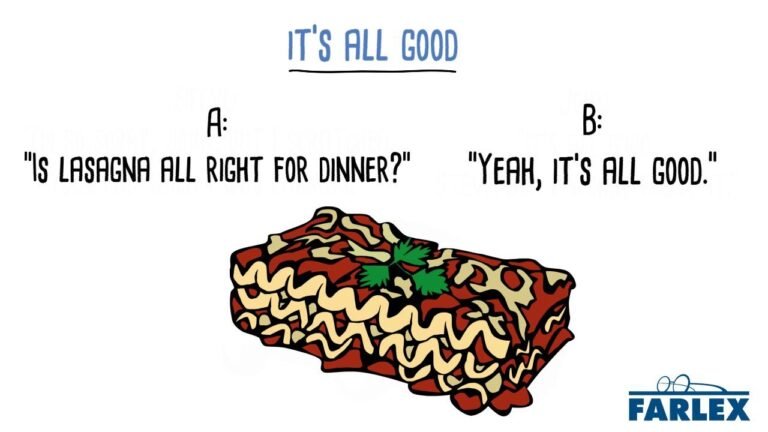
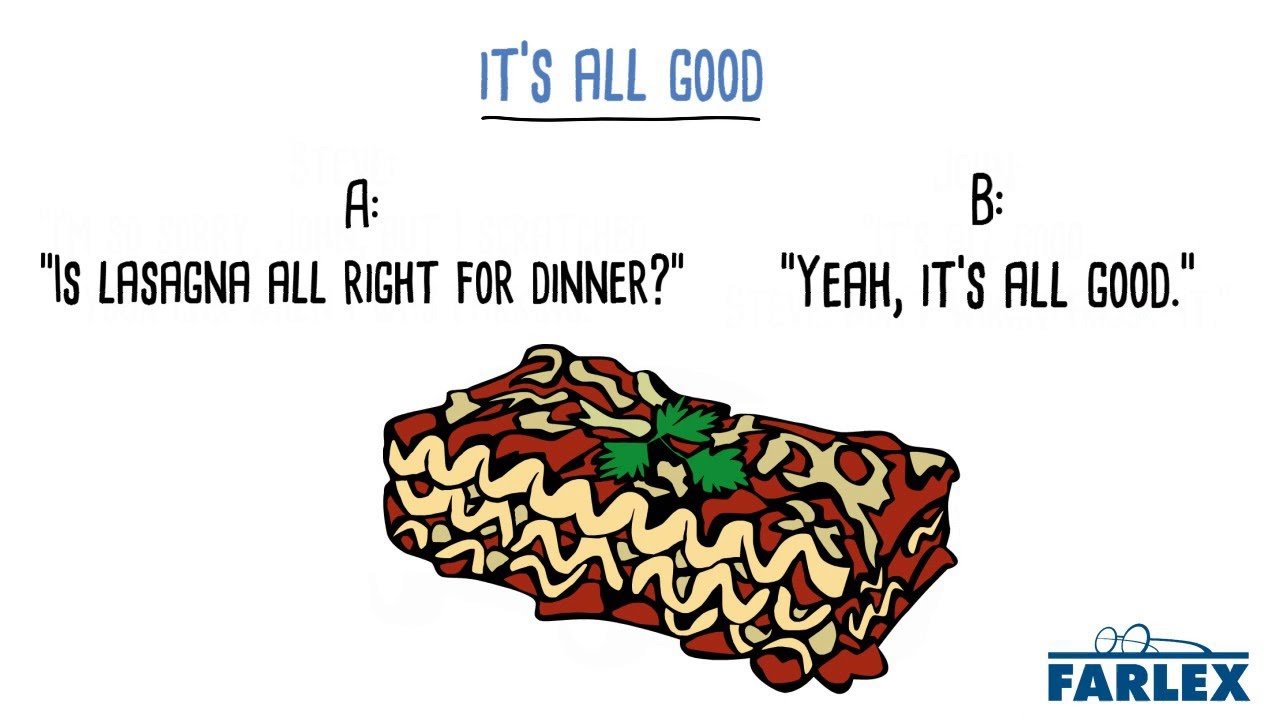
Person A: “Sorry I didn’t reply to your message yesterday.”
Person B: “It’s all good. I know you were busy.”
The response communicates understanding and indicates that the delayed reply was not a serious issue.
You can use this expression when someone forgets something small, arrives late, makes an innocent mistake, or accidentally inconveniences you.
When Plans Change
Plans do not always work out as expected. A meeting may be delayed, a friend may cancel an outing, or a scheduled activity may need to be moved.
Example:
Person A: “Can we meet tomorrow instead of today?”
Person B: “It’s all good. Tomorrow works for me.”
Here, the phrase shows that the change is acceptable and that there is no need for the other person to feel uncomfortable.
When Someone Thanks You
“It’s all good” can sometimes be used to respond to thanks, particularly when the speaker wants to emphasize that helping was not an inconvenience.
Example:
Person A: “Thanks for helping me carry those boxes.”
Person B: “It’s all good. Happy to help.”
Although “you’re welcome” is more traditional, “it’s all good” can sound relaxed and friendly in informal conversations.
When a Small Mistake Happens
Minor mistakes are a normal part of life. Responding calmly can help everyone feel more comfortable.
Example:
Person A: “I accidentally deleted the first version of the file.”
Person B: “It’s all good. We still have the updated version.”
In this example, the phrase reassures the other person and shifts attention toward the solution instead of the mistake.
Is “It’s All Good” Formal or Informal?
“It’s all good” is primarily an informal expression. It is common among friends, family members, classmates, coworkers who have a relaxed relationship, and people communicating through text messages.
The phrase is generally suitable for casual conversations because it sounds approachable and natural.
However, it may not be the best choice in every professional or formal situation. When speaking with a customer, writing a formal business email, or communicating with someone in a position of authority, a more professional expression may be appropriate.
For example, instead of writing:
“It’s all good. Don’t worry about the delay.”
You could write:
“No problem. Thank you for letting me know about the delay.”
Or:
“That is perfectly fine. I appreciate the update.”
The right choice depends on the relationship between the speakers, the seriousness of the issue, and the tone expected in the situation.
“It’s All Good” Meaning in Text Messages
Text messages are one of the most common places where people use this phrase. Because texting often favors short and conversational language, “it’s all good” is a convenient way to communicate reassurance without writing a long response.
For example:
Message 1
Friend: “Sorry, I couldn’t call you last night.”
You: “It’s all good!”
Message 2
Friend: “I forgot to send you the address.”
You: “It’s all good. Just send it when you can.”
Message 3
Friend: “I hope you’re not upset about what happened.”
You: “It’s all good. We’re fine.”
In each example, the phrase helps maintain a friendly tone and reduces the possibility of unnecessary tension.
Punctuation can also affect how a message feels. “It’s all good!” may sound enthusiastic and reassuring, while “It’s all good.” may sound calm and straightforward. A short reply such as “all good” is also common in casual texting.
Nevertheless, written messages do not always communicate emotion perfectly. If the issue is serious, a longer and more thoughtful response may be more helpful than a brief expression.
What Is the Difference Between “It’s All Good” and “It’s Okay”?
“It’s all good” and “it’s okay” have similar meanings, but they are not always interchangeable.
“It’s okay” is a broad expression that can communicate acceptance, reassurance, or permission. It can be used in both informal and relatively neutral situations.
“It’s all good” generally sounds more relaxed and conversational. It often suggests that a small issue has been accepted, resolved, or forgiven.
Consider these examples:
“It’s okay if you need more time.” This means the speaker accepts the situation or gives permission for a delay.
“It’s all good if you need more time.” This expresses similar acceptance but sounds more casual.
Another difference appears when responding to an apology. Both phrases can reassure the person who apologizes, but “it’s all good” often emphasizes that the mistake is not a major concern.
Neither expression is automatically better than the other. The best choice depends on the situation and the tone you want to communicate.
What Is the Difference Between “It’s All Good” and “No Worries”?
“No worries” is another common expression used to reassure people. It usually means that there is no need to worry, feel guilty, or apologize excessively.
“It’s all good” often communicates the same message, but it can also emphasize that the overall situation is fine.
For example:
Person A: “Sorry for asking you so many questions.”
Person B: “No worries!”
This response reassures the person that asking questions is acceptable.
Now consider another conversation:
Person A: “The weather ruined our picnic plans.”
Person B: “It’s all good. We can go next weekend.”
In the second example, “it’s all good” expresses acceptance of the situation and a willingness to make new plans.
In everyday English, both expressions are friendly, informal, and widely understood.
Can “It’s All Good” Have a Negative or Sarcastic Meaning?
Although “it’s all good” usually communicates reassurance, its meaning can change according to the speaker’s tone and the situation.
Sometimes, people use the phrase sarcastically when they are actually disappointed, annoyed, or hurt.
For example, imagine that someone repeatedly cancels plans at the last minute. After another cancellation, the other person replies, “Yeah, it’s all good.”
The words suggest that everything is fine, but the context may indicate frustration or disappointment.
Similarly, a person might say “it’s all good” to avoid an argument even though they are still upset.
This does not mean the phrase is inherently sarcastic. Most of the time, people use it sincerely. However, understanding tone, facial expressions, and the surrounding conversation can help you identify what the speaker really means.
If you are unsure whether someone is genuinely okay, you can ask a gentle follow-up question, such as, “Are you sure? I want to make sure we’re okay.”
This approach gives the other person an opportunity to explain their feelings without feeling pressured.
Common Alternatives to “It’s All Good”
English offers many expressions that communicate similar ideas. Choosing the right alternative can make your conversations more natural and appropriate.
Here are several useful options:
1. No problem: Use this when someone apologizes or asks for help with something reasonable.
Example: “Sorry for the late reply.” “No problem!”
2. No worries: Use this to reassure someone that a small mistake or inconvenience is not a concern.
Example: “Sorry I forgot.” “No worries!”
3. That’s okay: Use this when accepting an apology or acknowledging an understandable mistake.
Example: “I couldn’t finish the task today.” “That’s okay. You can finish it tomorrow.”
4. Don’t worry about it: Use this when you want someone to stop feeling anxious or guilty about a minor issue.
Example: “I’m sorry I made you wait.” “Don’t worry about it.”
5. We’re good: Use this informally to communicate that a relationship or situation is fine.
Example: “Are you still upset with me?” “No, we’re good.”
6. Everything is fine: Use this when you want to provide clear reassurance in a neutral tone.
Example: “Is there a problem with the schedule?” “No, everything is fine.”
7. It’s fine by me: Use this to indicate that you accept a suggestion or arrangement.
Example: “Would you prefer to meet at six?” “It’s fine by me.”
Although these expressions overlap in meaning, each has a slightly different tone. Some emphasize forgiveness, while others focus on reassurance, permission, or acceptance.
Common Mistakes to Avoid When Using “It’s All Good”
Even though the phrase is easy to understand, using it thoughtfully is important.
First, avoid using it automatically when someone is discussing a serious problem. If a friend shares a painful experience, saying “it’s all good” may make the person feel that you are dismissing their concerns. A more compassionate response would be, “I’m sorry you’re going through that. I’m here for you.”
Second, remember that the expression is informal. It may sound too casual in certain professional emails, official communications, or serious discussions.
Third, do not assume that every person who says “it’s all good” has completely forgiven you. The phrase may simply mean that the person does not want to discuss the matter at that moment.
Finally, pay attention to your tone. A warm voice and friendly expression can make the phrase sound sincere, while a dismissive tone may make it sound sarcastic.
The goal is not merely to use the words correctly but to communicate the intended message clearly.
Why Is “It’s All Good” So Popular?
The popularity of “it’s all good” comes from its simplicity, flexibility, and friendly tone. People often prefer expressions that communicate a message quickly without making an ordinary situation feel unnecessarily serious.
Instead of saying, “Please do not feel bad because your mistake has not caused any significant inconvenience,” someone can simply say, “It’s all good.”
The phrase also supports positive social interactions. It can reduce embarrassment, acknowledge an apology, and help people move forward after a minor problem.
Its usefulness in spoken English and digital communication has made it a familiar expression in everyday conversations. It works well in many informal settings because it is short, easy to remember, and generally understood.
However, its popularity does not mean that it should replace every other expression. Sometimes, a more specific response communicates empathy, gratitude, or understanding more effectively.
Frequently Asked Questions
1. What does “it’s all good” mean in simple words?
“it’s all good meaning” means everything is fine, there is no serious problem, or there is no need to worry. People often use it to reassure someone or accept an apology.
2. Does “it’s all good” mean no problem?
Yes. In many situations, “it’s all good” means “no problem.” For example, when someone apologizes for arriving late, you can say, “It’s all good,” to show that you are not upset about the delay.
3. Is “it’s all good” a positive expression?
Generally, yes. It usually communicates reassurance, acceptance, or a relaxed attitude. However, the speaker’s tone and the context can sometimes make it sound sarcastic.
4. Can I say “it’s all good” to my boss?
You can use it if your workplace has a relaxed communication style and you have an informal relationship with your boss. In formal situations, expressions such as “That’s perfectly fine” or “No problem” may be more appropriate.
5. What does “it’s all good” mean from a friend?
When a friend says “it’s all good,” they usually mean that there is no problem, they are not concerned about a minor mistake, or they accept the situation. If a disagreement has occurred, however, you should consider the surrounding conversation before assuming that everything has been resolved.
6. Is “all good” the same as “it’s all good”?
They are very similar. “All good” is a shorter, more casual version that is especially common in text messages and everyday speech. For example, you might reply, “All good!” when a friend apologizes for being late.
7. How should I reply when someone says “it’s all good”?
In most situations, you do not need to say anything more. You can respond with “Thanks for understanding,” “I appreciate it,” or simply continue the conversation. Your reply should depend on what happened and whether the other person has reassured you about a particular concern.
Conclusion
Understanding the it’s all good meaning makes it easier to recognize and use one of the most common expressions in informal English. The phrase generally means that everything is fine, there is no need to worry, or a particular mistake or inconvenience is acceptable.
People use it when responding to apologies, accepting changes in plans, reassuring friends, and keeping conversations friendly. It is similar to expressions such as “no problem,” “no worries,” and “that’s okay,” although each alternative has its own tone and uses.
The most important thing to remember is that context matters. “It’s all good” is usually positive and reassuring, but it may not fully express someone’s feelings in every situation. When a conversation involves serious emotions or important concerns, a thoughtful and specific response may be more appropriate.
By understanding its definition, recognizing its different meanings, and practicing the examples in this article, you can use “it’s all good” naturally and confidently in everyday English conversations.
About the Author