Have you searched for “traunch meaning” and wondered whether it’s a real English word? You’re not alone. Thousands of people type traunch into search engines every month because they hear the word in conversations about banking, investing, or business. However, the spelling often creates confusion.
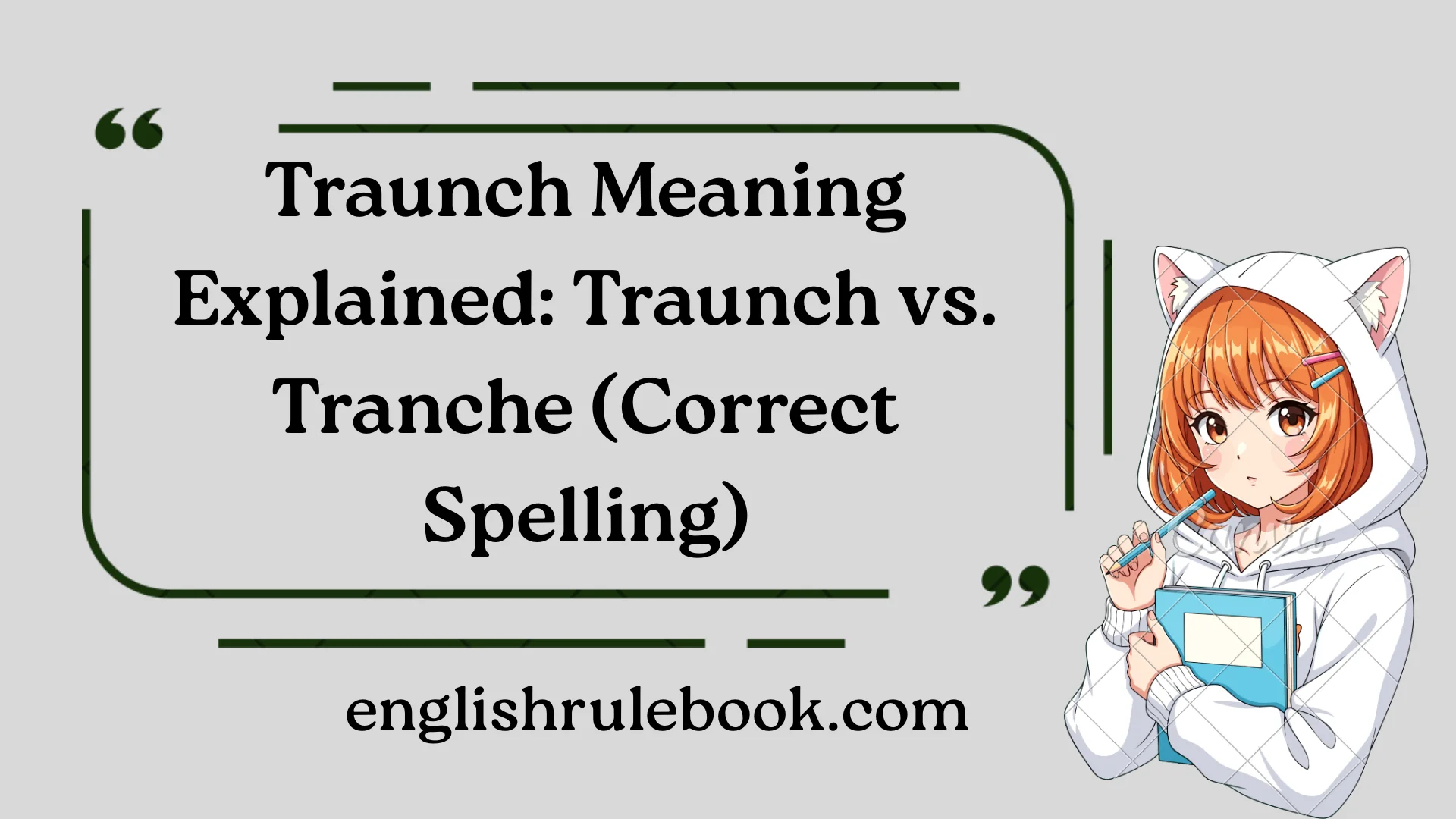
The truth is simple: “traunch” is almost always a misspelling of “tranche.” The correct word is tranche, a term commonly used in finance, investing, lending, law, and government funding. It refers to a portion, section, or slice of something larger, especially when money, assets, or payments are divided into separate parts.
Understanding the difference matters because using the wrong spelling can make professional writing appear inaccurate. Whether you’re reading financial news, preparing business documents, or simply expanding your vocabulary, knowing the correct term helps you communicate with confidence.
This guide explains the meaning of tranche, why people mistakenly write traunch, how to pronounce the word correctly, where it’s used, and how to avoid one of the internet’s most common spelling mistakes.
Quick Answer: Is “Traunch” a Real Word?
No. “Traunch” is not a recognized English word.
If you’re searching for traunch meaning, you’re almost certainly looking for tranche.
| Word | Is It Correct? | Meaning |
| Traunch | ❌ No | Common misspelling of tranche |
| Tranche | ✅ Yes | A portion, section, or allocation of a larger amount |
In modern English dictionaries, including those used by publishers and financial institutions, tranche is the accepted spelling. The incorrect version appears mostly because people spell the word the way it sounds.
Quick fact: Most search queries for “traunch meaning” actually seek the definition of tranche.
Tranche Meaning in Simple English
Simply put, a tranche is one part of a larger whole.
Instead of giving or using everything at once, people divide it into smaller sections. Each section is called a tranche.
Think of cutting a loaf of bread into slices. Every slice belongs to the same loaf, yet each slice is separate. A tranche works in much the same way, except it usually refers to money, investments, loans, or assets rather than physical objects.
Dictionary Definition
The word tranche generally means:
A distinct portion, share, or segment of a larger amount, especially in finance or investment.
Depending on the situation, a tranche may refer to:
- Part of a loan
- Section of an investment
- Stage of funding
- Allocation of government money
- Portion of securities issued to investors
Although finance uses the term most frequently, the broader idea remains the same: a carefully divided portion of something larger.
Origin of the Word
The word tranche comes from French.
Originally, it meant “slice” or “cut.”
English later adopted the term, especially within financial and legal industries, where dividing large sums into smaller portions became common practice.
Today, the original meaning still makes sense. A tranche is simply a slice of a larger whole.
Traunch vs. Tranche: The Key Difference
Many people believe both spellings are acceptable. They aren’t.
The difference is straightforward.
| Feature | Traunch | Tranche |
| Recognized English word | ❌ No | ✅ Yes |
| Found in dictionaries | ❌ No | ✅ Yes |
| Used in finance | ❌ No | ✅ Yes |
| Accepted in professional writing | ❌ No | ✅ Yes |
| Correct spelling | ❌ | ✅ |
The confusion happens because tranche has an unusual spelling. Unlike many English words, it comes from French, so its pronunciation doesn’t perfectly match its letters.
For someone hearing the word for the first time, writing traunch feels natural because it resembles the way it sounds.
However, every major financial institution, dictionary, academic publication, and business textbook uses tranche.
Remember This Easy Trick
Think of the word:
Tranche = Slice
Both contain the letter “e.”
Once you remember that connection, the correct spelling becomes much easier to recall.
How to Pronounce Tranche Correctly
Many spelling mistakes happen because people aren’t sure how to pronounce the word.
American Pronunciation
Most American speakers pronounce tranche as:
TRANSH
The ending sounds similar to:
- branch (without the “br”)
- blanche
- ranch (soft ending)
British Pronunciation
British English uses almost the same pronunciation, although the vowel sound may be slightly softer depending on the speaker’s accent.
IPA Pronunciation
/trɑːnʃ/
or
/trænʃ/
Both pronunciations are widely accepted.
Common Pronunciation Mistakes
People sometimes pronounce it as:
- Tran-chee
- Tran-chay
- Tran-see
- Tra-unch
These versions are incorrect.
The easiest pronunciation remains:
TRANSH
Where Is the Word “Tranche” Used?
Although people often associate tranche with investing, many industries use the word.
Let’s look at the most common examples.
Tranche in Finance
Finance relies heavily on tranches.
Banks, investment firms, and financial institutions often divide large financial products into separate sections.
Each section carries its own:
- Interest rate
- Risk level
- Expected return
- Repayment schedule
For example, a company may issue three investment tranches:
| Tranche | Risk | Expected Return |
| Senior | Low | Lower |
| Mezzanine | Medium | Moderate |
| Junior | High | Higher |
Investors choose the tranche that best matches their investment goals.
Tranche in Banking
Banks frequently release loans in stages.
Instead of giving a borrower the entire amount immediately, the bank releases money over time.
For example:
A construction company receives a $5 million loan.
Instead of transferring all the money on day one, the lender may divide it into five separate tranches.
| Stage | Amount Released |
| First tranche | $1 million |
| Second tranche | $1 million |
| Third tranche | $1 million |
| Fourth tranche | $1 million |
| Final tranche | $1 million |
Each payment depends on project progress.
This approach reduces financial risk for the lender.
Tranche in Investing
Investment funds often organize securities into multiple tranches.
Each tranche attracts different investors.
For instance:
- Conservative investors choose lower-risk tranches.
- Experienced investors may prefer higher-risk tranches with greater potential returns.
This system allows a single investment product to meet different financial objectives.
Tranche in Business
Businesses regularly distribute funding in phases.
Instead of investing all available capital immediately, companies release funding gradually.
Examples include:
- Product development budgets
- Marketing campaigns
- Startup investments
- International expansion
Suppose a startup raises $10 million.
Rather than spending everything immediately, investors release funds after the company achieves specific milestones.
Those funding stages are known as tranches.
Tranche in Government Funding
Governments also divide funding into tranches.
Instead of distributing an entire budget at once, agencies often approve payments in stages.
Examples include:
- Infrastructure projects
- Education grants
- Disaster relief
- International aid
- Public health initiatives
Each tranche becomes available only after meeting predetermined requirements.
This process improves accountability and financial oversight.
Tranche in Legal Agreements
Legal contracts sometimes include tranche-based payments.
A settlement agreement might require:
- Initial payment
- Second payment after six months
- Final payment after one year
Rather than calling these simple installments, lawyers may refer to them as payment tranches when the agreement involves larger financial transactions.
Read More: Alr Meaning in Text: What It Means, How to Use It, and Real Chat Examples
Real-World Examples of Tranche
Understanding the concept becomes easier with practical examples.
Example 1: Mortgage Lending
A bank approves a developer for $20 million.
The developer receives:
- First tranche after purchasing land.
- Second tranche after completing the foundation.
- Third tranche after construction reaches 50%.
- Final tranche once inspections are complete.
Each tranche reduces the lender’s exposure to risk.
Example 2: Venture Capital
A venture capital firm agrees to invest $8 million.
Instead of transferring the entire amount immediately, it releases funds after the startup reaches milestones such as:
- Product launch
- Customer growth
- Revenue targets
- Market expansion
Each funding stage represents another tranche.
Example 3: Government Grants
A research institution wins a government grant worth $2 million.
Funding arrives in four tranches based on:
- Proposal approval
- Mid-project review
- Successful testing
- Final report submission
The institution receives additional funding only after completing each stage successfully.
Examples of Tranche in Sentences
Seeing the word in context makes it easier to remember.
- The bank approved the first tranche of the construction loan.
- Investors purchased the lowest-risk tranche of the bond issue.
- The government released another tranche of emergency funding.
- Our company received the second tranche after meeting performance goals.
- Each tranche carried a different level of investment risk.
- The final tranche became available after the project passed inspection.
- The startup used the first funding tranche to hire engineers.
- Analysts carefully reviewed every tranche before recommending the investment.
Why Do People Type “Traunch” Instead of “Tranche”?
The mistake happens more often than you might think.
Here are the main reasons:
- Phonetic spelling: People write the word exactly as they hear it.
- French origin: The spelling doesn’t follow common English patterns.
- Autocorrect limitations: Some keyboards don’t recognize the intended word.
- Limited exposure: Many people encounter the term only in spoken conversations.
- Search habits: Once a misspelling spreads online, more users repeat it.
This is a classic example of a common spelling error rather than a separate English word.
Similar Words That Mean Portion or Section
Although tranche has a specialized meaning, several English words express similar ideas.
| Word | Best Used For |
| Portion | General amounts |
| Section | Documents, objects, or divisions |
| Segment | Marketing, business, or data |
| Slice | Literal or figurative pieces |
| Allocation | Budgets and funding |
| Installment | Scheduled payments |
| Batch | Manufacturing or production |
| Phase | Projects and timelines |
| Division | Organizational structures |
| Share | Ownership or distribution |
While these words overlap, tranche is the preferred choice in financial and investment contexts.
FAQs
What does tranche mean?
A tranche is a portion or section of a larger amount, most commonly used for loans, investments, securities, and funding.
Is traunch a real English word?
No. Traunch is generally considered a misspelling of tranche.
Why do people spell tranche as traunch?
Because the pronunciation can lead people to write the word phonetically rather than using its correct French-derived spelling.
How do you pronounce tranche?
Most English speakers pronounce it as “TRANSH.”
Is tranche only used in finance?
No. While finance is the most common field, the word also appears in business, government, legal agreements, and project funding.
What is a loan tranche?
A loan tranche is one scheduled portion of a larger loan that the lender releases at a specific stage or after certain conditions are met.
What is an investment tranche?
An investment tranche is a category or portion of securities with its own level of risk, return, and repayment priority.
Can tranche mean installment?
Sometimes. However, tranche usually refers to a strategically divided portion of a larger financial package, whereas installment commonly describes scheduled payments.
Is tranche a French word?
Yes. It comes from French and originally meant “slice” or “cut.”
Which spelling should I use?
Always use tranche in professional, academic, financial, and business writing.
conclusion
The confusion surrounding traunch meaning comes down to a simple spelling mistake. Traunch is not a recognized English word, while tranche is the correct term used worldwide in finance, banking, investing, business, government, and legal writing. It refers to a portion, slice, or allocated section of a larger amount and often describes funding, loans, securities, or payments that are divided into separate stages.
Using the correct spelling helps your writing appear accurate and professional. Whether you’re reading financial reports, discussing investments, or preparing business documents, remember that tranche is always the right choice. Once you associate the word with the idea of a slice of a larger whole, you’ll rarely confuse it with the common misspelling traunch again.
About the Author