Affect vs Effect
Have you ever paused while writing a sentence because you were unsure whether to use affect or effect? You are not alone. These two words are among the most commonly confused terms in English, even for people who have been speaking and writing English for years. They look and sound similar, but they usually perform different grammatical jobs in a sentence.
The confusion becomes even greater because both words can sometimes function as either nouns or verbs. However, there is a simple pattern that can make the difference much easier to remember. In most everyday situations, affect is used as a verb, while effect is used as a noun.
Learning the difference between affect vs effect is not about memorizing complicated grammar rules. Instead, it is about understanding what each word means and recognizing how it works within a sentence. Once you understand the basic relationship between an action and its result, choosing the correct word becomes much easier.
Whether you are writing an email, preparing an academic assignment, creating website content, or simply trying to improve your English, knowing how to use affect and effect correctly can make your writing clearer and more professional.
What Does Affect Mean?
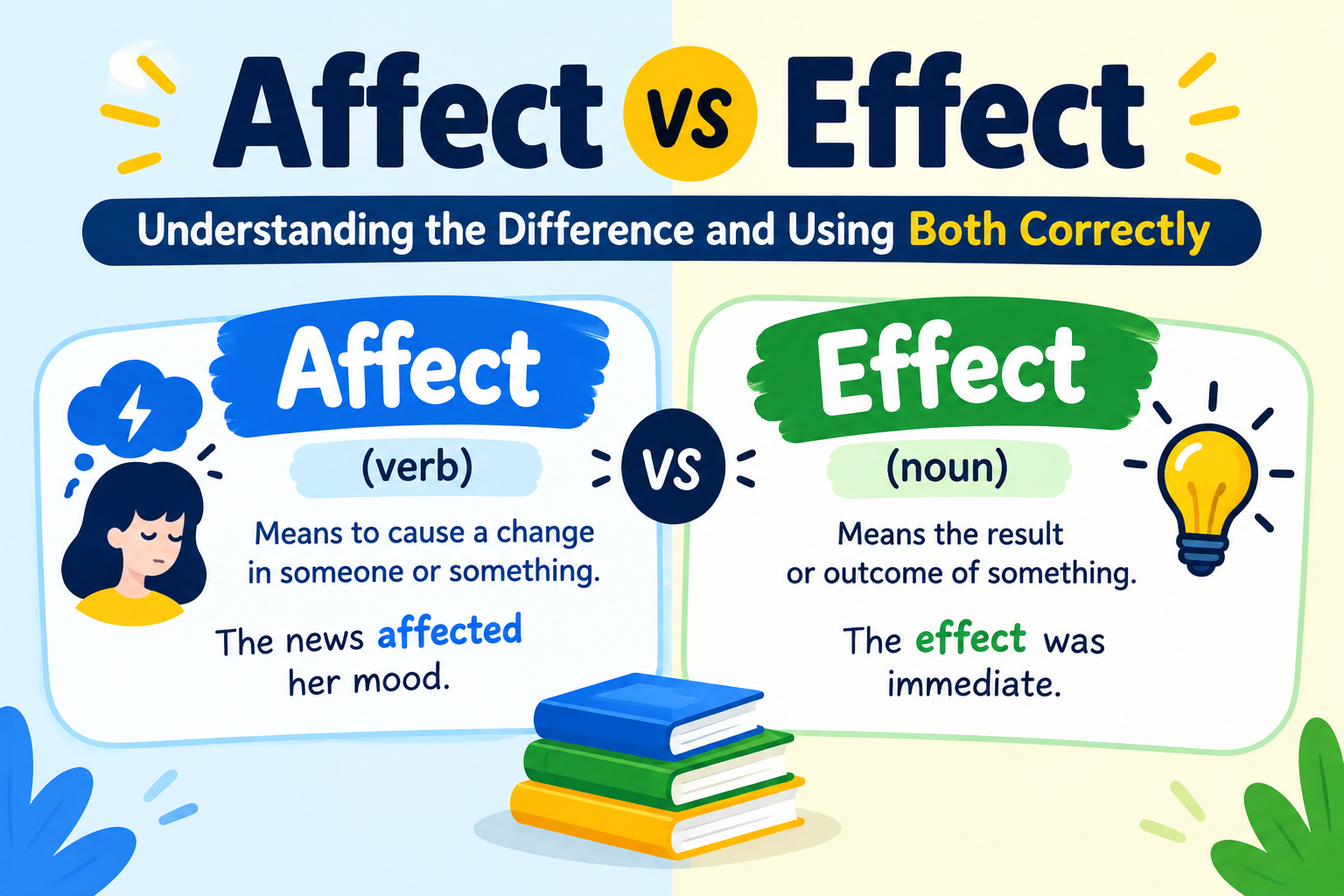
The word affect is most commonly used as a verb. As a verb, affect means to influence, change, or have an impact on something or someone. When one thing affects another, it produces some kind of influence on it.
For example, you might say, “Lack of sleep can affect your concentration.” In this sentence, lack of sleep is influencing concentration. The important point is that affect describes an action or influence.
Another example is, “The heavy rain affected traffic throughout the city.” Here, the rain influenced the movement of traffic. The sentence describes something causing a change, so affect is the appropriate word.
A useful way to remember this meaning is to associate affect with action. Both words begin with the letter “A,” which can serve as a simple memory trick. When something affects something else, it is doing something to it or influencing it.
What Does Effect Mean?
The word effect is most commonly used as a noun. It refers to the result, consequence, or outcome produced by an action or event. In simple terms, an effect is what happens because something else happened.
For instance, consider the sentence, “The heavy rain had a major effect on traffic.” The rain is the cause, while the change in traffic is the result. Therefore, effect is the correct choice because the sentence is discussing the outcome.
You can also say, “One effect of regular exercise is improved energy.” In this example, improved energy is a result of exercising regularly. Again, effect identifies the result rather than the action that creates it.
A helpful memory trick is to think of effect as the end result. If you are talking about what happened because of something else, effect will often be the correct word.
Affect vs Effect: The Basic Difference
The easiest way to understand affect vs effect is to think about cause and result. Affect usually describes the action of influencing something, while effect usually describes the result of that influence.
For example, “Stress can affect your sleep.” In this sentence, stress is influencing sleep. The word affect functions as a verb because it describes what stress can do.
Now consider the sentence, “Stress can have a negative effect on your sleep.” Here, the sentence is talking about the result of stress. Effect is a noun because it identifies the outcome.
This simple distinction works in many everyday situations. If you can replace the word with “influence” or “change,” affect is often the right choice. If you can replace it with “result” or “outcome,” effect is usually the better option.
The distinction becomes easier with practice. Instead of trying to remember an isolated spelling rule, look at the role the word plays in the sentence. Ask yourself whether you are describing an influence or discussing a result.
Examples of Affect in Everyday Sentences
Understanding examples is one of the fastest ways to become comfortable with affect. Because affect is generally used as a verb, it often appears after a subject that performs an action or creates an influence.
Consider the sentence, “Cold weather can affect your car battery.” The cold weather influences how the battery performs. Since the word describes that influence, affect is correct.
Another example is, “The new schedule affected everyone in the office.” The schedule caused a change in people’s routines. Once again, affect works as a verb because it describes the influence created by the schedule.
Here are a few more examples:
- Lack of exercise can affect your energy levels.
- Noise can affect your ability to concentrate.
- The decision affected the entire team.
- Social media can affect how people communicate.
- A positive attitude can affect your productivity.
Notice the pattern in these sentences. In each case, something is influencing or changing something else. That is the main job of affect.
Examples of Effect in Everyday Sentences
Now let’s look at effect. Since effect is usually a noun, it commonly follows words such as “the,” “an,” “its,” “this,” or “that.” It identifies a consequence or result.
For example, “The new policy had a significant effect on employees.” The policy created a consequence, and that consequence is the subject being discussed.
You might also say, “The medicine had an immediate effect.” The effect is the result produced by the medicine. The sentence is not describing the medicine’s action directly; instead, it is describing what happened afterward.
Here are several additional examples:
- The storm had a serious effect on local businesses.
- Exercise has a positive effect on your mood.
- The announcement had little effect on the public.
- The new technology could have a major effect on education.
- The experience had a lasting effect on her career.
In each example, effect refers to an outcome or consequence. This is the most common use you will encounter in everyday English.
A Simple Affect vs Effect Memory Trick
If you constantly confuse these words, try using a simple memory trick. Remember “Affect = Action” and “Effect = End result.” This is not a complete rule for every unusual use of the words, but it works extremely well for ordinary writing.
Imagine a simple chain: cause → action → result. Affect generally describes the influence or action in the middle, while effect generally identifies the result at the end.
For example, “Poor sleep affected my performance.” Poor sleep influenced performance, so affect is correct. You could then say, “Poor sleep had a negative effect on my performance.” Here, the negative result is the effect.
Another useful test is to look at the word’s position in the sentence. If you need a verb after the subject, affect may be appropriate. If you need a noun describing an outcome, effect may be the correct choice.
With regular practice, you will eventually stop translating the rule in your head. You will simply recognize which word sounds grammatically correct based on the sentence structure.
When Effect Can Be Used as a Verb
There is an important exception that makes affect vs effect slightly more complicated. Effect can sometimes be used as a verb, although this usage is less common in everyday conversation.
As a verb, effect means to cause something to happen or to bring about a change. For example, “The new manager hopes to effect positive changes in the company.”
In this sentence, effect does not mean “influence.” Instead, it means to bring about or make something happen. This is a more formal use of the word and is often found in professional, academic, legal, or organizational writing.
For example, “The committee wants to effect meaningful reforms.” This means the committee wants to bring those reforms into existence.
Because this usage is relatively advanced, beginners should not let it make the basic rule confusing. In ordinary writing, you will usually encounter affect as a verb and effect as a noun. The verb form of effect is something to learn once you are comfortable with the fundamentals.
When Affect Can Be Used as a Noun
Affect can also function as a noun, but this use is much less common in general English. It is particularly associated with psychology, psychiatry, and related professional fields.
As a noun, affect refers to the observable expression of emotion. For example, a professional might describe someone’s affect as cheerful, flat, restricted, or appropriate based on their outward emotional expression.
This meaning is different from the common verb “affect.” In everyday writing, most people will use affect as a verb rather than as a noun.
For general English learners, there is usually no need to focus heavily on this specialized meaning. It is more useful to first become confident with the everyday distinction between affect and effect.
Still, knowing that affect can be a noun helps explain why dictionaries sometimes provide definitions that seem different from what you have learned. English contains many words that can change grammatical roles depending on context, and affect is one of them.
Common Mistakes With Affect vs Effect
One of the most common mistakes is writing “The weather had a bad affect on my mood.” In standard everyday English, this should be “The weather had a bad effect on my mood.” The sentence is describing a result, so effect is the appropriate noun.
Another frequent mistake is saying, “The noise can effect my concentration.” In most normal contexts, this should be “The noise can affect my concentration.” Here, the word describes an influence, so affect functions as the verb.
People also sometimes choose the word based purely on how it sounds. Unfortunately, pronunciation alone is not a reliable guide. The two words can sound similar, especially in fast conversation.
The better approach is to identify the meaning first. Ask whether the word represents an influence or an outcome. Once you make that distinction, the correct spelling usually becomes much easier to choose.
Affect vs Effect in Professional Writing
Using affect and effect correctly becomes particularly important in professional writing. A small grammatical mistake can distract readers and make otherwise strong content appear less polished.
Imagine writing a business report that says, “The marketing campaign had a significant affect on sales.” The intended meaning is clear, but the incorrect word may make the sentence look careless. The correct version is, “The marketing campaign had a significant effect on sales.”
Similarly, “The price increase will effect customer demand” is generally incorrect if the intended meaning is influence. The better sentence is, “The price increase will affect customer demand.”
Professional writers often work with cause-and-effect relationships, which means these words appear frequently. Reports, articles, emails, research papers, and business documents can all benefit from using the terms accurately.
How to Choose the Correct Word Quickly
When you are unsure whether to use affect or effect, stop for a moment and identify the meaning of the sentence. Do not immediately focus on spelling. First, determine whether you are describing an action or a result.
Ask yourself: “Is something influencing or changing something else?” If the answer is yes, affect is probably the correct choice.
Then ask: “Am I talking about the result or consequence of something?” If the answer is yes, effect is probably correct.
You can also substitute simpler words. Try replacing affect with “influence” and effect with “result.” If the sentence still makes sense, you have a useful clue.
For example, “Exercise can affect your health” becomes “Exercise can influence your health.” That works, so affect is appropriate. “Exercise has a positive effect on health” becomes “Exercise has a positive result on health.” Although the substitution may sound slightly less natural, the original meaning clearly concerns an outcome.
Affect vs Effect: A Quick Comparison
The difference can be summarized simply:
Affect is usually a verb meaning to influence or change something.
Effect is usually a noun meaning the result or consequence of something.
For example:
Affect: “Lack of sleep can affect your memory.”
Effect: “Lack of sleep can have a negative effect on your memory.”
The first sentence focuses on the influence. The second focuses on the result.
Remember that English has exceptions. Effect can be a verb meaning to bring about a change, while affect can be a specialized noun referring to emotional expression. However, these less common meanings should not prevent you from mastering the everyday rule.
The most useful starting point is therefore simple: Affect = influence; effect = result. Once this distinction becomes familiar, you will find it much easier to use both words naturally.
Final Thoughts on Affect vs Effect
Understanding affect vs effect does not have to be difficult. The biggest mistake is treating the two words as interchangeable simply because they look and sound similar. Their meanings and grammatical roles are usually different.
About the Author