Hi vs. High
English has many words that look or sound similar but have completely different meanings. Hi vs. High is a simple example that can still cause confusion, especially for English learners and people who are learning through everyday conversations. Although these two words share similar letters and pronunciation, they are used in very different situations.
Understanding the difference between Hi and High is useful because both words appear frequently in spoken and written English. One is mainly used as a greeting, while the other describes something that is elevated, greater than normal, or located far above a particular level.
The good news is that learning this difference does not require complicated grammar rules. Once you understand what each word means and see how it works in sentences, choosing the correct word becomes much easier.
In this guide, we will explain the meaning of Hi vs. High, show practical examples, discuss common mistakes, and provide simple tips that can help you remember the difference.
What Does “Hi” Mean?
The word “Hi” is an informal greeting. People use it when they want to say hello to someone. It is common in everyday conversations and is especially popular in friendly or casual situations.
For example, you might say, “Hi, Sarah!” when you meet a friend. You could also start a text message with “Hi, how are you?” In these situations, hi has nothing to do with height, distance, or position.
“Hi” is generally considered friendly and informal. It can be used when talking to friends, classmates, coworkers, relatives, or even someone you have just met in a casual setting. It is slightly more relaxed than some formal greetings.
The word can also appear at the beginning of emails, text messages, online conversations, and social media messages. For example, “Hi John, I wanted to ask you a quick question” is a natural way to begin a casual message.
Remember that hi is a greeting. If you can replace the word with “hello” without changing the meaning, you are almost certainly using “hi” correctly.
What Does “High” Mean?
The word “high” has several meanings, but most of them are connected to the ideas of height, level, amount, or degree. It can describe something that is physically far above the ground or something that has a greater value or level than usual.
For example, you might say, “The bird is flying high in the sky.” Here, high describes the bird’s position above the ground.
High can also describe numbers, prices, temperatures, sounds, levels, or amounts. For instance, “The temperature is high today” means the temperature is greater than normal or expected.
Similarly, you might say, “The price of gas is high,” “She has a high score,” or “The volume is too high.” In each sentence, the word refers to a level, amount, or degree rather than a greeting.
Because “high” has several meanings, it is important to look at the context of the sentence. However, it is never used as a standard greeting. If you want to say hello, use hi, not high.
Hi vs. High: The Main Difference
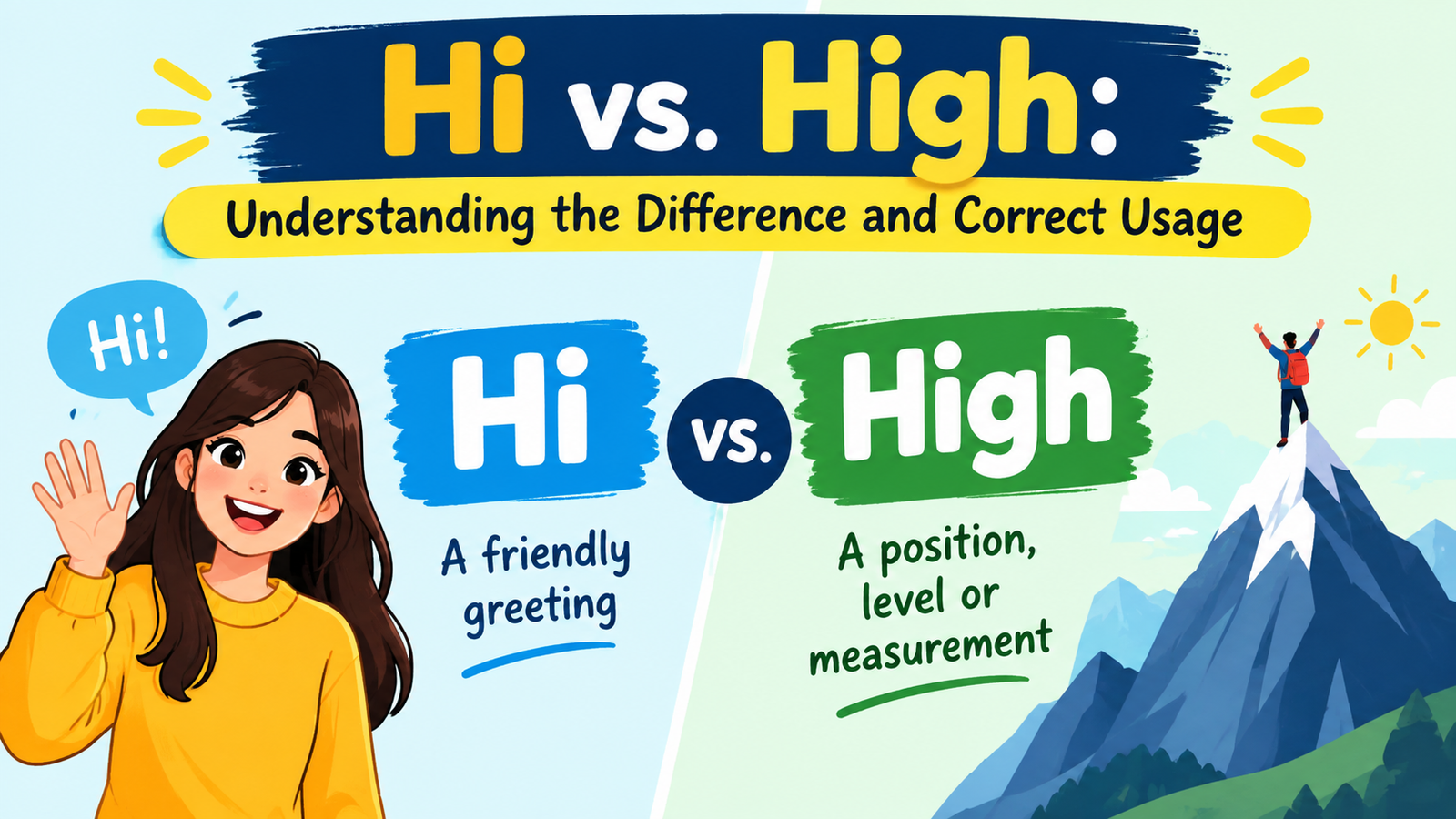
The easiest way to understand Hi vs. High is to remember their basic functions. Hi is used to greet someone, while high is usually used to describe height, level, amount, position, or degree.
Consider these two sentences: “Hi, David!” and “The mountain is high.” The first sentence is a greeting. The second sentence describes the mountain’s considerable height.
The words also differ in pronunciation. “Hi” is pronounced like the first syllable in “high,” so they sound essentially the same in standard English. This is why they can be confusing when heard in conversation. Their spelling and meaning, however, are different.
Context makes the difference clear. If someone is starting a conversation, hi is appropriate. If someone is describing something elevated or greater than a particular level, high is appropriate.
A simple memory trick is to connect hi with hello and high with height. Both “high” and “height” begin with the same three letters, which can help you remember that “high” is associated with something being up or elevated.
Examples of “Hi” in Everyday English
“Hi” is one of the easiest English words to use because its main purpose is to greet another person. You can use it at the beginning of a conversation or when you want to get someone’s attention in a friendly way.
For example, you might say, “Hi, how are you?” when meeting a friend. Another natural sentence is, “Hi, everyone! Thanks for coming.” These examples show how the word works as a casual greeting.
It is also very common in written communication. A text message might begin with “Hi, are you free this evening?” An email could start with “Hi Maria, I hope you’re doing well.” In both cases, the word establishes a friendly tone.
Here are some more examples:
- Hi, Tom! Nice to see you.
- Hi, everyone. How was your weekend?
- Hi, can I ask you something?
- Hi, Mom. I’ll be home soon.
- Hi there! How can I help you?
In every example, hi can be understood as “hello.”
Examples of “High” in Everyday English
“High” is much more flexible than “hi” because it can describe many different things. One common use relates to physical height.
For example, “The plane is flying high” means the plane is far above the ground. Likewise, “That wall is very high” describes the wall’s vertical measurement.
High can also describe an amount or level. You might say, “The price is too high,” “The temperature is high,” or “The building has high ceilings.” These examples do not involve greeting anyone.
Here are several common examples:
- The mountain is very high.
- The temperature is unusually high today.
- The shelf is too high for me to reach.
- The company has high expectations.
- The sound is too high.
- The airplane is flying high above the clouds.
These sentences demonstrate why context matters. The meaning of “high” changes slightly depending on what it describes, but the general idea of a level, position, amount, or degree remains.
Why Do “Hi” and “High” Sound the Same?
One reason Hi vs. High can be confusing is that the two words are homophones. Homophones are words that have the same pronunciation but different spellings and meanings.
“Hi” and “high” are pronounced the same in standard English. If someone says either word aloud, you normally cannot determine which spelling they mean without looking at the context.
For example, if someone says, “Hi!” you know from the situation that they are greeting you. If someone says, “The plane is high,” the surrounding words make it clear that they are talking about height or position.
English contains many other examples of words that sound alike but have different meanings. That is why listening alone is not always enough to understand spelling. Reading and context also play important roles.
When writing, however, you need to choose the correct spelling. Using “high” when you mean “hi” can make a sentence look incorrect, even though the words sound identical when spoken.
Common Mistakes With Hi and High
A common mistake is writing “High” when someone means “Hi.” This usually happens because the writer knows that both words sound the same but has not yet memorized their different meanings.
For example, writing “High, John!” as a greeting is incorrect. The correct version is “Hi, John!” The word “high” cannot normally be used as a replacement for “hello.”
Another mistake is confusing “hi” with “high” when describing something elevated. For example, “The building is very hi” is incorrect. The correct sentence is “The building is very high.”
These errors are particularly common in informal online communication, where people sometimes type quickly and rely on sound rather than spelling. Autocorrect can also occasionally create confusion.
The best way to avoid these mistakes is to focus on meaning rather than pronunciation. Ask yourself whether you are greeting someone. If yes, choose hi. If you are describing height, level, amount, or degree, choose high.
Hi vs. High in Questions
Both words can appear naturally in questions, but they serve completely different purposes.
For example, “Hi, are you ready?” uses hi as a greeting before asking a question. On the other hand, “How high is the building?” uses high to ask about the building’s height.
Another example is “Hi, can you help me?” Here, “hi” simply starts the conversation. Compare that with “How high can the balloon fly?” In the second question, “high” describes vertical distance.
You can also use high when asking about levels or amounts. “How high is the temperature?” asks about the temperature level. “How high is the price?” asks about the amount of money required.
These examples show how easily context separates the two words. Even though they sound alike, their grammatical roles and meanings are different.
How to Remember the Difference Between Hi and High
A simple memory trick can make the distinction much easier. Think of hi as a shortened form of hello. Whenever you want to greet someone, use “hi.”
For high, think about height. Both words relate to something being up, elevated, or at a greater level. This association can help you choose the correct spelling when writing.
You can also remember a simple sentence: “Hi means hello; high means up.” It is not a complete explanation of every meaning of “high,” but it is an excellent starting point for beginners.
Another useful technique is to replace the word in your sentence. If “hello” makes sense, use hi. If “elevated,” “greater,” “above,” or “at a high level” makes sense, you probably need high.
With regular reading and writing practice, the difference becomes automatic. Eventually, you will not need to stop and think about which spelling to use.
Hi vs. High: Quick Comparison
The difference can be summarized very simply.
| Word | Main Meaning | Example |
|---|---|---|
| Hi | A casual greeting | Hi, how are you? |
| High | Elevated or greater than usual | The mountain is high. |
| Hi | Similar to “hello” | Hi, Sarah! |
| High | A greater level or amount | The price is high. |
| Hi | Used to begin a friendly conversation | Hi, everyone! |
| High | Far above the ground | The plane is flying high. |
The pronunciation is essentially the same, but the spelling and meaning are different. That distinction is the most important thing to remember.
Final Thoughts on Hi vs. High
Understanding Hi vs. High is a small but useful step toward becoming a more confident English speaker and writer. These words sound the same, but they have completely different purposes.
About the Author