itsself
English contains many words that look or sound similar but have different meanings, spellings, and grammatical functions. One example is “itsself,” a term people sometimes use when they want to refer to something acting independently or existing as a separate entity. Although this spelling may appear in informal writing, online searches, and everyday conversations, it is important to understand whether it is grammatically correct and which word should be used instead.
The word “itsself” is commonly confused with “itself,” which is the standard and correct spelling in modern English. Understanding the difference helps writers improve their grammar, communicate clearly, and avoid spelling mistakes in professional documents, academic assignments, emails, and online content.
This article explores the meaning of itsself, explains why people use this spelling, introduces the correct grammatical form, and provides practical examples to help readers understand the difference.
What Does Itsself Mean?
The term “itsself” is generally an incorrect spelling of the English reflexive pronoun “itself.” People may write itsself because they assume that the possessive pronoun “its” requires another letter s before adding “self.” However, standard English does not follow this spelling pattern for the reflexive pronoun associated with the word “it.”
When someone searches for itsself, they are usually trying to understand how to refer to an object, animal, situation, organization, or abstract idea when the subject and the object of a sentence are the same.
For example, consider the sentence, “The machine turned itself off.” The machine performs the action, and the action affects the same machine. Therefore, itself is the appropriate reflexive pronoun.
Writing “The machine turned itsself off” communicates a similar intended meaning, but the spelling is incorrect in standard English.
Although readers can often understand the intended message, using the correct spelling makes writing more professional and easier to evaluate.
Is Itsself a Correct English Word?
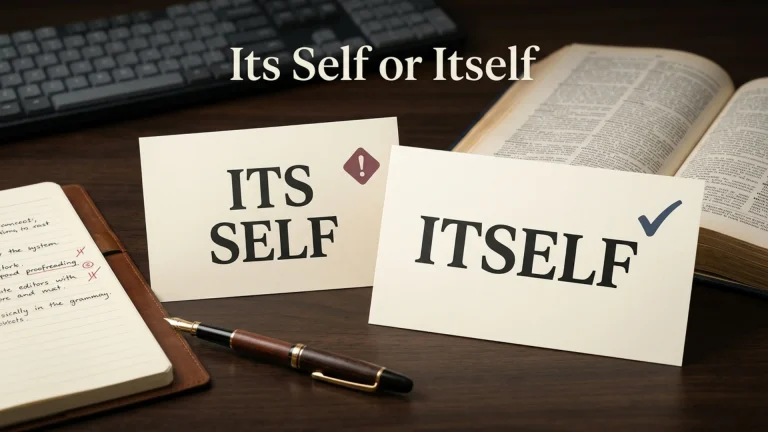
In standard modern English, “itsself” is not the accepted spelling of the reflexive pronoun. The correct form is “itself.”
The distinction matters because spelling conventions help readers recognize words quickly and understand how they function within sentences. Although people occasionally create alternative spellings or use nonstandard forms in informal settings, those forms should not automatically be treated as grammatically correct.
For example:
- Incorrect: The cat cleaned itsself after eating.
- Correct: The cat cleaned itself after eating.
- Incorrect: The computer restarted itsself.
- Correct: The computer restarted itself.
- Incorrect: The organization introduced itsself to the public.
- Correct: The organization introduced itself to the public.
In each example, itself refers back to the subject of the sentence.
For school assignments, business communication, website articles, reports, and other formal writing, writers should consistently use itself rather than itsself.
Understanding the Correct Word: Itself
“Itself” is a reflexive pronoun used when the subject of a sentence is also the person, animal, object, or entity receiving the action. It can also emphasize the subject or refer to something considered independently.
The word consists of “it” and “self.” However, its conventional spelling does not include an additional s between “it” and “self.”
Consider this example: “The door closed itself.”
The door is the subject, and itself refers back to that same door. The sentence describes an action affecting the object that performs or experiences it.
Another example is, “The application updated itself overnight.” In this sentence, the application is both the subject and the entity receiving the update.
The word itself can also emphasize something. For instance, “The idea itself is interesting.” Here, itself highlights the idea rather than referring to an action performed on the idea.
These uses demonstrate why itself is an important word in everyday English.
Why Do People Spell It as Itsself?
There are several reasons people may write itsself instead of itself. Most of them relate to the way English spelling patterns are learned and applied.
1. Confusion With the Word Its
One common reason for the spelling mistake is confusion between “its” and “itself.”
The word its is a possessive determiner used to indicate ownership or association. For example, “The bird spread its wings.” The word itself is a reflexive pronoun.
Because both words begin with “it” and relate to the same grammatical pronoun, some writers mistakenly combine the spelling of its with self.
However, the correct forms are different:
- Its tail was long.
- The animal scratched itself.
- The device turned itself off.
Remembering this distinction helps prevent the error.
2. Applying a General Spelling Pattern
English includes many words that combine a pronoun or noun with the word self. Examples include myself, yourself, himself, herself, and themselves.
People sometimes assume that adding self to it should produce itsself. This assumption may seem reasonable because the possessive form its already contains two letters s.
Nevertheless, English spelling depends on established word forms rather than simply combining visible parts. The standard reflexive form is itself.
3. Typing Quickly
Another reason for this mistake is typing quickly without checking the final text.
When writing emails, social media posts, blog articles, or messages, people may accidentally add an extra letter. Spellcheckers sometimes identify these errors, but not every writing environment catches every nonstandard word.
Proofreading carefully and using a reliable grammar checker can help writers identify such mistakes before publishing.
4. Learning English Through Everyday Conversation
People often learn vocabulary by listening to other speakers. If they encounter a nonstandard pronunciation or spelling repeatedly, they may assume it is correct.
However, spoken language and written language do not always follow identical patterns. Learning the standard written form is especially useful for academic and professional communication.
Itsself vs. Itself: What Is the Difference?
The main difference is that itself is the standard English spelling, while itsself is generally a spelling error when intended to mean itself.
| Feature | Itsself | Itself |
|---|---|---|
| Standard spelling | No | Yes |
| Grammatical use | Nonstandard form | Reflexive pronoun |
| Appropriate for formal writing | No | Yes |
| Example | The phone fixed itsself. | The phone fixed itself. |
The table shows that writers should choose itself whenever they want to refer back to a singular subject represented by it.
For example, “The problem solved itself” is a standard sentence. It means that the problem was resolved without someone directly solving it.
In contrast, “The problem solved itsself” contains a spelling mistake, even though readers will probably understand the intended meaning.
How to Use Itself Correctly in Sentences
Learning through examples is one of the easiest ways to understand a grammatical rule. The following examples demonstrate how itself functions in different contexts.
Example 1: Animals
“The dog entertained itself while its owner was away.”
In this sentence, itself refers to the dog. The word describes an action that the dog performs independently.
Example 2: Technology
“The smartphone restarted itself after installing the update.”
Here, itself refers to the smartphone. The sentence indicates that the device restarted automatically.
Example 3: Nature
“The flower opened itself to the morning sunlight.”
The pronoun refers to the flower, which is the subject of the sentence. The sentence uses itself to connect the action with the same subject.
Example 4: Organizations
“The company introduced itself to potential customers.”
Itself refers to the company. This example is useful because organizations, institutions, and businesses can be represented by the pronoun it when treated as single entities.
Example 5: Ideas and Concepts
“The explanation itself was enough to answer the question.”
In this example, itself emphasizes the explanation. It does not describe a reflexive action in the same way as “The machine repaired itself,” but it still performs an important grammatical function.
Example 6: Everyday Situations
“The door opened by itself.”
This sentence means that the door opened without an apparent person opening it. The phrase “by itself” is frequently used to describe something happening independently or without direct assistance.
When Should You Use Itself?
The word itself is appropriate in several common situations. Understanding these uses helps writers produce clearer and more natural sentences.
When the Subject and Object Are the Same
Use itself when the subject performs an action that affects the same entity.
For example, “The robot moved itself across the room.”
The robot performs the movement, and itself refers back to the robot.
When Emphasizing a Thing
Itself can emphasize a noun or clarify that the thing under discussion is important independently of other factors.
For example, “The book itself is excellent, although the movie adaptation is disappointing.”
Here, itself emphasizes the book rather than its adaptation.
When Describing Independent Action
The phrase “by itself” can indicate that something happens without assistance.
For example, “The lamp switched on by itself.”
This construction is common when describing machines, devices, natural events, or unexplained situations.
When Referring to an Organization or System
Writers can use itself when referring to a singular organization, business, system, or institution.
For example, “The software automatically updates itself.”
The pronoun refers to the software system.
Common Mistakes Involving Itself
Although itself is a relatively simple word, it is sometimes confused with other pronouns and possessive forms.
Confusing Itself With Its
Its indicates possession or association, while itself is a reflexive or emphatic pronoun.
Consider these sentences:
- “The company changed its policy.”
- “The company introduced itself to the community.”
In the first sentence, its indicates that the policy belongs to or is associated with the company. In the second, itself refers back to the company.
A useful way to remember the difference is to ask whether the sentence expresses possession or refers back to the subject.
Confusing Itself With It Is
“Itself” is one word, while “it is” consists of two words. The contraction “it’s” means “it is” or “it has,” depending on the sentence.
For example:
- “The machine repaired itself.”
- “It’s working properly.”
- “It’s been running all day.”
These expressions have different grammatical functions. The apostrophe in it’s does not belong in itself.
Adding an Unnecessary Letter
The spelling itsself usually results from adding an extra s. Writers should remember the standard form as a single established word: itself.
Repeating the correct spelling in practice sentences can help make it easier to remember.
Is Itsself Ever Used in Informal Language?
The spelling itsself may appear in online discussions, informal messages, user-generated content, or writing that intentionally reproduces nonstandard language. Its appearance does not make it the standard spelling.
In some dialects or historical varieties of English, nonstandard reflexive forms may be encountered. Such forms should be understood within their specific linguistic context rather than automatically treated as interchangeable with standard modern English.
For most readers, the important distinction is straightforward: use itself in ordinary writing unless you have a specific reason to reproduce a particular dialect, quotation, or historical form.
Writers should also avoid assuming that every unusual spelling represents a meaningful alternative. Sometimes a word is simply misspelled.
Tips for Remembering the Correct Spelling
If you regularly confuse itsself with itself, a few simple techniques can help.
First, memorize the complete word. Instead of trying to construct the word from its and self, learn itself as a single spelling unit.
Second, practice with common examples. Write sentences such as “The computer updated itself,” “The cat groomed itself,” and “The door closed by itself.”
Third, compare itself with other reflexive pronouns. English uses myself, yourself, himself, herself, itself, ourselves, and themselves. Remembering this group can make the correct form easier to recognize.
Fourth, proofread before publishing. Pay particular attention to repeated letters and words that resemble other grammatical forms.
Finally, use a dictionary when uncertain. A reputable English dictionary can confirm the standard spelling, definition, and grammatical function of a word.
These techniques are especially useful for students, content writers, bloggers, editors, and anyone who wants to improve written English.
Why Correct Spelling Matters in Professional Writing
Correct spelling helps establish credibility and makes written communication easier to understand. A single spelling mistake may not prevent readers from understanding a sentence, but repeated errors can distract them from the main message.
For website owners and content creators, proofreading is particularly important. Articles containing unnecessary spelling mistakes can appear less polished and may reduce readers’ confidence in the overall quality of the content.
In academic writing, correct spelling demonstrates attention to language conventions. In business communication, it helps messages look professional. In personal communication, it reduces confusion and makes ideas easier to follow.
The goal is not to make every sentence complicated or overly formal. Instead, writers should choose familiar words, use standard spelling, and express their ideas clearly.
Replacing itsself with itself is a small correction, but it is a useful step toward more accurate English writing.
Frequently Asked Questions About Itsself
1. What is the correct spelling: itsself or itself?
The correct standard spelling is itself. Itsself is generally considered a misspelling when used as the reflexive pronoun associated with it.
2. What does itself mean?
Itself is a reflexive pronoun that refers back to a subject represented by it. It can also emphasize a thing or idea.
For example, “The device turned itself off” uses itself to refer to the device.
3. Why do people write itsself?
People may write itsself because they confuse it with the possessive word its, add an unnecessary letter, or apply an incorrect spelling pattern.
4. Can I use itsself in an academic essay?
You should use itself in academic essays and other formal writing. The standard spelling is the appropriate choice for school assignments, reports, and research papers.
5. Is itself a reflexive pronoun?
Yes. Itself is a reflexive pronoun when it refers back to the subject of a sentence, as in “The animal protected itself.” It can also function as an emphatic pronoun, as in “The plan itself was simple.”
6. What is the difference between itself and its?
Its is a possessive determiner, as in “The tree lost its leaves.” Itself is a reflexive or emphatic pronoun, as in “The tree supported itself against the wall.”
7. Is itself one word or two?
Itself is one word. It does not contain an apostrophe or a space.
8. How can I avoid spelling itsself incorrectly?
Learn itself as a complete word, practice writing example sentences, and check your work before publishing. Remembering that itself is the standard form will help you avoid adding an unnecessary s.
Conclusion
The keyword “itsself” highlights a common English spelling confusion. Although people may use this form when typing quickly or misunderstanding the relationship between its and self, the standard modern English reflexive pronoun is “itself.”
Itself is used when referring back to a subject, emphasizing a thing or idea, or describing something that acts independently. It appears in everyday conversations, academic writing, professional communication, and online content.
Understanding the difference between itself, its, and it’s can prevent common grammatical mistakes and improve overall writing quality. By memorizing the correct spelling, practicing with simple sentences, and proofreading carefully, anyone can become more confident in using this word.
Ultimately, the best approach is simple: whenever you need the standard reflexive pronoun associated with it, choose itself. This small habit will help you communicate more accurately and produce clearer, more professional English writing.
About the Author