
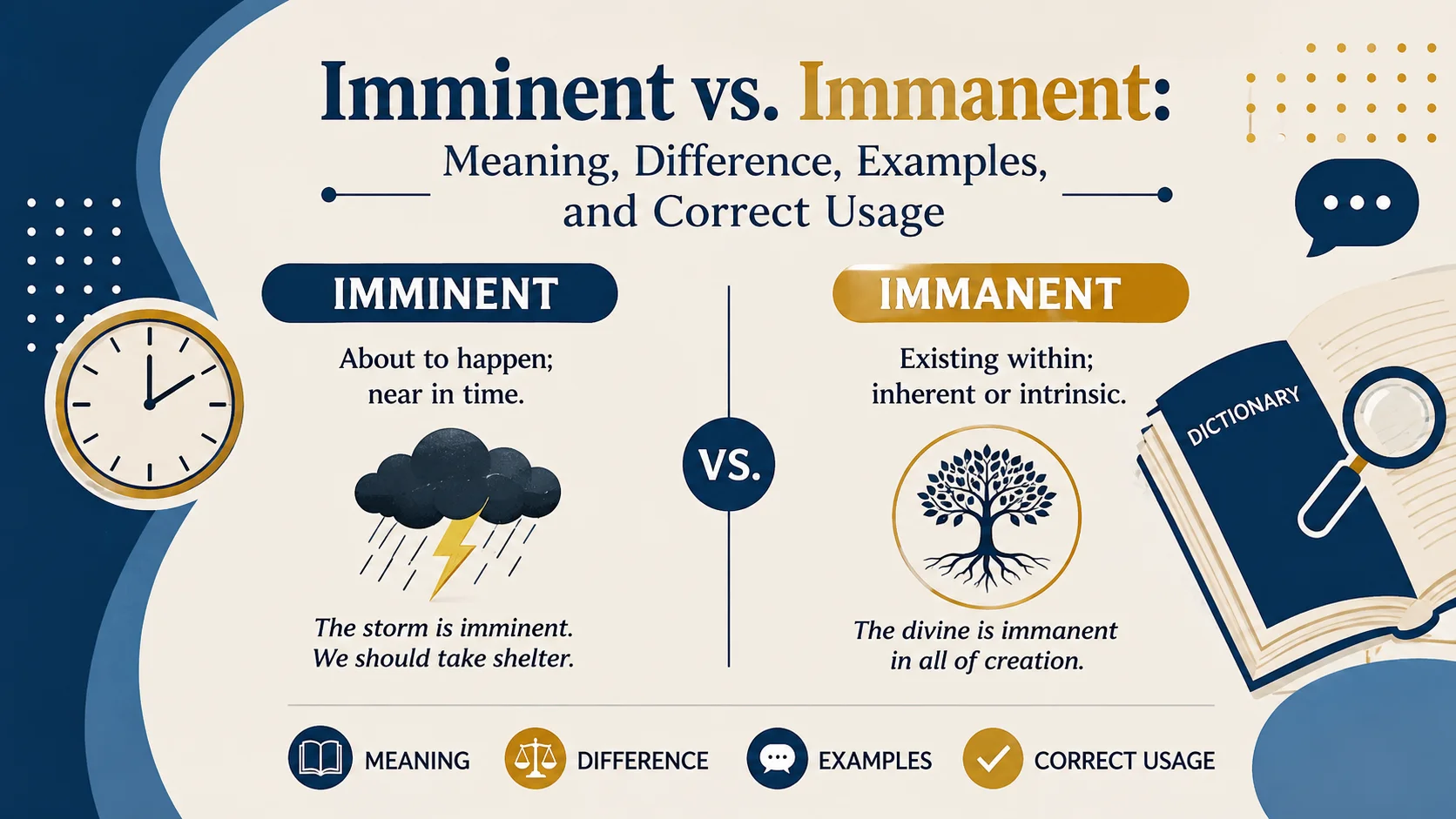
Imminent vs. Immanent can be confusing because these English words look and sound similar, but their meaning and usage are quite different. Imminent relates to time and describes an event that is about to happen soon. For example, if a storm is approaching, the storm is imminent. When I explain this difference, I usually connect the word with something that is close to happening. This makes it easier to remember that imminent describes an expected event rather than a quality or presence.
Immanent, however, describes something that exists within another thing as an inherent, natural, or permanent part. It can describe a quality that exists within a structure or system, and it often appears in philosophical or spiritual context. The key difference is simple: imminent points toward something that will happen in time, while immanent points to something already existing within something else. Once you connect each word with its central meaning, choosing the correct word becomes much easier.
In everyday English, this distinction improves your vocabulary, communication, and overall usage. Use imminent for an approaching event, such as an important change that will happen shortly. Use immanent when discussing a presence, quality, or feature that naturally exists within a particular thing. Keeping these two ideas separate helps you write more accurately and avoid a common word-choice mistake.
Quick Answer: Imminent vs. Immanent
The easiest way to understand imminent vs. immanent is to remember these two ideas:
- Imminent = about to happen
- Immanent = existing within
| Word | Meaning | Main Idea | Example |
| Imminent | Likely to happen very soon | Near in time | “A storm is imminent.” |
| Immanent | Existing or operating within something | Present within | “The principle is immanent in nature.” |
A simple memory trick can make the distinction stick:
Imminent → immediate → soon
Immanent → within → existing inside
So, when you’re talking about an approaching event, use imminent. When you’re describing something naturally present within another thing, use immanent.
What Does Imminent Mean?
Imminent is an adjective that means about to happen or likely to happen very soon.
It describes something that hasn’t happened yet but appears close in time. The word often creates a sense of urgency because the event seems just around the corner.
For example:
The arrival of the guests is imminent.
This means the guests are expected to arrive very soon.
Similarly:
The company warned employees that layoffs were imminent.
The sentence tells readers that the layoffs haven’t happened yet. However, they are expected to happen shortly.
Common Uses of Imminent
You’ll often see imminent use with events, situations, or developments such as:
- imminent danger
- imminent threat
- imminent arrival
- imminent departure
- imminent change
- imminent decision
- imminent announcement
- imminent storm
- imminent disaster
- imminent deadline
The word can describe positive, negative, or neutral events. It doesn’t automatically mean something bad is coming.
For instance:
The baby’s arrival is imminent.
That’s generally positive.
On the other hand:
The residents were warned of imminent danger.
That’s clearly negative.
The shared idea is simply nearness in time.
Imminent in Simple Terms
Imagine you’re standing outside a theater waiting for a movie to begin.
The lights have dimmed. The audience has settled down. The opening screen is about to appear.
You could say:
The movie’s beginning is imminent.
It hasn’t started yet, but it’s very close.
That’s the heart of imminent.
Examples of Imminent in a Sentence
Here are several natural examples:
- A severe storm is imminent.
- The player’s retirement appears imminent.
- The company expects an announcement to be imminent.
- The deadline is imminent, so finish the report today.
- Her departure is imminent.
- The team’s victory seemed imminent during the final minutes.
- Officials warned residents about an imminent threat.
- The baby’s arrival is imminent.
In every example, the word points toward something happening soon.
What Does Immanent Mean?
Immanent is an adjective that describes something that exists or operates within something else.
It can refer to a quality, principle, force, presence, or characteristic that exists naturally within a person, system, experience, nature, or reality.
Unlike imminent, the word doesn’t focus on the future.
It focuses on internal presence.
For example:
The philosopher argued that meaning is immanent in human experience.
The sentence doesn’t say that meaning will appear soon. Instead, it suggests that meaning already exists within human experience.
The word often appears in more specialized areas of language, particularly philosophy, theology, religious studies, literature, and academic writing.
Immanent in Simple Terms
Think of something that belongs within another thing rather than coming from outside.
For example, imagine someone says:
Creativity is immanent in artistic expression.
The idea is that creativity exists naturally within artistic expression itself.
It’s not an approaching event. It’s an internal quality or presence.
That’s why immanent can be remembered as a word connected with “within.”
Examples of Immanent in a Sentence
- The philosopher believed that meaning is immanent in human experience.
- The writer explored the immanent qualities of nature.
- The theory treats order as immanent within the system.
- The author described beauty as immanent in ordinary life.
- The tradition presents the divine as immanent within nature.
These examples all deal with something present within another thing.
Imminent vs. Immanent: The Key Difference
The biggest difference between imminent and immanent is remarkably simple.
Imminent describes when something will happen.
Immanent describes where something exists or operates.
| Feature | Imminent | Immanent |
| Core meaning | About to happen | Existing within |
| Main concept | Time | Internal presence |
| Focus | Near future | Internal existence |
| Common setting | Everyday and formal English | Mostly formal or academic English |
| Common phrases | Imminent danger, imminent arrival | Immanent nature, immanent principle |
| Related noun | Imminence | Immanence |
Consider these two sentences:
The storm is imminent.
The storm is coming soon.
The principle is immanent in nature.
The principle exists within nature.
One word looks forward in time. The other looks inward toward presence.
Imminent vs. Immanent Examples Side by Side
Seeing the words together makes the difference easier to remember.
| Imminent | Immanent |
| Danger is imminent. | The quality is immanent in the design. |
| A storm is imminent. | Meaning is immanent in human experience. |
| Her arrival is imminent. | The principle is immanent within the system. |
| A major announcement is imminent. | The author describes beauty as immanent in nature. |
| The deadline is imminent. | The theory presents order as immanent in reality. |
Notice the pattern.
The imminent examples describe things that are approaching. The immanent examples describe qualities or principles that exist within something.
A Quick Context Test
When you’re unsure which word belongs in your sentence, ask yourself one question:
Am I talking about something happening soon?
If the answer is yes, use imminent.
If you’re describing something that exists naturally or permanently within something else, use immanent.
This test handles most everyday cases.
How to Remember Imminent vs. Immanent
These words can trip up even careful writers because their spelling and pronunciation are so similar.
Fortunately, a couple of simple memory tricks can help.
Imminent = Immediate
Connect imminent with immediate.
Both words can make you think about something happening soon or without much delay.
For example:
- An imminent announcement = an announcement expected soon.
- An immediate announcement = an announcement made without delay.
They aren’t exact synonyms, but the connection makes imminent easier to remember.
Immanent = Within
Connect immanent with the idea of something being within.
For example:
The quality is immanent in the work.
The quality exists within the work itself.
This is a memory aid rather than a literal breakdown of the word. Still, it’s an effective way to keep the two spellings apart.
Imminent vs. Immanent Pronunciation
Pronunciation adds another layer of confusion.
In standard US English, imminent and immanent are pronounced very similarly. In many contexts, they can sound essentially identical.
That means you can’t always rely on pronunciation to determine which spelling belongs on the page.
| Word | Pronunciation | Meaning |
| Imminent | ih-muh-nuhnt | About to happen |
| Immanent | ih-muh-nuhnt | Existing within |
Because they sound so similar, writers need to rely on context and meaning.
If you’re writing about a deadline approaching, think imminent.
If you’re writing about a principle existing within something, think immanent.
Imminent and Immanent Word Origins
The two words may look like close relatives, but their histories help explain their different meanings.
Origin of Imminent
Imminent comes from Latin roots associated with the idea of overhanging or projecting over something.
That image gives the modern meaning an interesting sense of movement.
Something that hangs overhead feels close. It seems ready to descend or affect you.
Over time, the word developed its modern sense of something approaching or about to happen.
That’s why phrases such as imminent danger feel so natural. The danger seems to be hanging over the situation.
Origin of Immanent
Immanent comes from a Latin root associated with remaining within or dwelling in.
That history connects directly with its modern meaning.
Something immanent doesn’t approach from the outside. Instead, it exists within something.
This distinction gives both words a useful mental picture:
- Imminent: something approaching.
- Immanent: something dwelling within.
Their spelling may be close, but their underlying concepts move in different directions.
Common Mistakes With Imminent and Immanent
The most common errors happen when writers remember the sound but forget the meaning.
Mistake 1: Using Immanent for an Upcoming Event
Incorrect:
The deadline is immanent.
If you mean the deadline is approaching, the correct word is imminent.
Correct:
The deadline is imminent.
The deadline is close in time.
Mistake 2: Using Imminent for Something Existing Within
Incorrect:
The quality is imminent in the design.
If you mean the quality naturally exists within the design, use immanent.
Correct:
The quality is immanent in the design.
The sentence describes an internal quality rather than an approaching event.
Mistake 3: Treating the Words as Synonyms
The similar spelling doesn’t make the words interchangeable.
Consider:
The announcement is imminent.
This means the announcement is coming soon.
Now compare:
The principle is immanent in the theory.
This means the principle exists within the theory.
Swapping the words would destroy the intended meaning.
Imminent vs. Immediate vs. Impending
The confusion doesn’t stop with imminent vs. immanent. English also has several words that describe something close in time.
The most useful comparisons are imminent, immediate, and impending.
Imminent vs. Immediate
Imminent means something is expected to happen very soon.
Immediate often means something happens at once or without delay.
Compare these sentences:
The storm is imminent.
The storm hasn’t arrived yet. It’s expected soon.
Take immediate action.
The instruction means to act right now.
The key difference is timing.
Imminent usually points toward a future event that’s close. Immediate often emphasizes something happening now or without delay.
Imminent vs. Impending
Impending means approaching or about to happen.
Because the meanings overlap, these words can often appear in similar sentences.
For example:
- An imminent storm
- An impending storm
- An imminent crisis
- An impending crisis
- An imminent deadline
- An impending deadline
Both can work in many situations.
However, impending often creates a stronger feeling of something looming ahead. It frequently appears with unpleasant events such as crises, disasters, problems, or threats.
Immanent vs. Inherent vs. Intrinsic
Immanent also has some overlap with words such as inherent and intrinsic.
Still, each word has its own emphasis.
Immanent vs. Inherent
Inherent means naturally belonging to something.
For example:
Risk is inherent in the activity.
The sentence says that risk naturally belongs to the activity.
Immanent can describe something existing within something else. However, it tends to sound more specialized.
Compare:
Creativity is inherent in artistic work.
This sounds fairly general.
Meaning is immanent in artistic experience.
This sounds more philosophical or theoretical.
Immanent vs. Intrinsic
Intrinsic describes something that belongs to the essential nature of a thing.
For example:
The material has intrinsic value.
The value belongs to the material itself.
Immanent, meanwhile, emphasizes something being present or operating within another thing.
The meanings can overlap, but intrinsic is generally more common in everyday formal writing. Immanent has a more specialized philosophical and theological flavor.
When to Use Imminent
Use imminent when you’re describing something that is about to happen.
The word works naturally with events and situations such as:
- Danger
- Threats
- Storms
- Arrivals
- Departures
- Deadlines
- Decisions
- Announcements
- Changes
- Disasters
- Elections
- Major events
Examples of Correct Usage
A major announcement is imminent.
The deadline is imminent, so the team needs to finish the project.
The patient’s arrival is imminent.
Officials warned residents that flooding was imminent.
The company expects the leadership change to be imminent.
A helpful substitution test is to replace imminent with “likely to happen very soon.”
If the sentence still makes sense, imminent is probably the right choice.
When to Use Immanent
Use immanent when you’re discussing something that exists or operates within something else.
You’ll most often encounter the word in more formal subjects, including:
- Philosophy
- Theology
- Religious studies
- Metaphysics
- Literature
- Art criticism
- Academic theory
Examples of Correct Usage
The philosopher argued that meaning is immanent in human experience.
The writer explored the immanent qualities of nature.
The theory suggests that order is immanent within the universe.
The author presents beauty as immanent in everyday life.
The word can sound too formal for casual conversation. That’s not a grammatical problem. It simply reflects the contexts where immanent naturally appears.
Case Study: Choosing Between Imminent and Immanent
Imagine a weather service issues a warning about a severe storm.
The storm hasn’t arrived yet. However, weather conditions suggest that it will reach the area within a short time.
The correct sentence is:
A severe storm is imminent.
The word works because the sentence deals with time.
Now consider a completely different situation.
A philosopher argues that spirituality doesn’t exist separately from nature. Instead, spirituality exists within nature itself.
A suitable sentence would be:
The philosopher describes the divine as immanent in nature.
Here, the word works because the sentence describes presence within something.
What Happens When You Switch the Words?
Consider:
The storm is imminent.
This clearly means the storm is approaching.
Now change one word:
The storm is immanent.
That doesn’t express the intended meaning. It would suggest an idea involving internal existence rather than an approaching weather event.
This is a perfect example of how one letter can carry a completely different meaning.
Real-World Contexts for Imminent
You can find imminent in many areas of everyday communication.
Weather
Severe weather is imminent.
The weather event is expected soon.
Business
The company announced that a merger was imminent.
The merger is expected to happen soon.
Sports
The team’s victory appeared imminent.
The result seemed very close to becoming certain.
Travel
The plane’s arrival is imminent.
The plane is expected shortly.
Deadlines
The submission deadline is imminent.
The deadline is very close.
These examples show that imminent isn’t restricted to emergencies. It simply describes something approaching in time.
Real-World Contexts for Immanent
Immanent appears in more specialized discussions.
Philosophy
A philosopher may discuss a principle as immanent in reality, meaning the principle exists within reality rather than outside it.
Theology
The term can describe the idea of divine presence within the natural world or creation.
Literature
A critic might describe meaning as immanent in a text, suggesting that the meaning arises from or exists within the text itself.
Art
A writer might describe beauty as immanent in an artwork, emphasizing that the quality belongs to the work itself.
These contexts explain why immanent feels more academic than imminent.
Quick Reference: Imminent vs. Immanent
When you’re editing your writing, this table provides a quick check.
| Meaning you want | Correct word |
| About to happen | Imminent |
| Likely to happen soon | Imminent |
| Approaching danger | Imminent |
| Upcoming event | Imminent |
| Approaching deadline | Imminent |
| Upcoming arrival | Imminent |
| Existing within something | Immanent |
| Naturally present within something | Immanent |
| Existing within nature | Immanent |
| A philosophical idea of internal presence | Immanent |
| A theological idea involving internal divine presence | Immanent |
| A principle operating within a system | Immanent |
A Simple Rule for Remembering the Difference
If you only remember one thing from this guide, remember this:
Imminent is about time.
Immanent is about presence.
Ask yourself:
Is it coming soon?
Use imminent.
Ask yourself:
Is it already present within something?
Use immanent.
For example:
The storm is imminent.
The storm is coming soon.
The principle is immanent in nature.
The principle exists within nature.
That’s the whole distinction in a nutshell.
Here’s a concise conclusion followed by 10 useful FAQs for Imminent vs. Immanent.
Conclusion
The difference between Imminent vs. Immanent becomes much easier once you focus on what each word describes. Imminent relates to time and means that something is about to happen or is likely to happen very soon. A storm, event, change, or problem can be imminent when it’s approaching.
Immanent, in contrast, describes something that exists or operates within something else. It often appears in philosophical, spiritual, and academic contexts when discussing an inherent or natural quality. A simple memory trick is to connect imminent with an upcoming event and immanent with something existing within.
Although the two words look and sound similar, their meanings are quite different. Learning this distinction will help you choose the right word, improve your vocabulary, and make your writing clearer and more accurate.
FAQs
Q1. What does imminent mean?
Imminent means something is about to happen or is expected to happen very soon.
Q2. What does immanent mean?
Immanent means existing or operating within something as an inherent or natural part.
Q3. What is the main difference between imminent and immanent?
Imminent refers to something approaching in time, while immanent refers to something existing within something else.
Q4. Is a storm imminent or immanent?
A storm is imminent when it’s about to happen or is approaching soon.
Q5. Is immanent commonly used in everyday English?
Immanent is less common in casual conversation and appears more often in philosophical, spiritual, academic, and formal contexts.
Q6. Can imminent describe a person?
Usually, imminent describes an event, situation, or occurrence that is about to happen rather than a person’s importance.
Q7. What is an easy way to remember imminent?
Think of imminent as something that is coming soon. It connects with the idea of an approaching event.
Q8. What is an easy way to remember immanent?
Think of immanent as something that exists within something else as a natural or inherent part.
Q9. Are imminent and immanent pronounced the same?
They are pronounced very similarly, which is one reason they’re often confused, but they have different meanings.
Q10. Which word should I use for something about to happen?
Use imminent when you mean that something is about to happen or is expected very soon.
About the Author