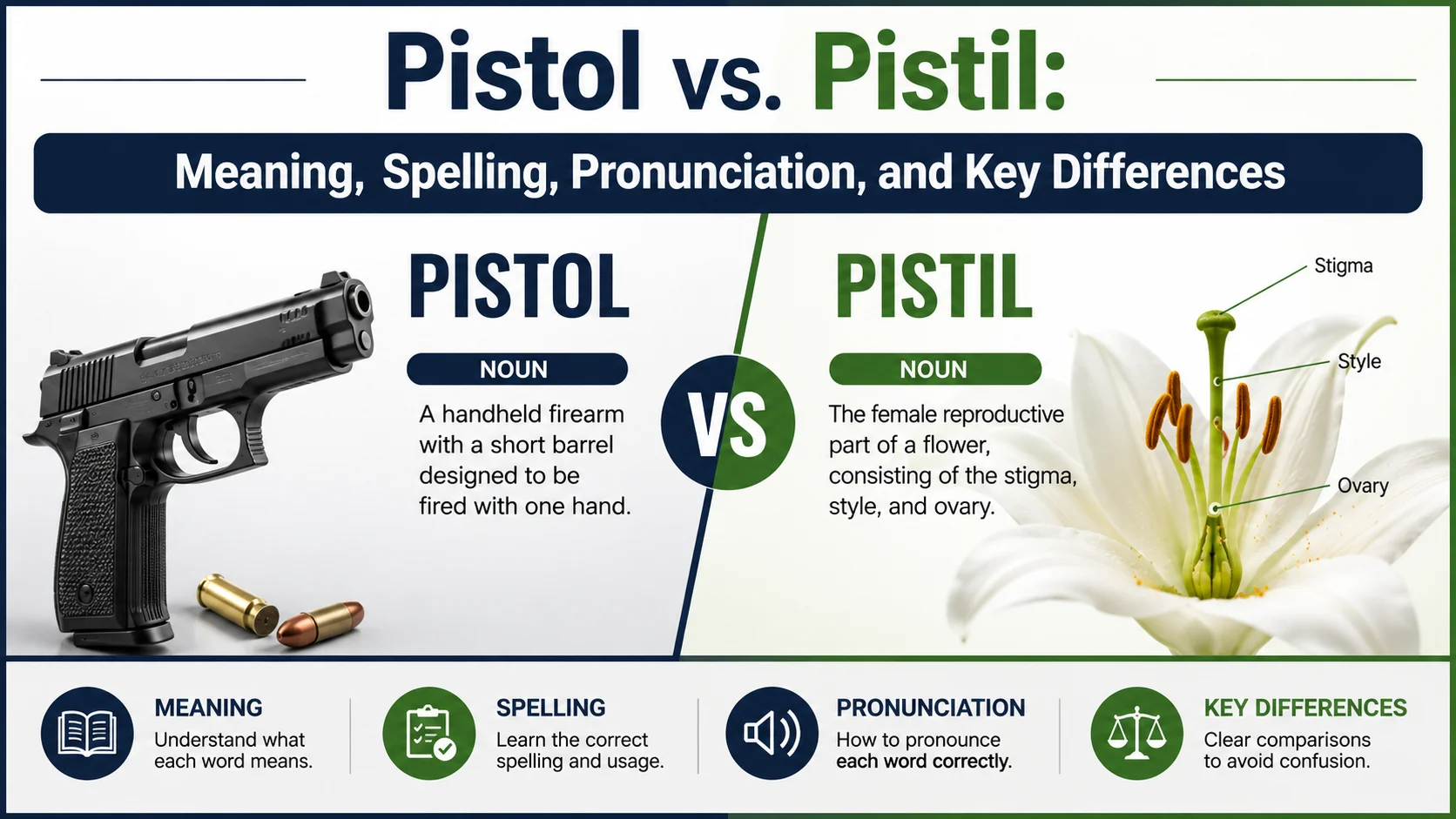
The Pistol vs. Pistil difference becomes easier when you connect each word to its meaning: pistol means a handgun, while pistil is a flower part. The words have similar spelling and similar sounds, so they can easily confuse English speakers at first glance. A pistol is a small firearm or handheld weapon associated with firearms, police officers, personal defense, and action movies.
A pistil, however, is a botanical term from botany and plant science. It is the female reproductive part of a flower, where reproduction takes place and seeds can develop. In gardening, you might notice the pistil in the center part of a rose or another flower. The four letters that differ in the middle can help you remember which spelling matches which meaning.
From my experience with confusing English words, I find it useful to focus on the vowel, sound, and context rather than trying to memorize the words alone. The words aren’t identical in meaning, even though their pronunciation can be close. Once you recognize the connection between pistol and firearm, and between pistil and flower part, the difference becomes much clearer. Their history, biology, and everyday uses come from different worlds, so learning the meaning difference makes it easier to spell, pronounce, and use each word correctly in everyday vocabulary.
Quick Answer: Pistol vs. Pistil
The simplest distinction is this:
- Pistol means a handgun.
- Pistil means the female reproductive structure of a flower.
- Pistol commonly appears in discussions about firearms, history, literature, and crime.
- Pistil appears in botany, biology, gardening, pollination, and plant reproduction.
- Both words are normally used as nouns.
- Their similar spelling causes confusion, but their meanings have no connection.
| Word | Meaning | Main Context | Example |
| Pistol | A type of handgun | Firearms and general vocabulary | The historical display included an old pistol. |
| Pistil | The female reproductive structure of a flower | Botany and biology | The pistil occupies the center of the flower. |
Easy memory trick: Pistol = handgun. Pistil = flower.
Once you connect pistil with plants, the spelling becomes much easier to remember.
What Does “Pistol” Mean?
A pistol is a type of handgun. The word usually refers to a firearm designed to be held and operated with one hand, although the broader category of handguns includes different designs.
In everyday English, pistol can appear in historical writing, fiction, journalism, museum descriptions, and discussions of firearms. The exact technical classification can vary depending on the context and terminology being used.
For a spelling article, however, the key point is simple:
Pistol refers to a handgun, not a part of a flower.
The word can also appear in established phrases and specialized expressions. For example, historical accounts may discuss pistols carried by soldiers, travelers, or law-enforcement officers. Fiction writers may use the word when describing a character or a historical setting.
Pistol in a Sentence
Here are a few natural examples:
- The museum displayed a pistol from the nineteenth century.
- The detective found a pistol at the scene.
- The historical novel describes a character carrying a pistol.
- The collection includes several antique pistols.
The surrounding vocabulary usually makes the meaning obvious. Words such as firearm, handgun, ammunition, holster, museum, soldier, and historical can strongly signal the intended sense.
Pistol: A Useful Vocabulary Note
The word pistol is often used as a general term for a handgun. However, firearm terminology can become more precise in technical writing.
For example, revolver is a specific type of handgun rather than a perfect synonym for every use of pistol. This distinction matters in detailed technical contexts, while everyday writing may use broader terms.
For a grammar or spelling article, there’s no need to overcomplicate the definition: pistol is the firearm word.
What Does “Pistil” Mean?
A pistil is a central reproductive structure of a flower. In traditional botanical terminology, it refers to the female reproductive part of a flower.
The pistil plays an important role in the plant’s reproductive process. It typically includes three major parts:
- Stigma
- Style
- Ovary
The stigma sits at the top and receives pollen. The style forms the connecting structure between the stigma and ovary. The ovary contains ovules, which can develop into seeds after successful fertilization.
So, if a biology textbook says that pollen reaches the stigma of a flower, you’re firmly in pistil territory.
Pistil in a Sentence
Consider these examples:
- The pistil stands at the center of the flower.
- Bees can transfer pollen to the pistil during pollination.
- The flower’s pistil contains the ovary.
- Students learned about the stigma, style, and ovary of the pistil.
Notice how the surrounding words point toward plants. Terms such as flower, pollen, stigma, style, ovary, seed, and pollination make pistil the obvious choice.
The Main Difference Between Pistol and Pistil
The biggest difference isn’t grammatical. It’s meaning.
A pistol is associated with a handgun. A pistil is associated with a flower.
That distinction becomes easier when you look at their fields:
- Pistol → firearms
- Pistil → botany
Think of the two words as strangers wearing nearly identical name tags. Their spellings look alike, but they belong to entirely different conversations.
| Feature | Pistol | Pistil |
| Basic meaning | A type of handgun | Female reproductive structure of a flower |
| Field | Firearms/general vocabulary | Botany/biology |
| Part of speech | Noun | Noun |
| Plural | Pistols | Pistils |
| Common associations | Handgun, firearm, history | Flower, pollen, stigma, ovary |
| Meaning category | Object | Plant structure |
| Common mistake | Writing pistil when meaning handgun | Writing pistol when discussing flowers |
Pistol vs. Pistil: Spelling Differences
The spelling difference is tiny but important.
Pistol
P-I-S-T-O-L
Pistil
P-I-S-T-I-L
The first four letters are identical:
P-I-S-T
The difference appears in the final part:
- pistOL
- pistIL
That’s where many spelling mistakes happen.
If you’re writing about a handgun, use pistol.
If you’re writing about a flower’s reproductive structure, use pistil.
A Simple Spelling Memory Trick
Associate the final vowel with the meaning:
PistOL → firearm
PistIL → flower
Another useful trick is to connect pistil with the botanical terms stigma, style, and ovary. Once you remember that pistil belongs with those plant structures, its spelling becomes easier to retrieve.
Pistol vs. Pistil: Pronunciation
The two words are close enough in pronunciation to cause confusion, especially during fast conversation.
In standard US English, pistol is commonly pronounced roughly like:
PISS-tuhl
Pistil is also commonly pronounced roughly like:
PISS-tuhl
This similarity explains an important part of the confusion: in ordinary American speech, the words can sound the same or extremely close.
That means context becomes especially important.
Merriam-Webster’s pronunciation guidance explains that English pronunciation can vary in connected speech and across speakers. (Merriam-Webster)
So don’t rely only on sound when choosing between these spellings. Look at the meaning and context.
Why Pronunciation Creates Confusion
Imagine hearing someone say:
“The pistil is in the center of the flower.”
If you’ve never encountered the botanical word before, you might mentally spell it as pistol. The sound alone doesn’t always provide enough information.
Writing solves the ambiguity.
Once you see pistil next to words such as stigma, style, and ovary, the intended meaning becomes unmistakable.
Pistol vs. Pistil: Parts of Speech
Both pistol and pistil normally function as nouns.
Pistol as a Noun
A pistol names a type of handgun.
Example:
The museum preserved an antique pistol as part of its historical collection.
Pistil as a Noun
A pistil names a reproductive structure of a flower.
Example:
The student carefully labeled the pistil during the biology experiment.
Their grammatical role is similar even though their meanings differ dramatically.
Plural Forms
The plural forms follow the normal English pattern:
- pistol → pistols
- pistil → pistils
The spelling distinction remains intact in both forms.
Pistol vs. Pistil: Origins and Etymology
The two words don’t simply represent different spellings of one old word. Their histories are separate.
The Origin of “Pistol”
Pistol entered English through a long linguistic history involving European languages. Historical explanations commonly connect the word with the Italian pistola and with the European city of Pistoia in Italy, although the exact historical development has been debated.
Over time, pistol became established in English as a term for a handgun.
Its modern meaning therefore belongs to the vocabulary of firearms and weapons.
The Origin of “Pistil”
Pistil has a completely different background.
The word comes from Latin pistillum, referring to a pestle or similar implement. Botanical terminology later applied the term to the central female reproductive structure of a flower.
That history creates an interesting linguistic contrast:
- Pistol developed through European terminology associated with firearms.
- Pistil developed from Latin terminology that eventually became part of botanical language.
The resemblance between the modern English spellings is therefore largely a matter of linguistic coincidence.
Why Do People Confuse Pistol and Pistil?
Several factors make this pair particularly tricky.
They Begin With the Same Four Letters
Both words start with:
PIST-
That shared opening gives the eye a strong visual pattern.
They Sound Very Similar
In US English, the pronunciation of pistol and pistil can be extremely similar. This makes the distinction more difficult when someone hears the word instead of seeing it.
The Difference Is Only One Vowel
Compare:
pistol
pistil
Only the vowel in the final portion changes.
That tiny difference carries the entire semantic load.
The Words Belong to Unrelated Fields
The meanings don’t naturally reinforce one another.
A reader familiar with firearms may know pistol well but rarely encounter pistil. Someone studying botany may have the opposite experience.
This is a classic spelling-confusion pattern: similar form, similar sound, unrelated meaning.
Common Mistakes With Pistol and Pistil
Even experienced writers can make a typo when the words appear outside familiar contexts.
Mistake 1: Using “Pistol” for a Flower
Incorrect:
The flower’s pistol receives pollen.
Correct:
The flower’s pistil receives pollen.
The botanical term requires pistil.
Mistake 2: Using “Pistil” for a Handgun
Incorrect:
The character carried a pistil.
Correct:
The character carried a pistol.
The firearm word is pistol.
Mistake 3: Assuming the Similarity Is More Than Coincidental
The words look related because they share most of their letters. However, they have different meanings and separate etymological histories.
Don’t let visual similarity trick you into treating them as variants.
Mistake 4: Relying Only on Pronunciation
Because the spoken forms can be very similar, listening alone may not settle the spelling.
When you’re unsure, check the context:
Flower? → pistil
Handgun? → pistol
How to Remember the Difference Between Pistol and Pistil
A good memory device should be quick enough to use while writing.
The Simplest Memory Rule
Pistol = weapon.
Pistil = flower.
That’s enough for most readers.
Use the Final Letters
Look at the endings:
- PistOL → think of the word as the firearm term.
- PistIL → connect it with the botanical word.
Connect Pistil With Plant Vocabulary
Remember this chain:
Pistil → stigma → style → ovary → flower
Once those words become a mental group, pistil stops looking like a strange spelling.
Use a Visual Association
Picture two separate scenes:
Pistol: a historical museum display containing a handgun.
Pistil: the center of a colorful flower containing the stigma, style, and ovary.
Visual memory often works better than memorizing isolated letters.
Pistol vs. Pistil in Real-World Usage
Context gives each word a very different home.
A historical article might discuss a pistol in relation to a particular period, person, or event. A biology lesson might explain how pollen interacts with the pistil during reproduction.
Compare these examples:
| Sentence | Correct Word | Reason |
| The museum displayed an antique ___ . | pistol | The sentence concerns a firearm. |
| Pollen landed on the flower’s ___ . | pistil | The sentence concerns plant reproduction. |
| The historian wrote about an early ___ . | pistol | The context involves firearms. |
| The ___ includes the stigma, style, and ovary. | pistil | These are botanical structures. |
| Bees can transfer pollen to the ___ . | pistil | Pollination involves the flower’s reproductive structures. |
| The novel describes a character holding a ___ . | pistol | The object is a handgun. |
The surrounding words act like signposts. They point you toward the correct spelling.
A Closer Look at the Pistil in Botany
The botanical meaning deserves a little extra attention because pistil isn’t simply another word for “flower center.”
In traditional botanical descriptions, the pistil consists of structures involved in the flower’s female reproductive function.
Stigma
The stigma forms the receptive surface at the top of the pistil. It plays an important role in receiving pollen.
Its surface can vary considerably among plant species. Some stigmas are sticky, hairy, lobed, or otherwise adapted to capture pollen efficiently.
Style
The style connects the stigma with the ovary.
After compatible pollen reaches the stigma, pollen tubes can grow through the style toward the ovary. This pathway helps connect the pollen with the ovules.
Ovary
The ovary contains the ovules.
Following successful fertilization, the ovules can develop into seeds. In flowering plants, the ovary itself can develop into a fruit.
That means the pistil has a direct connection to one of the most familiar processes in plant biology: the formation of seeds and fruits.
Pistil vs. Carpel: Are They Exactly the Same?
This is a useful botanical distinction for readers who want more than a basic definition.
The terms pistil and carpel are related, but botanists don’t always use them as exact synonyms.
A carpel is an individual female reproductive unit of a flower. A pistil may consist of one carpel or multiple carpels that have fused together.
For example, a flower can have:
- One carpel forming one pistil
- Several separate carpels
- Several fused carpels forming one compound pistil
This distinction explains why botanical descriptions can become more precise than the simple classroom definition of “the female part of a flower.”
For everyday writing, pistil remains the useful term to remember.
Pistol vs. Pistil: Common Related Words
Understanding nearby vocabulary can reinforce the difference.
Words Associated With Pistol
- Handgun
- Firearm
- Weapon
- Holster
- Ammunition
- Revolver
These words belong to the general vocabulary surrounding firearms. Some are broader terms while others describe specific categories or related objects.
Words Associated With Pistil
- Flower
- Stigma
- Style
- Ovary
- Ovule
- Pollen
- Pollination
- Seed
This group belongs to plant reproduction and makes pistil easier to identify.
A Practical Context Test
When you’re unsure which spelling belongs in your sentence, don’t stare at the two words. Instead, inspect the words around them.
Ask yourself:
Is the sentence talking about a flower, pollen, or plant reproduction?
If yes, choose pistil.
Is the sentence talking about a handgun or firearm?
If yes, choose pistol.
This works because the two words occupy dramatically different semantic fields.
Example
Consider this sentence:
The researcher examined the ___ under a microscope.
By itself, the blank doesn’t tell you enough.
Now add context:
The researcher examined the pistil under a microscope to study its reproductive structures.
The botanical vocabulary makes the choice clear.
Now change the context:
The museum curator examined the pistol as part of the historical collection.
The historical setting points to the firearm meaning.
Pistol vs. Pistil: Quick Reference Table
| Question | Pistol | Pistil |
| Is it related to flowers? | No | Yes |
| Is it related to plant reproduction? | No | Yes |
| Is it a handgun? | Yes | No |
| Is it a noun? | Yes | Yes |
| Does it have a botanical meaning? | No | Yes |
| Does it have a firearm meaning? | Yes | No |
| Plural form | Pistols | Pistils |
| Key memory word | Weapon | Flower |
Case Study: How One Letter Changes the Meaning
Imagine proofreading a biology worksheet.
The original sentence reads:
“The pistil receives pollen during pollination.”
A typo changes it to:
“The pistol receives pollen during pollination.”
The grammar still looks perfectly normal. The sentence is also structurally correct.
But the meaning has fallen apart.
A pistol can’t receive pollen as a flower’s reproductive structure. The writer has simply replaced a botanical word with a firearm term.
Now reverse the mistake:
“The soldier carried a pistil.”
Again, the sentence structure works. The vocabulary doesn’t.
This illustrates an important lesson about spelling: a single letter can completely change a word’s meaning even when the surrounding grammar remains correct.
Here’s a longer conclusion with 10 clear, simple FAQs.
Conclusion
Understanding Pistol vs. Pistil becomes much easier when you focus on the meaning of each word instead of their similar appearance. A pistol refers to a handheld firearm, while a pistil is an important part of a flower involved in plant reproduction. Although the two words look and sound similar, they belong to completely different areas of language. The easiest way to remember them is to connect pistol with a firearm and pistil with a flower. When you see these words in writing, the surrounding context will usually make their meaning clear. Learning this small spelling difference can help you avoid mistakes in everyday English, gardening discussions, and writing about plants or firearms.
FAQs
Q1. What does pistol mean?
A pistol is a type of handheld firearm. The word is commonly used when talking about guns or firearms.
Q2. What does pistil mean?
A pistil is the female reproductive part of a flower. It plays an important role in the plant’s reproductive process.
Q3. Are pistol and pistil the same word?
No. Pistol and pistil have different meanings and spellings, even though they can sound similar.
Q4. Is a pistil found in every flower?
Many flowers have pistils, although flower structures can vary between different plant species. The pistil is generally associated with the female reproductive structure of a flower.
Q5. Is a pistol a handgun?
Yes. A pistol is generally a type of handgun, meaning a firearm designed to be held in the hand.
Q6. Why are pistol and pistil confusing?
They can be confusing because they have very similar spellings and pronunciations. Their completely different meanings make context especially important.
Q7. How do you spell pistil?
The correct spelling is p-i-s-t-i-l. It refers to the reproductive structure of a flower.
Q8. How do you spell pistol?
The correct spelling is p-i-s-t-o-l. It refers to a type of handheld firearm.
Q9. What is an easy way to remember pistol vs. pistil?
Remember pistol = firearm and pistil = flower. Connecting each spelling to its meaning makes the difference easier to recall.
Q10. Can pistol and pistil be used interchangeably?
No. They cannot be used interchangeably because they refer to completely different things. Using one in place of the other can change the meaning of a sentence.
About the Author