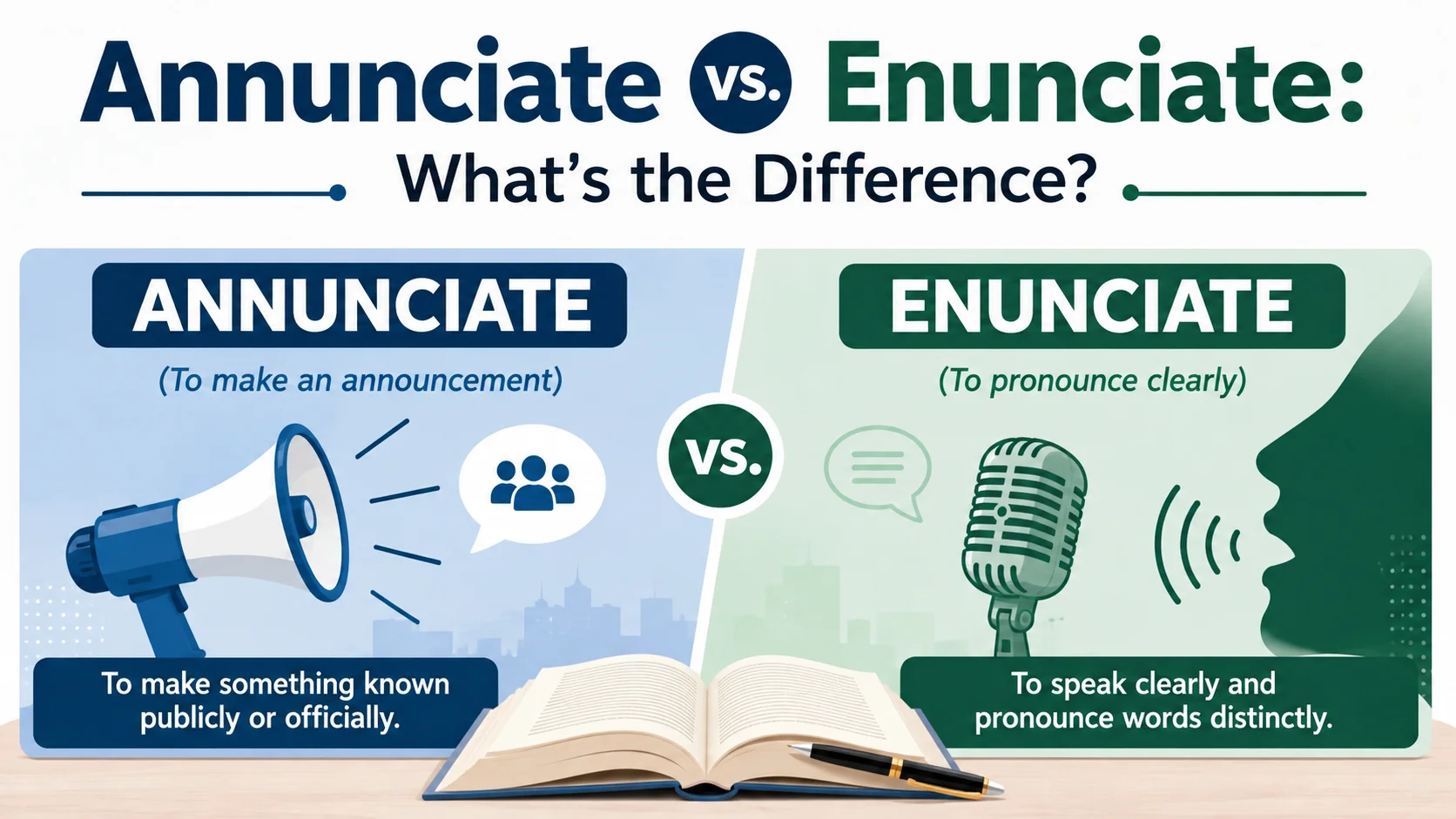
Annunciate vs. Enunciate: What’s the Difference? explains the difference between these similar-sounding words and helps people use the correct term with confidence. Many people feel confused about annunciate and enunciate because the words have a similar sound, but their meaning and usage are not the same. In standard English, enunciate is the correct term for speaking, pronunciation, and speech.
It means to pronounce clearly and distinctly so others can hear, understand, and communicate with confidence. Annunciate is connected with Annunciation, a noun that refers to an announcement or proclamation of something, especially the recognizable event where the angel Gabriel told the Virgin Mary about the birth of the son of God, Jesus Christ. This occasion is known as the Annunciation, an important celebration in the Christian faith, marked by the Feast on March 25. I always remember this by thinking of announce, and that simple link makes the distinction much easier.
In everyday conversation, professional meeting settings, formal contexts, and writing, this mix-up is common even among fluent speakers. The confusion exists because the meanings, differences, and nuances are separate, even though the terms sound alike. A detailed guide is the simplest way to learn the comparison, correctness, and proper use of each word. Enunciation is a crucial aspect and cornerstone of effective communication because it improves every spoken message with clarity, reduces poor pronunciation, prevents misunderstandings and mistakes, and helps improve skills, shape better messages, focus on speaking correctly, keep trying, break bad habits, and avoid common errors.
Quick Answer: Annunciate vs. Enunciate
The difference is simple:
| Word | Meaning | Common Usage |
| Annunciate | To announce, proclaim, or declare something. This word is now rare in modern English. | Rarely used outside historical, literary, or religious contexts. |
| Enunciate | To pronounce words clearly and distinctly. | Widely used in speech, education, broadcasting, acting, and language learning. |
Quick rule to remember:
- Use enunciate when talking about clear pronunciation.
- Use annunciate only when referring to announcing or proclaiming, usually in formal or historical contexts.
For everyday English, enunciate is almost always the correct choice.
Meaning of Annunciate
Annunciate means to announce, declare, or make something known, especially in a clear or formal way. It is closely related to announcement and often appears in religious, formal, or literary contexts. For example, “The speaker will annunciate the final decision” means the speaker will formally make the decision known.
Definition
Annunciate means to announce, proclaim, declare, or make something publicly known. It comes from the Latin annuntiare, meaning “to announce.”
Although dictionaries still recognize the word, it appears very rarely in modern writing and speech. Today, most people simply use announce instead.
Origin and Etymology
The word traces back to:
- Latin annuntiare
- Medieval Latin
- Early English religious writings
Historically, annunciate appeared in religious literature, especially when referring to divine messages or formal proclamations.
How the Word Is Used
Today, you may encounter annunciate in:
- Historical documents
- Religious writings
- Literary works
- Older English texts
Outside those settings, it has largely fallen out of everyday use.
Example Sentences
- The messenger annunciated the king’s decree.
- Ancient texts often annunciate important religious events.
- The priest annunciated the arrival of the festival.
Common Contexts
You might see the word when discussing:
- Religious announcements
- Royal proclamations
- Historical records
- Classical literature
Meaning of Enunciate
Enunciate means to pronounce words clearly and distinctly, making each sound easy for others to understand. It can also mean to express an idea or statement clearly. For example, “Please enunciate each word during the presentation” means to speak clearly so the audience can understand every word.
Definition
Enunciate means to pronounce words clearly and distinctly so listeners can easily understand you.
It focuses on speech clarity, not simply speaking louder.
Origin and Etymology
The word comes from the Latin enuntiare, meaning:
- To declare
- To state clearly
- To express
Over time, English narrowed its meaning to emphasize clear pronunciation.
How the Word Is Used
People commonly use enunciate in:
- Public speaking
- Acting
- Teaching
- Broadcasting
- Singing
- Language learning
- Speech therapy
Example Sentences
- Please enunciate every word during your presentation.
- Good teachers encourage students to enunciate clearly.
- News anchors carefully enunciate each sentence.
Common Contexts
The word frequently appears when discussing:
- Pronunciation
- Accent improvement
- Speech coaching
- Communication skills
- Presentations
- Interviews
Annunciate vs. Enunciate Comparison Table
| Feature | Annunciate | Enunciate |
| Primary Meaning | Announce or proclaim | Speak clearly |
| Modern Usage | Rare | Very common |
| Everyday English | Almost never | Frequently |
| Public Speaking | No | Yes |
| Speech Training | No | Yes |
| Religious Texts | Sometimes | Rare |
| Common Alternative | Announce | Pronounce clearly |
Key Differences Between Annunciate and Enunciate
Although annunciate and enunciate look and sound similar, they have different meanings and uses. Annunciate means to announce or declare something, while enunciate means to pronounce words clearly or express an idea clearly. For example, a speaker may annunciate an important decision but enunciate each word carefully during the announcement.
Difference in Meaning
The biggest distinction lies in purpose.
Annunciate relates to making an announcement.
Enunciate relates to speaking clearly.
Although they sound similar, their meanings point in completely different directions.
Difference in Everyday Usage
You’ll hear enunciate every day.
Teachers, actors, speech therapists, and employers regularly use it.
On the other hand, annunciate rarely appears in ordinary conversation.
Difference in Context
Use enunciate whenever pronunciation matters.
Examples include:
- Giving speeches
- Reading aloud
- Broadcasting
- Classroom presentations
- Learning English
Use annunciate only in specialized contexts involving formal declarations.
Difference in Frequency
Modern English overwhelmingly favors enunciate.
Books, newspapers, universities, and professional communication almost always use enunciate instead of annunciate.
Difference in Pronunciation
Although both words sound alike, their meanings—not their pronunciation—create the confusion.
| Word | Pronunciation |
| Annunciate | uh-NUN-see-ate |
| Enunciate | ee-NUN-see-ate |
Annunciate vs. Enunciate in Everyday English
If you’re speaking with friends, coworkers, teachers, or clients, choose enunciate.
Examples include:
- “Please enunciate your words.”
- “She enunciates beautifully.”
- “Actors must enunciate clearly.”
Using annunciate here would sound unusual to most native speakers.
Examples in Real Sentences
Seeing annunciate and enunciate in real sentences makes the difference easier to remember. You might say, “The official will annunciate the new policy tomorrow,” while “The teacher asked the student to enunciate each word clearly.” In short, annunciate focuses on making something known, whereas enunciate focuses on clear pronunciation or expression.
Sentences Using Annunciate
- The bishop annunciated the beginning of the ceremony.
- Historical documents annunciated new royal policies.
- The ancient messenger annunciated victory.
Sentences Using Enunciate
- She enunciates every word carefully.
- Please enunciate during the interview.
- Radio hosts enunciate clearly.
- Language learners should enunciate each sound.
- The professor enunciated every technical term.
Incorrect Examples and Corrections
| Incorrect | Correct |
| Please annunciate clearly. | Please enunciate clearly. |
| Actors should annunciate. | Actors should enunciate. |
| Students need to annunciate better. | Students need to enunciate better. |
Common Mistakes People Make
Many learners accidentally substitute one word for the other.
The most common mistakes include:
- Using annunciate when discussing pronunciation
- Assuming both words mean exactly the same thing
- Confusing announce with enunciate
- Believing annunciate is simply a more formal version of enunciate
A helpful tip is to ask yourself a simple question:
Are you talking about speaking clearly or making an announcement?
If it’s about speech clarity, choose enunciate.
Easy Memory Trick
Simple memory devices make confusing words much easier to remember.
Remember “E” for Enunciate
Enunciate = Every syllable.
The letter E can remind you to pronounce every sound clearly.
Remember “A” for Annunciate
Annunciate = Announcement.
Both words begin with A, making the connection easy.
Similar Word Pairs That Cause Confusion
English contains many similar-looking words.
Here are several commonly confused pairs.
| Word Pair | Difference |
| Pronounce vs. Enunciate | Pronounce means saying a word correctly. Enunciate means saying it clearly. |
| Articulate vs. Enunciate | Articulate refers to expressing ideas clearly. Enunciate focuses on pronunciation. |
| Announce vs. Annunciate | Announce is the standard modern word. Annunciate is rare. |
| Speak vs. Enunciate | Speaking is general communication. Enunciating emphasizes clarity. |
| Declare vs. Annunciate | Both involve making something public, though declare is much more common today. |
When You Should Use Each Word
Academic Writing
Choose enunciate when discussing pronunciation or communication.
Example:
Students should enunciate each syllable during language exercises.
Public Speaking
Professional speakers rely on clear pronunciation.
Good enunciation helps audiences understand every point.
Professional Communication
Customer service representatives, lawyers, doctors, teachers, and broadcasters all benefit from strong enunciation.
Clear speech builds confidence and reduces misunderstandings.
Language Learning
English learners improve much faster when they practice proper enunciation.
Speaking slowly while emphasizing vowel sounds often leads to better pronunciation.
Historical or Religious Discussions
Here, annunciate occasionally appears because older texts sometimes preserve traditional vocabulary.
Dictionary Definitions Compared
Major dictionaries agree on the modern distinction.
| Dictionary | Annunciate | Enunciate |
| Merriam-Webster | Announce or proclaim | Pronounce distinctly |
| Cambridge Dictionary | Rare usage | Speak clearly |
| Oxford English Dictionary | Declare publicly | Pronounce words clearly |
| American Heritage Dictionary | Formal declaration | Speak distinctly |
Across these respected references, enunciate consistently carries the meaning of clear speech, while annunciate remains uncommon and largely historical.
“Clear communication begins with clear pronunciation.”
This principle explains why educators emphasize enunciation rather than volume.
Historical Development of Both Words
Although annunciate and enunciate share related Latin origins, their paths in English gradually separated.
During earlier periods of English, annunciate appeared in translations of religious texts and formal proclamations. Over time, everyday writers preferred the shorter and more familiar verb announce, causing annunciate to fade from common use.
Enunciate, by contrast, developed a specialized role. As education, theater, broadcasting, and speech training became more prominent, the word increasingly referred to speaking words clearly and distinctly. Today, it remains the standard term in these contexts.
This historical shift explains why one word feels outdated while the other remains part of everyday English.
Final Verdict
Although annunciate and enunciate sound similar, they serve different purposes.
Use enunciate whenever you’re talking about clear pronunciation or speech clarity. It’s the correct choice in classrooms, workplaces, interviews, presentations, and everyday conversation.
Reserve annunciate for rare situations involving formal announcements, proclamations, or historical and religious texts. In modern English, most writers simply use announce instead.
If you’re ever unsure, remember this simple rule:
- Enunciate = Speak clearly.
- Annunciate = Announce or proclaim.
Choosing the right word makes your communication more precise, professional, and easier for others to understand.
FAQs
Q1. Is “enunciate” the same as “pronounce”?
No. Pronounce means saying a word correctly, while enunciate means speaking each word clearly and distinctly so others can understand you. You can pronounce a word correctly without enunciating it well if you mumble.
Q2. Is “annunciate” a real English word?
Yes, annunciate is a legitimate English word. However, it is rarely used in modern English and mostly appears in historical, literary, or religious contexts.
Q3. Which word should I use in everyday conversation?
For everyday conversations, enunciate is almost always the correct choice when referring to clear speech or proper pronunciation. Most native English speakers rarely use annunciate.
Q4. Why do people confuse annunciate and enunciate?
People often confuse them because they have similar spellings, similar pronunciations, and Latin origins. Despite these similarities, their meanings and modern usage are different.
Q5. Can I use “annunciate” instead of “announce”?
Although annunciate can mean to announce or proclaim, modern English almost always uses announce because it sounds more natural and is widely understood.
Q6. Is “enunciate” commonly used in public speaking?
Yes. Public speakers, teachers, actors, news anchors, and speech therapists frequently use the word enunciate because clear pronunciation improves communication and audience understanding.
Q7. How can I remember the difference between annunciate and enunciate?
A simple memory trick is:
- Enunciate = Every sound clearly
- Annunciate = Announcement
This association makes it much easier to choose the correct word.
Q8. Which word appears more often in dictionaries and modern writing?
Both words appear in major dictionaries, but enunciate is far more common in modern books, articles, education, and professional communication.
Q9. Is enunciation important for English learners?
Absolutely. Good enunciation helps learners improve their pronunciation, fluency, and confidence. Speaking clearly also makes conversations easier for listeners to understand.
Q10. What is the biggest difference between annunciate and enunciate?
The main difference is their purpose. Annunciate means to announce or proclaim, while enunciate means to pronounce words clearly. In most modern situations, enunciate is the correct word when discussing speech.
Conclusion
Understanding the difference between annunciate and enunciate can make your English more accurate and professional. Although the two words share similar roots and sound alike, they serve different purposes. Enunciate refers to speaking clearly and distinctly, making it the preferred choice in education, public speaking, broadcasting, and everyday communication. Annunciate, by contrast, is a rare word that usually relates to formal announcements or appears in historical and religious writing.
Whenever you’re unsure which word to use, remember this simple rule: enunciate is about clear pronunciation, while annunciate is about making a proclamation. Using the correct term not only strengthens your vocabulary but also helps you communicate with greater clarity, confidence, and precision in both spoken and written English.
About the Author