apposed
The English language contains many words that look simple but carry meanings that are easy to misunderstand. Apposed is one such word. Although it is not used as frequently as everyday terms such as “placed,” “added,” or “attached,” it has an important role in grammar, writing, biology, medicine, and other specialized fields. Understanding the meaning of apposed can make reading easier and can also help writers choose more precise language.
At its most basic level, apposed means placed next to, positioned beside, or brought into close contact with something else. The word comes from the verb “appose,” which means to place one thing beside another. Depending on the context, however, the exact meaning can change slightly.
This article explores the meaning of apposed, its origins, grammatical use, examples, common misunderstandings, and the different areas where the word can appear.
What Does Apposed Mean?
The word apposed is the past tense and past participle of the verb “appose.” When something is apposed to another object, it is positioned next to it or placed closely against it.
For example, someone might write:
“The two surfaces were apposed to one another.”
In this sentence, the word indicates that the surfaces were positioned closely together.
The term can describe physical objects, structures, words, phrases, or even concepts. Its central idea is the relationship between two things that are placed beside or against each other.
Because “apposed” is relatively formal, it is more common in academic, scientific, medical, and technical writing than in casual conversation.
The Origin of the Word Apposed
Understanding the origin of apposed helps explain its meaning. The word is related to the Latin expression “ad ponere,” which broadly carries the idea of placing something toward or beside something else. Over time, related forms developed in English and other languages.
The prefix “ap-” in “appose” is associated with the idea of direction toward something, while “pose” relates to placing or positioning. This connection can help learners remember that apposed involves the placement of one thing beside another.
Although the word has an established history, it remains less familiar to many modern English speakers. This is partly because simpler alternatives such as “placed beside,” “positioned next to,” and “put against” are much more common in everyday writing.
Apposed in Grammar
One of the interesting uses of apposed appears in grammar and linguistics. In this context, words or phrases can be described as being in apposition when one element is placed next to another to provide additional information about it.
For example:
“My brother, James, lives in London.”
Here, “James” gives additional information about “my brother.” The noun “James” is in apposition to “my brother.”
The term “apposed” can therefore appear in discussions about grammatical structures where two elements are positioned together and one explains, identifies, or describes the other.
This grammatical meaning is related to the general idea behind the word: two elements are placed beside one another in a meaningful relationship.
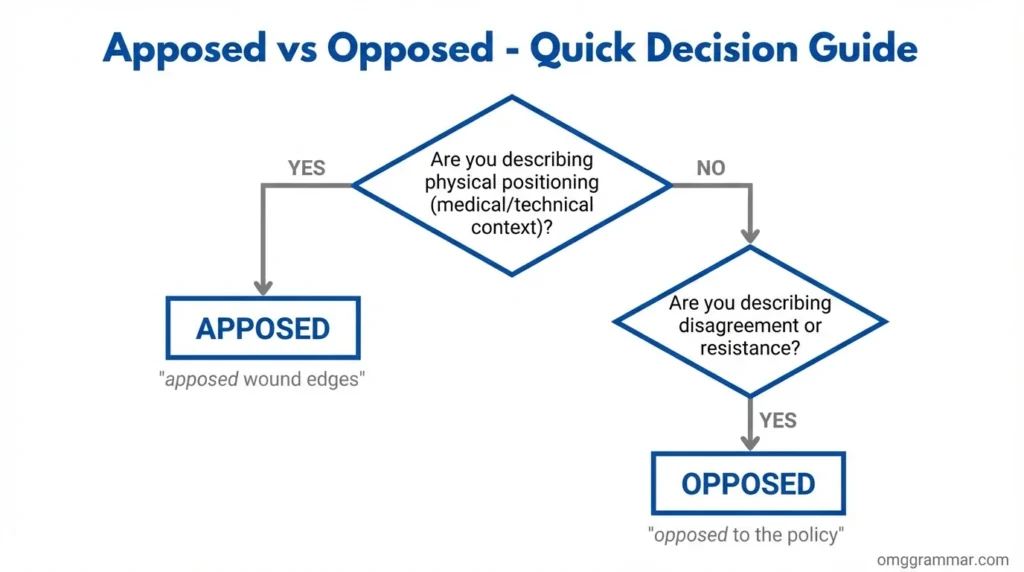
Apposed vs. Opposed
One of the most important distinctions to understand is the difference between apposed and opposed.
These words look and sound somewhat similar, but they have very different meanings.
Apposed generally means placed beside, positioned against, or brought into close contact.
Opposed means against something in terms of disagreement, resistance, conflict, or contradiction.
Consider these examples:
- “The two surfaces were apposed.”
- “The committee was opposed to the proposal.”
In the first sentence, the surfaces were positioned together. In the second, the committee disagreed with or resisted the proposal.
Confusing these two words can completely change the meaning of a sentence. Writers should therefore check the context carefully before choosing one.
Apposed in Biology and Medicine
The word apposed is particularly useful in scientific and medical writing. Researchers and healthcare professionals often need precise vocabulary to describe the relationship between anatomical structures.
For example, two tissues may be described as apposed when they are positioned closely against each other. Similarly, two surfaces can be apposed when they are brought together.
This type of terminology is valuable because “apposed” communicates a specific spatial relationship without requiring a longer phrase.
A scientific text might describe two membranes as being closely apposed. In this situation, the word does not mean that the membranes are arguing or opposing one another. Instead, it refers to their physical positioning.
The same principle can apply to cells, tissues, anatomical structures, and other biological components.
Apposed in Anatomy
Anatomy frequently uses words that describe exact positions and relationships between structures. Apposed can be helpful when describing two anatomical surfaces that are touching or positioned closely together.
For example, a medical text might discuss two surfaces that become apposed during a particular movement or biological process.
This terminology is especially useful because anatomy depends heavily on spatial relationships. Words such as “adjacent,” “parallel,” “attached,” “opposed,” and “apposed” can have distinct meanings.
When reading medical material, understanding these differences can make complex descriptions much easier to follow.
Apposed in Scientific Writing
Scientific writing generally favors precision over conversational simplicity. As a result, apposed may appear more often in research papers, textbooks, laboratory reports, and technical descriptions than in ordinary articles.
Instead of writing:
“Two surfaces were placed very close together,”
a scientific writer might write:
“The two surfaces were closely apposed.”
The second sentence is shorter and more technical. It communicates the same general idea in a way that fits specialized writing.
However, writers should avoid using technical vocabulary simply to make their writing sound more sophisticated. If the intended audience is unfamiliar with the term, “positioned closely together” may be clearer.
Good writing is not about using the most complicated word available. It is about using the word that communicates the intended meaning accurately.
Examples of Apposed in Sentences
Seeing the word in different contexts is one of the best ways to understand it.
Here are several examples:
- The two surfaces were carefully apposed before the experiment began.
- The medical procedure required the edges of the tissue to be closely apposed.
- The researchers observed that the two membranes remained apposed throughout the process.
- The grammatical elements were apposed to provide additional information about the noun.
- The two structures became apposed when the joint was moved into position.
- The surgeon ensured that the tissue edges were properly apposed.
- The leaves were closely apposed along the central stem.
In each example, the word expresses the idea of positioning one thing beside or closely against another.
Apposed and Similar Words
Several words can have meanings that overlap with apposed, but they are not always interchangeable.
Adjacent
“Adjacent” means next to or nearby. It is a common and useful word for describing things that are positioned close to one another.
For example:
“The buildings are adjacent.”
However, adjacent does not necessarily mean that the objects are touching.
Abutting
“Abutting” means directly touching or bordering something. It can be stronger than “adjacent” when physical contact is important.
Attached
“Attached” means connected or fastened to something. Two things can be apposed without being permanently attached.
Opposed
As mentioned earlier, “opposed” usually indicates conflict, resistance, or being positioned opposite something. It should not automatically be treated as a synonym for apposed.
Aligned
“Aligned” means arranged in a particular line, direction, or relationship. Two things can be aligned without being physically apposed.
Understanding these differences allows writers to select the most accurate word for their intended meaning.
Why Is Apposed Less Common in Everyday English?
There is nothing incorrect or outdated about apposed, but it belongs to a relatively specialized part of English vocabulary.
Everyday speakers usually choose simpler expressions. Instead of saying:
“The two objects were apposed,”
someone might naturally say:
“The two objects were placed next to each other.”
The second version is easier for a general audience to understand.
Specialized communities, however, often prefer apposed because it provides a concise way to describe a particular relationship. This is why the word can be encountered in scientific papers, medical texts, grammar books, and academic discussions.
How to Use Apposed Correctly
When using apposed, it is important to make the relationship between the two things clear.
A common construction is:
“A was apposed to B.”
For example:
“The tissue was apposed to the surrounding structure.”
Another construction is:
“The two structures were apposed.”
When writing for a general audience, consider whether the reader will understand the term. If not, a brief explanation can help.
For example:
“The two tissue edges were apposed, meaning they were positioned closely together.”
This approach maintains technical accuracy while making the sentence accessible.
Common Mistakes With Apposed
One common mistake is confusing apposed with opposed. The similarity in spelling makes this error understandable, but the meanings are distinct.
Another mistake is assuming that apposed always means permanently attached. It generally describes positioning or close contact rather than permanent connection.
Writers may also misuse the word when “adjacent” would be more appropriate. If two objects are merely nearby but not touching or closely positioned against each other, “adjacent” may be the better choice.
Finally, some writers use technical vocabulary unnecessarily. If a simple phrase communicates the idea more clearly, there is no reason to replace it with a specialized term.
The Importance of Context
Like many English words, apposed becomes easiest to understand when viewed in context.
In a grammar textbook, it may refer to words or phrases placed together in apposition. In medicine, it may describe tissue surfaces positioned together. In biology, it can describe structures that lie closely against one another. In general writing, it may simply mean that two things have been placed side by side.
Therefore, the surrounding sentence is often the best clue to its exact meaning.
Readers who encounter an unfamiliar word should avoid assuming its meaning based only on appearance. Looking at the words surrounding it can often reveal how the term is being used.
Is Apposed a Useful Word?
Yes, particularly for specialized writing. Apposed offers a concise way to describe objects, structures, surfaces, or linguistic elements that are positioned beside or closely against one another.
It is not a word that most people need to use every day. However, knowing its meaning can be valuable when reading academic, scientific, medical, or grammatical material.
For writers, the key is knowing when the word is appropriate. In a technical paper, apposed can provide useful precision. In a general-interest article, “placed next to” or “positioned closely together” may be easier for readers.
Final Thoughts on Apposed
The word apposed may not appear frequently in casual conversation, but it has a clear and useful meaning. It generally describes something that has been placed beside, positioned against, or brought into close contact with another thing.
Its applications range from grammar and linguistics to biology, anatomy, medicine, and scientific writing. Understanding the word also helps readers distinguish it from similar-looking terms such as “opposed,” which has a very different meaning.
The most important point to remember is simple: apposed relates to positioning things together or beside one another. Once this central idea is understood, the word becomes much easier to recognize and use.
Whether you encounter “apposed” in a medical textbook, a scientific article, a grammar lesson, or a technical report, its meaning can usually be understood by focusing on the relationship between the things being described. Learning words like this expands vocabulary while also making specialized English easier to read and understand.
About the Author