
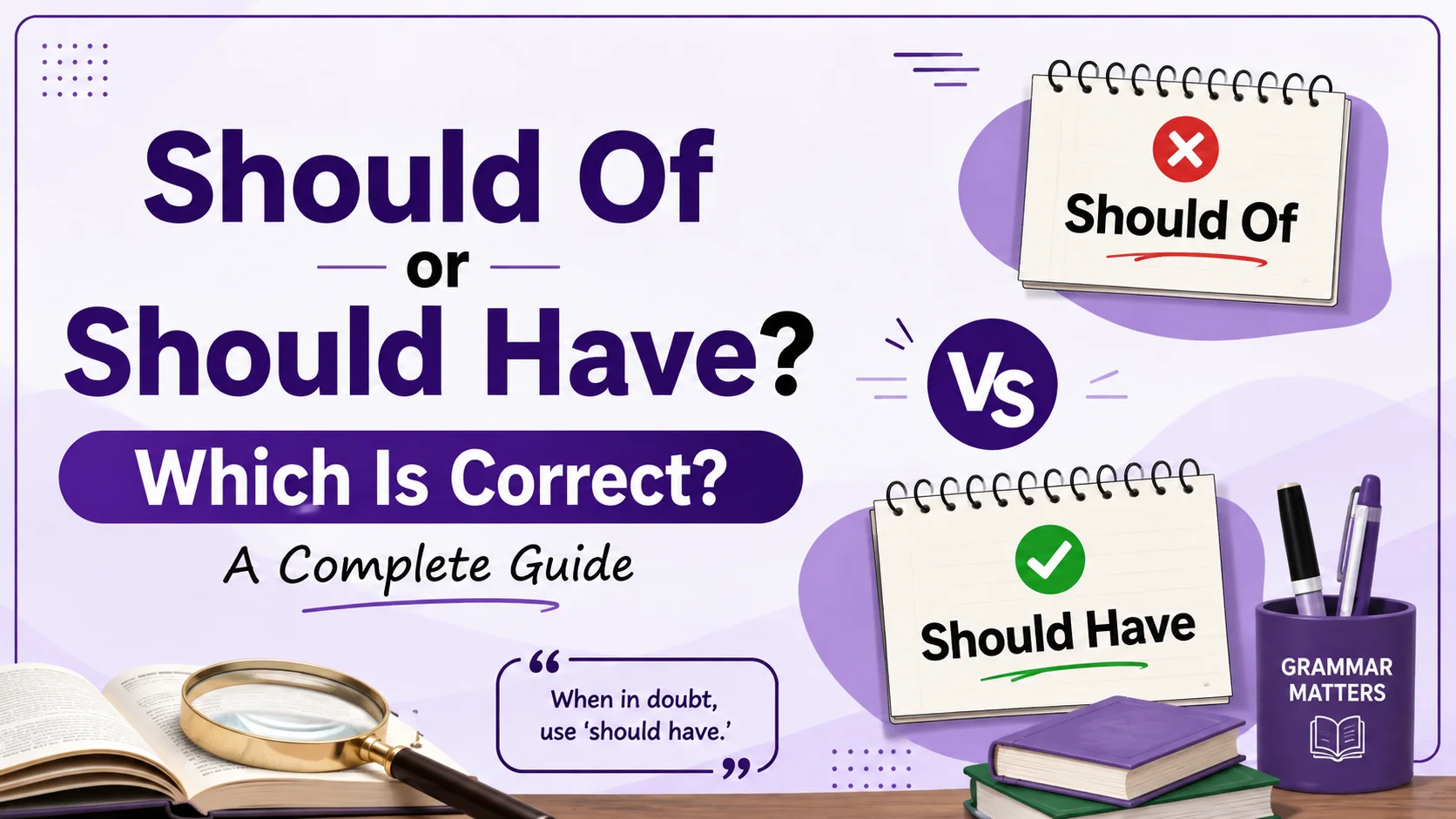
When learning English, Should of or Should Have? can seem confusing because should’ve sounds a lot like “should of” in casual conversations. The correct form is should have. We use it to talk about something that was supposed to happen but did not.
For example, “I should have gone to bed early” can express regret about staying up late. In contrast, should of is a common mistake caused by the similar sound of the contraction should’ve. When you write, choose should have or should’ve, depending on the style of your sentence.
A simple way to remember the difference is to connect should have with regret, an unrealized action, or something that would have been better to do. You might say, “I should have studied last night” or “I should have arrived earlier.” The word have follows should to create the correct grammatical structure, while “of” cannot replace it. Although the pronunciation may sound similar, the original phrase remains should have. Using the right form keeps your English clear, accurate, natural, and professional.
Quick Answer: Should Of or Should Have?
“Should have” is correct. “Should of” is incorrect in standard English.
The contraction “should’ve” is also correct because it means “should have.”
| Form | Correct? | Meaning | Example |
| should have | Yes | Full form | You should have called me. |
| should’ve | Yes | Short form of “should have” | You should’ve called me. |
| should of | No | Incorrect spelling | You should have called me. |
The easiest rule to remember is:
Should’ve always expands to “should have,” never “should of.”
So if you’re choosing between should of or should have, choose should have.
The Correct Form: “Should Have”
Should have combined the modal auxiliary verb should with have to talk about a past situation.
The basic grammatical pattern is:
Subject + should + have + past participle
For example:
- You should have listened.
- She should have called.
- They should have arrived.
- We should have waited.
- He should have known.
The phrase can express several related ideas. It may show regret, criticism, past advice, an expected action, or a better choice that wasn’t made.
“Should Have” for Past Advice
You can use should have when someone had a better course of action available in the past.
For example:
You should have checked the address before leaving.
The speaker believes checking the address would’ve been the wiser decision.
Another example is:
I should have brought an umbrella.
This sentence suggests that bringing an umbrella would’ve been a sensible choice.
“Should Have” for Regret
The phrase often expresses regret about a past decision.
Consider:
I should have studied harder for the exam.
The speaker now recognizes that more studying would’ve been beneficial.
Likewise:
We should have taken the earlier train.
The speaker regrets choosing the later option.
“Should Have” for Criticism
Should have can also criticize someone’s past action or lack of action.
For example:
You should have told me about the problem.
The sentence suggests that telling the speaker would’ve been the appropriate thing to do.
The tone depends on the situation. It can sound gentle and helpful or firm and critical.
“Should Have” for Past Expectations
Sometimes should have expressed an expectation about something that was supposed to happen.
For example:
The package should have arrived by now.
Here, the speaker isn’t necessarily criticizing anyone. The sentence simply communicates an expectation based on time or circumstances.
Why “Should Of” Is Incorrect
The main problem with should of is grammatical rather than stylistic.
In should have finished, the word has works as an auxiliary verb. It helps create a perfect construction that refers to a past action or situation.
The word can’t perform that grammatical job.
Compare these sentences:
Correct:
She should have finished the report.
Incorrect:
She should have finished the report.
Although have and of can sound similar in fast speech, they aren’t interchangeable words.
Have can function as an auxiliary verb. Of is primarily a preposition. Their similar sound doesn’t change their grammatical roles.
Why People Write “Should Of”
The confusion usually comes from spoken English.
When people speak naturally, they don’t pronounce every word with equal emphasis. Sounds blend together, syllables become weaker, and common phrases become shorter.
That’s especially noticeable with contractions.
Should have becomes:
should’ve
When spoken quickly, should’ve can sound close to should of to someone who hasn’t connected the contraction with its full form.
That creates a common chain of confusion:
should have → should’ve → “should of”
The last step is the mistake.
“Should Have” vs. “Should’ve”
Both should have and should’ve are correct.
The difference comes from style and formality rather than meaning.
Should have is the complete form:
You should have called earlier.
Should’ve is the contraction:
You should’ve called earlier.
Both sentences communicate essentially the same idea.
The apostrophe in should’ve shows that letters have been omitted. The contraction doesn’t create a different grammatical structure.
When to Use “Should Have”
The full form works particularly well in:
- Academic writing
- Professional documents
- Formal correspondence
- Reports
- Essays
- Explanatory articles
- Situations where maximum clarity matters
For example:
The committee should have reviewed the proposal before making its decision.
The full form gives the sentence a polished, formal feel.
When to Use “Should’ve”
The contraction sounds natural in:
- Everyday conversation
- Text messages
- Informal emails
- Personal writing
- Online conversations
- Dialogue
For example:
You should’ve seen the look on his face!
That sentence sounds relaxed and conversational.
Contractions aren’t grammatically wrong. They’re a normal part of modern English. The important point is to use the correct contraction.
Examples of “Should Have” in Real Sentences
Seeing the expression in different situations makes the rule easier to apply.
Positive Examples
- You should have checked your email.
- She should have arrived earlier.
- We should have booked the tickets sooner.
- He should have asked for help.
- They should have finished the work yesterday.
- I should have brought my notes.
- You should have listened to the warning.
Each sentence refers to an action connected with the past.
Negative Examples
The negative form usually appears as should not have or shouldn’t have.
Examples include:
- You shouldn’t have said that.
- She shouldn’t have ignored the warning.
- We shouldn’t have waited so long.
- He shouldn’t have taken that risk.
- They shouldn’t have left without telling anyone.
These sentences can express regret, criticism, or disapproval.
Questions With “Should Have”
You can also use should have in questions.
- Should I have called earlier?
- Should we have waited for them?
- Should he have apologized?
- Should they have told us sooner?
- Should she have taken another approach?
These questions usually ask whether a different past action would’ve been more appropriate.
Common Mistakes With “Should Have”
The should of vs. should have error often appears alongside other mistakes involving modal verbs.
Here are some of the most common examples:
| Incorrect | Correct |
| should of gone | should have gone |
| should’ve of gone | should’ve gone |
| should have gone | should have gone |
| should had gone | should have gone |
| should have went | should have gone |
Each mistake has a different cause, but the solution comes back to the same grammatical pattern.
Should + have + past participle
Mistake: “Should Of Gone”
❌ You should of gone earlier.
✅ You should have gone earlier.
The writer has confused the sound of have with the word of.
Mistake: “Should Has Gone”
❌ She should has gone home.
✅ She should have gone home.
Modal verbs such as should don’t take has in this construction.
Mistake: “Should Had Gone”
❌ They should had gone earlier.
✅ They should have gone earlier.
The auxiliary after should is have, not had.
The Pronunciation Trap Behind “Should Of”
Spoken English can be wonderfully messy.
People naturally connect words, reduce sounds, and speak quickly. That makes conversation fluid, but it can also create spelling confusion.
Consider the difference:
Full form:
You should have told me.
Contraction:
You should’ve told me.
Incorrect spelling based on sound:
You should have told me.
The third version isn’t a new variation of English grammar. It’s simply a spelling error caused by interpreting a spoken sound incorrectly.
This same problem appears with several other modal constructions.
Other Modal Constructions With the Same Problem
The should of mistake belongs to a larger group of errors.
You may also see:
- could of instead of could have
- would of instead of would have
- might of instead of might have
- must of instead of must have
For example:
❌ We could of stayed longer.
✅ We could have stayed longer.
❌ She would of helped us.
✅ She would have helped us.
❌ He might of forgotten.
✅ He might have forgotten.
❌ They must of missed the train.
✅ They must have missed the train.
The underlying problem remains the same: the writer hears a reduced form of have and writes of.
A Simple Case Study: How “Should Of” Happens
Imagine someone hears this sentence during a conversation:
You should’ve called me.
The speaker says it naturally and quickly. The listener understands the meaning but doesn’t recognize that should’ve is short for should have.
Later, the listener writes:
You should have called me.
The person hasn’t misunderstood the sentence’s meaning. Instead, they’ve misunderstood its sound-to-spelling relationship.
This example explains why the error appears so often in informal writing. People sometimes write English exactly as they think it sounds.
The solution isn’t simply to memorize what should of is wrong. It’s better to understand the source of the confusion.
Once you know that:
should’ve = should have
the spelling becomes much easier to remember.
“Should Have” in Formal and Informal Writing
The choice between should have and should’ve depends on your audience and the type of writing.
Formal Writing
In academic essays, professional documents, reports, and other formal contexts, the full form usually works best.
For example:
The research team should have examined the data more carefully.
The sentence sounds clear and professional.
Informal Writing
In casual writing, contractions often sound more natural.
For example:
You should’ve told me sooner.
That sentence fits naturally into a text message or friendly conversation.
The contraction doesn’t make the sentence grammatically incorrect. It simply creates a more conversational tone.
When you’re unsure which form to choose, should have is the safest option for formal writing.
How to Remember the Difference
You don’t need a complicated mnemonic.
Just remember this:
Should’ve = should have
That’s the entire key.
When you see or hear should’ve, mentally expand it:
should’ve → should have
Never expand it as:
should’ve → should of
Another useful trick is to look at the word that follows have.
If the sentence says:
You should have gone.
you can identify the normal grammatical pattern immediately.
A Three-Step Memory Rule
- Should have is the full correct form.
- Should’ve is the contraction of should have.
- Should of is not the standard form.
That simple distinction handles most situations.
Should Of or Should Have? Quick Reference
| Question | Correct Answer |
| Is should have correct? | Yes |
| Is should’ve correct? | Yes |
| Is should of correct? | No |
| What does should’ve mean? | Should have |
| Can of replace have after should? | No |
| What follows should have? | A past participle |
| Is should have gone correct? | No |
| Correct version of “should have gone”? | Should have gone |
| Is should have suitable for formal writing? | Yes |
| Is should’ve suitable for casual writing? | Yes |
Conclusion
The difference between should of and should have is simple once you understand where the confusion comes from. Should have is the correct grammatical form, while should of is an incorrect form caused by the way should’ve sounds in spoken English.
Use should have when you write formal or professional English, and use should’ve when a contraction fits the sentence. Remember that have always follows should in this structure. This small rule can help you avoid a common mistake and make your English clearer and more accurate.
FAQs
Q1. Is “should of” grammatically correct?
No. Should of is not grammatically correct. The correct forms are should have and its contraction should’ve.
Q2. Why do people say “should of”?
People often write should of because should’ve sounds very similar when spoken quickly.
Q3. What does “should have” mean?
Should have usually refers to something that was expected, advisable, or better to do but didn’t happen.
Q4. Is “should’ve” the same as “should have”?
Yes. Should’ve is simply the contraction of should have and has the same meaning.
Q5. How can I remember that “should have” is correct?
Remember that have is the word that follows should in this grammatical structure. “Of” cannot replace have.
About the Author