
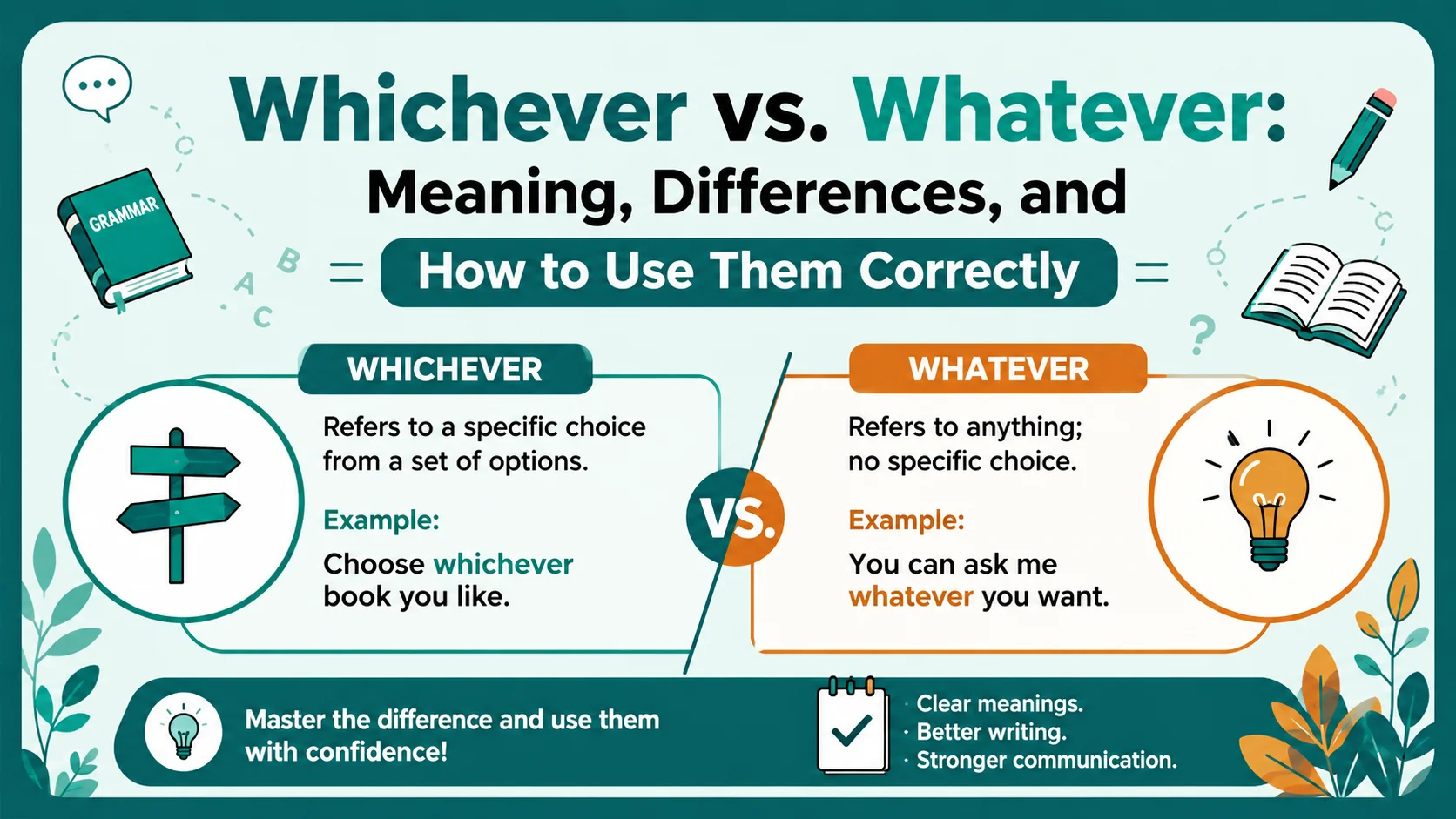
Whichever vs. Whatever becomes easier when you focus on the type of choice you’re making. Whichever works with specific, known, or limited options, while whatever works for an open, unlimited range of possibilities. For example, if you have tea, coffee, and juice, you can say, “Choose whichever you want.” If there are no fixed options, you can say, “Choose whatever you like.” This simple difference helps English learners avoid confusion and choose the right word in everyday sentences.
Both words can express choice or possibility, but their meaning changes with the situation. Whichever suggests selection from a set, while whatever can refer to anything without restriction or limits. Both can appear as pronouns or determiners, and both can introduce clauses. They also belong to the -ever family, which explains why their similar sound and appearance can cause mistakes. In my experience, remembering the idea of a clear boundary makes this grammar point much easier: whichever stays within a set, while whatever keeps the choice open.
The tone can also differ. Whatever often sounds more casual and flexible, whereas whichever can sound more precise and polite. You may use either word in writing, speaking, emails, exams, or chatting with friends, depending on the context. A useful rule is to ask whether you’re choosing from known choices or allowing a broad possibility. If the choices are clear, use whichever; if the possibilities are open, use whatever. This approach makes your English skills more confident, natural, and correct.
Whichever vs. Whatever: Quick Answer
The simplest distinction is this:
- Whichever means any one from a particular or limited group.
- Whatever means anything at all or no matter what.
| Word | Main Meaning | Typical Context | Example |
| Whichever | Any one from a particular group | Known or limited choices | Choose whichever shirt you like from these. |
| Whatever | Anything at all | Broad or unrestricted choices | Choose whatever shirt you like. |
Think of whichever as pointing toward a group of alternatives. Think of whatever as opening the door to a much wider range.
For example:
Take whichever book you want from this shelf.
The shelf creates a clear group.
Take whatever book you want.
This sentence doesn’t establish the same boundary.
The difference isn’t always absolute because context can make the two words overlap. Still, this distinction works in most everyday situations.
What Does “Whichever” Mean?
Whichever means any one or ones from a particular group of choices. It combines the idea of which with -ever.
The word normally appears when the speaker has a recognizable set of alternatives in mind. The alternatives may appear directly in the sentence or may already be clear from the situation.
Consider these examples:
- Choose whichever color you prefer.
- Take whichever seat is available.
- Use whichever route is shorter.
- Pick whichever answer you think is correct.
- Call me on whichever day works best.
In each example, the listener chooses from a relevant range of possibilities.
Whichever Usually Suggests a Defined Group
The group doesn’t have to be explicitly listed.
Suppose you’re looking at a restaurant menu with several desserts. Someone might say:
Choose whichever dessert you want.
The listener understands that the available desserts on the menu form the relevant group.
Similarly:
Take whichever bus arrives first.
The speaker doesn’t need to name every bus. The context supplies the group.
This is one reason whichever can feel more specific than whatever.
Whichever Before a Noun
Whichever can work as a determiner when it appears before a noun.
Common combinations include:
- whichever option
- whichever route
- whichever answer
- whichever day
- whichever seat
- whichever method
- whichever candidate
For example:
Choose whichever option seems most practical.
Here, whichever modifies the noun option.
Whichever Can Stand Alone
You can also use whichever without repeating the noun.
For example:
There are two seats left. Take whichever you prefer.
The word seat is understood from the previous sentence.
Another example is:
Monday or Wednesday—whichever works better for you.
Because the alternatives are already obvious, repeating the day would be unnecessary.
What Does “Whatever” Mean?
Whatever has a broader meaning. It can refer to anything, everything that fits a condition, or no matter what.
Examples include:
- Take whatever you need.
- Eat whatever you like.
- Choose whatever seems appropriate.
- Whatever happens, stay calm.
- I’ll support whatever decision you make.
Unlike whichever, whatever doesn’t need to point toward a clearly established group.
Whatever Allows a Broader Choice
Imagine someone asks:
What should I bring to the picnic?
You answer:
Bring whatever you want.
You’re giving the person broad freedom. You haven’t limited them to sandwiches, fruit, chips, or drinks.
Now imagine you’ve already placed three snacks on a table. You say:
Take whichever snack you want.
The second sentence naturally points toward that particular collection.
That’s the heart of the difference.
Whatever Before a Noun
Whatever can also appear directly before a noun.
Examples include:
- whatever food
- whatever option
- whatever method
- whatever reason
- whatever plan
- whatever amount
For example:
Use whatever method works best for you.
The sentence doesn’t necessarily restrict the person to a known list of methods.
Whatever Can Stand Alone
Like whichever, whatever can function without the following noun.
For example:
Take whatever you need.
The word refers broadly to anything the person needs.
Another example:
I’ll accept whatever you decide.
Here, whatever refers to any decision the person might make.
Whichever vs. Whatever: The Core Difference
The biggest difference between whichever vs. whatever involves the scope of the choice.
Whichever Refers to a Particular Range
Use whichever when the speaker has a particular collection or set of alternatives in mind.
For example:
Choose whichever of these four jackets fits best.
The phrase these four jackets clearly establishes the group.
The listener can choose any jacket within that group. The individual choice doesn’t matter.
Whatever Can Cover Almost Any Possibility
Use whatever when you want to leave the possibilities more open.
For example:
Wear whatever jacket you want.
This sentence doesn’t necessarily point toward four specific jackets.
The speaker cares more about giving freedom than defining the available options.
A Simple Way to Remember the Difference
Try this mental substitution:
Whichever → “which one from the choices?”
Whatever → “what thing or anything at all?”
For example:
Choose whichever color you like from these samples.
You can think of it as “which one of these colors?”
Meanwhile:
Choose whatever color you like.
You can understand it as “any color you want.”
This isn’t a rigid grammar formula. Context still matters. However, it’s an excellent shortcut for everyday writing.
Whichever vs. Whatever in Choice and Selection
Choice and selection provide the clearest examples of the difference.
Choosing From Known Options
Suppose a teacher gives students three project topics:
- Renewable energy
- Ocean pollution
- Climate change
The teacher might say:
Choose whichever topic interests you most.
The options already exist as a defined group.
You could make the restriction even clearer:
Choose whichever of these three topics interests you most.
The phrase of these three strongly favors whichever.
Choosing Without a Fixed List
Now imagine the teacher gives students complete freedom.
The instruction might be:
Choose whatever topic interests you.
The student isn’t limited to three named subjects.
That is where whatever becomes more natural.
Side-by-Side Examples
| Whichever | Whatever | Main Difference |
| Choose whichever book you want from this shelf. | Choose whatever book you want. | Specific shelf vs. broad choice |
| Take whichever key works. | Take whatever key works. | Known keys vs. any suitable key |
| Choose whichever route is shorter. | Take whatever route you prefer. | Identified routes vs. open choice |
| Pick whichever seat is available. | Sit in whatever seat you like. | Available seats vs. unrestricted choice |
| Select whichever option you prefer. | Choose whatever option seems right. | Known options vs. broad possibilities |
Whichever vs. Whatever in “No Matter” Clauses
Both words can appear in clauses that express the idea that the particular choice doesn’t matter.
This is where the distinction can become less obvious.
Using Whichever
Consider:
Whichever route you take, you’ll reach the town.
The sentence suggests that several routes exist. Regardless of which route the listener selects, the result remains the same.
Another example:
Whichever candidate wins, the company will continue its expansion.
The sentence focuses on a group of candidates.
Using Whatever
Now consider:
Whatever happens, stay calm.
This sentence doesn’t focus on a defined list of events. It covers any possible event.
You can also say:
Whatever decision you make, I’ll respect it.
The speaker doesn’t identify a fixed group of decisions.
Why Both Words Sometimes Work
English doesn’t always draw a sharp line between the two.
For example:
Whichever route you take, you’ll get there.
and:
Whatever route you take, you’ll get there.
Both can sound natural.
The first tends to suggest a known range of routes. The second can sound broader.
Therefore, don’t memorize a rule that says whichever can only refer to limited choices. Natural English depends heavily on context.
Whichever vs. Whatever: Common Mistakes
Understanding common errors can help you recognize the distinction faster.
Using Whatever for an Explicitly Limited Group
Consider:
Choose whatever of these two options you prefer.
A more natural choice is:
Choose whichever of these two options you prefer.
The phrase these two options establish a specific set.
Assuming Whichever Always Means “Anything”
Whichever doesn’t simply mean “anything.”
For example:
Take whichever of these three folders you need.
The sentence refers specifically to the three folders.
If you mean anything without a stated restriction, whatever works better:
Take whatever you need.
Assuming the Words Are Always Interchangeable
Sometimes both words work. Sometimes replacing one with the other changes the intended meaning.
Compare:
Choose whichever restaurant from this list you prefer.
with:
Choose whatever restaurant you prefer.
The first sentence clearly limits the selection to a list. The second doesn’t create the same restriction.
Forgetting the Special Tone of “Whatever”
Standalone whatever can also express dismissal.
For example:
“You should apologize.”
“Whatever.”
Here, the speaker isn’t offering a broad choice. Instead, whatever suggests indifference or unwillingness to continue the discussion.
That use is informal and can sound rude depending on the situation.
Whichever vs. Whatever in Questions
Whatever has another important use in questions.
Consider:
Whatever are you doing?
This isn’t a question asking someone to choose something.
Instead, whatever adds emphasis. It can express surprise, confusion, or disbelief.
Other examples include:
- Whatever did you mean?
- Whatever made you think that?
- Whatever is that noise?
This use is quite different from:
Choose whatever you want.
In the first group, whatever adds emotional emphasis. In the second, it expresses a broad choice.
Whichever doesn’t normally serve this same emphatic function.
The Tone of “Whatever”
Context can dramatically change the tone of whatever.
Neutral Use
Do whatever you think is best.
This sounds generous and permissive.
Dismissive Use
Whatever.
This can sound like “I don’t care” or “I’m not interested in arguing.”
Because of that, standalone whatever deserves some caution in professional communication.
A short reply such as “Whatever.” may sound much harsher in a workplace message than it would in a casual conversation between close friends.
Whichever vs. Whatever in Everyday Situations
Whichever refers to choosing from specific options, while whatever refers to anything or any option without a fixed limit.
Shopping
Choose whichever shirt you like from these five.
The five shirts form a defined group.
Buy whatever shirt you like.
The choice is broader.
Travel
Take whichever of these two trains leaves first.
Two specific trains are under consideration.
Take whatever train gets you there fastest.
The sentence focuses on the best suitable train rather than a named pair.
School
Choose whichever topic from the list interests you.
The list defines the available choices.
Choose whatever topic interests you.
The student appears to have greater freedom.
Work
Use whichever template from the shared folder fits the project.
The shared folder supplies the relevant collection.
Use whatever format works for the report.
The sentence leaves the format more open.
A Simple Decision Guide for Whichever vs. Whatever
When you’re uncertain, ask yourself a few quick questions.
Is There a Particular Group?
If you can identify a group of alternatives, whichever will often fit.
Choose whichever of these three plans you prefer.
Is the Choice Open-Ended?
If almost anything could qualify, whatever usually works better.
Choose whatever plan you think will work.
Does “Which One?” Fit?
Try replacing whichever with the idea of which one.
Whichever option you choose…
This has the sense of which option from the available alternatives.
Does “Anything” Fit?
Try replacing whatever with anything.
Take whatever you need.
This carries the sense of taking anything you need.
The substitution isn’t always grammatically possible. It’s simply a useful way to identify the underlying meaning.
Whichever vs. Whatever: Quick Reference
| If you mean… | Use |
| Any one from a known group | Whichever |
| One choice from several alternatives | Whichever |
| Anything at all | Whatever |
| A broad or unrestricted choice | Whatever |
| “It doesn’t matter which one” | Whichever |
| “It doesn’t matter what happens” | Whatever |
| An emphatic question | Whatever |
| Informal dismissal | Whatever |
Conclusion
Understanding Whichever vs. Whatever becomes simple when you focus on whether the choice has clear limits. Use whichever when selecting from a specific or limited set of options, and use whatever when the choice is open or unlimited. Remembering this small difference can help you write and speak English more naturally, clearly, and confidently.
FAQs
Q1. What is the main difference between whichever and whatever?
Whichever refers to one choice from a known or limited set, while whatever refers to anything without a fixed limit.
Q2. Can whichever and whatever be used interchangeably?
Not always. They can overlap in some casual situations, but whichever emphasizes a specific set of choices, while whatever suggests a more open choice.
Q3. What does whichever mean?
Whichever means “any one from a particular group or set.” For example: “Choose whichever book you prefer.”
Q4. What does whatever mean?
Whatever means “anything or no matter what.” For example: “You can choose whatever you like.”
Q5. How can I remember the difference between whichever and whatever?
Use whichever for limited options and whatever for unlimited options. Think: whichever = which one from the set, while whatever = anything at all.
About the Author