
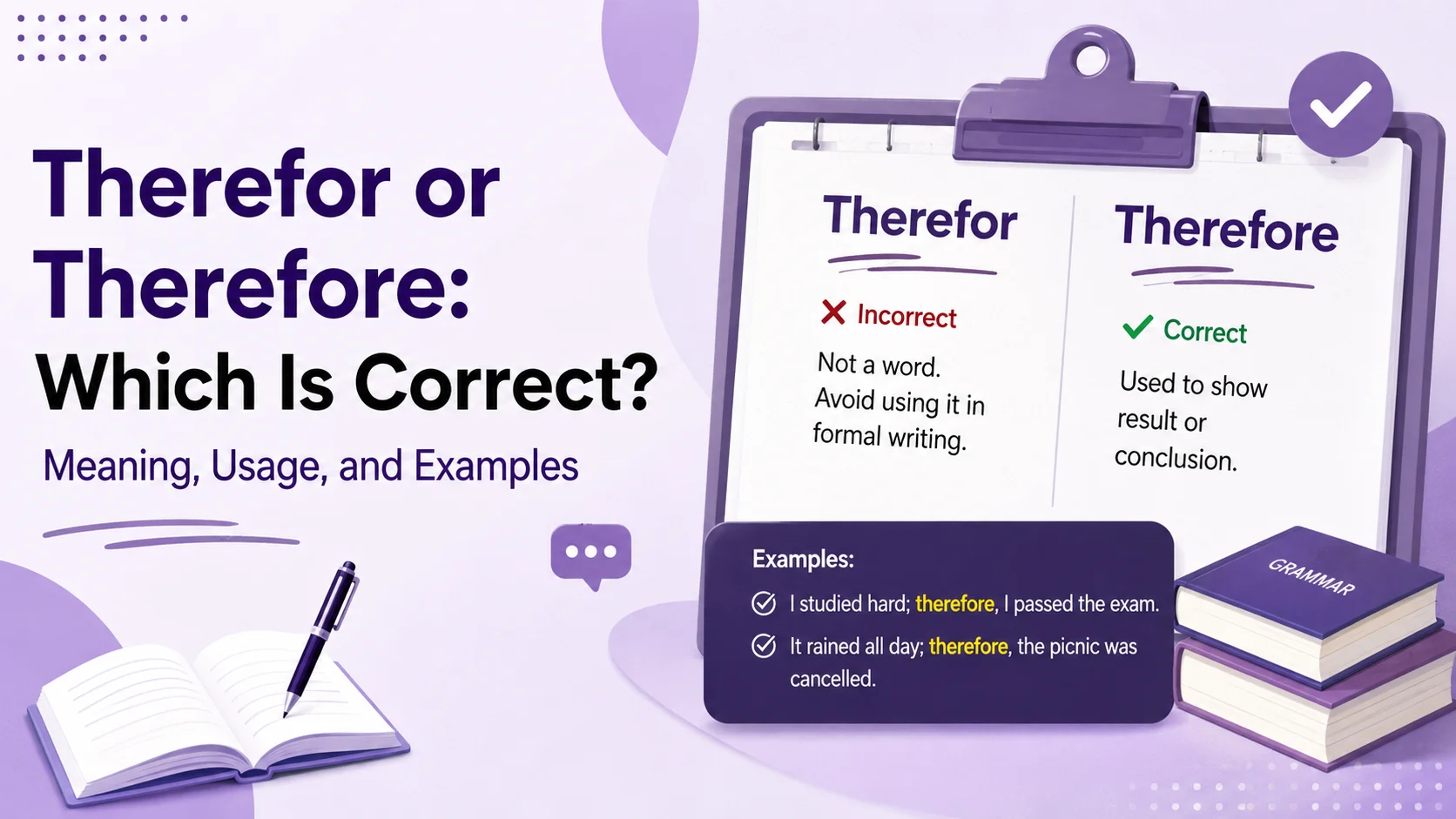
Therefor or Therefore can seem confusing because these words have a similar appearance, but their meanings are different and they aren’t alternate spellings. Therefor is an older word that means “for that” or “for it.” It appears mainly in legal, contractual, and highly formal writing, such as formal documents. For example, “He paid the fee therefor” means he paid the fee for that service or item.
Therefore is the more common English word and is used to show a reason, result, conclusion, consequence, or logical conclusion. You’ll often see it in everyday, academic, business, and professional writing. For example, “It was raining; therefore, we stayed inside.” Here, the rain gives the reason, while staying inside is the result. Generally, readers expect therefore when a sentence explains what happened as a result of something else.
The history of these words also explains why they can cause confusion. Their close spelling and sound make them easy to mix up, especially when you’re learning the English language. Still, understanding their meaning makes the choice easier. In my experience with grammar rules, complex sentences, and vocabulary lists, remembering that therefor means “for that” while therefore introduces a result helps prevent common mistakes and strengthens your language skills. These small nuances matter in clear writing, including SocialSciences and other formal contexts.
Quick Answer: Therefor or Therefore?
Use therefore when you mean “as a result” or “for that reason.”
Use therefor when you mean “for that” or “for it.”
| Word | Meaning | Common Use | Example |
| Therefore | For that reason; as a result | General and formal English | It was raining; therefore, we stayed home. |
| Therefor | For that; for it | Legal and formal writing | The buyer received payment therefor. |
Here’s the easiest test:
Therefore = as a result
Therefor = for that
If you’re talking about a conclusion or consequence, choose therefore. If you’re referring to something that was provided or done for a previously mentioned thing, therefor may be correct.
What Does “Therefore” Mean?
Therefore is an adverb that shows a result, conclusion, or logical consequence. It can often be replaced with phrases such as “as a result,” “consequently,” or “for that reason.”
For example:
The roads were covered with ice; therefore, the school closed.
The school closed as a result of the icy roads.
The word creates a clear connection between two ideas:
Cause → Therefore → Result
That makes therefore especially useful when you’re explaining reasoning or drawing a conclusion.
According to Cambridge Dictionary, therefore means “for that reason” and is used to introduce a result or conclusion.
Examples of “Therefore” in Sentences
- The store was closed; therefore, we went somewhere else.
- She practiced every day and therefore improved quickly.
- The evidence was incomplete. Therefore, the investigation continued.
- The weather became dangerous; therefore, the hikers returned to camp.
- He missed the deadline and therefore couldn’t submit the application.
Notice the pattern. In every example, therefore connects an earlier fact with its result.
What Does “Therefor” Mean?
Therefor is a legitimate word rather than a misspelling of therefore. It means “for that,” “for it,” or “in return for that.”
Merriam-Webster defines therefor as meaning “for or in return for that.” The word has existed in English for centuries, although modern readers encounter it far less frequently than therefore.
Consider this sentence:
The contractor completed the repairs and received payment therefor.
Here, therefor doesn’t mean “as a result.” It means “for the repairs.”
In plain English, the sentence could become:
The contractor completed the repairs and received payment for them.
That version sounds more natural in everyday writing.
Examples of “Therefor” in Sentences
- The supplier delivered the equipment and received payment therefor.
- The contractor completed the work and received compensation therefor.
- The buyer accepted the goods and paid the amount due therefor.
- The company provided the requested services and received payment therefor.
These examples have something important in common. Therefor points back to something already mentioned.
Therefor vs. Therefore: The Key Difference
The most reliable way to distinguish therefor or therefore is to ignore the spelling for a moment and examine the meaning.
| Meaning you’re trying to express | Correct word |
| For that reason | Therefore |
| As a result | Therefore |
| Consequently | Therefore |
| For that | Therefor |
| For it | Therefor |
| In return for that | Therefor |
Compare these sentences:
The road was flooded; therefore, traffic stopped.
Here, therefore means “as a result.”
Now look at:
The company supplied the materials and received payment therefor.
Here, therefor means “for those materials.”
The difference is small on the page but significant in meaning.
A Simple Substitution Test
Try replacing the word with “as a result.”
The weather was severe; therefore, the flight was canceled.
Becomes:
The weather was severe; as a result, the flight was canceled.
The meaning remains intact. That tells you therefore is correct.
For therefor, try “for it.”
The supplier received payment therefor.
The intended meaning is:
The supplier received payment for it.
This simple test can prevent most mistakes.
How to Use “Therefore” Correctly
Therefore can appear in several positions within a sentence. Its placement depends on the sentence structure and the emphasis you want.
“Therefore” at the Beginning
You can begin a sentence with therefore when the sentence presents a conclusion.
The company failed to meet the deadline. Therefore, the project was delayed.
The comma after therefore is common in this position.
“Therefore” After a Semicolon
A particularly useful construction is:
The roads were dangerous; therefore, the drivers slowed down.
The semicolon separates two independent clauses while therefore connecting their ideas.
A useful pattern to remember is:
Independent clause; therefore, independent clause.
“Therefore” in the Middle
Therefore can also appear within a sentence.
The company was therefore unable to complete the order.
Or:
The proposal was, therefore, rejected.
The exact punctuation depends on how therefore functions within the sentence.
How to Use “Therefor” Correctly
Because therefor is uncommon, it requires more attention to context.
The word normally refers to something previously mentioned.
For example:
The employee provided the requested services and received compensation therefor.
Here, therefor refers to the services.
In ordinary writing, a clearer version would be:
The employee provided the requested services and received compensation for them.
Both versions communicate the same basic relationship, but the second one feels more natural to most modern readers.
Common Formal Uses of “Therefor”
You may encounter therefor in phrases such as:
- payment therefor
- compensation therefor
- consideration therefor
- fees therefor
- services therefor
These expressions are especially common in legal and contractual documents.
Therefor or Therefore in Legal Writing
Legal documents often contain therefor because it provides a compact way to refer back to something already identified.
For example:
The contractor shall perform the services described in this agreement and shall receive compensation therefor.
A plain-English version would be:
The contractor shall perform the services described in this agreement and shall receive compensation for those services.
The traditional version is shorter, but it can be harder for a general reader to understand.
| Formal wording | Plain-English wording |
| Payment therefor | Payment for it |
| Compensation therefor | Compensation for it |
| Fees therefor | Fees for it |
| Consideration therefor | Consideration for that |
| Services therefor | Services for that |
The important point is that therefor isn’t simply a more formal version of therefore. They perform different grammatical functions.
Common Mistakes With Therefor and Therefore
Common Mistakes With Therefor and Therefore: Learn how confusing these similar-looking words can lead to incorrect usage and discover how to use each one correctly.
Using “Therefor” to Mean “As a Result”
This is the most common error.
❌ The weather was terrible; therefor, the game was canceled.
Correct:
✅ The weather was terrible; therefore, the game was canceled.
The cancellation happened as a result, so therefore is required.
Treating “Therefor” as a Short Form of “Therefore”
Some writers assume therefor is simply therefore without its final e. It isn’t.
Therefor has its own definition and history.
Using it as a shortened version of therefore changes the intended meaning.
Assuming “Therefor” Is Incorrect
This is the opposite mistake.
Because therefor looks unusual, some people assume it must be a spelling error. However, major dictionaries recognize it as a valid word.
The issue isn’t whether therefor exists. It does.
The issue is whether its meaning fits your sentence.
Therefore Synonyms and Alternatives
When you need to express a result, several alternatives may work.
| Alternative | General meaning |
| As a result | Because of that |
| Consequently | As a consequence |
| Thus | In this way or as a result |
| Hence | For this reason |
| Accordingly | In response to that situation |
| For that reason | Because of that |
For everyday writing, as a result, it can sometimes sound more conversational than therefore.
For formal or analytical writing, therefore, thus, and consequently can work well.
How to Remember Therefor or Therefore
A short memory trick can make the distinction stick.
Remember “Therefore” as a Result Word
Think:
Therefore = for that reason.
The evidence was weak; therefore, the claim wasn’t accepted.
Ask yourself:
“Does this word introduce a result?”
If yes, use therefore.
Remember “Therefor” as “For That”
Think:
Therefor = for that.
The company received payment therefor.
Ask:
“Does this mean for that thing or for it?”
If yes, therefor may be the right choice.
Therefor or Therefore: Which One Should You Use?
The answer depends entirely on your intended meaning.
Use “Therefore” When:
- You mean as a result.
- You mean for that reason.
- You’re introducing a conclusion.
- You’re explaining cause and effect.
- You’re connecting two logical ideas.
Example:
The evidence was insufficient; therefore, the researchers conducted another test.
Use “Therefor” When:
- You mean that.
- You mean it.
- You mean in return for that.
- You’re referring to something already mentioned.
- You’re writing in a formal or legal context where the construction fits.
Example:
The contractor completed the work and received payment therefor.
For most everyday writing, therefore will be the word you need.
Conclusion
Choosing between therefor and therefore becomes easier when you remember their different roles. Therefor means “for that” or “for it” and mainly appears in legal or highly formal writing. Therefore is much more common and shows a result, consequence, or logical conclusion. Keeping this simple distinction in mind can help you avoid spelling and grammar mistakes.
FAQs
Q1. What is the difference between therefor and therefore?
Therefor means “for that” or “for it,” while therefore means “as a result,” “consequently,” or “for that reason.”
Q2. Is therefor a correct English word?
Yes. Therefor is a correct but uncommon English word. It mostly appears in legal, contractual, and other formal writing.
Q3. When should I use therefore?
Use therefore when you want to introduce a result, conclusion, or consequence. For example: “The road was closed; therefore, we took another route.”
Q4. Can therefor and therefore be used interchangeably?
No. They have different meanings and perform different jobs in a sentence, so you shouldn’t use them interchangeably.
Q5. How can I remember the difference between therefor and therefore?
Remember therefor = for that and therefore = as a result. This simple rule makes the difference easier to recall when writing.
About the Author