When you learn What Is Assonance, the easiest way to understand it is through sound rather than spelling. Assonance is a literary device based on the repetition of vowel sounds in nearby words. A poet, writer, or songwriter can repeat a particular sound to create rhythm, music, and a more memorable effect. The words don’t need to have the same letters, and their consonants don’t have to match. For example, repeating a long “o” sound can produce a slow, flowing quality that makes a sentence feel smoother and more musical.
You can find assonance in poetry, prose, songs, lyrics, advertisements, and even daily conversations. A songwriter may use repeated vowel sounds to make a line easier to remember, while lyricists and poets may use the technique to build an unforgettable melody. When I read examples aloud, the rhythmic pulse, beat, and melody become much easier to notice because the effect depends on what you hear. This repeated sound can create a mood, add flavor to phrases, and make language pleasing to hear. It can also help a writer emphasize particular ideas or themes without making the pattern feel forced.
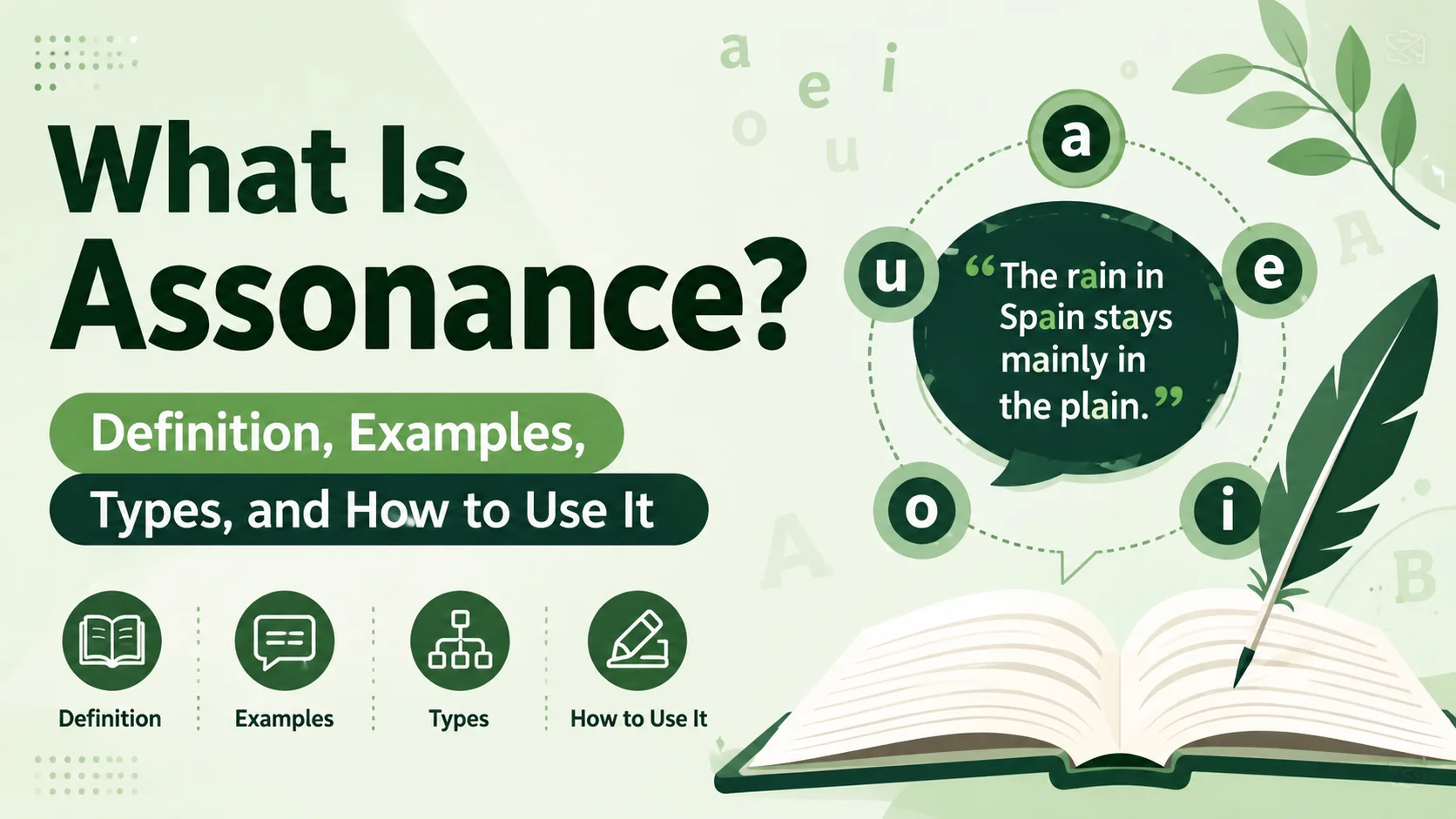
A simple example is “the rain in Spain falls mainly in the plain,” where the “ai” sound repeats across several words. This shows why assonance isn’t simply rhyming at the end of lines. It can appear anywhere in a phrase or sentence, as long as noticeable vowel sounds occur close together. Understanding this difference makes the technique easier to identify and use in your own writing. In English, this tool can create a subtle tapestry of sound that sticks in the mind, giving ordinary language a stronger sense of rhythm and expression.
Quick Answer: What Is Assonance?
Assonance is the repetition of similar vowel sounds in nearby words.
The repeated vowel sound can appear at the beginning, middle, or end of a word. Unlike alliteration, assonance doesn’t require the repeated sound to appear at the beginning. Unlike rhyme, it doesn’t require words to have matching endings.
For example:
“The cool moon moved through the room.”
The long oo sound repeats in cool, moon, moved, and room. The surrounding consonants differ, yet the recurring vowel sound creates a clear pattern.
Here’s the basic idea:
Assonance = repetition of vowel sounds.
| Feature | Assonance |
| What repeats? | Vowel sounds |
| Must the spelling match? | No |
| Must the sound appear at the beginning? | No |
| Common in | Poetry, prose, speeches, songs, advertising |
| Main effects | Rhythm, emphasis, mood, musicality |
| Closely related devices | Alliteration, consonance, rhyme |
The easiest way to recognize assonance is to listen to the words instead of simply looking at them.
What Does Assonance Mean in Simple Terms?
Imagine hearing an echo.
You say one word and then another. Although the words have different meanings, a particular vowel sound keeps returning. That repeated sound creates a subtle connection between them.
Consider this sentence:
“The bright kite climbed high.”
The long i sound appears in bright, kite, climbed, and high.
The words don’t rhyme perfectly. Their consonants don’t match. However, the recurring vowel sound gives the sentence a noticeable sonic pattern.
That’s assonance.
Assonance Is About Sounds, Not Letters
This is one of the most important points to remember.
English spelling doesn’t always provide a reliable guide to pronunciation. The same letter can represent different sounds. Different combinations of letters can also represent similar sounds.
For that reason, you shouldn’t identify assonance simply by circling every repeated vowel letter.
Instead, read the passage aloud.
If several nearby words share a noticeable vowel sound, you’re much more likely to have found genuine assonance.
How Does Assonance Work?
Assonance works by repeating a vowel sound across words that appear close together.
A writer chooses words that contain a particular sound. As readers move through the sentence or poem, that sound returns. The repetition creates a kind of acoustic thread.
For example:
“The slow boat floated home.”
The long o sound appears repeatedly. The repetition gives the sentence a smooth and measured quality.
Assonance can be obvious or extremely subtle. Sometimes the reader immediately notices the pattern. In other cases, the sound repetition works quietly in the background.
The Basic Pattern of Assonance
The process can be understood like this:
Repeated vowel sound → sound connection → rhythm or emphasis → stylistic effect
The effect depends on context.
A writer might use assonance to make a phrase more memorable. A poet might use it to support a particular mood. A speechwriter could use it to make a phrase sound more polished.
However, no vowel sound carries one universal emotional meaning. Context always matters.
Assonance Examples in Sentences
Examples make the concept much clearer.
Example 1: Long “O”
“The lonely road rolled home.”
The long o sound appears repeatedly.
The repetition creates a slow, flowing rhythm that fits the image of traveling along a road.
Example 2: Long “I”
“The bright kite climbed high.”
The long i sound appears in several important words.
The repeated sound gives the sentence energy and reinforces the upward movement.
Example 3: Short “A”
“The black cat sat back.”
The short sound appears repeatedly.
The result is a compact and rhythmic sentence that feels almost playful.
Example 4: Long “E”
“Three green trees leaned in the breeze.”
The long e sound appears throughout the sentence.
The repeated sound creates a smooth, flowing quality.
More Assonance Examples
| Example | Repeated sound | Effect |
| “The slow road rolled home.” | Long o | Creates a relaxed rhythm |
| “The bright kite climbed high.” | Long i | Adds energy |
| “The black cat sat back.” | Short a | Creates a punchy rhythm |
| “Three green trees leaned in the breeze.” | Long e | Creates musical flow |
| “The cool moon moved through the room.” | Long oo | Produces a smooth sound |
These examples show why spelling alone can’t identify assonance. The spoken vowel sound is what matters.
Assonance in Poetry
Poetry provides one of the clearest examples of how assonance works.
Poets carefully consider sound because poetry is designed to be experienced through both meaning and language. Repeated vowel sounds can connect words across a line or even throughout an entire poem.
Consider this original example:
“The pale rain stayed late over the gray plain.”
The long sound appears in pale, rain, stayed, late, gray, and plain.
The words aren’t identical. Their endings differ. Still, the repeated vowel sound creates cohesion.
Why Do Poets Use Assonance?
Poets may use assonance to:
- Create rhythm
- Add musicality
- Emphasize important words
- Connect separate lines
- Reinforce a mood
- Make phrases memorable
- Create sound patterns without relying on exact rhyme
Assonance can also work alongside other poetic techniques. A single line may contain assonance, alliteration, consonance, rhyme, imagery, and meter at the same time.
That combination can give poetry its distinctive texture.
Assonance in Literature and Prose
Assonance isn’t limited to poetry.
Novelists, essayists, speechwriters, and other writers can use repeated vowel sounds in prose. Sometimes the pattern is deliberate. At other times, it occurs naturally because certain words happen to share sounds.
Consider:
“The weary traveler gazed at the fading daylight.”
Several vowel sounds recur throughout the sentence. The overall sound contributes to the sentence’s flow even if the reader doesn’t consciously identify a literary device.
This distinction matters because not every repeated vowel sound represents deliberate assonance.
English naturally contains recurring sounds. Strong literary analysis should consider whether the repetition is noticeable and whether it contributes to rhythm, emphasis, tone, or meaning.
Assonance vs. Alliteration vs. Consonance
Assonance often gets confused with other sound-based literary devices.
The differences become simple once you know what each technique repeats.
| Device | What it repeats | Example |
| Assonance | Vowel sounds | “The cool moon” |
| Alliteration | Usually initial consonant sounds | “Wild winds” |
| Consonance | Consonant sounds | “black / book” |
What Is Alliteration?
Alliteration involves the repetition of initial consonant sounds in nearby words.
For example:
“Silent seas shimmer.”
The repeated s sound occurs at the beginning of the words.
The key difference is simple:
Assonance focuses on vowels. Alliteration usually focuses on repeated beginning consonant sounds.
What Is Consonance?
Consonance involves repeated consonant sounds anywhere within nearby words.
For example:
“The black rock cracked.”
The repeated k sound appears in multiple words.
Unlike alliteration, consonance doesn’t have to occur at the beginning.
Assonance vs. Rhyme
Assonance and rhyme can sound similar, but they aren’t the same thing.
Rhyme generally involves a fuller correspondence of sounds, often near the ends of words. Assonance only requires repetition of vowel sounds.
Compare:
light — night
These words rhyme because their ending sounds match closely.
Now consider:
bright — high
Both contain the long i sound. However, their endings don’t completely match.
That makes them a useful example of vowel repetition without full rhyme.
Why This Difference Matters
A writer can use assonance when exact rhyme would sound too predictable or restrictive.
It gives language a sonic relationship without forcing every word into a matching ending.
Types and Patterns of Assonance
Assonance doesn’t have one universally accepted list of formal categories. Instead, it’s more useful to describe the different positions and patterns in which repeated vowel sounds can appear.
Initial-Vowel Repetition
A repeated vowel sound can occur near the beginning of several words.
For example:
“Every eager eagle entered early.”
The repeated vowel sounds create a noticeable pattern.
Internal Vowel Repetition
Vowel sounds can repeat within words.
For example:
“The silver river shimmered.”
The recurring vowel sounds contribute to the sentence’s overall sound pattern.
End-Position Vowel Repetition
Assonance can also occur toward the ends of words.
For example:
“The rain came late and stayed.”
The repeated long a sound links several words.
This type can sometimes overlap with rhyme, so context and the surrounding consonants matter.
Extended Assonance
A writer may repeat the same vowel sound across several words, sentences, or poetic lines.
Extended assonance can create unity throughout a passage. Readers may not consciously identify the pattern, yet the repeated sound can make the writing feel connected.
Why Do Writers Use Assonance?
Assonance has several practical uses.
To Create Rhythm
Repeated vowel sounds can make sentences easier to say and give them a stronger rhythm.
“The slow boat floated home.”
The recurring long o sound supports the sentence’s relaxed pace.
To Establish Mood
Sound can contribute to the atmosphere.
A passage with smooth recurring vowel sounds may feel gentle or reflective. A passage with strong stressed sounds and abrupt consonants may feel more forceful.
Still, sound doesn’t work alone. Vocabulary, context, sentence rhythm, imagery, and subject matter all influence mood.
To Emphasize Ideas
Repeating a sound around important words can give those words additional prominence.
This technique can be particularly useful in poetry and speeches.
To Make Writing Memorable
Patterns are easier for the ear to recognize than completely random sound sequences.
That makes assonance useful in short, memorable phrases.
To Add Musical Quality
Assonance can make ordinary language more pleasing to hear.
When vowel sounds move naturally through a sentence, the writing may feel polished without sounding artificial.
How to Identify Assonance
Finding assonance becomes easier when you use a systematic approach.
Read the Passage Aloud
Start by speaking the sentence or poem.
Because assonance depends on sound, reading silently can hide patterns.
Listen for Recurring Vowel Sounds
Pay attention to vowel sounds that appear more than once.
Don’t worry about spelling yet.
Ignore the Written Vowels
Two words can use different letters while sharing a vowel sound.
This is why pronunciation matters more than visual similarity.
Look at Nearby Words
Assonance usually involves sounds that occur close enough together to create a recognizable pattern.
A repeated sound scattered randomly across several pages doesn’t have the same immediate effect.
Consider the Purpose
Finally, ask what the sound repetition accomplishes.
Does it strengthen rhythm? Does it emphasize an idea? Does it create musicality?
If the answer is yes, you’ve identified a meaningful use of assonance.
Common Mistakes About Assonance
Common mistakes about assonance often involve confusing repeated vowel sounds with rhyme, alliteration, or simple vowel repetition.
Mistake: Thinking Assonance Repeats Letters
It doesn’t.
Assonance repeats vowel sounds, not necessarily written vowels.
Mistake: Confusing It With Alliteration
Alliteration generally repeats initial consonant sounds. Assonance repeats vowel sounds.
Mistake: Calling Every Repeated Vowel Assonance
English naturally repeats sounds.
A strong example usually contains a noticeable pattern that contributes to the language’s sound or effect.
Mistake: Looking Only at Spelling
This is perhaps the most common mistake.
Always consider pronunciation.
Mistake: Assuming Assonance Has One Emotional Effect
A repeated vowel doesn’t automatically make writing happy, sad, calm, or tense.
The complete context determines the effect.
Does Spelling Matter in Assonance?
No, spelling doesn’t have to match.
For example, words can have different written forms while sharing a vowel sound.
This happens frequently in English because spelling and pronunciation don’t always correspond neatly.
That creates an important rule:
If you’re analyzing assonance, listen to the words instead of simply comparing their letters.
Reading aloud is therefore one of the most reliable ways to identify the technique.
Assonance and Tone
Sound repetition can influence tone, although its effect depends heavily on context.
| Tone or effect | How assonance may contribute |
| Calm | Smooth, sustained vowel patterns |
| Energetic | Strong repeated sounds |
| Playful | Noticeable rhythmic repetition |
| Reflective | Gentle recurring sounds |
| Tense | Repetition combined with sharper rhythm |
| Musical | Recurring vowels woven through the line |
The word may matters here.
Assonance doesn’t work like a fixed emotional code. Writers create tone by combining sound with meaning, rhythm, imagery, punctuation, and word choice.
Assonance in Different Forms of Writing
Assonance in Different Forms of Writing shows how repeated vowel sounds can add rhythm, emotion, emphasis, and musical quality to poetry, prose, speeches, and other types of writing.
Poetry
Poetry frequently uses assonance to create rhythm, musicality, and sound relationships.
Prose
Novelists can use it subtly to improve the flow and texture of sentences.
Speeches
Speakers can use recurring sounds to make phrases more memorable and rhetorically effective.
Advertising
Catchy phrases often benefit from sound repetition because memorable wording is easier to recognize and recall.
Creative Writing
Writers can use assonance to strengthen atmosphere, pacing, character voice, and emotional tone.
The best examples don’t always announce themselves. Sometimes the reader simply feels that a sentence has a satisfying rhythm.
How to Use Assonance in Your Own Writing
Assonance works best when it feels natural.
Don’t choose an awkward word just because it contains the vowel sound you want. Meaning should remain the priority.
Do:
- Read your writing aloud.
- Choose words that fit both meaning and sound.
- Use repetition to strengthen rhythm.
- Pay attention to stressed syllables.
- Keep the pattern subtle when appropriate.
- Combine assonance with other literary techniques.
- Revise phrases that sound forced.
Don’t:
- Force unnatural vocabulary.
- Assume matching letters create assonance.
- Add repeated sounds to every sentence.
- Confuse vowel repetition with alliteration.
- Sacrifice clarity for sound.
A useful principle is:
Let sound support meaning rather than compete with it.
A Practical Case Study: Finding Assonance
Consider this original sentence:
“The pale rain stayed late over the gray plain.”
At first, it looks like a simple description.
Now listen carefully.
The long sound appears repeatedly in pale, rain, stayed, late, gray, and plain.
That’s a strong assonant pattern.
What Does It Accomplish?
The repeated sound connects the main descriptive words. It also gives the sentence a smooth rhythm.
Now compare it with:
“The light rain remained for hours across the open field.”
The basic idea remains similar, but the sound pattern changes dramatically.
The first sentence feels more unified because the recurring vowel sound acts like an invisible thread.
That’s one of the most useful ways to understand assonance: it can change the sound and feel of language without changing its central meaning.
Assonance Quick Reference Guide
| Question | Answer |
| What is assonance? | Repetition of similar vowel sounds |
| Does spelling have to match? | No |
| Does it require rhyme? | No |
| Can it appear in prose? | Yes |
| Where is it especially common? | Poetry and creative writing |
| What can it create? | Rhythm, musicality, emphasis, and cohesion |
| How can you identify it? | Listen for repeated vowel sounds |
| Is it alliteration? | No |
| Is it consonance? | No |
| Can it occur with rhyme? | Yes |
Conclusion
Assonance is a simple but powerful literary device that uses repeated vowel sounds to create rhythm, music, and emphasis. You can find it in poetry, songs, prose, advertisements, and everyday language. Since assonance depends on sound rather than spelling, reading examples aloud can help you identify it more easily. Once you understand how repeated vowel sounds shape mood and meaning, you can use this technique naturally in your own writing.
FAQs
Q1. What is assonance?
Assonance is the repetition of similar vowel sounds in nearby words. Writers and poets use it to create rhythm, musical effects, and emphasis.
Q2. How is assonance different from rhyme?
Assonance focuses mainly on repeated vowel sounds, while rhyme usually involves matching sounds at the ends of words. Assonance doesn’t require matching consonants.
Q3. Can assonance appear in prose?
Yes. Assonance can appear in prose, sentences, conversations, advertisements, and other forms of writing. It doesn’t only belong to poetry.
Q4. Does assonance depend on spelling?
No. Assonance depends on sound, not necessarily on the same vowel letters. Different spellings can produce the same or similar vowel sound.
Q5. Why do writers use assonance?
Writers use assonance to make language more memorable, musical, and expressive. It can also strengthen rhythm, create a mood, and emphasize important ideas.
About the Author