tare vs tear
English contains many words that look or sound similar but have completely different meanings. These words can sometimes confuse even experienced writers, especially when they are used in different situations. One interesting example is tare vs tear. Although these words share similar spelling patterns, they have different meanings, pronunciations, and uses in everyday communication.
Understanding the difference between tare and tear can help you improve your vocabulary, avoid spelling mistakes, and communicate more clearly. The word tare is commonly associated with weighing objects, packaging, and measurements, while tear can refer to a drop of liquid from the eye or the act of ripping something apart.
In this article, we will explore the meanings of both words, explain how they differ, provide practical examples, and share useful tips to help you remember when to use each one correctly.
What Does Tare Mean?
The word tare vs tear is primarily used in weighing and measurement. It refers to the weight of a container or packaging that holds a product, excluding the weight of the product itself. This distinction is important in industries where accurate measurements are necessary.
For example, imagine that you buy a bag of rice. The bag itself has weight, but you are interested in knowing how much rice it contains. The weight of the empty bag is called the tare weight. By subtracting the packaging weight from the total weight, you can calculate the net weight of the rice.
Tare is especially common in grocery stores, laboratories, shipping facilities, manufacturing plants, and warehouses. It helps ensure that products are measured accurately and that customers receive the amount they expect.
Definition of Tare
As a noun, tare refers to the weight of a container or packaging that must be deducted from the combined weight of the container and its contents.
As a verb, tare means to set a weighing scale to disregard the weight of a container. Many modern digital scales include a tare function that allows users to place an empty container on the scale and reset the display to zero.
For example:
- The tare weight of the box was 200 grams.
- Please tare the scale before measuring the ingredients.
- The technician checked the tare weight before weighing the sample.
In each sentence, tare relates to weighing or calculating weight.
Examples of Tare in Everyday Life
Tare is not a word that everyone uses daily, but it is important in many practical situations.
1. Cooking and baking
When preparing a recipe, you might place a mixing bowl on a kitchen scale. Instead of calculating the bowl’s weight separately, you can press the tare button. The scale resets to zero, allowing you to measure only the ingredients.
Example: “I tared the kitchen scale before adding the flour.”
2. Grocery shopping
Some stores sell products by weight. If a container is included in the measurement, its weight may need to be deducted to determine the amount of food inside.
Example: “The shopkeeper removed the tare weight to calculate the net weight of the nuts.”
3. Shipping and transportation
Shipping companies often distinguish between gross weight, tare weight, and net weight. These measurements help determine the weight of goods and the equipment used to transport them.
Example: “The shipping document listed the tare weight of the container separately.”
4. Scientific experiments
Laboratories frequently use precise weighing equipment. Taring a balance allows researchers to measure a chemical or sample without including the weight of the container.
Example: “The researcher tared the balance before measuring the powder.”
These examples demonstrate that tare is connected to measurement and accuracy.
What Does Tear Mean?
The word tear has two main meanings and two different pronunciations. This is what makes it especially interesting in English.
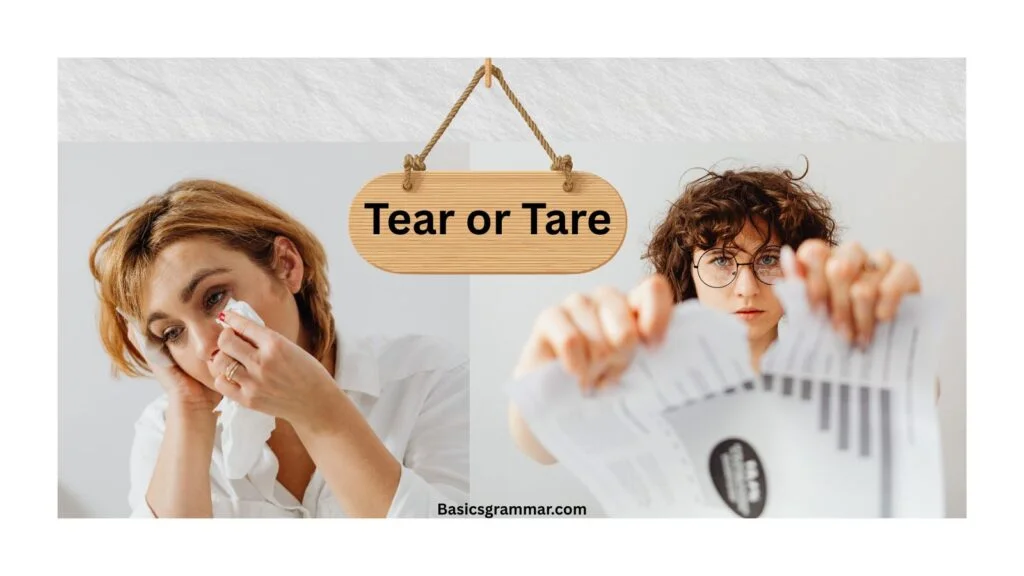
First, tear can refer to a drop of liquid produced by the eyes. Tears are commonly associated with emotions such as sadness, happiness, pain, or relief. They also help keep the eyes moist and protect their surfaces.
Second, tear can mean to rip, split, or pull something apart. This meaning is used when paper, fabric, or another material becomes damaged or separated.
Although both meanings are spelled identically, their pronunciation differs.
Tear as a Drop of Liquid from the Eye
When tear refers to the liquid that comes from the eyes, it is pronounced like “peer” or “deer.” The vowel sound is similar to the one in the word ear.
A tear may appear when someone cries because of emotional distress, joy, physical discomfort, or irritation. Tears can also occur naturally when the eyes react to smoke, dust, wind, or other irritants.
Examples include:
- A tear rolled down her cheek.
- He wiped a tear from his eye.
- She shed a tear of happiness during the ceremony.
- A single tear appeared in his eye as he remembered his childhood.
In these examples, tear refers to a drop of liquid from the eye.
The plural form is tears. For instance, “Her eyes filled with tears when she heard the good news.”
Tear as the Act of Ripping Something
The second meaning of tear refers to damaging or separating something by pulling it apart. In this sense, the word is pronounced like “air” or “care,” but it begins with a T sound.
This verb is frequently used when discussing paper, clothing, books, packaging, and other materials.
Examples include:
- Be careful not to tear the paper.
- I accidentally tore my shirt on a sharp branch.
- The child tried to tear the wrapping paper.
- Strong winds can tear loose signs from their supports.
The word changes form depending on the tense.
- Present: tear
- Past tense: tore
- Past participle: torn
- Present participle: tearing
For example, “I tear the paper carefully,” “I tore the paper yesterday,” and “I have torn the paper into small pieces.”
These forms are important because tore and torn are used instead of regular forms such as “teared” in the context of ripping something.
Tare vs Tear: The Main Differences
The easiest way to understand tare vs tear is to compare their meanings and uses directly.
| Feature | Tare | Tear |
|---|---|---|
| Main meaning | The weight of a container or the act of resetting a scale | A drop from the eye or the act of ripping |
| Part of speech | Noun or verb | Noun or verb |
| Common context | Weighing, shipping, cooking, and science | Emotions, crying, paper, fabric, and damage |
| Pronunciation | Rhymes with “air” | Rhymes with “air” when ripping; rhymes with “ear” for eye liquid |
| Example | Tare the scale before weighing the food. | She began to tear the paper. |
One important detail is that tare and the ripping sense of tear are pronounced the same way in many English accents. However, their meanings are completely different.
The context of a sentence usually makes the intended meaning clear.
For example, if someone says, “Please tare the scale,” the discussion is about measurement. If someone says, “Please tear the paper,” the instruction involves ripping something.
Why Do People Confuse Tare and Tear?
There are several reasons why English learners and native speakers may confuse these words.
1. Similar Spelling
Both words contain four letters and have similar spelling patterns. When people write quickly, they may select the wrong word without noticing the mistake.
Although the difference is only one letter, the meanings are significantly different.
2. Identical Pronunciation in Some Contexts
Tare and the verb tear, meaning to rip, are homophones in many English accents. Homophones are words that sound alike but have different meanings or spellings.
Other familiar examples include right and write, flour and flower, and sea and see.
Because tare and tear can sound identical, spelling depends on understanding the meaning of the sentence.
3. Multiple Meanings of Tear
The word tear has two separate meanings, and each has its own pronunciation. This can make it difficult for learners to understand without examples.
Consider these sentences:
- “A tear fell from her eye.”
- “Do not tear the envelope.”
The spelling is the same, but the pronunciation and meaning change.
4. Limited Familiarity with Tare
Many people encounter tear frequently but see tare less often. As a result, they may assume that tear is the correct spelling in every situation.
Learning that tare is a legitimate word associated with weighing equipment helps prevent this error.
How to Use Tare Correctly in a Sentence
To use tare correctly, first determine whether your sentence involves the weight of a container or the adjustment of a scale.
If you are discussing a weighing process, tare is likely the appropriate word.
Correct examples:
- The tare weight of the empty jar is 50 grams.
- Remember to tare the scale before adding the sugar.
- The package’s tare weight was recorded on the shipping form.
- We calculated the net weight after subtracting the tare.
- The laboratory assistant used the tare function on the electronic balance.
Incorrect example:
“The tare in her eye showed that she was sad.”
This sentence is incorrect because the writer intends to describe liquid from the eye. The correct word is tear.
Another incorrect example is “I need to tear the scale before weighing the ingredients.” If the intended meaning is to reset the scale, the correct word is tare.
Choosing the right word depends on the intended meaning rather than how the word sounds.
How to Use Tear Correctly in a Sentence
When using tear, ask yourself whether you are talking about crying or ripping something apart.
If the sentence describes liquid from the eye, use tear with the pronunciation that rhymes with “ear.”
Examples:
- A tear appeared in her eye.
- He could not stop the tears from falling.
- One tear rolled down his face.
- She smiled through her tears.
If the sentence describes ripping, use tear with the pronunciation that rhymes with “air.”
Examples:
- Please do not tear the page.
- The dog may tear the cushion.
- I do not want to tear my new jacket.
- She tore the letter into several pieces.
Remember that the past tense of the ripping verb is tore, while its past participle is torn.
For example, “He tore the paper yesterday” and “He has torn the paper already.”
Common Mistakes When Using Tare vs Tear
Understanding common errors is an effective way to improve your writing.
Mistake 1: Using Tear Instead of Tare for a Scale
Incorrect: “I pressed the tear button on the kitchen scale.”
Correct: “I pressed the tare button on the kitchen scale.”
The correct word is tare because the user wants to reset the scale to exclude the container’s weight.
Mistake 2: Using Tare Instead of Tear for Crying
Incorrect: “A tare rolled down his cheek.”
Correct: “A tear rolled down his cheek.”
The correct spelling is tear because the sentence describes a drop of liquid from the eye.
Mistake 3: Using Tare Instead of Tear for Ripping
Incorrect: “She tried to tare the paper into two pieces.”
Correct: “She tried to tear the paper into two pieces.”
The intended action is ripping, so tear is the correct choice.
Mistake 4: Forgetting the Different Forms of Tear
Incorrect: “I have teared the paper.”
Correct: “I have torn the paper.”
In standard English, the usual past participle of the verb meaning to rip is torn. Although teared can appear in specialized or uncommon uses, it is not the normal form for this meaning.
Mistake 5: Assuming Every Similar-Sounding Word Has the Same Meaning
English includes many words that share pronunciations but have different meanings. Correct spelling requires attention to context, not just sound.
Reading sentences carefully and practicing common examples can help you recognize the intended word more quickly.
Easy Tricks to Remember Tare vs Tear
If you frequently confuse tare and tear, a few simple memory techniques can make the distinction easier.
1. Associate tare with a scale.
Think of the word tare as a technical term used when weighing objects. If a scale or container is involved, tare may be the word you need.
2. Associate tear with the eye.
Imagine a tear running down someone’s cheek. This image can help you remember the spelling used for crying.
3. Connect tear with ripping paper.
Think of the phrase “tear the paper.” If something is being pulled apart, tear is the correct verb.
4. Read the entire sentence before choosing.
Rather than selecting a word based on its pronunciation, identify the action or object being described.
5. Practice with short sentences.
Writing a few examples every day can help reinforce the difference. For example, write one sentence about taring a kitchen scale, another about shedding a tear, and a third about tearing a sheet of paper.
These simple habits can make correct usage more natural over time.
Tare vs Tear: Practice Quiz
Test your understanding by selecting the correct word for each sentence.
- Please press the _____ button before placing the ingredients in the bowl.
- A single _____ rolled down his cheek.
- Be careful not to _____ the important document.
- The empty container’s _____ weight was 100 grams.
- She began to _____ the wrapping paper.
- He wiped away a _____ after hearing the emotional story.
- The technician needed to _____ the scale before measuring the sample.
- The child accidentally _____ his trousers on a fence.
Answers and Explanations
- Tare — The sentence refers to resetting a scale.
- Tear — The sentence describes liquid from the eye.
- Tear — The action involves damaging or ripping a document.
- Tare — The sentence refers to the weight of an empty container.
- Tear — The wrapping paper is being ripped.
- Tear — The word refers to a drop of liquid from the eye.
- Tare — The technician needs to adjust the scale.
- Tore — This is the past tense of tear when it means to rip.
If you answered most or all of these correctly, you have a good understanding of the distinction.
Frequently Asked Questions
Is Tare a Real Word?
Yes. tare vs tear a standard English word used mainly in weighing and measurement. It can refer to the weight of packaging or a container, or it can describe setting a scale to disregard that weight.
Are Tare and Tear Homophones?
Tare and tear, when tear means to rip, are pronounced identically in many English accents. They are therefore homophones in that usage. The word tear referring to liquid from the eye has a different pronunciation.
What Is the Difference Between Tare Weight and Net Weight?
Tare weight is the weight of the empty container or packaging. Net weight is the weight of the product alone. Gross weight generally includes both the product and its packaging.
For example, if a filled container weighs 750 grams and its empty container weighs 150 grams, the net weight of the contents is 600 grams.
Can Tear Be Used as Both a Noun and a Verb?
Yes. As a noun, tear can refer to liquid from the eye or a rip in a material. As a verb, it can mean to rip something apart. The pronunciation depends on the meaning.
Which Word Should I Use When Talking About a Kitchen Scale?
Use tare. The tare function allows you to reset the scale’s display to zero after placing an empty container on it, so you can measure the ingredients without including the container’s weight.
Conclusion
The difference between tare vs tear becomes simple once you understand their meanings and contexts. Tare is mainly associated with weighing, packaging, and adjusting scales, while tear can refer to liquid from the eye or the action of ripping something apart.
Although tare and the ripping sense of tear often sound identical, their spellings are not interchangeable. Using the wrong word can change the meaning of a sentence and create confusion for readers.
The best way to remember the distinction is to connect tare with scales and measurements, while connecting tear with crying or ripping. Pay attention to the context, practice with everyday examples, and remember the different forms of the verb tear.
With regular practice, you can use both words confidently and improve the accuracy of your English writing.
About the Author