his self or himself
English grammar can sometimes be confusing, especially when two expressions look similar but have different meanings. One common question is whether to write “his self” or “himself.” Both expressions contain the word “self,” but they are not interchangeable in ordinary English. Understanding the difference can help you write more naturally, avoid common grammatical mistakes, and communicate your ideas clearly.
The correct choice in most situations is “himself.” It is a standard English reflexive pronoun used when a male person performs an action on his own or when you want to emphasize that he did something personally. In contrast, “his self” is uncommon in everyday writing and usually appears in specialized contexts, such as psychology, philosophy, or discussions about personal identity.
This article explains the difference between his self or himself, provides practical examples, and explores common mistakes so you can choose the correct expression with confidence.
What Is the Difference Between His Self and Himself?
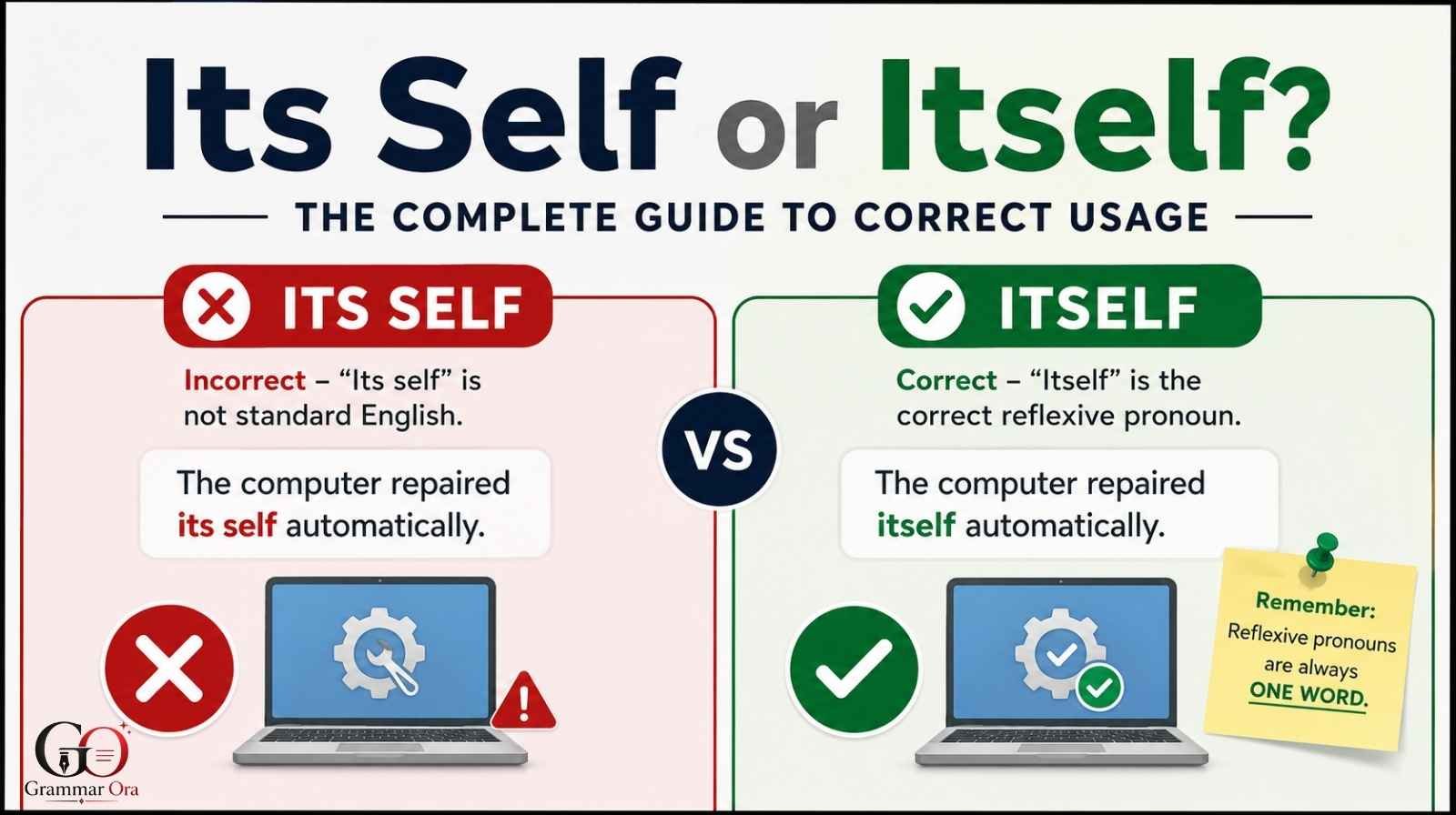
The main difference between “his self or himself” and “himself” is their grammatical function. “Himself” is a reflexive or intensive pronoun, while “his self” combines a possessive determiner with the noun “self.”
In everyday English, people use “himself” in sentences such as “He introduced himself to the new students” or “He completed the assignment himself.” These sentences are grammatically correct because “himself” refers to the male person already mentioned.
The expression “his self” is different. It treats “self” as a noun that belongs to someone. Although this construction can appear in philosophical or psychological writing, it sounds unnatural in most ordinary sentences. For example, instead of saying “He hurt his self,” a writer should say “He hurt himself.”
Therefore, when you are deciding between these two expressions for everyday communication, “himself” is almost always the appropriate choice.
What Does Himself Mean?
“Himself” is a reflexive pronoun used when the subject and the object of a sentence refer to the same person. It can also emphasize that a person performed an action without another person’s direct involvement.
For example, consider the sentence, “Daniel looked at himself in the mirror.” Daniel is both the person looking and the person being looked at. The reflexive pronoun “himself” connects these two roles and makes the sentence clear.
Another example is “Michael taught himself how to play the guitar.” In this sentence, Michael learned the skill independently rather than relying entirely on a teacher. The word “himself” emphasizes his role in the learning process.
The word also appears in sentences where a speaker wants to stress personal responsibility or individual effort. For example, “The manager himself welcomed the visitors.” Here, “himself” emphasizes that the manager personally welcomed them.
These uses make “himself” a useful and widely accepted word in spoken and written English.
What Does His Self Mean?
The expression “his self” consists of two separate words. “His” is a possessive determiner, while “self” is a noun referring to a person’s identity, individuality, or essential nature.
In specialized writing, the phrase may refer to someone’s inner identity, sense of personal existence, or understanding of who they are. For instance, a philosophical discussion might explore the relationship between a person’s public identity and his private self.
Consider the sentence, “He struggled to understand his true self.” This sentence is correct because “self” functions as a noun modified by “his” and the adjective “true.”
However, notice that the natural expression is “his true self,” not simply “his self,” when describing someone’s authentic identity. Similarly, writers commonly use expressions such as “his inner self,” “his younger self,” and “his former self.”
The phrase “his self” may occasionally appear in specialized discussions of identity or older styles of writing, but it is not a standard replacement for “himself.”
When Should You Use Himself?
You should use “himself” when a male person performs an action that affects him personally, when he does something independently, or when you want to emphasize his involvement.
There are several common situations in which this word is appropriate.
1. When the Subject and Object Are the Same Person
Use “himself” when the person performing an action is also the person receiving that action.
Examples include:
- He accidentally cut himself while cooking.
- James blamed himself for the mistake.
- Robert prepared himself for the interview.
- The boy saw himself in the photograph.
- He reminded himself to finish the project.
In each example, the reflexive pronoun refers back to the subject of the sentence. Without it, the meaning might change or the sentence might become grammatically incomplete.
2. When Emphasizing Personal Effort
“Himself” can emphasize that a person completed an action personally. In this case, it is called an intensive pronoun.
For example, “The president himself attended the meeting” emphasizes the president’s personal attendance. Likewise, “David repaired the computer himself” highlights David’s own effort.
Other examples include:
- He built the bookshelf himself.
- The author himself answered the questions.
- My father himself cooked dinner for everyone.
- The student himself presented the research.
These sentences show that the person mentioned was directly responsible for the action.
3. When Talking About Independent Learning
People often use “himself” to describe someone who develops a skill without formal instruction.
For example, “He taught himself English by reading books and watching educational programs.”
Other examples include:
- He taught himself to draw.
- Mark learned to code himself.
- He trained himself to run longer distances.
- The young musician taught himself to play the piano.
Such sentences highlight individual effort and self-directed learning.
When Can You Use His Self?
Although “his self” is not generally used as a reflexive pronoun, the noun “self” can be used with “his” in appropriate expressions. The key is understanding that the sentence is discussing a person’s identity or nature rather than simply referring back to him as the object of an action.
For example, “He wanted to rediscover his true self” is grammatically correct. The phrase “true self” describes the person’s authentic identity.
Similarly, “His younger self would have been surprised by his achievements” compares the person he was in the past with the person he is today.
Here are some natural expressions:
- His true self
- His inner self
- His younger self
- His former self
- His authentic self
- His future self
Each phrase treats “self” as a noun. The possessive word “his” tells the reader whose identity or version of the person is being discussed.
Compare these two sentences:
Incorrect in ordinary usage: He introduced his self to the audience.
Correct: He introduced himself to the audience.
Now compare the following examples:
Correct: He wanted to express his true self.
Correct: He expressed himself through music.
Both sentences are grammatical, but their meanings differ slightly. The first describes the person’s identity or authentic nature. The second describes how he communicated his feelings, thoughts, or personality.
His Self or Himself in Everyday Sentences
The easiest way to understand the difference is to examine common sentences and their correct forms.
Example 1: Personal Care
Incorrect: He washed his self before dinner.
Correct: He washed himself before dinner.
Explanation: The person performing the action is also the person receiving it, so the reflexive pronoun “himself” is required.
Example 2: Independent Work
Incorrect: He completed the assignment his self.
Correct: He completed the assignment himself.
Explanation: Here, “himself” emphasizes that he completed the assignment personally.
Example 3: Personal Identity
Incorrect: He wanted to find himself true.
Better: He wanted to discover his true self.
Explanation: The second sentence discusses his authentic identity, so “self” functions as a noun.
Example 4: Emotional Understanding
Incorrect: He needed time to understand his self.
Better: He needed time to understand himself.
Alternative: He needed time to understand his inner self.
Explanation: “Understand himself” is the natural everyday expression. “Understand his inner self” is also possible when the writer specifically wants to emphasize a person’s inner thoughts, emotions, or identity.
Example 5: Personal Responsibility
Incorrect: He blamed his self for everything.
Correct: He blamed himself for everything.
Explanation: The reflexive pronoun refers directly to the subject, making “himself” the correct form.
These examples demonstrate that the right expression depends on the grammatical role of the word “self.”
Common Mistakes People Make With Himself
Many English learners confuse reflexive pronouns with possessive expressions because the words seem closely related. Recognizing a few common errors can help prevent these mistakes.
Using His Instead of Himself
Some writers use “his” where a reflexive pronoun is needed. For example, “He hurt his during the match” is incorrect because “his” does not function as the required object.
The correct sentence is “He hurt himself during the match.”
The word “his” normally indicates possession, as in “That is his jacket.” The word “himself,” however, refers back to the male subject.
Writing Himself as Two Words
In standard contemporary English, “himself” is written as one word. Writing “him self” in an ordinary sentence is incorrect.
For example:
Incorrect: He completed the task him self.
Correct: He completed the task himself.
The same principle applies to other common reflexive pronouns, including “myself,” “yourself,” “herself,” and “ourselves.”
Using His Self to Emphasize an Action
A common mistake is using “his self” when the writer wants to emphasize that someone did something personally.
For example:
Incorrect: The actor attended the event his self.
Correct: The actor attended the event himself.
In the correct version, “himself” emphasizes the actor’s personal attendance.
Confusing Identity With a Reflexive Action
Another mistake occurs when writers assume that every expression containing “self” must use the same grammatical form.
However, the sentences “He expressed himself” and “He expressed his true self” serve different purposes.
In the first sentence, “himself” is a reflexive pronoun. In the second, “his true self” is a noun phrase describing his identity. Both are correct because their grammatical structures differ.
Is Himself Always the Correct Choice?
No. Although “himself” is the correct choice in most situations involving an ordinary reflexive pronoun, “his self” can be appropriate in specialized contexts or particular noun phrases.
For instance, a psychologist might discuss a person’s “inner self” when exploring emotions, beliefs, and identity. A philosopher might examine the concept of the self as a person’s sense of existence. In literary writing, an author might use “his former self” to describe a character’s earlier personality.
Nevertheless, these expressions should not be confused with the standard reflexive pronoun.
When writing everyday sentences, ask yourself what you are trying to communicate. If the sentence means that a man did something to himself, performed an action personally, or experienced something directly, “himself” will usually be correct.
If you are describing his identity, personality, or a particular version of who he is, a phrase such as “his true self” or “his younger self” may be more appropriate.
How to Remember the Correct Form
A simple way to remember the difference is to focus on the meaning of the sentence.
Use “himself” when the word refers back to a male subject or emphasizes his personal involvement. Use “his self” only when “self” is functioning as a noun in a construction where that wording is appropriate. In ordinary writing, a more natural expression such as “his inner self” or “his true self” is often preferable.
You can also test the sentence by replacing the expression with “him.” If the sentence needs a reflexive meaning, the replacement may reveal the problem.
For example, “He blamed himself” means that he blamed the same person who performed the action. Simply writing “He blamed him” generally suggests that he blamed another male person.
This small difference can change the meaning of an entire sentence.
Another helpful strategy is to read your writing aloud. Phrases such as “he taught his self” or “he prepared his self” will often sound unnatural to fluent English speakers. Replacing them with “he taught himself” and “he prepared himself” improves both grammar and readability.
Practice Exercises: His Self or Himself
Try choosing the correct expression in each sentence to strengthen your understanding.
- He looked at ______ in the mirror.
- The author ______ signed every copy of the book.
- He wanted to discover his true ______.
- Daniel taught ______ how to cook.
- He blamed ______ for the misunderstanding.
- His younger ______ had very different ambitions.
Answers:
- Himself
- Himself
- Self
- Himself
- Himself
- Self
The answers illustrate two distinct uses of “self.” In the first, second, fourth, and fifth sentences, “himself” is a reflexive or intensive pronoun. In the third and sixth sentences, “self” is a noun preceded by a possessive or descriptive word.
Practicing with simple examples can make the distinction easier to remember and apply in daily communication.
Why Correct Grammar Matters
Choosing the correct expression is not just about following a grammatical rule. his self or himself It also helps make writing clear, natural, and professional.
In school assignments, business communication, blog posts, and online articles, small grammatical mistakes can distract readers from the main message. Using “himself” correctly allows readers to understand who is performing an action and whom that action affects.
For content writers, editors, and English learners, understanding reflexive pronouns is particularly useful because these words appear frequently in everyday communication. A writer who understands the distinction between “himself” and “his true self” can communicate more precisely without making sentences unnecessarily complicated.
Good grammar also improves confidence. Once you understand how reflexive pronouns work, you can recognize similar patterns in other words, such as “myself,” “herself,” and “themselves.”
Conclusion
The difference between his self or himself becomes simple once you understand how each expression works. “Himself” is the standard reflexive or intensive pronoun used when a male person performs an action that refers back to him or when you want to emphasize his personal involvement.
“His self,” on the other hand, is not a standard substitute for “himself.” The noun “self” can appear in expressions such as “his true self,” “his inner self,” and “his younger self,” which describe a person’s identity or different aspects of his personality.
For everyday English writing, remember this straightforward rule: use “himself” for reflexive actions and personal emphasis, and use expressions such as “his true self” when discussing identity. With regular practice and attention to sentence structure, you can use both forms accurately and write clearer, more natural English.
About the Author