
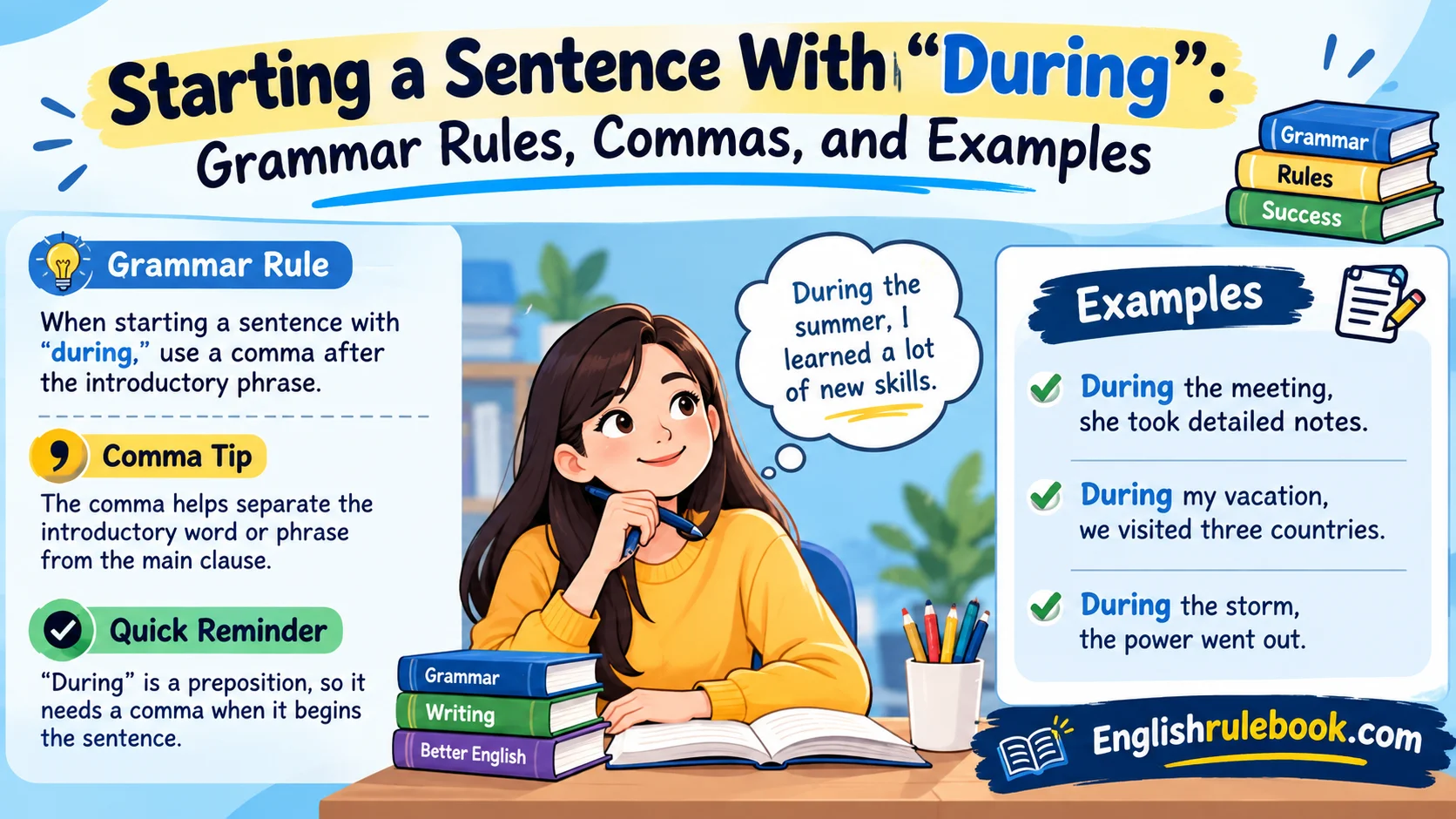
Starting A Sentence With “During” is perfectly natural in English when during introduces a time phrase that gives readers a clear setting before the main action. For example, during the meeting, the manager explained the new policy. This introductory prepositional phrase tells us when the event takes place, while the main clause presents the important action. In my experience with writing, this structure helps create better clarity, flow, and reader comprehension because the reader receives the context first. You can use it in an essay, story, report, or other written English without worrying that the sentence opening is incorrect. The key is understanding how during works with a noun phrase, rather than avoiding it simply because it appears at the beginning.
The main point to remember is that during is a preposition, so it normally connects with a noun or noun phrase rather than functioning alone. Consider during the night, for example. This short phrase establishes a time frame without needing extra information. If you add a clause, the structure becomes more detailed: during the night, when the town was asleep, he wrote his first poem. Here, the comma separates the additional information and makes the sentence easier to understand. This is where punctuation and comma usage become important. However, the comma isn’t required simply because the sentence starts with during; its use depends on the complete phrase and sentence structure. Understanding this grammar rule helps you avoid confusion and makes your writing style more precise and natural.
You can also compare during with while, for, and throughout, although these words don’t always have the same meaning or usage. During generally points to a period in which an action or event happens, while the other expressions can create a different temporal relationship or emphasis. This distinction becomes useful when you’re describing a scene, providing background, or explaining ideas in an essay. A well-placed introductory time expression can guide the reader smoothly toward the main action and improve readability. Once you understand the relationship between the preposition, phrase, clause, comma, and main clause, starting with during becomes a simple and effective part of English language sentence construction.
Quick Answer: Can You Start a Sentence With “During”?
Yes, you can start a sentence with “during.” There is no general English grammar rule that forbids beginning a sentence with this word.
The most common structure looks like this:
During + noun or noun phrase + main clause
For example:
- During the summer, we visited several national parks.
- During the meeting, the employees asked important questions.
- During the exam, students had to remain in their seats.
- During my vacation, I read three novels.
In each example, during introduces a noun phrase that identifies a period or event.
The important rule is that during normally takes a noun or noun phrase, rather than a complete clause. Cambridge Dictionary describes during as a preposition used before a noun or noun phrase to indicate when something happens.
So this is correct:
During the meeting, Sarah took notes.
But this isn’t:
❌ During Sarah was in the meeting, she took notes.
The second sentence needs while:
While Sarah was in the meeting, she took notes.
That distinction is the key to using during confidently.
What Does “During” Mean?
During refers to a time period in which something happens. It can identify a broad period such as a season or historical era, or a specific event such as a meeting or ceremony.
Consider:
During the summer, many people travel.
Here, the summer provides the time period.
Now consider:
During the meeting, the director announced the changes.
In this sentence, the meeting is the event that provides the time frame.
The word doesn’t necessarily mean that an action continues from beginning to end. For example:
During the movie, John received a phone call.
John probably didn’t spend the entire movie on the phone. The call happened at some point within the movie period.
That’s an important detail. During places an event within a period. It doesn’t automatically state how long that event lasted.
How to Start a Sentence With “During” Correctly
The easiest pattern to remember is:
During + noun phrase, + independent clause
For example:
During the conference, several researchers presented their findings.
The opening phrase is:
During the conference
The main clause is:
several researchers presented their findings
Together, they form a complete sentence.
During + an Event
You can use during before the name of an event:
- During the meeting, everyone reviewed the proposal.
- During the concert, the audience remained quiet.
- During the ceremony, the guests stood.
- During the interview, the candidate answered confidently.
- During the examination, students followed strict instructions.
During + a Period
You can also use it with periods of time:
- During the summer, temperatures often rise.
- During the winter, some roads become difficult to travel.
- During the morning, the office was unusually quiet.
- During the twentieth century, technology changed rapidly.
During + a Possessive Phrase
Possessive noun phrases work naturally too:
- During my vacation, I explored several cities.
- During her absence, the team continued working.
- During their stay, they visited local attractions.
- During his childhood, he lived in several different places.
The common thread is easy to spot: during introduces a noun-based time expression.
Why Is Starting a Sentence With “During” Correct?
Some writers have heard the old idea that sentences shouldn’t begin with prepositions. That’s not a reliable rule of modern English.
English frequently begins sentences with prepositional phrases:
- After dinner, we went for a walk.
- Before sunrise, the hikers started climbing.
- During the storm, the electricity failed.
- In the afternoon, the temperature increased.
- After the meeting, everyone returned to work.
There is nothing inherently wrong with this construction.
In fact, opening with during can improve information flow. It tells readers when something happened before giving them the action itself.
Compare these two sentences:
We discussed the budget during the meeting.
During the meeting, we discussed the budget.
Both are grammatically correct.
The first sentence gives prominence to the discussion. The second establishes the meeting first.
That difference can matter when you’re building a paragraph or telling a story.
Should You Put a Comma After “During”?
This question needs a small clarification.
You don’t automatically put a comma after the word during. Instead, when punctuation calls for one, the comma generally comes after the complete introductory phrase.
For example:
During the meeting, the manager answered questions.
The comma follows “during the meeting,” rather than simply following “during.”
Another example is:
During the final week of the course, students completed their projects.
The entire introductory phrase is:
During the final week of the course
The main clause begins with:
students completed their projects
Short Introductory Phrases
With very short introductory phrases, writers sometimes omit the comma when the sentence remains perfectly clear:
During lunch we discussed the proposal.
You may also see:
During lunch, we discussed the proposal.
The second version creates a slightly stronger pause.
For polished writing, consistency and readability matter more than treating every short introductory phrase as a mechanical comma exercise.
A Common Punctuation Mistake
Don’t write:
❌ During, the meeting began.
The problem isn’t simply punctuation. During needs something after it to complete its meaning.
A correct version would be:
During the meeting, everyone remained focused.
During at the Beginning vs. During at the End
The position of during can change the emphasis of a sentence without changing its basic meaning.
| Position | Example | Main emphasis |
| Beginning | During the meeting, we discussed the proposal. | Time/context |
| End | We discussed the proposal during the meeting. | Main action |
| Beginning | During the storm, the lights went out. | Setting |
| End | The lights went out during the storm. | Event |
Neither position is inherently better.
If you’re establishing a setting, putting during first often works beautifully:
During the storm, the streets became nearly empty.
If the action matters more, keeping the time phrase later may sound more natural:
The streets became nearly empty during the storm.
Good writers choose the position according to the information they want readers to notice first.
During vs. While: What’s the Difference?
During and while often describe overlapping time relationships. However, they follow different grammatical patterns.
During + Noun Phrase
During the movie, we talked quietly.
While + Clause
While we watched the movie, we talked quietly.
The structural difference is crucial.
| Word | Common structure | Example |
| during | during + noun phrase | During the movie, we talked. |
| while | while + subject + verb | While we watched the movie, we talked. |
Cambridge Grammar explains that while can introduce a clause describing an action or event occurring at the same time as another.
The Easy Way to Remember It
Ask yourself what comes next.
If you have a noun, use during:
During the meeting…
If you have a subject and verb, while will often be the right choice:
While the meeting was taking place…
This simple test prevents many errors.
Can You Say “During I Was Studying”?
No. During I was studying, it isn’t standard English because during doesn’t normally introduce a complete finite clause.
Incorrect:
❌ During I was studying, my friend called.
Correct:
While I was studying, my friend called.
Or restructure the sentence:
During my study session, my friend called.
Notice how the correction changes the grammatical structure rather than merely replacing one word.
Compare These Patterns
During + noun phrase
During my study session, …
While + clause
While I was studying, …
This distinction applies to many situations:
- ❌ During I was working
- ✅ While I was working
- ❌ During she was sleeping
- ✅ While she was sleeping
- ❌ During they were traveling
- ✅ While they were traveling
During vs. For: When or How Long?
Another frequent source of confusion is during versus for.
The simplest distinction is:
During = when something happens
For how long something happens
Compare:
We traveled during the summer.
The sentence identifies the period.
Now:
We traveled for three weeks.
The sentence gives the duration.
Cambridge makes the same distinction between during and for in its grammar guidance.
Examples
| Incorrect | Better | Reason |
| We stayed there during three days. | We stayed there for three days. | For express duration. |
| She waited during two hours. | She waited for two hours. | For gives the length. |
| During the first three days, we explored. | During the first three days, we explored. | During identifies a time window. |
The last example works because the first three days identify a specific period rather than merely stating a duration.
When Can “During” Appear With Numbers?
This is a subtle point that often causes confusion.
You generally wouldn’t say:
❌ During three years, the company expanded.
Instead, you can say:
During the first three years, the company expanded rapidly.
Or:
During the last three years, sales have increased.
Why does the second structure work?
Because the first three years and the last three years identify particular periods. They function as time frames.
Compare:
The company operated for three years.
Here, for measuring duration.
But:
During the first three years of operation, the company hired 50 employees.
Here, during identifies when those hires occurred.
That distinction may seem small, yet it makes a major difference in precise writing.
During vs. Throughout
During and throughout are close in meaning, but throughout places stronger emphasis on the whole period.
For example:
During the afternoon, we received several phone calls.
This simply places the calls somewhere within the afternoon.
Now:
Throughout the afternoon, we received phone calls.
This suggests that the calls continued or occurred repeatedly across the afternoon.
Quick Comparison
| Word | Meaning | Example |
| during | At some point within a period | During the afternoon, we received a call. |
| throughout | Across the whole period | Throughout the afternoon, we received calls. |
Neither word is automatically better. The choice depends on what you mean.
Common Mistakes When Starting a Sentence With “During”
The biggest mistakes involve structure rather than sentence position.
Mistake 1: Putting a Complete Clause After “During”
Incorrect:
❌ During I was driving, it started raining.
Correct:
While I was driving, it started raining.
Or:
During my drive, it started raining.
Mistake 2: Using “During” to Express Duration
Incorrect:
❌ We stayed there during five days.
Correct:
We stayed there for five days.
Mistake 3: Forgetting the Noun After “During”
Incorrect:
❌ During, everyone became silent.
Correct:
During the presentation, everyone became silent.
Mistake 4: Assuming “During” Can’t Begin a Sentence
This belief is simply incorrect.
During the ceremony, the guests stood quietly.
The construction is grammatical and natural.
Mistake 5: Confusing “During” With “While”
Incorrect:
❌ During we were eating dinner, the phone rang.
Correct:
While we were eating dinner, the phone rang.
Or:
During dinner, the phone rang.
Examples of Sentences Starting With “During”
This section provides clear and practical examples of sentences that begin with “During” and shows how to use it naturally in different contexts.
Everyday Examples
- During breakfast, we discussed our plans.
- During the weekend, I cleaned the garage.
- During lunch, she told us about her new job.
- During the trip, we took hundreds of photographs.
Academic Examples
- During the experiment, researchers recorded the temperature.
- During the study, participants completed several tasks.
- During the first semester, students learned the basic concepts.
- During the final stage of the research, the team analyzed the results.
Professional Examples
- During the meeting, the director reviewed the proposal.
- During the interview, the applicant described her experience.
- During the training session, employees practiced the new procedure.
- During the negotiations, both sides considered several alternatives.
Narrative Examples
- During the storm, the lights suddenly went out.
- During the final scene, the theater became completely silent.
- During the night, the wind grew stronger.
- During the journey, they discovered an unexpected route.
When Starting With “During” Improves a Sentence
Sometimes starting with during isn’t just grammatically correct. It’s the better stylistic choice.
Imagine you’re telling a story:
During the storm, the old bridge began to shake.
The reader gets the setting first. Then comes the action.
That arrangement creates a natural progression:
time → setting → action
This can be especially effective when the time period affects what happens next.
Starting with during can help you:
- establish context immediately
- create a stronger narrative opening
- organize events chronologically
- emphasize a particular period
- connect one sentence to the previous sentence
- make a sequence of events easier to follow
However, don’t force the structure into every sentence. Repeatedly beginning sentences with during can create a predictable rhythm.
Good writing varies its sentence openings.
When You Might Prefer Another Structure
Suppose you have:
During the meeting, the manager announced the new policy.
That’s excellent if the meeting provides important context.
But if the announcement is the central point, this might read better:
The manager announced the new policy during the meeting.
The grammatical information hasn’t changed much. The focus has.
This is a useful editing principle: sentence structure should serve meaning.
Don’t move during to the beginning simply because an article says you can. Move it when the time reference deserves attention.
During With Different Types of Time Expressions
During work with many common categories of time expressions.
Seasons
- during the summer
- during the winter
- during the spring
- during the fall
Example:
During the winter, some mountain roads become dangerous.
Parts of the Day
- during the morning
- during the afternoon
- during the evening
- during the night
Example:
During the night, temperatures dropped significantly.
Events
- during the meeting
- during the exam
- during the ceremony
- during the concert
- during the interview
Example:
During the interview, she answered every question clearly.
Historical Periods
- during the Renaissance
- during the Industrial Revolution
- during the twentieth century
- during the war
Example:
During the twentieth century, communication technology developed rapidly.
Personal Periods
- during my childhood
- during his vacation
- during her absence
- during their stay
Example:
During my childhood, I spent many summers near the coast.
Case Study: Choosing Between During, While, and For
Consider this sentence:
During the experiment, the machine operated for six hours while researchers monitored its temperature.
Three different time expressions appear here.
During the experiment identifies the overall time period.
For six hours tells us how long the machine operated.
While researchers monitored its temperature, it connected two simultaneous actions.
Each expression performs a different grammatical job.
This is why replacing these words casually can distort the meaning or produce an ungrammatical sentence.
The Three Questions
When choosing between these words, ask:
- When did it happen? → during
- How long did it happen? → for
- What was happening at the same time? → while
That quick test solves a surprising number of common grammar problems.
Is Starting a Sentence With “During” Formal?
Yes. Starting a sentence with “during” works in both formal and informal English.
For example:
During lunch, we talked about our vacation.
That’s perfectly natural in everyday conversation.
Meanwhile:
During the investigation, researchers identified several significant patterns.
That structure works equally well in academic or professional writing.
The word during doesn’t make a sentence informal or formal by itself. The surrounding vocabulary, purpose, and level of detail have a much greater effect.
Practical Tips for Using “During” Correctly
Before you finalize a sentence beginning with during, run through this quick checklist:
- Identify the time period.
- Place a noun or noun phrase after “during.”
- Make sure the main clause is complete.
- Use “while” when you need to introduce a full clause.
- Use “for” when you need to express duration.
- Consider “throughout” when the entire period matters.
- Use punctuation that makes the sentence easy to read.
- Check whether placing the time phrase first improves emphasis.
- Vary your sentence openings when writing several sentences in succession.
These checks take only a few seconds. They can also prevent the most common errors.
Quick Reference: Correct and Incorrect Sentences
| Incorrect | Correct |
| ❌ During I was studying, she called. | ✅ While I was studying, she called. |
| ❌ During three hours, we waited. | ✅ We waited for three hours. |
| ❌ During, everyone became quiet. | ✅ During the presentation, everyone became quiet. |
| ❌ During we were eating, the phone rang. | ✅ While we were eating, the phone rang. |
| ❌ During five years, sales increased. | ✅ During the first five years, sales increased. |
| ❌ During the meeting the manager spoke. | ✅ During the meeting, the manager spoke. |
The pattern is clear: the issue isn’t starting the sentence with “during.” The real issue is using the correct grammatical structure afterward.
Conclusion
Starting a sentence with “during” is grammatically correct and can make your writing clearer and more natural. When during introduces a time phrase, it helps readers understand the setting before reaching the main action. Pay attention to what follows during and use commas when the sentence structure calls for them. Once you understand these simple rules, you can confidently use “during” at the beginning of sentences in essays, stories, reports, and everyday English.
Read More:20 Similes for Birds (With Examples): Creative & Fun Comparisons
FAQs
Q1. Can you start a sentence with “during”?
Yes. During can begin a sentence when it introduces a phrase that explains when an action or event happens.
Q2. Do you need a comma after “during”?
Not automatically. The comma depends on the structure of the introductory phrase. For example, “During the meeting, we discussed the plan” uses a comma after the introductory phrase.
Q3. Is “during” a preposition?
Yes. During is a preposition that usually comes before a noun or noun phrase to identify a period when something happens.
Q4. Can “during” be followed by a complete sentence?
Usually, no. During normally introduces a noun or noun phrase. If you need a subject and verb, while may be more appropriate.
Q5. What is the difference between “during” and “while”?
During is normally followed by a noun or noun phrase, such as “during the meeting.” While is normally followed by a clause, such as “while we were meeting.”
About the Author







1 thought on “Starting a Sentence With “During”: Grammar Rules, Commas, and Examples”