
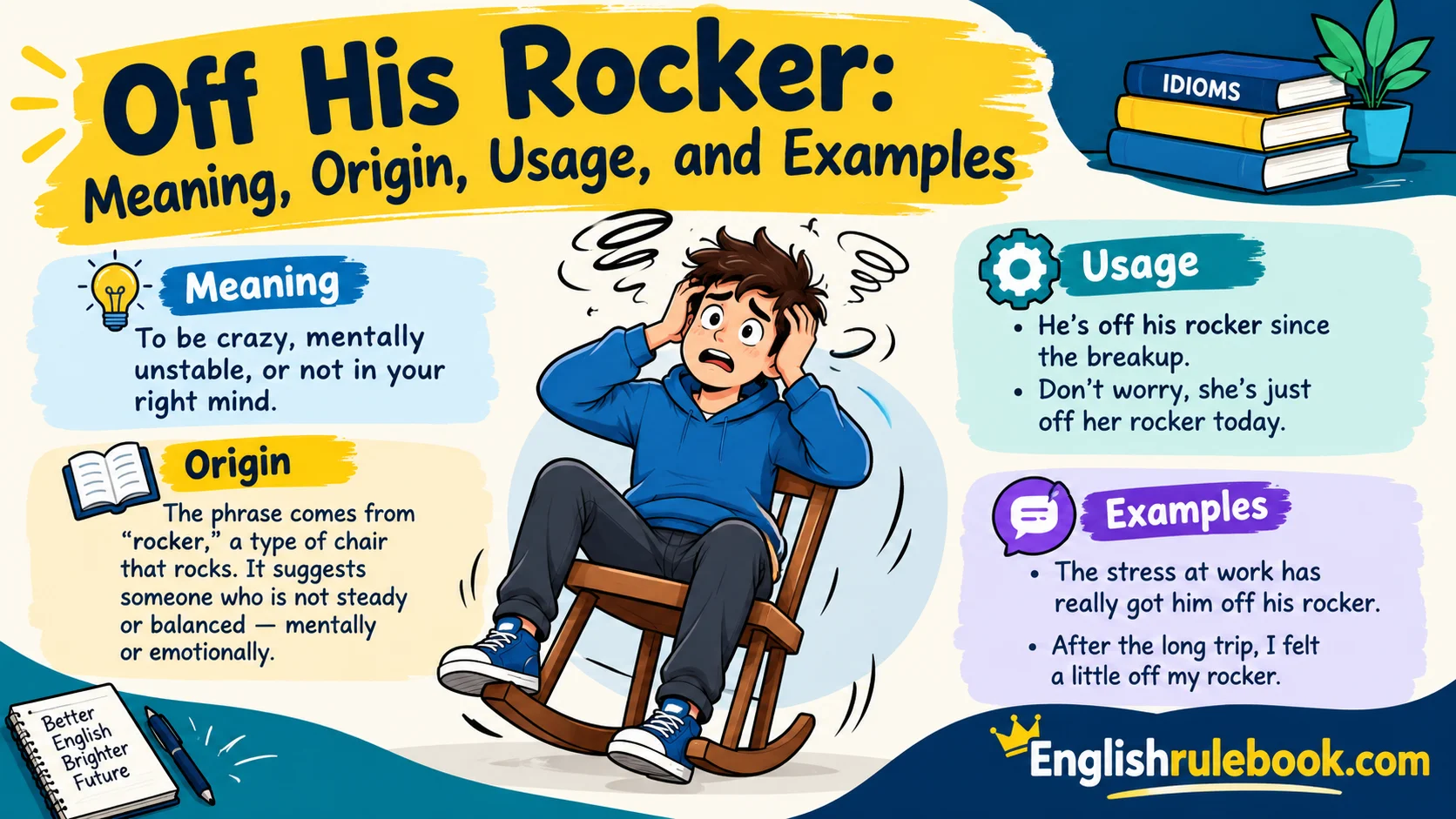
Off His Rocker is an informal idiom used when a person is acting strange, irrational, foolish, or crazy. The phrase creates a colorful picture of someone who has somehow moved away from normal behavior. In English, English speakers often use it in casual conversation to describe unusual or silly actions. The expression can sound playful when friends use it to tease each other, but it may become insulting if someone says it seriously. For example, if a man makes a very strange choice, someone might say that he is off his rocker because the decision seems funny, foolish, or unreasonable.
The phrase also has an interesting history and origin. Its exact origin is uncertain, but the most familiar explanation connects rocker with a rocking chair, a common piece of furniture. The idea is that someone who has fallen off a rocking chair might appear confused or unreasonable. Historical dictionary evidence shows that off one’s rocker was already in use by the late 19th century. The Oxford English Dictionary dates the expression to around 1890, while Etymonline records an attestation from 1897. This association between a simple chair and unusual behavior helps explain why the expression has stuck in our minds and remained part of everyday English.
In practical use and usage, context matters because the tone can change the meaning people hear. Someone might say “He’s off his rocker!” when a person wears a costume to work on a normal day, because the choice seems strange or funny. This light-hearted context makes the expression humorous rather than deeply offensive. However, using it while questioning someone’s sanity can make it sound harsher, so a better choice may be needed in a serious situation. Understanding the grammar, using the phrase grammatically, and knowing when it sounds natural are more useful than simply memorizing its definition. The real story behind this idiom shows how a familiar rocking chair became linked with unusual or silly behavior in English conversations.
Quick Answer: What Does “Off His Rocker” Mean?
“Off his rocker” means that a man is behaving irrationally, foolishly, strangely, or crazily.
It is an informal English idiom. People often use it to criticize someone’s judgment or describe behavior that seems completely unreasonable.
For example:
He must be off his rocker if he thinks he can finish all that work in one hour.
The speaker probably isn’t making a serious statement about the man’s mental health. Instead, the speaker thinks his expectation is ridiculously unrealistic.
Off His Rocker at a Glance
| Feature | Details |
| Phrase | Off his rocker |
| Meaning | Acting irrationally, strangely, foolishly, or crazily |
| Type | Idiom |
| Register | Informal |
| Tone | Humorous, teasing, critical, or insulting |
| Literal image | Being physically off a rocker |
| General form | Off one’s rocker |
| Formal writing | Usually inappropriate |
The exact meaning depends on context. In one conversation, it might be a joke between friends. In another, it could be a harsh criticism of someone’s behavior.
What Does “Off His Rocker” Actually Mean?
At its simplest, off his rocker suggests that someone isn’t behaving sensibly.
The expression can describe a person who:
- Makes an extremely unreasonable decision
- Says something bizarre
- Behaves unusually
- Takes an unnecessary risk
- Shows very poor judgment
- Seems confused or irrational
- Has an idea that sounds completely unrealistic
Consider this sentence:
John wants to quit his job tomorrow and travel around the world without any savings. He’s off his rocker.
Here, the speaker is criticizing John’s decision. The phrase doesn’t necessarily mean that John has a mental disorder. It simply emphasizes how unreasonable the decision appears.
The phrase often exaggerates
English speakers regularly use idioms for emphasis. Saying someone is off his rocker can be a colorful way of saying, “That makes absolutely no sense.”
For example:
He’s off his rocker if he thinks the boss will approve that plan.
The speaker is probably questioning his judgment rather than making a medical claim.
That distinction matters because idioms often communicate attitude rather than precise facts.
It can describe behavior, too
The phrase doesn’t have to focus on one decision.
Everyone thought he was off his rocker after he started arguing with the mailbox.
The speaker uses the idiom to describe behavior that appears extremely strange.
Still, off his rocker isn’t a clinical term. It doesn’t provide a professional description of someone’s mental state. In serious situations, precise language is much more appropriate.
Why Is It Called “Off His Rocker”?
The word rocker has several meanings in English. In this expression, the most familiar interpretation connects it with a rocking chair.
A rocker can refer to the curved part underneath a rocking chair that allows the chair to move backward and forward. Rocker also developed as a word for a rocking chair itself.
That gives the idiom a vivid mental image.
Imagine someone sitting comfortably in a rocking chair. Now imagine that person somehow ending up off the rocker. The person is no longer in the expected, stable position.
English often turns physical situations into metaphors for abstract ideas. In this case, being physically “off” something becomes associated with being mentally or behaviorally out of balance.
Literal and figurative meanings
| Literal idea | Figurative idea |
| Someone is physically away from a rocker | Someone is behaving irrationally |
| A person leaves a rocking chair | A person’s judgment seems unreasonable |
| A physical position changes | A person’s behavior seems abnormal |
| Furniture is involved | No furniture is actually required |
The expression therefore creates a humorous picture while communicating a serious idea about someone’s behavior.
The Origin and History of “Off His Rocker”
The phrase isn’t a recent invention.
Historical evidence places off one’s rocker in English slang during the late 19th century. The Oxford English Dictionary dates the expression to approximately 1890, while Etymonline cites a 1897 example for the slang meaning associated with craziness.
The word rocker itself is older. Its connection with rocking furniture predates the idiom by decades.
This historical sequence matters because it shows that the idiom didn’t suddenly appear because of modern pop culture. It developed from older English vocabulary and slang.
A brief historical timeline
| Period | Development |
| 18th century | Rocker was used for curved pieces that allowed objects such as chairs and cradles to rock |
| 19th century | Rocker developed a clear association with rocking chairs |
| Around 1890 | OED dates off one’s rocker to this period |
| 1897 | Etymonline records an attestation of the slang expression |
| Modern English | The idiom remains an informal way to describe irrational or strange behavior |
The evidence establishes the age of the expression. However, it doesn’t prove every popular story about how the phrase originated.
The Rocking-Chair Theory
The rocking-chair explanation is the easiest origin story to understand.
The idea is based on stability. A person who sits properly in a rocking chair is in the expected position. Someone who ends up off the rocker appears physically unstable.
That physical image can then become a metaphor for unusual thinking or behavior.
It’s a neat explanation. Yet historical linguistics requires more caution than simply saying, “That’s definitely where it came from.”
The exact pathway from rocking chair to crazy person isn’t firmly documented. Other explanations have also appeared in discussions of the phrase’s history.
Therefore, the most accurate conclusion is:
The rocking-chair explanation is plausible and widely associated with the idiom, but its precise origin isn’t completely certain.
“Off His Rocker” vs. “Off One’s Rocker”
Off his rocker is only one grammatical version of the expression.
The more general dictionary form is off one’s rocker. The possessive changes depending on who you’re talking about.
| Subject | Correct expression |
| I | off my rocker |
| You | off your rocker |
| He | off his rocker |
| She | off her rocker |
| We | off our rocker |
| They | off their rocker |
For example:
I must be off my rocker.
You must be off your rocker.
She must be off her rocker.
They must be off their rocker.
The meaning remains essentially the same.
Why dictionaries use “one’s”
Dictionaries often use one’s when presenting an idiom in its general form. It acts as a placeholder.
So off one’s rocker doesn’t mean that you must literally use one’s in normal conversation. Instead, you select the possessive that matches your subject.
Is “Off His Rocker” Grammatically Correct?
Yes. Off his rocker is grammatically correct when his refers to the male subject being discussed.
For example:
He is off his rocker.
He seems off his rocker.
I think he’s off his rocker.
Anyone who believes that is off his rocker.
The phrase normally functions as a complement describing someone’s state or behavior.
The basic structure is straightforward:
- off — preposition
- his — possessive determiner
- rocker — noun
You can also use the related form gone off his rocker.
Compare:
He is off his rocker.
This describes his current behavior.
He has gone off his rocker.
This suggests that his behavior has become irrational or strange.
That difference is small but useful when you’re trying to write naturally.
How to Use “Off His Rocker” in a Sentence
The expression works best when the context makes the speaker’s judgment obvious.
Talking about an unreasonable decision
He must be off his rocker to turn down such a good opportunity.
The speaker thinks the decision is extremely foolish.
Describing an unrealistic idea
He’s off his rocker if he thinks he’ll learn the entire language in a weekend.
The phrase emphasizes how unrealistic the expectation sounds.
Using it humorously
You’re off your rocker if you think I’m waking up at four in the morning on vacation.
Here, the expression sounds playful rather than hostile.
Describing bizarre behavior
He was acting completely off his rocker during the meeting.
The phrase focuses on unusual conduct.
Expressing disbelief
He wants to drive across the country without stopping for sleep? He’s off his rocker.
The idiom adds emotional force to the speaker’s reaction.
Is “Off His Rocker” Offensive?
It can be.
The expression has historically been associated with being crazy or mentally unsound. In casual speech, people often use it as exaggeration. However, that doesn’t remove the possibility that someone may find it insulting.
Context makes a huge difference.
It may sound harmless when:
- Close friends are teasing each other
- The situation is obviously humorous
- Someone has made a harmlessly ridiculous suggestion
- The speaker uses an exaggerated tone
It may sound offensive when:
- A stranger is being described
- Someone’s mental health is being discussed seriously
- The phrase appears in a workplace criticism
- Someone uses it to dismiss another person’s concerns
- The speaker clearly intends to insult
For sensitive situations, alternatives such as irrational, confused, unreasonable, or not thinking clearly may communicate the intended meaning more accurately.
“Off His Rocker” vs. Similar Expressions
Several English expressions have overlapping meanings, but they aren’t identical in tone.
| Expression | Meaning | Tone |
| Off his rocker | Acting irrationally or strangely | Informal |
| Out of his mind | Acting irrationally or experiencing an extreme state | Informal |
| Off his head | Crazy or irrational | Informal |
| Not thinking straight | Reasoning poorly | More neutral |
| Unreasonable | Not sensible or rational | Neutral |
| Irrational | Not based on logical reasoning | Formal/neutral |
| Foolish | Showing poor judgment | Neutral |
| Out of touch with reality | Failing to recognize reality accurately | More serious |
The best replacement depends on the situation.
For example, if you want to say that someone’s argument lacks logic, irrational may be more precise.
If you’re joking with a friend about an outrageous idea, off his rocker may sound much more natural.
“Off His Rocker” vs. “Off His Trolley”
Off his trolley is another expression associated with irrational or crazy behavior.
The two idioms are similar:
He must be off his rocker.
He must be off his trolley.
Both can communicate the idea that someone isn’t thinking sensibly.
However, off his rocker is the more useful expression for many modern readers because it remains recognizable in casual English.
The historical relationship between the expressions is interesting. Both belong to a group of older slang expressions that use physical objects or movement to represent unusual mental states.
Common Mistakes With “Off His Rocker”
Avoid using “off his rocker” in formal contexts, confusing it with similar idioms, or interpreting it literally instead of recognizing its informal meaning.
Taking the phrase literally
A learner might imagine someone physically falling out of a rocking chair.
In modern idiomatic usage, that’s normally not what the speaker means.
Thinking “rocker” means a rock musician
English has several meanings for rocker.
A rocker can refer to someone associated with rock music. That meaning isn’t the source you need when interpreting off his rocker.
Using it in formal writing
Because the expression is informal, it usually doesn’t belong in academic papers, business reports, legal documents, or formal professional correspondence.
Instead of:
The director was off his rocker.
A formal writer could say:
The director’s decision appeared highly irrational.
Treating it like a medical diagnosis
This is one of the most important mistakes to avoid.
Off his rocker is an idiom, not a clinical diagnosis.
It communicates the speaker’s perception of someone’s behavior. It doesn’t establish a medical condition.
Using the wrong possessive
Remember that the possessive must match the subject.
❌ He is off your rocker.
✅ He is off his rocker.
❌ She is off his rocker.
✅ She is off her rocker.
The expression changes naturally with the person being described.
How to Remember the Meaning
A simple visual trick can make the idiom stick.
Picture a rocking chair.
Someone sitting comfortably on the rocker is in the expected position. Someone who is suddenly off the rocker is out of position.
Now connect that image with behavior:
On the rocker → normal position
Off the rocker → figuratively unstable or unreasonable
This isn’t a literal explanation of every historical detail. It’s simply a useful way to remember the modern meaning.
Real-Life Usage and Tone
Idioms aren’t just about dictionary definitions. They also carry personality.
Compare these two sentences:
His decision was irrational.
He’s off his rocker if he thinks that will work.
The first sounds objective and restrained. The second sounds conversational, emotional, and slightly dramatic.
That’s exactly where his rocker earns its place.
It gives a speaker room to express disbelief, humor, frustration, or criticism without using a long explanation.
A short dialogue
Emma: “Did you hear? David wants to sell his house and buy a boat.”
Lucas: “Without having another place to live?”
Emma: “Exactly.”
Lucas: “He’s off his rocker.”
The idiom works because the surrounding conversation establishes why Lucas considers the decision unreasonable.
Can You Use “Off His Rocker” in Formal Writing?
Generally, you should avoid it in formal writing.
The phrase belongs to informal English and works best when the writing intentionally reflects everyday speech.
| Informal expression | More formal alternative |
| He’s off his rocker. | His decision is irrational. |
| She’s off her rocker. | Her behavior seems unusual. |
| You’re off your rocker. | Your assumption seems unreasonable. |
| He’s gone off his rocker. | His behavior has become increasingly erratic. |
This doesn’t mean idioms are bad writing. In the right setting, they make prose lively and natural.
The key is audience and purpose.
Key Facts About “Off His Rocker”
- Off his rocker is an English idiom.
- It generally means irrational, foolish, strange, or crazy.
- The phrase is informal.
- It can be humorous or insulting depending on context.
- Off one’s rocker is the general dictionary form.
- The possessive changes according to the subject.
- The expression dates back to the late 19th century.
- The Oxford English Dictionary dates the expression to around 1890.
- Etymonline cites an attestation from 1897.
- Rocker has a long-established connection with rocking furniture.
- The rocking-chair explanation is plausible, but the exact origin isn’t completely certain.
- The phrase isn’t a medical or psychological diagnosis.
- More precise alternatives are better for serious or formal contexts.
Read More:Collective Nouns for Wolves: Terms, Meanings, and Examples
Conclusion
Off His Rocker is an informal idiom that describes a person behaving in a strange, foolish, irrational, or crazy way. Its possible connection to a rocking chair gives the phrase a memorable history and origin, while its continued use in everyday English shows how strongly it has remained part of casual English conversations. Because its tone can be playful or insulting, understanding the context is important before using it.
FAQs
Q1. What does “off his rocker” mean?
Off his rocker means that a person is acting strange, foolish, irrational, or crazy.
Q2. Is “off his rocker” a formal expression?
No. Off his rocker is an informal idiom mainly used in casual conversation and everyday English.
Q3. Where does “off his rocker” come from?
The exact origin is uncertain, but the most familiar explanation connects rocker with a rocking chair. The image suggests someone who has fallen from the chair and seems confused or unreasonable.
Q4. Can “off his rocker” be insulting?
Yes. The tone depends on the context. Friends may use it in a playful or light-hearted way, but using it to question someone’s sanity can sound insulting or harsh.
Q5. How can I use “off his rocker” naturally?
You can use off his rocker when someone makes an unusually strange, funny, or foolish decision. For example: “He’s off his rocker if he thinks that plan will work.”
About the Author