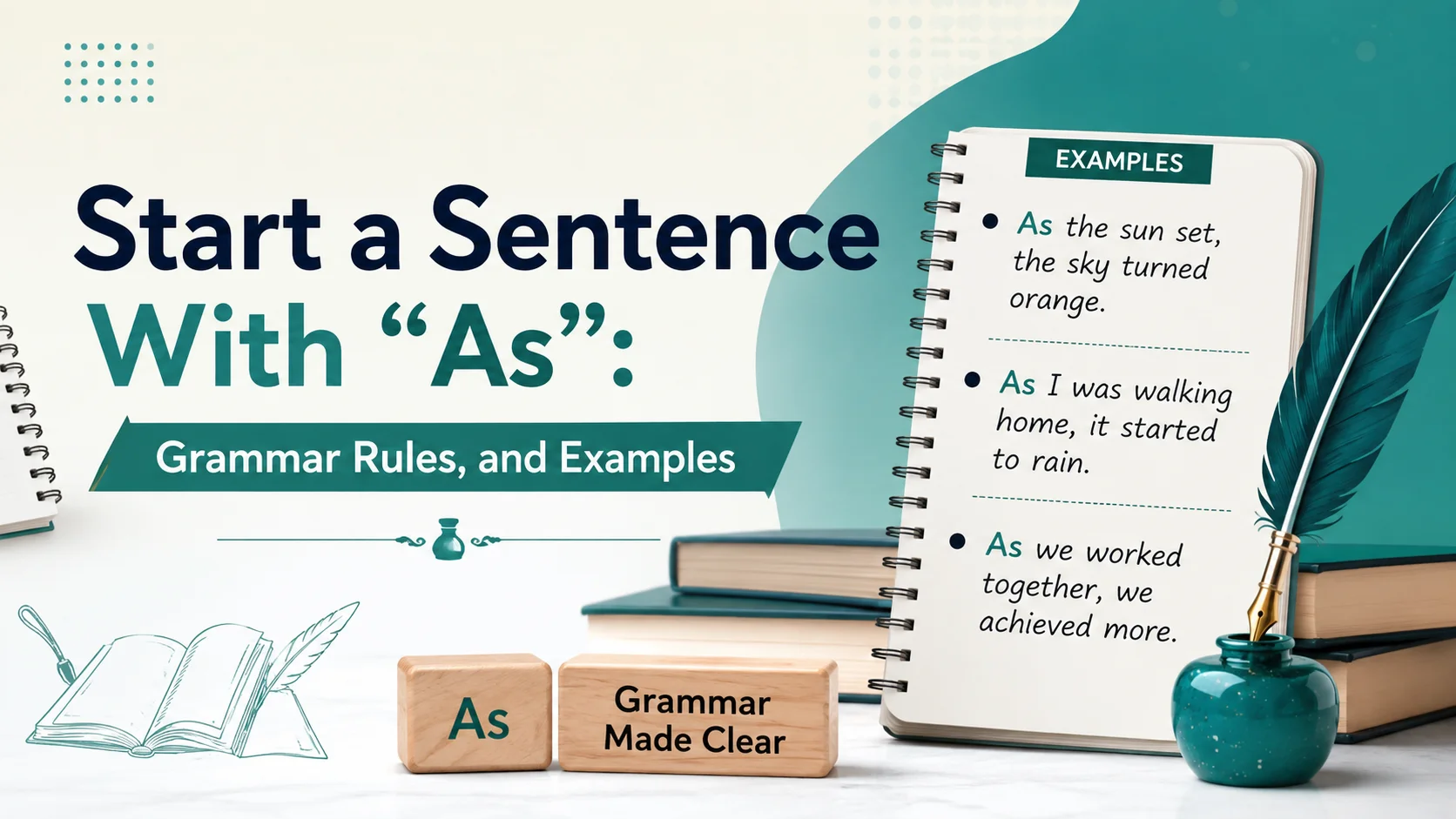
Starting a sentence with as is a common and natural choice in English. In everyday conversations, professional writing, academic essays, storytelling, and explanatory articles, as can introduce a reason, show a comparison, or connect ideas in a clear way. For example, as may mean “because” when you say, “As it was getting late, we decided to leave.” The meaning depends on the context, position, and function of the word, so writers should focus on making each sentence grammatically correct.
While some people believe that beginning with as is a no-go zone, there is no general English language rule that bans it. An age-old grammar rule may sometimes create caution, but this does not mean the construction is wrong. Expressions such as as if, as though, and just as can also begin sentences when their function is clear. In edited sentences, writers may adjust the structure when an as clause makes the time frame, reason, or comparison difficult to understand. The key is understanding the relationship between the ideas rather than treating every rule as set in stone.
A useful approach is to check whether the sentence remains clear and easy to understand after you read it aloud. As can describe a situation, explain a reason, or introduce a comparison, and its exact role should be obvious from the context. For example, “As I walked home, the rain started” uses as to connect events in a time frame. A mistake can happen when writers avoid a perfectly fine structure simply because of a common belief. With hard work and practice, you can understand when to bend rules, when to avoid breaking rules, and when a specific structure is perfectly fine.
Quick Answer: Can You Start a Sentence With “As”?
Yes, you can start a sentence with “as.” It is completely acceptable in standard English.
When as introduces a dependent clause at the beginning of a sentence, you will normally place a comma between that introductory clause and the main clause.
For example:
As the rain became heavier, we went inside.
As I was leaving the office, my manager called.
As the meeting ended, everyone gathered their belongings.
The opening clause provides background information. The main clause then delivers the central idea.
A sentence beginning with as can show:
- Time: As I walked home, I called my sister.
- Reason: As it was late, we went home.
- Manner: As I explained earlier, the rule has an exception.
- Comparison: Just as exercise strengthens the body, reading strengthens the mind.
- Appearance: As if he knew the answer, he raised his hand.
So, there is no general grammar rule that prohibits starting a sentence with as.
What Does “As” Mean at the Beginning of a Sentence?
The meaning of as depends on the sentence around it. In many cases, it works as a subordinating conjunction that introduces a dependent clause.
Consider:
As the sun went down, the temperature dropped.
The words “As the sun went down” form a dependent clause. They provide the circumstances under which the main action happens.
The word as can establish several different relationships.
| Meaning | Function | Example |
| While | Shows simultaneous actions | As I walked home, I listened to music. |
| Because | Gives a reason | As it was raining, we stayed inside. |
| In the way that | Shows manner | As I explained earlier, the rule is simple. |
| Just as | Shows close timing or similarity | Just as I sat down, the phone rang. |
| As if | Shows an imagined comparison | As if he knew the answer, he raised his hand. |
| As though | Shows appearance or comparison | As though nothing had happened, she continued working. |
The context usually tells readers which meaning you intend.
However, if the sentence could have two meanings, choosing a more specific word may improve clarity.
Starting a Sentence With “As” to Show Time
One of the most common uses of as is to describe two events happening at the same time.
For example:
As I walked through the park, I noticed a small bird.
The walking and noticing occur during the same period.
Another example:
As the sun disappeared behind the hills, the sky became darker.
The two events unfold together.
This use makes as particularly useful in storytelling because it allows writers to connect actions smoothly.
Examples of “As” for Simultaneous Actions
- As she entered the room, everyone became quiet.
- As we drove toward the city, the traffic became heavier.
- As the wind grew stronger, the trees began to bend.
- As I was cooking dinner, someone knocked on the door.
- As the children played outside, their parents prepared dinner.
- As the train approached the station, passengers gathered near the doors.
Notice how the opening clause creates a setting for the main action.
“As” vs. “While”
As and while can both describe actions happening at the same time.
As I studied, my brother watched television.
While I studied, my brother watched television.
Both sentences are correct.
However, it often gives stronger attention to duration. As can emphasize that two things are unfolding together.
For example:
As the storm approached, the streets slowly emptied.
The sentence creates a sense of gradual movement.
“As” vs. “When”
When can also introduce a time relationship.
When the bell rang, the students left the classroom.
This focuses on a specific event.
Compare that with:
As the students left the classroom, the teacher collected the papers.
Here, the two actions feel more simultaneous.
The difference is subtle, but choosing the right word can make your writing more precise.
Starting a Sentence With “As” to Give a Reason
The word as can also mean because.
For example:
As the road was closed, we took another route.
The sentence means:
Because the road was closed, we took another route.
The first clause explains why the action in the second clause occurred.
More examples include:
- As it was getting dark, we decided to head home.
- As the store was closed, we went somewhere else.
- As the weather looked uncertain, we canceled the picnic.
- As I had already finished the assignment, I left early.
- As you already understand the basics, we’ll move to the next topic.
This use appears frequently in formal and informational writing.
“As” vs. “Because”
Compare:
As the evidence was incomplete, the committee rejected the proposal.
Because the evidence was incomplete, the committee rejected the proposal.
Both are grammatical.
However, because it usually makes the reason more direct. As can present the reason as background information.
If the cause is the most important part of your sentence, because it may be the better choice.
For example:
Because the machine was damaged, production stopped.
The causal relationship is unmistakable.
Using as isn’t wrong:
As the machine was damaged, production stopped.
It simply places slightly less emphasis on the cause.
Starting a Sentence With “As” to Show Manner
Another important use of as involves manner. It can introduce information about how something is done or connect an idea to something already mentioned.
Common expressions include:
- As I mentioned earlier
- As we discussed
- As expected
- As shown below
- As explained above
- As you can see
- As noted earlier
For example:
As we discussed yesterday, the deadline remains unchanged.
As expected, the project finished ahead of schedule.
As shown in the results, the two groups responded differently.
This construction is especially useful in professional and academic writing because it connects related ideas without unnecessary repetition.
Starting a Sentence With “As If”
The expression as if introduces an imagined comparison or describes how something appears.
For example:
As if that weren’t enough, the power suddenly went out.
This common expression adds another problem to an already difficult situation.
You can also use as if to describe someone’s behavior:
As if she knew the answer, Maria immediately raised her hand.
The sentence doesn’t necessarily confirm that Maria knew the answer. It says her behavior looked that way.
Other examples include:
- As if he had expected the question, he produced the document immediately.
- As if nothing had happened, she continued with the presentation.
- As if the problem weren’t serious enough, another issue appeared.
- As if they had practiced for weeks, the team performed perfectly.
Starting a Sentence With “As Though”
As though has a similar function to as if.
For example:
As though nothing had happened, he continued working.
Or:
As though she had known the result all along, she smiled quietly.
In many situations, as if and as though can replace each other without changing the basic meaning.
He acted as if he knew the answer.
He acted as though he knew the answer.
Both sentences are correct.
Starting a Sentence With “Just As”
The phrase just as adds a stronger sense of timing or similarity.
For example:
Just as I opened the door, the phone rang.
This suggests that the two events happened almost simultaneously.
It can also create a comparison:
Just as exercise strengthens the body, reading strengthens the mind.
This structure is useful when explaining an unfamiliar idea through a familiar one.
For example:
Just as a map helps you navigate a city, an outline helps you navigate a long article.
The comparison makes the explanation easier to understand.
“As” at the Beginning of a Sentence: Comma Rules
Punctuation is another important part of using as correctly.
When an introductory as-clause comes before the main clause, a comma normally separates the two.
Correct Examples
As the meeting ended, everyone left.
As I was leaving the house, my phone rang.
As the temperature increased, the ice began to melt.
As the storm approached, the streets became empty.
The comma helps readers recognize where the introductory clause ends.
When the Main Clause Comes First
When the main clause comes first, you usually don’t need a comma before a closely connected as-clause.
Everyone left as the meeting ended.
My phone rang as I was leaving the house.
The ice began to melt as the temperature increased.
Compare these two structures:
As the meeting ended, everyone left.
Everyone left as the meeting ended.
Both are correct.
The difference is mainly one of emphasis and information flow.
Common Sentence Patterns With “As”
Learning common patterns can help you use as naturally.
| Pattern | Purpose | Example |
| As + clause, main clause | Time | As I walked home, it began to rain. |
| As + clause, main clause | Reason | As it was late, we left. |
| Just as + clause, main clause | Close timing | Just as I sat down, the phone rang. |
| As if + clause, main clause | Appearance | As if he knew the answer, he raised his hand. |
| As though + clause, main clause | Comparison | As though nothing had happened, she continued working. |
| As expected, + clause | Expected outcome | As expected, the project finished early. |
| As mentioned earlier, + clause | Reference | As mentioned earlier, the rule has an exception. |
These patterns aren’t rules that must be memorized word for word. They simply demonstrate common ways to structure sentences beginning with as.
“As” vs. “While,” “When,” “Because,” and “Since”
Several conjunctions can perform similar jobs.
| Word | Common meaning | Example | Main emphasis |
| As | While or because | As I walked home, it began to rain. | Background or simultaneous action |
| While | During the time that | While I studied, my brother cooked. | Duration |
| When | At the time that | When the bell rang, we left. | Specific event |
| Because | For the reason that | Because it rained, we stayed home. | Direct cause |
| Since | Because or from a time | Since it was late, we left. | Reason or starting point |
As vs. While
As I drove home, I listened to the radio.
While I drove home, I listened to the radio.
Both are grammatical. While can place greater emphasis on the ongoing activity.
As vs. When
As the door opened, everyone looked up.
When the door opened, everyone looked up.
Both work, although when can sound more focused on the specific event.
As vs. Because
As the road was flooded, we turned around.
Because the road was flooded, we turned around.
Use because when you want the cause to stand out clearly.
Common Mistakes When Starting a Sentence With “As”
Starting a sentence with “as” can create confusion about meaning, sentence structure, and whether the opening phrase clearly connects to the main clause.
Assuming “As” Cannot Begin a Sentence
This is simply incorrect.
As the sun went down, the temperature dropped.
There is nothing wrong with this construction.
Forgetting the Comma
Less effective:
As the meeting ended everyone left.
Better:
As the meeting ended, everyone left.
Creating Ambiguity
Consider:
As the manager arrived, the employees stopped talking.
Here, as probably means when.
But:
As the manager was experienced, the company hired him.
Here, as means because.
When the meaning could confuse readers, use a more precise conjunction.
Using an Incorrect “As + -ing” Structure
Avoid:
As walking to work, I saw an accident.
Instead, write:
As I was walking to work, I saw an accident.
The revised sentence contains a complete clause after as.
How to Make Sentences Beginning With “As” Clearer
Before using as, determine exactly what relationship you want to express.
Ask yourself:
- Do I mean while?
- Do I mean because?
- Am I describing manners?
- Am I making a comparison?
- Could the reader misunderstand the meaning?
For example:
As the company needed more workers, it opened another office.
The intended meaning is clearly causal. However, because makes that relationship even more direct:
Because the company needed more workers, it opened another office.
Now consider:
As the company expanded, it hired more employees.
Here, as works naturally because the expansion and hiring develop together.
The lesson is simple: use “as” when it expresses the relationship you actually mean.
Examples of Starting a Sentence With “As”
This section provides clear examples showing how “as” can naturally begin a sentence in different contexts, including time, reason, comparison, and simultaneous actions.
Everyday English
As I was leaving, she asked me to wait.
As you know, we’re meeting tomorrow.
As it was getting late, we decided to go home.
Professional Writing
As the deadline approaches, the team is reviewing the final draft.
As discussed during the meeting, all employees must submit the form by Friday.
As expected, the revised schedule reduced delays.
Academic Writing
As previous studies suggest, the results require further analysis.
As the data indicate, customer demand increased during the second quarter.
As shown in the results, the two groups responded differently.
Narrative Writing
As the door creaked open, everyone turned toward the hallway.
As the storm moved closer, the streets became empty.
As dawn approached, the lights across the valley slowly disappeared.
These examples demonstrate how versatile an introductory as-clause can be.
When Should You Avoid Starting a Sentence With “As”?
You don’t need to avoid as simply because it appears at the beginning.
However, another word may be better when it communicates the intended meaning more precisely.
Use “Because” for a Strong Cause
Because the evidence was incomplete, the committee rejected the proposal.
The word because makes the causal relationship very clear.
Use “While” for Duration
While I was studying, my brother watched television.
The word while highlights the ongoing activity.
Use “When” for a Specific Event
When the bell rang, the students left the classroom.
The word clearly identifies the event that triggered the action.
The goal isn’t to eliminate as. It’s to choose the word that gives the reader the clearest meaning.
“As” at the Beginning vs. “As” in the Middle
Moving an as-clause can change the emphasis of a sentence.
Compare:
As the storm approached, we closed the windows.
with:
We closed the windows as the storm approached.
Both sentences describe the same basic situation.
The first version puts the storm in the spotlight. The second puts the action of closing the windows first.
This small change can improve paragraph flow.
For example, if the previous sentence discusses dark clouds, the first structure may fit naturally:
Dark clouds gathered over the city. As the storm approached, we closed the windows.
If the previous sentence discusses the windows, the second structure may be smoother:
The old windows were difficult to close. We closed them as the storm approached.
Grammar gives you options. Good writing comes from choosing the option that fits the surrounding context.
Practical Case Study: Choosing the Right Conjunction
Consider this sentence:
As the sales team needed more time, the product launch was delayed.
The sentence is correct.
However, if the writer wants to emphasize the cause, this version is stronger:
Because the sales team needed more time, the product launch was delayed.
Now consider a different sentence:
As the sales team prepared its final materials, the launch date approached.
Here, as works particularly well because the two events happen during the same period.
This comparison highlights an important principle:
Don’t ask whether “as” is allowed. Ask whether “as” expresses the relationship accurately.
Quick Facts About Starting a Sentence With “As”
- As can begin a sentence correctly.
- It can introduce a dependent clause.
- It can mean while when describing simultaneous events.
- It can mean because when giving a reason.
- It can describe manner or similarity.
- It appears in structures such as as if, as though, and just as.
- An introductory as-clause normally takes a comma before the main clause.
- A closely connected as-clause after the main clause usually doesn’t require a comma.
- Because it can be clearer when the cause deserves strong emphasis.
- While it can be better when duration matters.
- When can be better for a specific event.
- The main challenge with as is often ambiguity rather than grammatical correctness.
Rules for Starting a Sentence With “As”
Remember these practical rules:
- You can start a sentence with “as.”
- Use as when it clearly expresses the relationship between two ideas.
- Use as for simultaneous events when it means while.
- Use as for reasons when it means because.
- Place a comma after an introductory as-clause.
- Consider because when you need to make a cause unmistakable.
- Consider while when you want to highlight duration.
- Consider when you’re referring to a particular event.
- Avoid as when its meaning could confuse the reader.
- Never assume that beginning with as is automatically incorrect.
Is It Correct to Start a Sentence With “As”?
Yes, it is correct to start a sentence with “as.”
The construction is common across many forms of English writing. The important consideration is not the position of as but its meaning and grammatical function.
When as means while, it can connect simultaneous actions:
As I walked home, it started to rain.
When it means because, it can introduce a reason:
As it was getting late, we decided to leave.
It can also appear in comparisons and expressions such as:
As if that weren’t enough, the computer stopped working.
The punctuation is equally important. When an introductory as-clause comes before the main clause, a comma normally separates the two.
So, if someone says that starting a sentence with as is automatically bad grammar, that advice should be treated cautiously.
The real goal is clarity.
If as expresses your intended meaning naturally, use it. If because, while, or when communicating the relationship more precisely, choose that word instead.
Starting with “as” isn’t the problem. Using “as” unclearly is.
Conclusion
Starting a sentence with “as” is perfectly acceptable when the word clearly connects ideas. Whether it introduces a reason, comparison, or time frame, the key is to keep the sentence grammatically correct, clear, and easy to understand. With practice, you can confidently use as in everyday conversations, professional writing, and academic essays without worrying about the common belief that it should never begin a sentence.
FAQs
Q1. Can you start a sentence with “as”?
Yes, you can start a sentence with “as.” It’s grammatically correct when as clearly connects the ideas in the sentence.
Q2. What does “as” mean at the beginning of a sentence?
At the beginning of a sentence, as can introduce a reason, show a comparison, or describe something happening within a time frame.
Q3. Is starting a sentence with “as” formal?
Yes. Starting a sentence with as can work well in professional writing, academic essays, and other formal contexts when the sentence is clear.
Q4. Is it wrong to start a sentence with “as”?
No. There is no general English grammar rule that says you cannot start a sentence with as. The important thing is how the word functions in the context.
Q5. What are some expressions that begin with “as”?
Common expressions include as if, as though, and just as. Their meaning depends on the surrounding context and how they connect the sentence.
About the Author