Drying operations represent a critical stage in chemical manufacturing where product quality, energy efficiency, and operational costs intersect. The selection of appropriate drying equipment directly impacts production throughput, final product specifications, and the overall economics of a processing facility. Understanding the technical requirements of different drying systems helps plant engineers and process managers make informed decisions that align with their specific processing needs.
Fundamental Drying Mechanisms in Industrial Processes
Industrial drying systems remove moisture or solvents from solid materials through various heat and mass transfer mechanisms. Convective dryers use heated air or inert gas streams to evaporate liquids from material surfaces and pores. Conductive dryers transfer heat through direct contact between heated surfaces and wet materials. Radiant dryers employ infrared or microwave energy to generate heat within the material itself. Each mechanism offers distinct advantages depending on material properties, required drying rates, and product sensitivity to temperature.
The choice of drying mechanism affects both capital investment and operating costs. Convective systems typically require larger footprints and higher energy consumption but offer gentle drying for heat-sensitive materials. Conductive dryers provide efficient heat transfer in compact designs, making them suitable for high-throughput operations. The material’s physical form—whether powder, granules, slurry, or paste—constrains which drying technologies are technically feasible.
Common Dryer Configurations in Chemical Plants
Rotary dryers handle free-flowing solids and slurries in continuous operations, using a rotating drum to tumble material through a heated gas stream. These systems excel at processing large volumes but require careful attention to residence time distribution to ensure uniform drying. Tray dryers organize materials on multiple shelves within an enclosed cabinet, providing excellent control for batch operations where different products require different drying profiles.
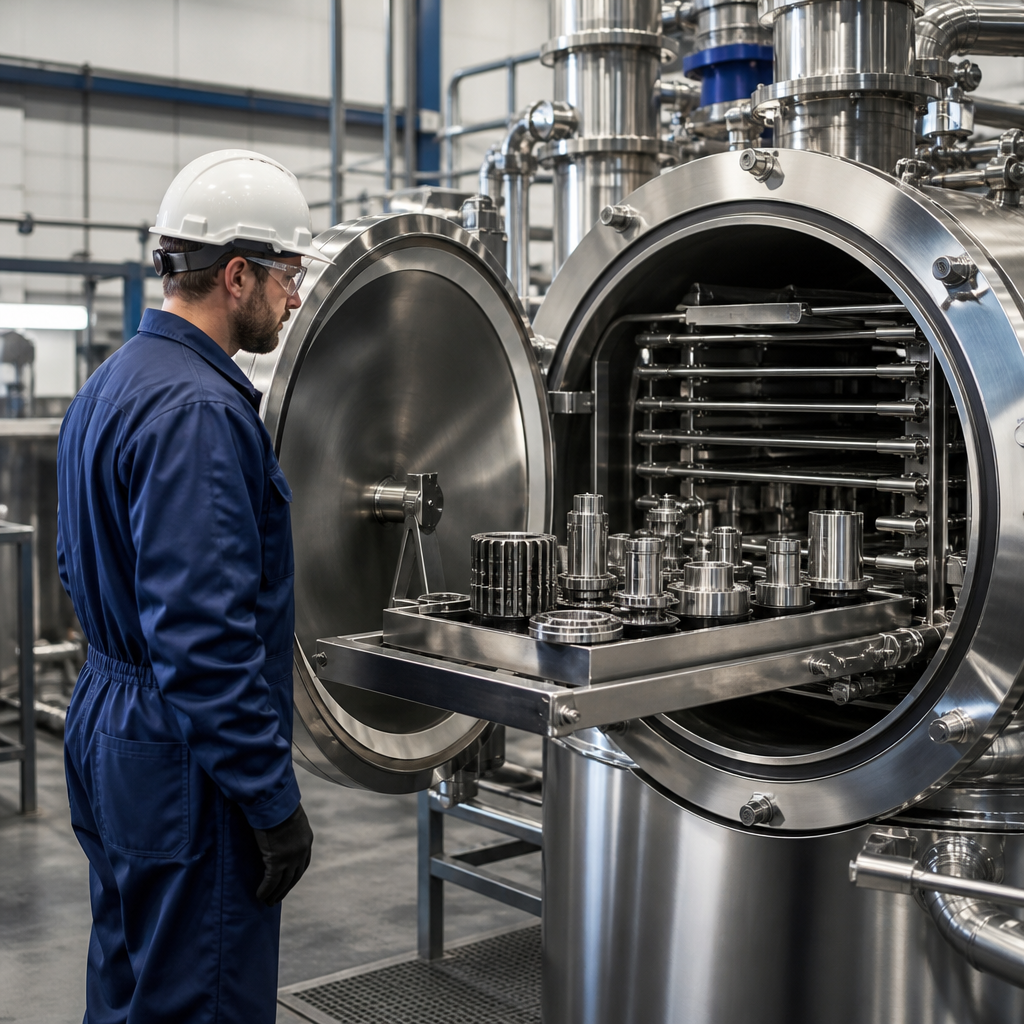
Fluid bed dryers suspend particles in an upward-flowing gas stream, creating excellent heat and mass transfer conditions. This technology works well for granular materials that can be fluidized without excessive attrition. Spray dryers convert liquid feeds into dry powders in a single step, making them essential for producing pharmaceutical intermediates and specialty chemicals. Vacuum dryers operate at reduced pressure to lower boiling points, protecting temperature-sensitive compounds from thermal degradation.
Specialized Drying Technologies
Freeze dryers preserve heat-sensitive biological materials and pharmaceuticals by sublimating frozen water under vacuum. Though expensive to operate, this technology maintains product structure and activity better than conventional thermal drying. Paddle dryers use heated agitators to mix and dry viscous materials, handling sticky or pasty feedstocks that would foul other equipment types. Thin-film dryers spread material across heated surfaces in continuous layers, achieving rapid drying with minimal thermal exposure.
Capital Equipment Decisions for Processing Facilities
Process engineers evaluating drying equipment must balance multiple technical and economic factors. Material throughput requirements determine minimum equipment capacity, while product specifications establish acceptable temperature ranges and residence times. Solvent recovery needs may mandate closed-loop systems with condensers and scrubbers. Safety considerations become paramount when processing flammable solvents or combustible dusts, requiring explosion-proof designs and inert gas atmospheres.
The secondary equipment market provides viable alternatives to new dryer purchases for many applications. Facilities can find used dryers for sale from decommissioned plants or operations that have upgraded their equipment, offering substantial capital savings while maintaining performance standards. Reconditioned industrial dryers often include updated controls and safety features, extending their useful life while reducing the financial barrier to capacity expansion or process improvements.
Equipment selection must also account for utility requirements and operating costs. Steam-heated dryers integrate well with existing boiler systems but may lack the temperature control of electric or thermal oil systems. Natural gas burners offer low-cost heat but require emissions controls. The total cost of ownership calculation should include energy consumption, maintenance requirements, and expected equipment lifespan rather than focusing solely on initial purchase price.
Integration with Upstream and Downstream Operations
Drying systems rarely operate in isolation within chemical processing facilities. The dryer must accept material in the form delivered by upstream filtration, centrifugation, or crystallization equipment. Feed consistency directly impacts drying efficiency—variations in moisture content, particle size, or cake density can cause processing bottlenecks or quality deviations. Chemical engineering principles guide the design of material handling systems that maintain feed uniformity and prevent segregation.
Downstream packaging or further processing steps impose constraints on dried material properties. Final moisture specifications typically include both average values and maximum limits to prevent quality failures. Particle size distribution must remain within acceptable ranges to ensure proper flow characteristics and dissolution rates. Residual solvent levels face regulatory limits in pharmaceutical and food-grade applications, requiring validated analytical methods and process controls.
Operational Challenges and Maintenance Considerations
Industrial dryers face multiple operational challenges that affect reliability and performance. Material buildup on internal surfaces reduces heat transfer efficiency and can lead to cross-contamination between product batches. Regular cleaning protocols must balance thoroughness against downtime costs. Abrasive materials accelerate wear on rotating components, requiring scheduled replacement of flights, paddles, or air distribution plates.
Temperature control systems require calibration and validation to maintain product quality. Hot spots within the drying chamber can cause localized overheating, degrading sensitive compounds or creating off-specification material. Insufficient drying leaves excess moisture that promotes microbial growth or chemical instability during storage. Process monitoring systems track critical parameters like inlet temperature, outlet temperature, air flow rates, and residence time to detect deviations before they impact product quality.
Safety and Environmental Compliance
Drying operations involving flammable solvents require comprehensive safety systems including explosion venting, inert gas blanketing, and continuous monitoring of solvent vapor concentrations. Static electricity buildup during powder handling presents ignition risks that proper grounding and bonding practices must address. Chemical storage and handling safety extends to the temporary accumulation of dried materials within processing equipment.
Environmental regulations govern emissions from dryer exhaust streams. Volatile organic compounds require capture through condensation, adsorption, or thermal oxidation before atmospheric release. Particulate emissions need filtration or wet scrubbing to meet air quality standards. Facilities must document compliance through periodic testing and maintain emissions control equipment to prevent violations.
Process Optimization and Performance Improvement
Optimizing dryer performance begins with understanding the drying kinetics of specific materials. Laboratory-scale tests establish drying curves that show moisture removal rates under different temperature and air flow conditions. These data inform scale-up calculations and help identify the rate-limiting mechanisms—whether surface evaporation, internal diffusion, or bound moisture removal controls overall drying time.
Energy efficiency improvements often focus on heat recovery from exhaust streams. Regenerative heat exchangers preheat incoming air using hot exhaust, reducing fuel consumption by recovering otherwise wasted thermal energy. Recirculating dryer designs minimize fresh air makeup, lowering heating requirements while maintaining process conditions. Variable frequency drives on blowers and agitators allow operators to match equipment output to actual process demands rather than running at fixed maximum capacity.
Advanced control strategies use real-time moisture measurements to adjust drying conditions dynamically. Near-infrared spectroscopy or microwave sensors provide continuous feedback, enabling closed-loop control that maintains target moisture content despite feed variations. Model predictive control algorithms optimize multiple variables simultaneously, balancing drying time, energy consumption, and product quality to maximize overall process economics.
About the Author