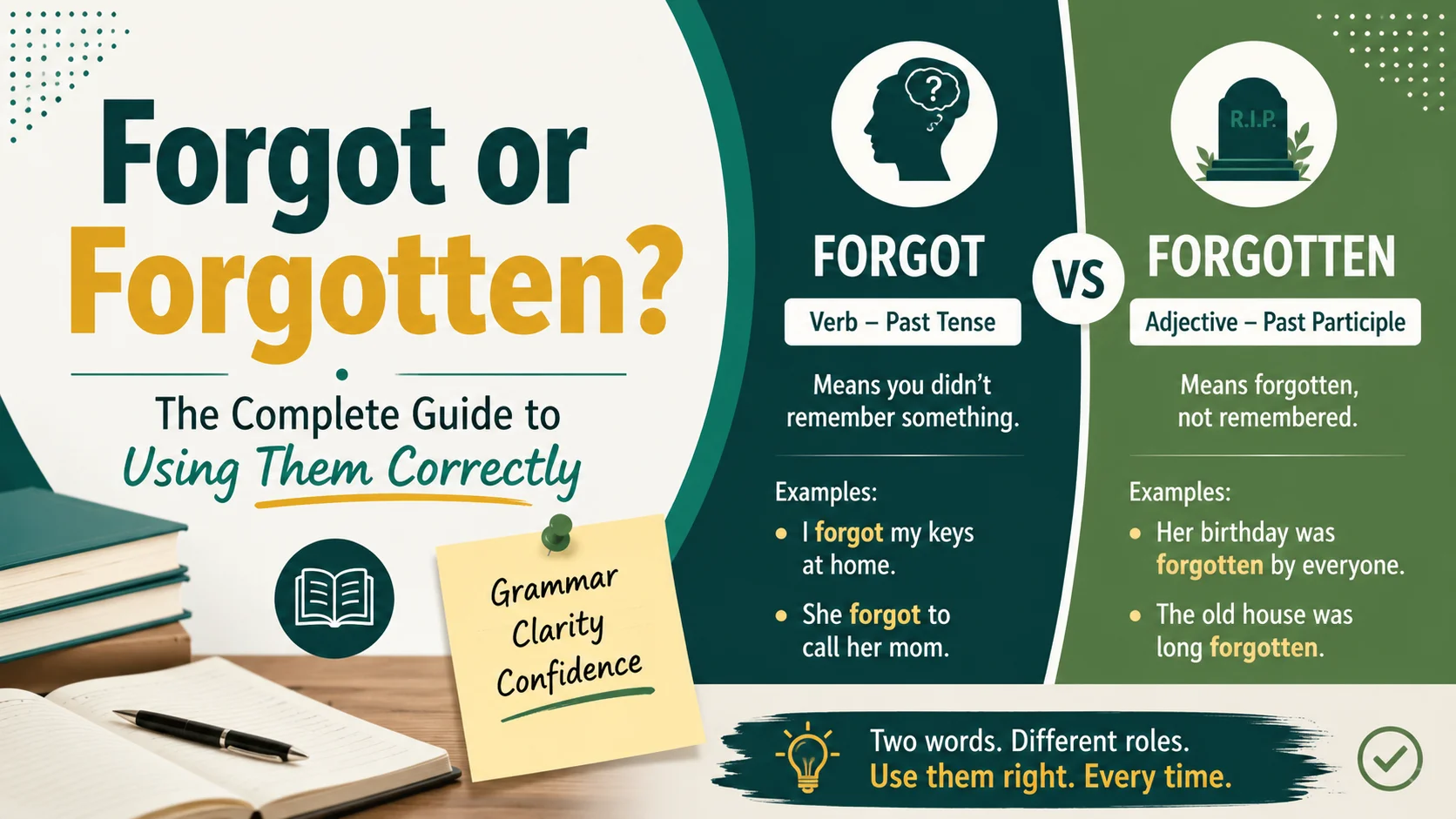
Forgot or Forgotten can be confusing because both forms come from the same irregular verb, but they have different grammatical roles in English grammar. Forgot is the simple past form, while forgotten is the standard past participle. In everyday English, I find it easiest to remember the difference by looking at the verb structure around each word. For example, “I forgot my wallet yesterday” uses the simple past because the action happened in the past.
The main distinction becomes clearer when you look at the sentence structure and the words that work with each form. Forgot can stand as the main verb in a simple past sentence, while forgotten normally needs auxiliary verbs or helping verbs such as have, has, or had. For example, “She forgot the appointment” is correct, while “She has forgotten the appointment” uses the past participle. This grammar rule helps you choose the correct form without relying only on whether something happened in the past.
When writing, speaking, or answering a grammar question, using the right form makes your sentence sound more natural and clearer. Learning the verb forms and practicing their use can prevent common mistakes. A simple trick is to connect forgot with the past tense and forgotten with the past participle. This pattern is also consistent with Cambridge Dictionary, which lists forget, forgot, forgotten, forgetting as the main forms of the verb.
Quick Answer: Forgot or Forgotten?
Forgot is the simple past form of forget.
I forgot my keys yesterday.
Forgotten is the past participle of forget. It’s commonly used with have, has, or had.
I have forgotten my keys.
The basic pattern looks like this:
| Form | Grammatical role | Example |
| forget | Base form | I often forget names. |
| forgot | Simple past | I forgot her name. |
| forgotten | Past participle | I have forgotten her name. |
| forgetting | -ing form | I keep forgetting names. |
| forgets | Third-person singular | She forgets things easily. |
So if you’re asking “Should I use forgot or forgotten?”, start by checking the sentence structure.
- I forgot → correct simple past
- I have forgotten → correct present perfect
- I had forgotten → correct past perfect
- I will have forgotten → correct future perfect
- I forgotten → incorrect in standard English
What Is the Difference Between “Forgot” and “Forgotten”?
The most important difference is grammatical rather than semantic.
Both forms come from forget, which means to fail to remember something, fail to remember an action, or stop thinking about someone or something.
However, forgot works as the simple past form:
She forgot the appointment.
Forgotten works as the past participle:
She has forgotten the appointment.
Think of the two forms as tools designed for different jobs. Using forgotten where you need the simple past is like using a screwdriver to hammer a nail. The words are related, but the grammatical job isn’t the same.
Forgot vs. Forgotten at a Glance
| Point | Forgot | Forgotten |
| Verb | Forget | Forget |
| Form | Simple past | Past participle |
| Common structure | Subject + forgot | Have/has/had + forgotten |
| Example | I forgot my wallet. | I have forgotten my wallet. |
| Main focus | Past event | Perfect construction or description |
| Standard US English | Correct | Correct |
The most useful rule is short:
Use “forgot” for the simple past. Use “forgotten” as the standard past participle.
The Verb Forms of “Forget”
Before looking at individual sentences, it helps to see the complete verb pattern.
| Verb form | Example |
| forget | Don’t forget your keys. |
| forgets | He often forgets appointments. |
| forgot | She forgot the address. |
| forgotten | We have forgotten the details. |
| forgetting | They are forgetting important information. |
English calls forget an irregular verb because its past forms don’t follow the regular -ed pattern.
You don’t say:
❌ I forgetted my keys.
You say:
✅ I forgot my keys.
You also don’t form the past participle as forgoted. Instead, the standard past participle is forgotten. Cambridge specifically lists forgot as the past tense and forgotten as the past participle.
When to Use “Forgot”
“Forgot” is used when talking about failing to remember something or leaving something out unintentionally.
“Forgot” for a Completed Past Event
Use forgot when you’re describing something that happened in the past.
I forgot my wallet.
She forgot his name.
We forgot about the meeting.
They forgot the address.
The simple past presents the forgetting as a past event.
If you mention a finished past time, forgot often sounds especially natural:
- yesterday
- last night
- last week
- two hours ago
- earlier
- when I was younger
For example:
I forgot my passport yesterday.
She forgot the appointment last Monday.
We forgot about the deadline earlier.
The important point isn’t simply that the action happened in the past. The sentence uses the simple past structure.
“Forgot” With a Noun
You can use forgot directly before a noun when someone failed to remember something.
I forgot my password.
He forgot his wallet.
She forgot the address.
We forgot the tickets.
This construction is extremely common in everyday American English.
Cambridge gives examples such as “I forgot my keys” for the meaning of failing to remember to bring something.
“Forgot to” + Verb
Another common structure is:
forgot + to + verb
This means someone failed to remember an action they needed to perform.
I forgot to call my sister.
She forgot to lock the door.
He forgot to send the email.
We forgot to buy milk.
This distinction matters because the action usually didn’t happen.
If you say:
I forgot to call John.
The natural meaning is that you didn’t call John because you failed to remember.
Cambridge identifies forget to do something as the structure used when someone doesn’t remember to perform an action.
When to Use “Forgotten”
“Forgotten” is used when something has been unintentionally left out of memory or no longer remembered.
“Forgotten” With Have or Has
The present perfect follows this pattern:
have/has + past participle
Because forgotten is the standard past participle of forget, you get:
I have forgotten.
She has forgotten.
They have forgotten.
For example:
I have forgotten his name.
She has forgotten the password.
We have forgotten the address.
The present perfect often connects a past event with the present situation.
Imagine someone asks you for a password. You reply:
“I’ve forgotten it.”
The important detail is that you still don’t remember it now.
Cambridge gives examples such as “I’ve forgotten your name” and “I’ve forgotten which” to illustrate this use.
“Forgotten” With Had
The past perfect uses:
had + past participle
Therefore:
I had forgotten.
She had forgotten.
They had forgotten.
For example:
I had forgotten my wallet before I reached the store.
There are two past events here:
- I forgot my wallet.
- I reached the store.
The forgetting happened first.
That’s why had forgotten works so well.
Simple Timeline
Earlier past: I had forgotten my wallet
↓
Later past: I reached the store
The past perfect gives readers a clear chronological signal.
“Forgot” vs. “Have Forgotten”
This distinction causes plenty of confusion because both sentences can describe the same basic situation.
I forgot her name.
I have forgotten her name.
Neither sentence is automatically wrong. The difference comes from how the speaker frames the event.
“I Forgot”
The simple past focuses on the past event.
I forgot her name during the conversation.
The sentence treats the forgetting as a completed past occurrence.
“I Have Forgotten”
The present perfect connects the past with the present.
I have forgotten her name.
The speaker is emphasizing the current state: the name isn’t available in memory now.
Consider this everyday exchange:
Person A: “What’s the name of that restaurant?”
Person B: “I don’t remember. I’ve forgotten it.”
Now imagine someone describing yesterday’s conversation:
“I forgot the restaurant’s name when she asked me.”
Both forms make sense because the speaker presents the same basic event from different grammatical angles.
“Forgot” vs. “Had Forgotten”
The difference between these forms is mainly about the relationship between two past events.
Simple Past
I forgot the document.
This simply tells us what happened.
Past Perfect
I had forgotten the document when I arrived at the office.
This shows that the forgetting happened before the arrival.
Here’s another example:
She realized that she had forgotten her phone.
First, she forgot the phone.
Then, she realized it.
The word had helped establish that sequence.
Is “I Have Forgot” Correct?
For standard US English, the preferred form is:
I have forgotten.
Not:
I have forgot.
Why? Because have in a perfect construction is followed by a past participle.
The pattern is:
have + past participle
For forget:
have + forgotten
Therefore:
I have forgotten.
She has forgotten.
They have forgotten.
And with the past perfect:
I had forgotten.
He had forgotten.
Cambridge’s American English entry identifies forgotten as the past participle while also noting forgot as an alternative past-participle form in its dictionary information.
For clear, standard writing, however, forgotten is the safest choice when it follows have, has, or had.
Can “Forgot” Be a Past Participle?
This question needs some nuance.
In contemporary English, forgotten is the standard past participle taught and used in the familiar pattern:
have forgotten
has forgotten
had forgotten
Cambridge’s American English dictionary lists forgotten as the primary past participle and also records forgot as an alternative.
That means encountering forgot in a construction such as have forgot doesn’t necessarily mean the form has never existed in English. Language contains regional, historical, and stylistic variation.
Still, variation doesn’t mean every form works equally well for every audience.
For formal US English, use:
I have forgotten.
rather than:
I have forgot.
That choice is clear, conventional, and unlikely to distract your reader.
“Forgotten” as an Adjective
Forgotten can also describe a noun.
For example:
a forgotten village
a forgotten tradition
a forgotten hero
a forgotten letter
In these sentences, forgotten tells you something about the noun.
Consider:
They discovered a forgotten letter in the attic.
Here, forgotten describes the letter.
You can also see the word in compounds such as:
a long-forgotten memory
The meaning is something that hasn’t been remembered for a long time.
This adjective-like use explains why forgotten sometimes appears without have, has, or had. The grammatical role has changed.
“Forget to Do” vs. “Forget Doing”
The difference between forget to do and forget doing is another important part of understanding this verb.
Forget to Do
This means you failed to remember an action that needed to happen.
I forgot to close the window.
The window wasn’t closed because the speaker didn’t remember to do it.
Other examples include:
- She forgot to call her mother.
- He forgot to submit the application.
- We forgot to turn off the lights.
- They forgot to bring the documents.
Forget Doing
This focuses on memory of an action or experience.
I’ll never forget visiting that museum.
The visit happened. The speaker is saying the experience will remain in memory.
Another example:
I don’t remember meeting him before.
With forget, the -ing structure can refer to something that actually happened but isn’t remembered. Cambridge specifically documents forget + -ing in examples involving remembered experiences.
A simple way to remember the distinction is:
forget to do = fail to remember an action
forget doing = fail to remember an action that happened
Common Mistakes With Forgot and Forgotten
The most common mistakes with “forgot” and “forgotten” happen when choosing between the simple past and past participle forms of forget.
Using “Forgotten” as the Simple Past
Incorrect:
❌ I forgotten my keys yesterday.
Correct:
✅ I forgot my keys yesterday.
Forgotten cannot normally stand alone as the simple past.
Leaving Out the Auxiliary Verb
Incorrect:
❌ I forgotten the password.
Correct:
✅ I forgot the password.
Or:
✅ I have forgotten the password.
The first sentence uses simple past tense. The second uses the present perfect.
Using “Forgot” After “Had”
Incorrect in standard usage:
❌ She had forgot the address.
Preferred:
✅ She had forgotten the address.
The structure is:
had + past participle
Therefore:
had forgotten
Confusing “Forgot” With “Forgot to”
These sentences aren’t identical:
I forgot my keys.
I forgot to bring my keys.
The first directly states that the keys weren’t remembered or brought.
The second specifically emphasizes failure to perform the action of bringing them.
Context determines the most natural construction.
Forgot or Forgotten: Useful Examples
| Situation | Correct sentence | Why |
| Past event | I forgot my wallet. | Simple past |
| Past event with time | I forgot it yesterday. | Simple past |
| Current result | I have forgotten my password. | Present perfect |
| Earlier past | I had forgotten the address. | Past perfect |
| Future completion | I will have forgotten it by then. | Future perfect |
| Failed action | I forgot to call her. | Forget + infinitive |
| Past experience | I won’t forget meeting him. | Forget + -ing |
| Description | a forgotten tradition | Adjective-like use |
A Simple Way to Remember the Difference
If the grammar feels confusing, remember the three-part sequence:
forget → forgot → forgotten
Then attach each form to its main job.
Forget → present or base form
Don’t forget the keys.
Forgot → simple past
I forgot the keys.
Forgotten → past participle
I have forgotten the keys.
One quick test can solve many questions:
Look for “Have,” “Has,” or “Had”
If the sentence contains one of these before the verb, you will generally need forgotten in standard US English.
I have forgotten.
She has forgotten.
They had forgotten.
If you’re simply describing a completed past event, use forgot.
I forgot.
She forgot.
They forgot.
It’s a small rule, but it covers a surprisingly large number of real-world sentences.
Conclusion
Understanding forgot and forgotten becomes easier when you focus on their grammatical roles. Use forgot as the simple past form when describing a completed action in the past. Use forgotten as the past participle with have, has, or had. Once you recognize the verb structure, you can choose the correct form and avoid common mistakes in everyday English.
FAQs
Q1. Is “I have forgot” correct?
No. In standard English, use “I have forgotten.” The word forgotten is the past participle, which follows have.
Q2. Is “I forgot” correct?
Yes. Forgot is the simple past form of forget. For example: “I forgot my keys yesterday.”
Q3. What is the difference between forgot and forgotten?
Forgot is the simple past form, while forgotten is the past participle. The surrounding verb structure determines which form you need.
Q4. Should I use “forgot” after did?
Yes. After that, use the base form forget, not forgot. For example: “Did you forget your appointment?”
Q5. How can I remember when to use forgot and forgotten?
A simple trick is to remember: forgot = simple past, while forgotten = past participle. If you see have, has, or had, forgotten is usually the correct choice.
About the Author