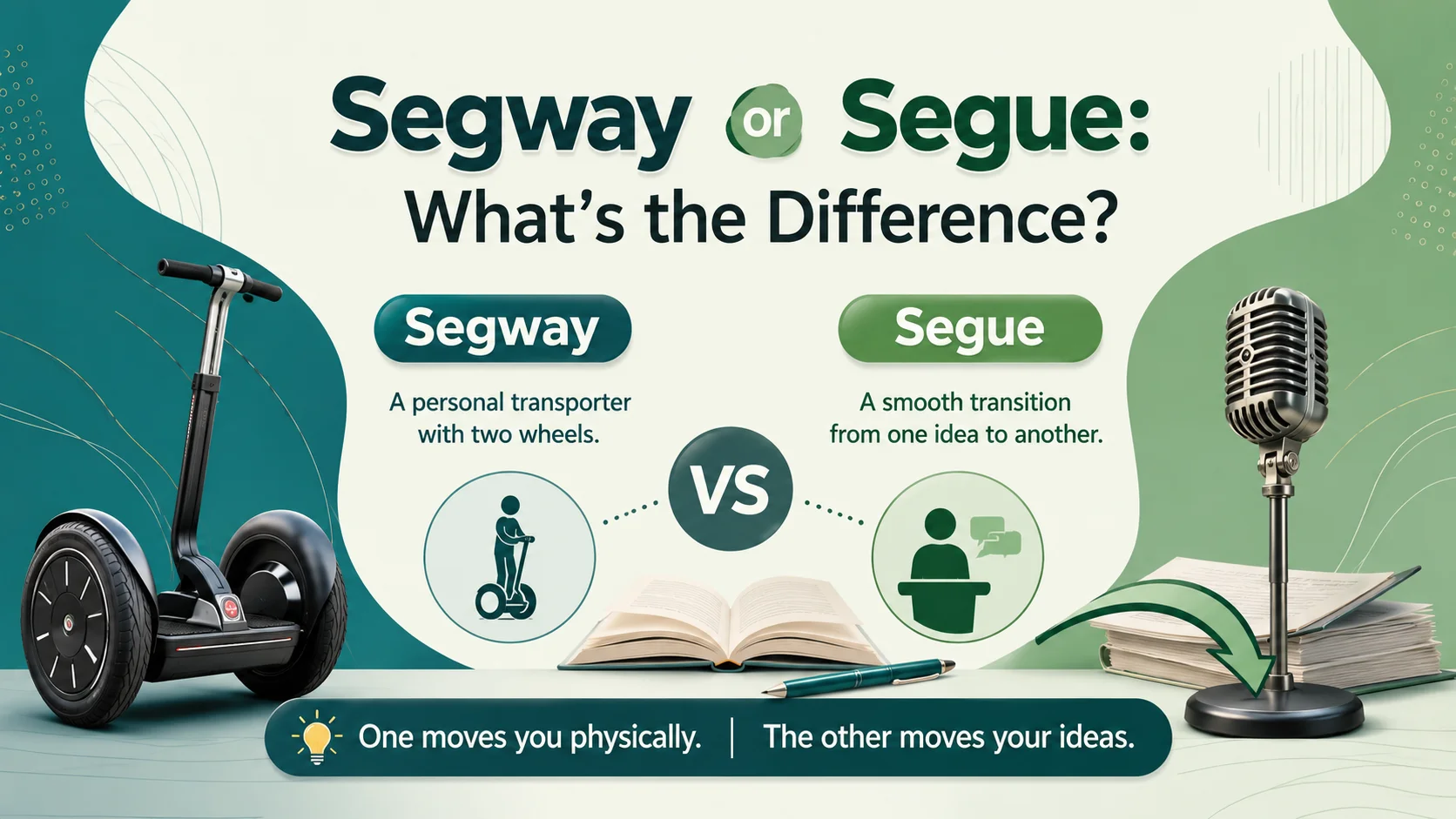
Segway or Segue can sound alike, but these English words have completely different meanings. Segue describes a smooth transition from one subject, idea, or situation to another, while Segway refers to a brand of self-balancing personal transportation. This classic example shows how pronunciation can make two words seem connected even when they belong to different worlds. Cambridge gives the pronunciation /ˈseɡ.weɪ/ for Segway, while the spelling difference helps readers choose the correct word in writing. Segue can work as a noun or verb, whereas Segway, with a capital S, identifies a transportation brand and its products.
The difference can seem tricky, especially in conversation, because the words may feel like distant cousins at the same family reunions. Think of the confusion as a slip of the tongue, a wrong turn, or a wrong path through the English language. Although the words have different purposes, a term can sometimes sound synonymous with another without having the same meaning. Segway connects with two-wheeled personal transporters, while segue is an elegant word borrowed from music. In music, a segue describes a natural movement from one section to another without a pause, which makes its meaning easier to remember.
On the flip side, knowing the context can help you avoid mix-ups, amusing situations, and confusing situations. Even though the words sound the same, they mean different things. If someone is riding a vehicle through a park or along city sidewalks, Segway is the right word because you are talking about the brand name. If a speaker is moving smoothly from one topic to another during conversations, the term used is segue. Segway has zoomed into our vocabulary, but segue remains useful whenever you are referring to a change from one part of an idea to another.
Quick Answer: Segue or Segway?
Segue and Segway are pronounced the same, but their meanings are entirely different.
| Word | Meaning | Common Use | Example |
| segue | A smooth transition | Writing, conversation, music, presentations | “That question provides a natural segue into the next topic.” |
| Segway | A transportation brand/product | Personal transportation and mobility | “The tourists explored the city on a Segway.” |
A simple rule makes the distinction easy:
Segue = transition. Segway = transportation.
So, if you’re changing subjects, choose segue. If you’re talking about riding a Segway product, choose Segway.
What Does Segue Mean?
Segue means to move smoothly and naturally from one thing to another. The transition can involve a conversation, story, subject, situation, or piece of music.
Cambridge defines segue as moving easily and without interruption from one piece of music, part of a story, subject, or situation to another. It can function as both a noun and a verb.
The central idea is continuity. One thing leads naturally into the next rather than stopping abruptly.
For example:
- “The host used the question as a segue into the next discussion.”
- “The speaker segued from education to technology.”
- “The final scene segues into the opening of the next episode.”
- “That story gives us a perfect segue into the next section.”
Think of a segue as a bridge between two ideas. You don’t suddenly jump across the river. You cross smoothly.
Segue as a Noun
As a noun, segue refers to the transition itself.
For example:
“The joke was a clever segue into a more serious discussion.”
Here, segue names the connection between the humorous part and the serious discussion.
You can also use the plural segues:
- “The presentation contained several smooth segues.”
- “Her segues between topics kept the interview flowing.”
Segue as a Verb
As a verb, segue means to transition smoothly.
Common forms include:
- segue
- segues
- segued
- segueing
Examples:
- “The discussion segued into workplace culture.”
- “The documentary segues from history into modern politics.”
- “The presenter is segueing into the final section.”
One particularly common mistake is writing segwayed when the intended word is the verb segue. If you’re describing a transition, write segued, not segwayed.
Segue in Music
The word has a strong connection to music. A musical segue occurs when one piece, section, or musical idea flows into another without a break.
That musical sense helps explain the modern figurative meaning. Instead of stopping completely between two pieces, the music moves naturally from one to the next.
For instance:
“The final track segues directly into the opening notes of the next song.”
From there, English speakers began using the word more broadly for smooth transitions between subjects and situations. Today, you can find segue in discussions about music, writing, television, interviews, presentations, and everyday conversation.
Where Does the Word Segue Come From?
Segue comes from Italian and entered English through its musical use. Its original sense involved continuing directly from one musical passage into another.
That history explains something important about the word’s meaning: segue has always carried the idea of continuity.
Over time, English speakers expanded the word beyond music. A transition between songs became a useful metaphor for transitions between ideas.
Today, you might say:
- “Let’s segue into the budget discussion.”
- “The article segues from grammar rules into practical examples.”
- “Her answer created a natural segue to the next question.”
The subject can change dramatically. The underlying idea doesn’t: one thing flows into another.
What Does Segway Mean?
Segway is different. It refers to the Segway brand, which became known for self-balancing personal transportation products.
The company says Segway was established in 1999 in Bedford, New Hampshire, and emerged as a pioneer in self-balancing personal transporters. In 2015, Segway and Ninebot completed a strategic merger that created Segway-Ninebot.
The brand’s history includes the Segway Human Transporter, later known as the Segway Personal Transporter. The company says its Segway PT went on sale to the public in 2002.
Today, Segway-Ninebot operates across several mobility and technology categories. Its official company information lists products and technologies involving electric scooters, e-bikes, powersports vehicles, personal robotics, and self-balancing vehicles.
What Is a Segway Personal Transporter?
The original Segway personal transporter was designed around self-balancing technology.
Unlike a conventional bicycle, the device doesn’t require the rider to maintain balance in the same way. Its two-wheel configuration and electronic control system help the rider move and steer the vehicle.
That’s why the word Segway belongs in transportation-related sentences:
- “We rented a Segway for the tour.”
- “The guide showed us how to operate the Segway.”
- “The park offers Segway tours.”
- “He learned to ride a Segway.”
The important point isn’t the specific model. It’s the meaning of the word in context.
A Brief History of the Segway Brand
Here are several useful milestones:
| Year | Segway milestone |
| 1999 | Segway was founded by inventor Dean Kamen. |
| 2001 | The Segway Human Transporter was publicly introduced. |
| 2002 | Segway PT products went on sale to the public. |
| 2015 | Segway and Ninebot merged. |
| 2020 | Ninebot became listed on the Shanghai Stock Exchange’s STAR Market. |
These dates come from Segway’s own company and historical materials.
Segue vs. Segway: The Key Differences
The spelling may differ by only a few letters, but the meanings don’t overlap.
Meaning Difference
Segue describes a transition.
Segway identifies a brand associated with personal transportation.
Compare these sentences:
- “The speaker made a smooth segue into the final topic.”
- “The visitors rode a Segway through the city.”
The first sentence concerns an idea transition. The second concerns transportation.
Grammar Difference
Segue can work as both a noun and a verb.
Examples:
- Noun: “That was an excellent segue.”
- Verb: “She segued into another subject.”
Segway, when referring to the brand, functions as a proper noun.
Example:
- “They rented a Segway.”
That distinction makes the words easier to separate when you’re writing.
How Do You Pronounce Segue and Segway?
Here’s the tricky part: segue and Segway are pronounced alike.
Cambridge gives segue the pronunciation /ˈseɡ.weɪ/.
In simple terms, both sound roughly like “SEG-way.”
segue (SEG-way)
The identical pronunciation explains much of the confusion. You might hear someone say the word during a podcast or presentation and know exactly what they mean, yet still be unsure which spelling belongs on the page.
That’s where context steps in.
Why Do Segue and Segway Get Confused?
The main reason is straightforward: they sound the same.
When people learn a word primarily through speech, they may create a spelling based on the sounds they hear. Segway looks almost like a phonetic spelling of segue, especially because the pronunciation sounds exactly like “Seg-way.”
There’s another factor, too. Segway is a familiar brand name. Once you’ve seen Segway associated with transportation, that spelling can become mentally dominant.
When to Use Segue
Use segue whenever you’re describing a smooth movement from one topic, idea, section, or situation to another.
Segue in Conversation
“That’s a great segue into something I’ve been meaning to ask.”
This sentence describes a conversational transition.
Segue in Writing
“The final paragraph provides a natural segue into the next chapter.”
Here, one part of the writing leads smoothly into another.
Segue in Presentations
“With that background established, let’s segue into the practical examples.”
The speaker changes subjects without making the shift feel abrupt.
Segue in Music and Media
“The song segued into the next track without a pause.”
That’s a direct use of the word’s musical sense.
When to Use Segway
Use Segway when you’re referring to the brand or its products.
Examples include:
- “We took a Segway tour.”
- “The guide demonstrated the Segway.”
- “She learned to ride a Segway.”
- “The company develops Segway mobility products.”
If you could replace the word with a reference to the transportation product or brand, Segway is likely the correct choice.
Segue vs. Segway Examples in Real Sentences
A side-by-side comparison makes the difference crystal clear.
| Sentence | Correct Word | Meaning |
| “The host used the question as a natural segue.” | segue | Transition |
| “The presenter segued into the final topic.” | segue | Changed subjects smoothly |
| “The documentary segues into a discussion of modern culture.” | segue | Moves smoothly between subjects |
| “We rented a Segway during our tour.” | Segway | Transportation brand |
| “The guide taught us how to ride a Segway.” | Segway | Personal transporter |
| “They offer Segway tours around the city.” | Segway | Transportation/product |
Incorrect vs. Correct Usage
| Incorrect | Correct | Reason |
| “That’s a great Segway into our next topic.” | “That’s a great segue into our next topic.” | The sentence describes a transition. |
| “The speaker segwayed into the conclusion.” | “The speaker segued into the conclusion.” | The verb is segue. |
| “We rented a segue for the tour.” | “We rented a Segway for the tour.” | The sentence refers to transportation. |
These aren’t merely spelling preferences. Changing the spelling changes the meaning.
Common Mistakes With Segue and Segway
Common mistakes with segue and Segway usually happen because they sound alike, even though they have completely different meanings and uses.
Using Segway for a Topic Transition
This is probably the most common mistake.
Incorrect:
“Let’s use that as a Segway into the next topic.”
Correct:
“Let’s use that as a segue into the next topic.”
The speaker isn’t talking about a vehicle. They’re talking about a smooth transition.
Using Segue for the Vehicle
The reverse mistake also occurs.
Incorrect:
“We booked a segue tour.”
Correct:
“We booked a Segway tour.”
Here, the word refers to a transportation product, so Segway is appropriate.
Writing Segwayed Instead of Segued
If you’re using the word as a verb, the correct form is segued.
Correct:
“The conversation segued into a discussion about travel.”
Incorrect:
“The conversation segwayed into a discussion about travel.”
The extra w doesn’t belong in the verb.
Easy Ways to Remember Segue vs. Segway
You don’t need a complicated mnemonic. A simple mental picture works better.
Remember Segue = Smooth Transition
Think:
Segue → shift smoothly.
If you’re moving from one idea to another, choose segue.
“The interview segued from sports into education.”
Remember Segway = Something You Ride
Think:
Segway → transportation.
If you’re talking about riding the product, choose Segway.
“They rode a Segway around the historic district.”
Use the One-Question Test
Before typing the word, ask yourself:
Am I describing a transition?
- Yes → segue
Am I referring to the transportation brand/product?
- Yes → Segway
That quick test eliminates most mistakes.
Segue or Segway: Which Spelling Is Correct?
Both spellings are correct, but they aren’t interchangeable.
Use segue when you mean:
- transition
- smooth change
- movement between subjects
- movement between sections
- musical transition
Use Segway when you mean:
- the Segway brand
- a Segway personal transporter
- Segway-related products
- Segway tours or transportation
The easiest rule remains:
If you’re changing topics, use “segue.” If you’re riding it, use “Segway.”
Quick Reference: Segue vs. Segway
| Feature | Segue | Segway |
| Meaning | Smooth transition | Transportation brand/product |
| Pronunciation | “SEG-way” | “SEG-way” |
| Part of speech | Noun and verb | Proper noun |
| Main context | Ideas, music, writing, conversation | Personal transportation |
| Example | “She made a smooth segue.” | “He rode a Segway.” |
| Past tense | segued | Usually not used as an ordinary verb |
| Capitalization | Usually lowercase | Usually capitalized |
Conclusion
The difference between Segway or Segue becomes much easier once you focus on their meanings rather than their similar sounds. Segway refers to a two-wheeled, self-balancing vehicle and transportation brand, while segue describes a smooth transition from one topic, subject, or part to another. Remembering this simple distinction can help you choose the right word in both writing and conversation.
FAQs
Q1. What is the difference between Segway and segue?
Segway is a brand associated with self-balancing personal transporters, while segue means a smooth transition from one subject or idea to another.
Q2. Are Segway and segue pronounced the same?
They can sound very similar in everyday speech, which is one reason people often confuse them.
Q3. Is segue a noun or a verb?
Segue can be used as both a noun and a verb, depending on how it appears in a sentence.
Q4. What does Segway mean?
Segway refers to a brand of self-balancing, two-wheeled personal transportation vehicles and related products.
Q5. What does segue mean in conversation?
In conversation, segue means to move smoothly from one topic or idea to another without an awkward break.
Q6. Why do people confuse Segway and segue?
People often confuse them because they sound alike, even though their spellings, meanings, and uses are different.
Q7. How can I remember Segway vs. segue?
Think of Segway as a vehicle and segue as a transition between ideas. This simple association makes the difference easier to remember.
About the Author