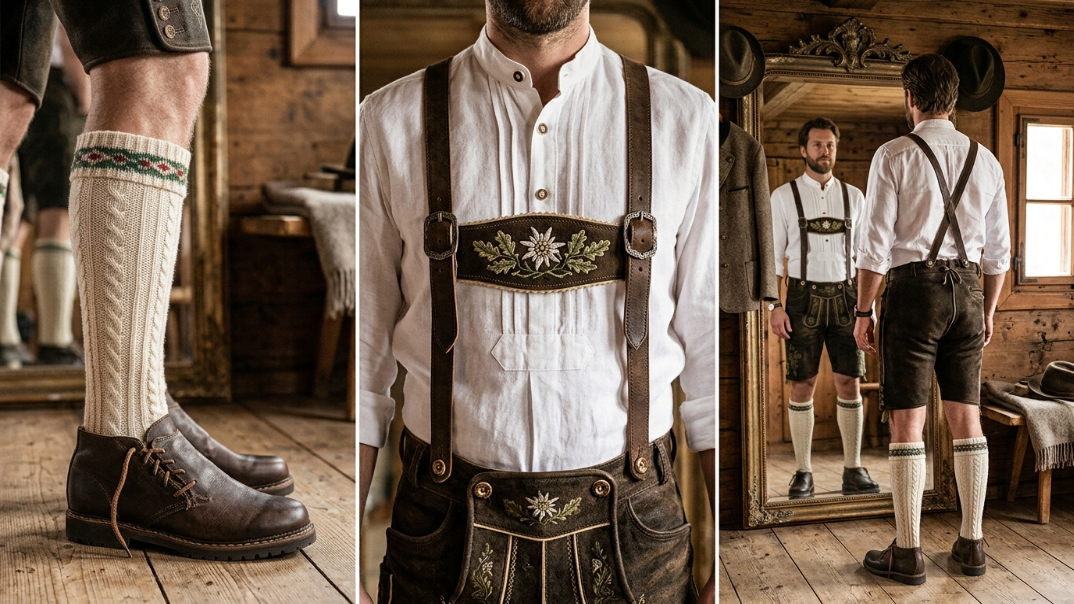
Buy the trousers and you own the centerpiece — but the tradition never dressed in centerpieces alone. The complete look is a system, and its three accessory pillars carry far more of the outfit’s authenticity than their price tags suggest: the wool socks filling the zone every photograph shows, the suspenders holding the outfit’s visual center, and the sturdy shoes grounding the whole silhouette. Experienced eyes at any festival read these three zones before anything else, which makes the accessories the cheapest credibility in the entire wardrobe. This guide covers each pillar completely — the traditional forms, the quality standards, and the pairing rules that finish a lederhosen outfit the way the tradition intended.
Lederhosen Socks: The Zone Everyone Sees
The Traditional Forms
Classic lederhosen end at or above the knee, and the calf below them is the outfit’s most visible skin zone — which is why the tradition developed specific answers for it. The full trachten sock — a wool knee sock in cream, natural grey or loden green, worn folded once below the knee — is the standard, its cable and rib knitting inherited from centuries of Alpine craft. The Loferl — a two-piece set of ankle socks plus separate calf warmers worn centered on the muscle with a visible ankle gap — is the older working style and the connoisseur’s signal.
Quality and Pairing
Real wool is the entire game: warmth regulation across a long festival day, cushioning for ten standing hours, and the matte textured look the tradition requires — where the costume tier’s thin acrylic tubes slide, pill and shine. Pairing socks with lederhosen follows the palette: cream as the universal answer against every leather tone, grey for darker rustic registers, green threading the Alpine connector color to the ankle. Two to three pairs rotate a full festival season and serve for years.
The Sock Rotation: How Many Pairs, Which Colors
The efficient sock ownership plan is small and specific. Two to three pairs cover a complete festival season: cream as the universal base (correct against every leather tone and register), plus one variation — natural grey for darker rustic looks, or green-flashed cream threading the Alpine connector color to the ankle. Multi-day events run the pairs in rotation, gently machine-washed on wool settings between festival days, and quality knits serve five or more seasons before retirement. The Loferl set joins the rotation when the wardrobe’s traditional depth earns it — the two-piece being the upgrade that signals fluency rather than the starting requirement. One sizing note completes the plan: sock sizing runs by shoe size with calf width noted on Loferl calf pieces, and the ribbed cuff should grip firmly at the fold — the single construction feature that decides whether the socks stay put through a bench-dancing evening.
Lederhosen Suspenders: The Visual Center
The H-Bar Tradition
Suspenders for lederhosen are not an accessory choice but the garment’s engineered suspension: traditional pairs are cut with natural-waist rise and dedicated buttons because shoulder straps — not belts — were always meant to carry the leather’s real weight. The traditional architecture is the H-bar: two leather straps joined across the chest by the decorated crossbar (Steg), whose embroidered Edelweiss, oak leaves and stags make it the outfit’s ornamental centerpiece.
Quality and Wearing
Genuine lederhosen suspenders are leather-built with button or buckle-tab attachment and solid metal hardware — clip-on elastic straps are the costume tier’s instant tell. Wearing follows fixed conventions: straps over the tucked shirt, crossbar at mid-chest, tension carrying the trousers at the natural waist. Worn correctly, lederhosen with suspenders read authentic at a glance; worn with clips, over an untucked shirt, or half-down, they read the opposite just as fast. No single accessory moves the outfit’s credibility further per dollar.
Lederhosen Footwear: Grounding the Silhouette
The Traditional Shoes
The classic shoes lederhosen pair with are the Haferlschuhe — sturdy Alpine leather shoes recognizable by their offset side lacing, robust uppers and grounded soles, born as mountain workwear and standard festival footwear for generations. Traditional leather ankle boots carry the same register with more coverage for cold and outdoor events. Together they define lederhosen footwear: dark leather, traditional profile, built for a full day standing.
Pairing and the Modern Question
The mens lederhosen shoes convention completes the ankle zone as a unit: dark trachten shoes below, wool socks above, leather ending at the knee — every element answering the others. The modern question gets a straight answer: clean minimalist sneakers have earned a niche at casual festivals, but never under wool knee socks — the wool-over-sneakers hybrid is the one combination every register rejects. Dress oxfords and branded athletic shoes stay home entirely; the outfit’s rural DNA refuses both.
Building the Accessory Set
The efficient complete set is small: two to three pairs of wool socks (cream base, one variation), one quality leather H-bar suspender set matched to the trousers’ tone, and one pair of traditional shoes or boots. Together they cost a fraction of the trousers they complete — and they transform every pair of lederhosen owned, present and future, because accessories transfer across the whole wardrobe. The buying screen is the tradition’s usual one, applied small: wool named on socks, leather named on straps and shoes, real hardware throughout, and the costume tier’s acrylic-elastic-vinyl substitutions declined at every position.
Order timing follows the category’s season: accessory stock in popular sizes thins alongside everything else as festival season opens — one cart, ordered early, completes the system.
The Head-to-Toe Order of Dress
The accessories earn their full effect only in the right assembly sequence, and the traditional order of dress is worth learning once. Socks first, positioned and folded before the trousers complicate reaching them. Trousers second, seated at the natural waist. Shirt third — tucked completely and smoothed, because everything above builds on it. Suspenders fourth: over the shirt, buttoned front and rear, crossbar centered at mid-chest, tension set to carry the trousers’ weight. Shoes fifth, laced over the positioned socks. Vest, jacket and hat follow in that order when the register calls them.
The sequence matters because each layer locks the one beneath: a shirt tucked after the suspenders never sits right; socks adjusted after the shoes never fold clean. Dressed in order, the complete system takes five minutes and holds for twelve hours — which was, historically, exactly the specification it was designed to.
Caring for the Accessory Set
The set’s maintenance asks minutes per season. Wool socks: gentle wash, air dry, and the occasional darned heel that the tradition considers membership rather than thrift. Leather suspenders: a wipe after spills, a light conditioning once or twice a year, hanging storage with the crossbar flat. Traditional shoes: brushed after festival dust, conditioned a few times yearly, resoled when the day comes rather than replaced — Alpine shoe construction was always meant to outlast its first soles. Under that minimal regimen the accessories do what the trousers do: age into character, and outlast every costume-tier substitute by a decade.
Frequently Asked Questions
What socks do you wear with lederhosen?
Wool trachten socks — cream, grey or loden knee socks folded below the knee — or the traditional two-piece Loferl with calf warmers and a visible ankle gap.
Are suspenders required with lederhosen?
They are the engineered system: traditional pairs are cut for shoulder suspension with dedicated buttons. Belts are a modern casual liberty, not the standard.
What shoes go with lederhosen?
Haferlschuhe — the side-laced Alpine leather shoes — or traditional leather boots; dark tones, sturdy soles, worn with the wool sock zone above.
Can you wear sneakers with lederhosen?
Clean minimalist sneakers pass at casual festivals — but never under wool knee socks. The full traditional look takes traditional shoes.
How much do proper accessories matter?
Disproportionately — socks, suspenders and shoes are the three zones experienced eyes read first, and the cheapest authenticity upgrade in the wardrobe.
What order do you put on a lederhosen outfit?
Socks, trousers, tucked shirt, suspenders, shoes — then vest, jacket and hat as the register requires. Each layer locks the one beneath it.
How long do quality lederhosen accessories last?
Years to decades: wool socks serve five-plus seasons, leather suspenders and traditional shoes age into character across ten or more with minutes of yearly care.
The System, Completed
Lederhosen accessories are where outfits stop being purchases and start being the tradition: real wool at the calf, a leather H-bar at the chest, Alpine shoes at the ground — three modest pillars carrying the look’s credibility from knee to shoulder. Build the small set once, hold the material standards, wear the conventions — and every pair of lederhosen you ever own arrives complete the moment you put it on. That was always the system’s promise, and it still costs less than the trousers it finishes.
About the Author