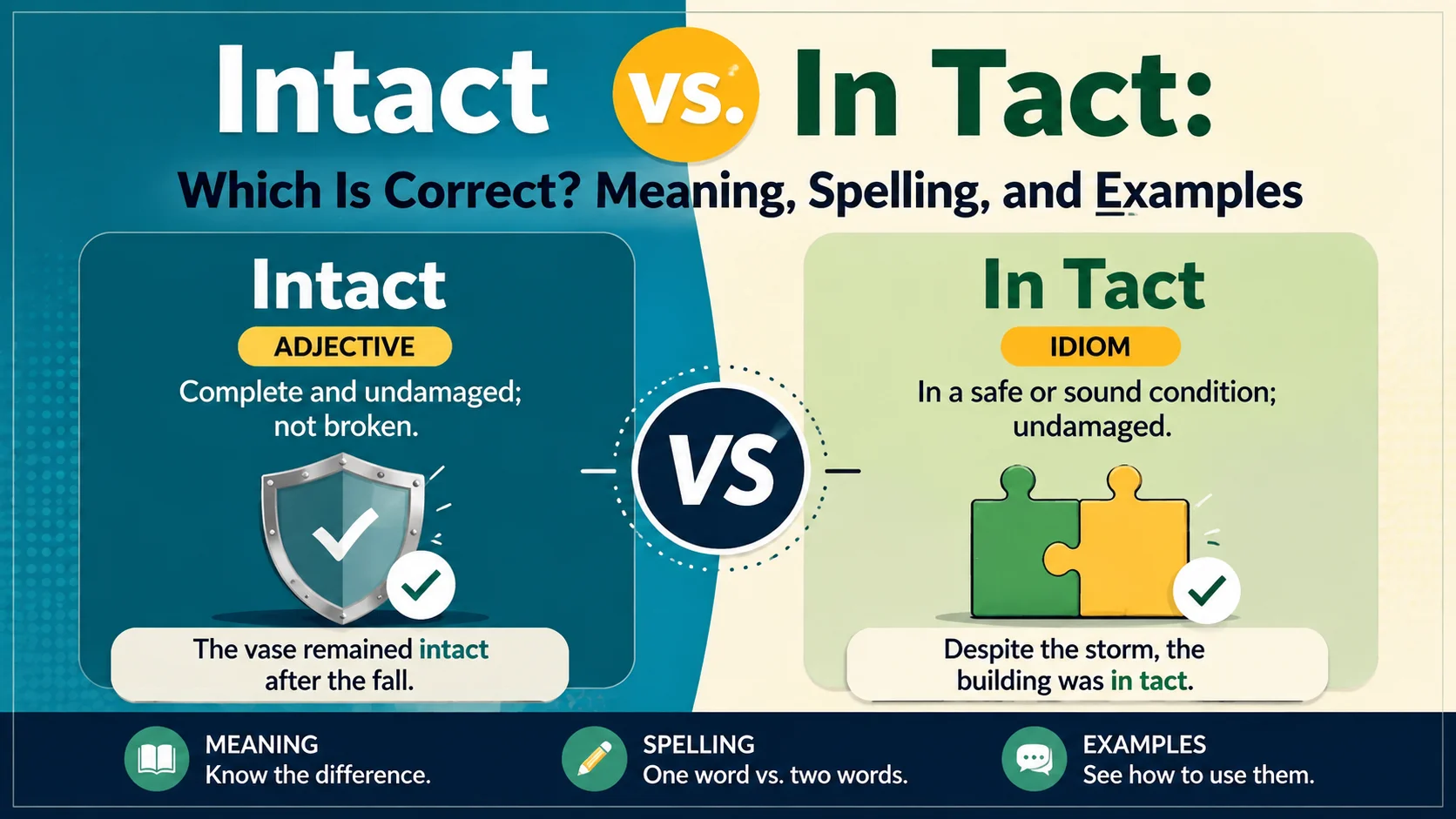
Intact vs in Tact often causes confusion because these spelling pairs can sound alike. When you’re writing quickly, a small spacing mistake can turn the standard word into an incorrect form. Intact is the standard spelling and an adjective that describes something whole, complete, untouched, unbroken, or undamaged. For example, after an accident, a vase may have remained intact even if other things around it were damaged. This simple meaning helps you understand why intact is the correct choice.
The expression in tact is usually a mistakenly separated version of intact, so it isn’t a standard phrase when you want to describe something as whole or undamaged. However, tact is a separate noun that means sensitivity or good judgment when dealing with people, especially in delicate situations. Because in tact can have a different form and possible meaning, it’s important not to treat the two expressions as interchangeable. In everyday English, knowing this distinction makes your writing more precise.
In an email or an essay, use the correct usage of intact when you mean something has stayed whole or undamaged. Avoid the incorrect spelling because choosing the right words improves clarity, professionalism, and effective communication. In professional communication as well as everyday English communication, this small distinction can help you improve each sentence. As a useful example, if the answer is that an original document stayed complete, you can say that it remained intact. This article uses the correct form to make the difference easier to remember.
Intact vs. In Tact: Quick Answer
Intact is the correct spelling when you mean that something remains whole, complete, original, or undamaged.
In tact is not the standard spelling when you want that meaning.
The separate word tact is correct when you’re talking about the ability to handle people or sensitive situations carefully.
| Word or phrase | Standard form? | Meaning | Example |
| intact | Yes | Whole, complete, or undamaged | The package arrived intact. |
| in tact | No, for this meaning | Not the standard spelling of intact | Avoid this spelling. |
| tact | Yes | Sensitivity and skill when dealing with others | She handled the criticism with tact. |
A simple rule makes the difference easy:
If something remains whole, use “intact.” If someone handles a delicate situation skillfully, use “tact.”
What Does “Intact” Mean?
Intact is an adjective that describes something that has remained whole, complete, or undamaged. Merriam-Webster defines it as untouched by something that harms or diminishes it, while Cambridge also describes it as remaining complete and in its original state.
The word can describe much more than physical objects. You can use intact for buildings, documents, relationships, reputations, records, plans, traditions, and other things that remain preserved.
For example:
- The ancient structure survived the earthquake intact.
- The documents were returned intact.
- Their friendship remained intact after the disagreement.
- The team’s undefeated record is still intact.
- The original design remains intact.
In each sentence, intact suggests that something has survived without losing its essential condition.
Intact: Definition, Pronunciation, and Part of Speech
Intact functions as an adjective.
Its US pronunciation is approximately in-TAKT, with the stress on the second syllable. Cambridge lists the US pronunciation as /ɪnˈtækt/.
Useful synonyms include:
- whole
- complete
- undamaged
- untouched
- preserved
- unimpaired
- entire
These words overlap with intact, but they aren’t always perfect substitutes. Intact particularly emphasizes that something has retained its original or complete condition. Merriam-Webster notes this distinction among related words such as whole and entire.
Common Uses of “Intact”
The word intact works naturally in several contexts.
Physical objects:
“The vase survived the move intact.”
Here, the vase didn’t break or suffer damage.
Buildings and structures:
“Much of the original building remains intact.”
The structure has retained its essential form.
Documents and records:
“The original records were found intact.”
The records weren’t destroyed or significantly altered.
Relationships:
“Despite the disagreement, their friendship remained intact.”
The friendship survived the conflict.
Reputations:
“She left the controversy with her reputation intact.”
Her reputation wasn’t seriously damaged.
Records and achievements:
“The athlete’s unbeaten record remains intact.”
The record still exists because nobody has broken it.
Cambridge specifically gives examples involving an undamaged altar, an intact mammoth skull, a reputation, and an undefeated record.
What Does “In Tact” Mean?
When you want to say that something is whole or undamaged, in tact is not the standard spelling.
The confusion probably feels natural because in and tact are both legitimate English words. Yet putting two real words together doesn’t automatically create a standard compound.
Think of it this way: intact is its own established word. It isn’t normally written as in tact when it carries the meaning “whole” or “undamaged.”
So write:
- The package arrived intact.
- The original painting remained intact.
- Their agreement stayed intact.
Don’t write:
- The package arrived in tact.
- The original painting remained in tact.
- Their agreement stayed in tact.
What Does “Tact” Mean?
Tact is a completely different word. It’s a noun referring to the ability to say or do the right thing without unnecessarily offending someone. Cambridge defines it as the ability to communicate or act without making people unhappy or angry.
For example:
- She handled the complaint with tact.
- His manager addressed the mistake with tact.
- It takes tact to discuss sensitive issues.
- He answered the difficult question with remarkable tact.
The related adjective is tactful:
“She gave a tactful response.”
The opposite is tactless:
“His tactless comment made the situation worse.”
Merriam-Webster traces tact to French and ultimately Latin tactus, connected with the idea of touch. The word’s meaning developed toward the figurative idea of having a sensitive perception of how to deal with people.
That’s an interesting connection: good tact is almost like having a sensitive touch in a difficult conversation.
Why Do People Confuse “Intact” and “In Tact”?
The main problem is word spacing.
When people hear intact, they may mentally divide its sounds into in + tact because both parts resemble familiar English words. Written English doesn’t always make word boundaries obvious from pronunciation alone.
There is also a genuine connection in the history of the word. Merriam-Webster traces intact to Middle English intacte and Latin intactus, formed from in- plus tactus. Its first known English use dates to the 15th century.
That historical connection doesn’t make in tact the modern spelling in tact, though. Today, when the intended meaning is “whole” or “undamaged,” standard English uses the single word intact.
Intact vs. Tact: The Meaning Makes the Difference
The easiest way to separate these words is to focus on what you’re describing.
If you’re describing the condition of something, use intact.
If you’re describing someone’s behavior or judgment, use tact.
| Situation | Correct word | Example |
| Something remains undamaged | intact | The glass arrived intact. |
| Something remains complete | intact | The original plan is intact. |
| A relationship survives | intact | Their trust remained intact. |
| Someone handles criticism carefully | tact | She responded with tact. |
| Someone discusses a sensitive issue skillfully | tact | He showed considerable tact. |
Here’s a useful mental picture: intact describes the thing that survived; tact describes the person who handled the situation well.
How to Remember the Difference
A quick memory trick can save you from the spelling mistake.
Intact = Whole
If you can replace the word with whole, complete, or undamaged, choose intact.
- The package was intact.
- The package was undamaged.
- The building remained intact.
- The building remained whole.
The substitution works because both sentences express the same basic idea.
Tact = Sensitive Handling
If you’re talking about diplomacy, consideration, or careful communication, choose tact.
- She handled the issue with tact.
- He discussed the problem tactfully.
A helpful pair to remember is:
Intact = condition
Tact = behavior
Once you connect each word with its meaning, the spelling becomes much easier to recall.
Intact in Different Sentence Contexts
Understanding how intact behaves in real sentences is more useful than memorizing a dictionary definition.
Intact for Physical Objects
Use intact when an object survives without breaking, tearing, crushing, or otherwise suffering significant damage.
- The phone remained intact after the fall.
- The package reached the customer intact.
- The fragile ornament survived the move intact.
Intact for Relationships
The word can also describe something abstract that remains strong or preserved.
- Their friendship remained intact.
- The partnership survived the dispute intact.
- The family’s trust stayed intact.
Here, nobody expects a friendship to be physically damaged. Instead, intact means its essential strength or unity survived.
Intact for Plans and Systems
You can also use the word for arrangements, structures, traditions, or systems that remain unchanged.
- The original plan remains intact.
- The tradition has survived intact for generations.
- The basic structure of the agreement remains intact.
This broader use makes intact a particularly versatile adjective.
Common Mistakes With “Intact”
A few errors appear repeatedly when writers aren’t sure about the spelling.
Writing “In Tact” Instead of “Intact”
This is the most direct mistake.
Incorrect: The machine arrived in tact.
Correct: The machine arrived intact.
Incorrect: The original structure remained in tact.
Correct: The original structure remained intact.
Confusing “Intact” With “Tact”
These words don’t perform the same grammatical job.
Intact describes a condition:
The document remained intact.
Tact describes a quality or skill:
She handled the document dispute with tact.
One describes preservation. The other describes sensitive judgment.
Using “Intact” When You Mean “Tactful”
Consider these sentences:
- “The manager responded with tact.”
- “The manager gave a tactful response.”
- “The manager’s reputation remained intact.”
All three are correct, but they communicate different ideas.
The first two concern how the manager handled a situation. The third concerns the condition of the manager’s reputation.
Intact vs. In Tact Examples
The following examples show the difference at a glance.
| Incorrect | Correct |
| The package arrived in tact. | The package arrived intact. |
| The painting survived in tact. | The painting survived intact. |
| Their friendship stayed in tact. | Their friendship stayed intact. |
| The original design remained in tact. | The original design remained intact. |
| The records were found in tact. | The records were found intact. |
Now compare intact with tact:
- The historic building remained intact.
- The architect discussed the changes with tact.
- Her reputation remained intact.
- She handled the criticism with tact.
The context does the heavy lifting.
Intact vs. In Tact: Key Differences
| Feature | Intact | In Tact |
| Standard spelling for “whole” | Yes | No |
| Written as one word | Yes | No |
| Part of speech | Adjective | Not a standard form for this meaning |
| Main meaning | Whole, complete, undamaged | — |
| Example | “The vase remained intact.” | Avoid this form |
| Related word | — | Tact is a separate noun |
Conclusion
The difference between intact vs in tact becomes easy to understand once you focus on their meanings and spelling. Intact is the correct standard word when you mean something is whole, complete, untouched, unbroken, or undamaged. On the other hand, in tact is generally an incorrect spacing of intact when used with this meaning. The word tact does exist, but it refers to sensitivity and good judgment when dealing with people or delicate situations. By remembering this simple distinction, you can avoid common spelling mistakes and make your English communication clearer and more professional.
FAQs
Q1. Is “intact” one word?
Yes. Intact is one word and the standard spelling when you mean whole, complete, or undamaged.
Q2. Is “in tact” correct English?
Usually, no. In tact is generally a spelling mistake when someone means intact.
Q3. What does “intact” mean?
Intact means something remains whole, complete, untouched, unbroken, or undamaged.
Q4. What does “tact” mean?
Tact is a noun meaning sensitivity and good judgment when dealing with people or delicate situations.
Q5. Can “intact” describe a person?
Yes. You can use intact for a person in contexts where you mean something about them remains whole or unaffected.
Q6. What is an example of “intact”?
A simple example is: “The vase remained intact after the accident.”
Q7. How can I remember “intact” vs. “in tact”?
Remember that intact is the single word for something that remains whole or undamaged. Use tact separately when talking about sensitivity or good judgment.
About the Author