
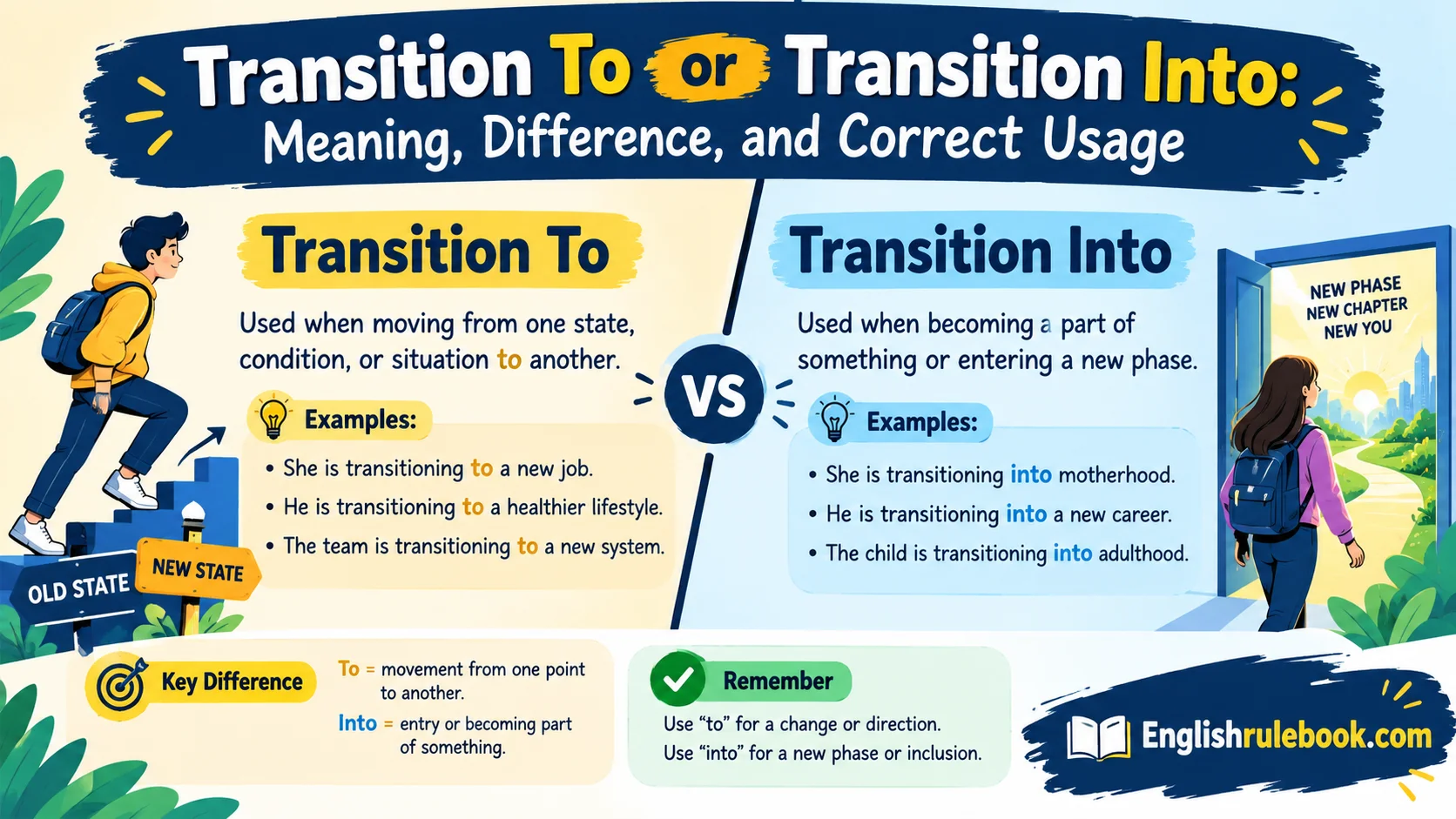
When choosing Transition To Or Transition Into, the right preposition depends on whether you mean a destination or entry into a new state or role. In English grammar, transition to usually shows movement towards a general or abstract destination, such as a new arrangement, software system, or new role. For example, a company may transition to a new software system, while a person may transition to a different professional role. The two expressions can seem interchangeable, but context helps determine which construction sounds more natural and accurate. As a writer, I find that asking what the change is pointing toward makes choosing the right preposition much easier.
Use transition into when the focus is on entering a new state, phase, condition, or specific role. For instance, someone may transition into a management role, showing that the person is becoming part of that professional position. Similarly, a person can transition into motherhood smoothly, where the phrase highlights a change in state. This difference is useful for English learners because small parts of speech such as prepositions can affect the meaning of a sentence. If you are deciding at a crossroads, remember that to often points toward something, while into emphasizes entering or becoming part of something. Neither construction is automatically right or wrong because context matters.
This simple guide can help make your writing clearer in professional emails, academic work, business reports, articles, presentations, and everyday communication. Think of to as describing broad movements and changes, while into describes more specific states and specific roles. Understanding these differences can strengthen your English skills and remove much of the confusion surrounding transition. Although the distinction may initially feel like a thick fog, a simple mental flashlight can help: to identify where something is going, whereas into shows what someone or something is entering. This approach keeps the explanation simple while preserving the important nuances of both expressions.
Quick Answer: Transition To or Transition Into?
Both “transition to” and “transition into” are grammatically correct.
Use transition to when you want to emphasize a destination, new system, arrangement, method, or condition.
Use transition into when you want to emphasize entering or becoming part of a new role, state, phase, or condition.
| Expression | Typical emphasis | Example |
| Transition to | Destination or new arrangement | The company transitioned to remote work. |
| Transition into | Entry or transformation | She transitioned into a leadership role. |
| Transition from X to Y | Starting point and destination | He transitioned from sales to marketing. |
| Transition from X into Y | Starting point and entry into a new state | She transitioned from teaching into administration. |
A useful memory trick is simple:
To points toward something. Into suggests entering something.
That distinction isn’t absolute. English usage often allows both forms when the meaning overlaps.
What Does “Transition” Mean?
The word transition refers to a change from one state, situation, stage, system, or condition to another. It can describe a physical change, but it often describes abstract changes as well.
For example:
- transitioning from school to college
- transitioning to a new career
- transitioning into adulthood
- transitioning to remote work
- transitioning into a leadership position
- transitioning to a new business model
The word can function as both a noun and a verb.
As a noun:
The transition to college took several months.
As a verb:
She transitioned to a new career.
The core idea remains the same: something moves from one condition to another.
Importantly, the word transition doesn’t automatically tell you how quickly the change happens. A transition can happen in a day, several months, or even years.
That’s why it’s misleading to claim that “transition to” always describes a sudden change while “transition into” always describes a gradual one. The surrounding context determines the timeline.
What Does “Transition To” Mean?
Definition of “Transition To”
Transition to generally identifies the new destination, arrangement, system, method, or condition resulting from a change.
The basic pattern is:
transition + to + destination
The destination doesn’t have to be a physical location.
For example:
The company transitioned to a four-day workweek.
A four-day workweek isn’t a physical destination. Instead, it represents the company’s new working arrangement.
Likewise:
She transitioned to a different career.
Here, the new career functions as the destination of the change.
Common Uses of “Transition To”
You can use transition to in many real-world situations.
Workplace
After five years in sales, Marcus transitioned to marketing.
The sentence emphasizes marketing as the new professional destination.
Technology
The organization transitioned to cloud-based software.
The focus falls on the new system the organization adopted.
Education
Students often need time to transition to college.
The new educational environment becomes the destination.
Business
The company transitioned to a subscription-based model.
The sentence identifies the business model that replaced the previous one.
Everyday Life
She transitioned to a healthier diet.
The healthier diet represents the new approach.
Why “To” Works
The preposition to commonly expresses direction toward a destination. That destination can be physical or abstract.
Compare:
He moved to Chicago.
with:
He transitioned to management.
Chicago is a physical destination. Management is an abstract professional destination.
The grammatical relationship is similar: the subject moves toward a new point or condition.
What Does “Transition Into” Mean?
“Transition into” means to gradually change, move, or develop from one state, situation, or activity into another.
Definition of “Transition Into”
Transition into emphasizes entering a new state, role, phase, condition, or form.
The basic pattern is:
transition + into + new state
For example:
She transitioned into a leadership role.
The sentence does more than identify the destination. It highlights her entry into the leadership role.
The same idea appears in:
He transitioned into adulthood.
Adulthood isn’t simply a destination on a map. It’s a new stage of life that a person enters.
Common Uses of “Transition Into”
Professional Roles
She transitioned into management after several years as an analyst.
The phrase highlights her move into a new professional role.
Life Stages
Teenagers gradually transition into adulthood.
The sentence emphasizes movement into a different stage of life.
Business Transformation
The company transitioned into a digital-first organization.
Here, the company isn’t merely adopting one new tool. Its broader organizational identity is changing.
Project Development
The project is transitioning into its final phase.
The project is entering a new stage.
Personal Development
He transitioned into a more independent lifestyle.
The sentence focuses on entering a new way of living.
Why “Into” Works
The preposition into often expresses movement from outside something to inside it. English extends this physical idea to abstract states and conditions.
You can move:
- into a room
- into a career
- into management
- into adulthood
- into a new phase
- into a different state
Therefore, transition into can create a stronger sense of entry or transformation.
Transition To vs. Transition Into: The Main Difference
The most useful way to understand transition to or transition into is to focus on emphasis rather than trying to memorize an inflexible grammar rule.
Destination vs. Entry
Consider:
She transitioned to management.
The sentence primarily identifies management as the destination.
Now consider:
She transitioned into management.
The second version emphasizes entering management.
Both can be correct.
The difference is subtle, but that subtlety can improve your writing.
Arrangement vs. Transformation
Another useful comparison involves business changes.
The company transitioned to remote work.
This tells readers about a new working arrangement.
Now:
The company transitioned into a remote-first organization.
This describes a broader transformation in how the company operates.
The first sentence focuses on what changed.
The second focuses more on what the organization became.
Can “Transition To” and “Transition Into” Both Be Used?
Yes. Sometimes both versions work naturally.
For example:
She transitioned to a leadership role.
She transitioned into a leadership role.
Both sentences communicate essentially the same broad event. The first treats the leadership role as the destination. The second places slightly more emphasis on entering that role.
This overlap is common in English.
Prepositions don’t always divide language into neat boxes. Instead, they often add shades of meaning. When the difference is small, writers should choose the version that best matches the surrounding context.
Transition From + To vs. Transition From + Into
The structure transition from X to Y is particularly common because it clearly identifies both ends of a change.
For example:
She transitioned from teaching to administration.
Here:
- from teaching = starting point
- to administration = destination
You can also write:
She transitioned from teaching into administration.
This version emphasizes entering the new field.
| Structure | Purpose | Example |
| Transition from X | Identifies the starting point | He transitioned from sales. |
| Transition to Y | Identifies the destination | He transitioned to marketing. |
| Transition into Y | Highlights entering the new state | He transitioned into management. |
| Transition from X to Y | Shows both ends clearly | She transitioned from teaching to administration. |
| Transition from X into Y | Shows the starting point and entry | She transitioned from teaching into administration. |
When you simply want to describe a before-and-after change, from X to Y is often the cleanest construction.
Transition To or Transition Into in Different Contexts
The choice between “transition to” and “transition into” depends on whether you’re referring to a new state, role, situation, or a gradual change into something.
Workplace and Careers
Career writing frequently uses both forms.
James transitioned to a new department.
The new department is the destination.
James transitioned into a management position.
The management position is presented as a role he entered.
The noun following the preposition often helps determine which construction feels most natural.
Education
Educational transitions also provide clear examples.
Students transition to college after high school.
Here, college is the new educational destination.
Students transition into independent learning.
Independent learning represents a new learning state.
Both sentences describe change, but they frame that change differently.
Business
Businesses commonly transition to new systems, models, or strategies.
The retailer transitioned to online sales.
Meanwhile, transition into can describe a broader change in organizational identity.
The retailer transitioned into a digital-first company.
The distinction becomes especially useful in business writing because adopting a system isn’t always the same thing as becoming a different type of organization.
Technology
Technology provides another practical example.
The company transitioned to cloud computing.
This focuses on the technology adopted.
The company transitioned into a fully digital operation.
This focuses on the transformed state of the company.
Personal Life
Personal changes can use both constructions.
He transitioned to a healthier diet.
The new diet is the destination.
She transitioned into independent living.
Independent living represents a new state or stage.
Writing and Presentations
When moving from one subject to another, transition to is usually straightforward.
Let’s transition to the next section.
The discussion now transitions to the final argument.
Here, the next topic is simply the destination of the discussion.
Transition into can also appear:
The presentation transitions into a discussion of future plans.
In this case, the phrase suggests that the presentation enters a new section or mode.
Transition To vs. Switch To vs. Move To vs. Shift To
The word transition isn’t always the most precise verb for describing change.
Several alternatives have related meanings.
| Expression | Typical meaning | Example |
| Transition to | Change from one state or arrangement to another | The company transitioned to remote work. |
| Switch to | Replace one option with another | She switched to another provider. |
| Move to | Relocate or change position | He moved to another department. |
| Shift to | Change direction, focus, or strategy | The business shifted to online sales. |
Switch can suggest a more direct replacement.
Move is broad and can describe physical or organizational changes.
Shift often emphasizes a change in focus or direction.
Transition works especially well when the change involves adaptation or movement between states.
Transition Into vs. Move Into vs. Develop Into
These expressions can look similar, but they aren’t identical.
Transition Into
Emphasizes changing from one state and entering another.
She transitioned into a leadership role.
Move Into
Often emphasizes entering a position, place, or area.
She moved into a management position.
Develop Into
Emphasizes growth or evolution.
The small startup developed into a major company.
This distinction matters because develop into suggests that something grows over time. Transition into focuses more broadly on the change from one condition to another.
Common Mistakes With Transition To and Transition Into
Common mistakes with “transition to” and “transition into” often happen when writers confuse their meanings, especially when describing a change, movement, or shift from one state or situation to another.
Mistake 1: Thinking One Is Always Correct
The biggest mistake is assuming that only one preposition can follow transition.
Both transition to and transition into are established English constructions.
The context determines which one communicates the intended meaning more effectively.
Mistake 2: Treating “Into” as Automatically Gradual
A transition into something can certainly happen gradually. However, into doesn’t guarantee a slow process.
The preposition primarily highlights entry into a state, role, or condition.
Mistake 3: Using “Into” for Every Destination
Sometimes to is cleaner.
For example:
Let’s transition to the next topic.
There is little benefit in making the sentence more complicated when to express the intended direction clearly.
Mistake 4: Assuming “To” Only Works With Physical Places
Abstract destinations work perfectly well.
Examples include:
- transition to remote work
- transition to digital learning
- transition to a new strategy
- transition to a healthier lifestyle
- transition to democracy
The destination can be an idea, system, condition, or arrangement.
Mistake 5: Making Simple Sentences Overly Complicated
Professional writing sometimes becomes unnecessarily wordy when a direct construction would work better.
Instead of:
The company made a transition in the direction of adopting a new software system.
Write:
The company transitioned to a new software system.
The second version is shorter and clearer.
How to Choose Between Transition To and Transition Into
When you’re unsure which expression to use, ask what the sentence is trying to emphasize.
Choose “Transition To” for a Destination
Use transition to when you mainly want to identify the new destination, system, method, or arrangement.
The school transitioned to online classes.
Choose “Transition Into” for Entry or Transformation
Use transition into when the sentence emphasizes entering a role, state, phase, or new condition.
She transitioned into a leadership position.
Use Context When Both Work
Sometimes there is no dramatic difference.
If both forms communicate the intended idea, choose the one that sounds more natural in the surrounding paragraph.
Don’t force a distinction where English speakers wouldn’t notice one.
Case Study: A Career Change
Imagine an employee who spends several years working in sales before moving into management.
You could write:
She transitioned to management.
This treats management as the destination.
You could also write:
She transitioned into management.
This emphasizes her entry into the management field.
Now imagine the article discusses her changing responsibilities, decision-making authority, and leadership skills.
In that context, transitions into management may be more expressive because the focus isn’t merely on where she went. The focus is on the professional role she entered.
Case Study: A Business Transformation
Consider a traditional retailer that begins selling products online.
The sentence:
The retailer transitioned to online sales.
clearly identifies the company’s new sales channel.
But suppose the retailer completely restructures its operations around digital commerce. Its marketing, customer service, logistics, and technology all change.
Now this sentence may better capture the transformation:
The retailer transitioned into a digital-first business.
The distinction is useful because adopting something new and becoming something new aren’t always the same event.
A Simple Way to Remember the Difference
Imagine you’re describing a journey.
To point toward where something is going.
Into highlights entering the new space or condition.
Therefore:
Transition to → destination
Transition into → entry or transformation
For example:
The company transitioned to remote work.
The destination is remote work.
The company transitioned into a remote-first organization.
The emphasis is on what the company became.
This memory trick won’t solve every possible sentence. It will, however, give you a reliable starting point.
Practice Quiz: Transition To or Transition Into
Choose the preposition that best fits each sentence.
- The company plans to transition ___ a new accounting system.
- She transitioned ___ a senior leadership role.
- The school transitioned ___ digital learning.
- The organization is transitioning ___ a more flexible structure.
- Let’s transition ___ the next topic.
- He transitioned ___ independent living after college.
- The business transitioned ___ a subscription model.
- The employee transitioned ___ management after receiving a promotion.
Answer Key
- to — the accounting system is the new destination.
- into — the sentence emphasizes entering a leadership role.
- to — digital learning represents the new educational arrangement.
- into — the organization is entering a new structural state.
- to — the next topic is the destination of the discussion.
- into — independent living represents a new life condition.
- to — the subscription model is the new business arrangement.
- into — management is the new professional role being entered.
These aren’t rigid rules. In some contexts, an alternative may also work if the intended emphasis changes.
Conclusion
Understanding the difference between transition to and transition into makes your English clearer and more precise. Use transition to when focusing on a destination, change, or new arrangement, and use transition into when emphasizing entry into a new state, phase, condition, or role. When in doubt, look at the context and consider whether the sentence focuses on where something is going or what someone is becoming.
FAQs
Q1. What is the difference between “transition to” and “transition into”?
Transition to usually focuses on a destination or new arrangement, while transition into emphasizes entering a new state, phase, condition, or role.
Q2. Is “transition to a new role” correct?
Yes. Transition to a new role is correct when the emphasis is on moving to or taking up the new position.
Q3. When should I use “transition into”?
Use transition into when someone or something is entering a particular state, phase, condition, or role.
Q4. Can “transition to” and “transition into” be interchangeable?
Sometimes, yes. However, they can create slightly different emphasis, so context should guide your choice.
Q5. Which sounds more natural: “transition to” or “transition into”?
Neither is always more natural. Transition to works well for destinations and broad changes, while transition into is better for entering specific states or roles.
About the Author