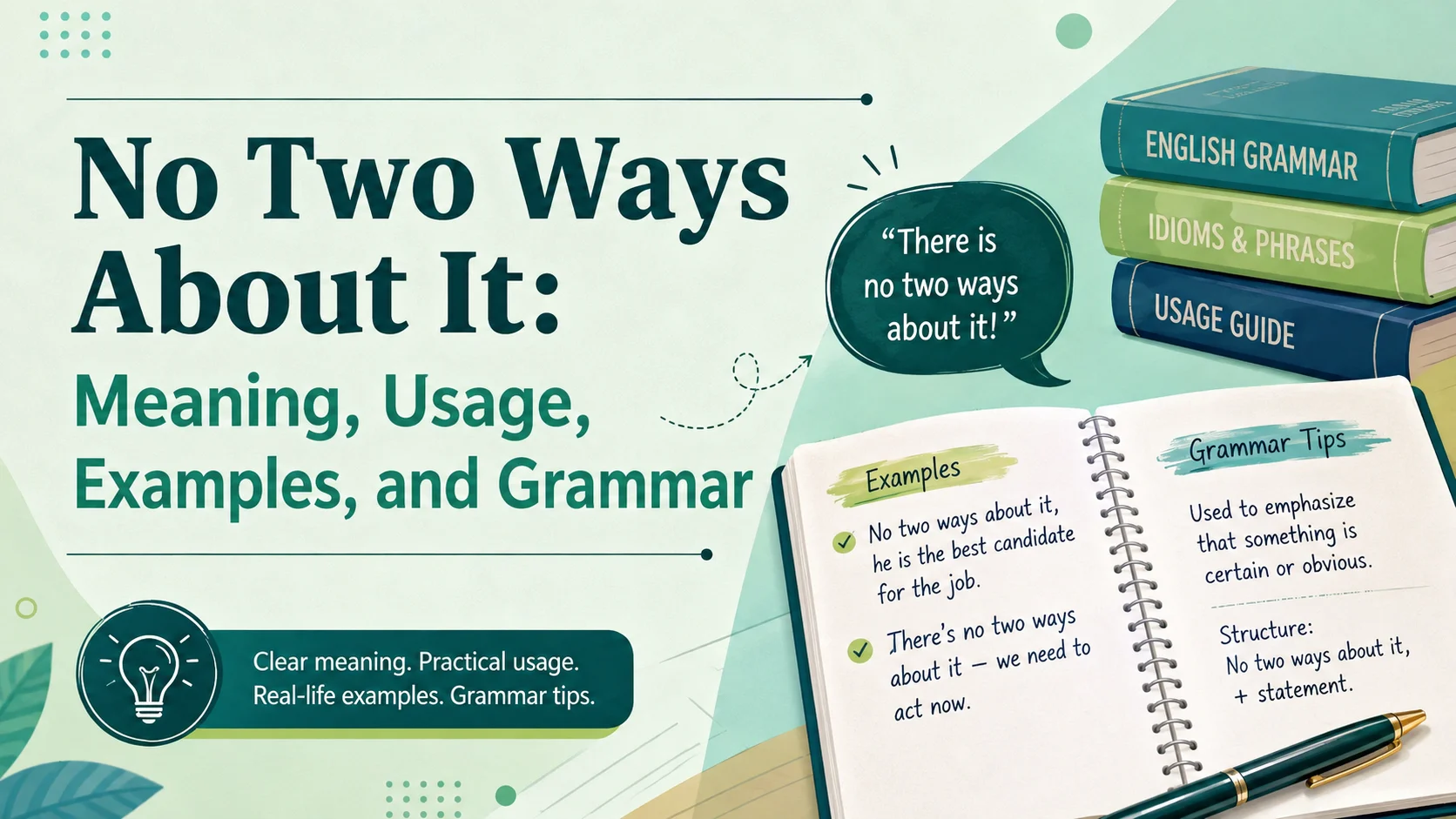
No Two Ways About expresses certainty when something seems very clear and undeniable. In everyday American English, people use the phrase when there is no doubt, no reasonable alternative interpretation, or no practical alternative. From my experience explaining English expressions, this phrase is easiest to understand when you stop thinking about literal choices, opinions, or possible directions and focus on the speaker’s main point. It adds strong emphasis to a statement, showing that the speaker feels certain about what they’re saying.
The expression can also show necessity when something is unavoidable or not optional. For example, “There’s no two ways about it: we have to leave now” means leaving is necessary. You might hear this wording in journalism, commentary, or informal writing, especially when everyone agrees about a fact or when there is no room for doubt. It can describe that powerful feeling of being all on the same page or seeing things eye-to-eye, particularly when people are discussing a plan or making a decision at work.
The phrase also works well when explaining something important, such as safety. If someone says that wearing a helmet while biking is essential, they’re saying it’s absolutely necessary and not worth debating. This makes the expression useful for stressing the importance of a statement being made. Whether you’re describing an exam that was difficult, a rare instance when people are instantly understanding each other, or a situation where there is one true way to see or think about something, the phrase tells you that there are no other options or opinions to consider.
Quick Answer: What Does “No Two Ways About It” Mean?
“No two ways about it” means that something is definitely true or that there is no reasonable alternative way to view or deal with a situation.
It can usually be understood as:
- There is no doubt about it.
- There is no question about it.
- The fact is clear.
- There is no reasonable alternative.
- The situation cannot be avoided.
For example:
She is the best candidate, no two ways about it.
This means the speaker is completely convinced that she is the best candidate.
Another example:
There’s no two ways about it: the company needs to change its strategy.
Here, the phrase emphasizes that changing the strategy has become necessary.
| Expression | Basic meaning |
| No two ways about it | There is no doubt |
| There’s no two ways about it | The conclusion is certain or unavoidable |
| Without a doubt | Something is definitely true |
| No way around it | Something cannot be avoided |
| No question about it | Something is certain |
What Does “No Two Ways About It” Really Mean?
The easiest way to understand this idiom is to imagine that a situation could have two possible interpretations.
Perhaps someone could look at a decision one way or another. Maybe an event could have two reasonable explanations. The phrase “no two ways about it” rejects that uncertainty.
It essentially says:
“There isn’t another reasonable way to look at this.”
Consider this example:
The restaurant was overpriced, no two ways about it.
The speaker isn’t claiming that exactly two opinions existed. Instead, the phrase reinforces the speaker’s judgment.
The expression can also emphasize an unavoidable reality:
There’s no two ways about it: we need more employees.
The speaker isn’t simply giving an opinion. The statement suggests that the situation has become clear enough that another practical option doesn’t exist.
The Two Main Uses
The idiom has two closely related uses.
Certainty: Something is unquestionably true.
That was his best performance, no two ways about it.
Necessity: Something cannot reasonably be avoided.
There’s no two ways about it: we have to start over.
Both uses share the same basic idea: the speaker sees little or no room for doubt.
Is “No Two Ways About It” an Idiom?
Yes. “No two ways about it” is an idiomatic expression.
Its meaning isn’t simply the sum of its individual words. The word “way” can literally mean a road or direction. It can also mean a method, approach, possibility, or manner of doing something.
In this expression, “ways” refers more broadly to possible interpretations, conclusions, or courses of action.
That’s why a literal interpretation doesn’t work well.
The project was a disaster, no two ways about it.
The speaker isn’t discussing two routes through a building. The phrase simply adds certainty to the assessment.
Major dictionaries recognize the expression as an established idiom. Merriam-Webster defines it as an expression used to indicate that something is definitely true. Cambridge similarly explains its use for emphasizing that something is true or certain.
How to Use “No Two Ways About It” Correctly
The idiom is flexible, but certain sentence patterns sound especially natural.
Use It After a Strong Statement
One of the most common structures is:
Statement + no two ways about it.
For example:
The weather was terrible, no two ways about it.
That was a smart decision, no two ways about it.
The project needs more funding, no two ways about it.
In each sentence, the idiom strengthens the statement that comes before it.
Use “There’s No Two Ways About It”
Another common structure places the idiom at the beginning of a conclusion.
There’s no two ways about it: we need more time.
There’s no two ways about it: the rules must change.
This pattern works particularly well when someone wants to introduce an unavoidable conclusion.
Use It With Opinions
The expression can make an opinion sound very firm.
She’s the most talented player on the team, no two ways about it.
The statement remains an opinion even though the speaker expresses it confidently. That’s an important distinction. An emphatic idiom doesn’t automatically turn an opinion into an objective fact.
“No Two Ways About It” Examples
The best way to learn an idiom is to see it in different contexts.
Everyday Examples
That was an expensive dinner, no two ways about it.
You need more practice, no two ways about it.
The movie was strange, no two ways about it.
He made the right decision, no two ways about it.
These examples show how naturally the expression fits ordinary conversation.
Work and Business Examples
The deadline is extremely tight, no two ways about it.
There’s no two ways about it: the company needs to reduce costs.
This project was a major challenge, no two ways about it.
In workplace conversations, the phrase can add confidence to an evaluation or recommendation.
However, formal reports may benefit from more precise language.
School Examples
The final exam was difficult, no two ways about it.
There’s no two ways about it: students need better preparation.
She earned the highest grade fairly, no two ways about it.
Sports Examples
They dominated the second half, no two ways about it.
He was the best player on the field, no two ways about it.
Sports writing often uses emphatic language, so the expression fits naturally.
Is “There’s No Two Ways About It” Grammatically Correct?
This question causes some confusion because “ways” is plural.
A learner might expect:
There are no two ways about it.
That construction follows ordinary subject-verb agreement more closely. However, “there’s no two ways about it” is a well-established idiomatic form and appears in major dictionaries and real-world English.
Cambridge records the expression as “(there’s) no two ways about it.”
This illustrates an important point about English: fixed expressions don’t always behave exactly like freshly constructed sentences.
Both forms occur:
There’s no two ways about it: we have to act.
There are no two ways about it: we have to act.
The “there’s” version is especially natural in conversational English.
“No Two Ways About It” vs. “No Way Around It”
These expressions sound similar, but they aren’t identical.
“No two ways about it” emphasizes certainty.
The decision was difficult, no two ways about it.
This means the decision was definitely difficult.
“No way around it” emphasizes that something cannot be avoided.
We have to pay the fee. There’s no way around it.
Here, the issue isn’t whether the fee exists. The point is that avoiding it isn’t possible.
| Phrase | Main idea |
| No two ways about it | There is no doubt |
| No way around it | There is no way to avoid it |
| No way | Refusal, disbelief, or impossibility |
| Without a doubt | Complete certainty |
Choosing the right expression makes your meaning much clearer.
“No Two Ways About It” vs. “No Way”
Don’t confuse these expressions.
“No way!” often expresses disbelief:
No way! You won the competition?
It can also express refusal:
No way am I paying that much.
By contrast:
The repair was expensive, no two ways about it.
This sentence doesn’t express refusal or disbelief. It expresses certainty about the speaker’s assessment.
The small difference matters.
Is “No Two Ways About It” Formal or Informal?
The expression is best described as conversational and emphatic.
You can find it in:
- Everyday speech
- Interviews
- Opinion writing
- Sports commentary
- Newspaper articles
- Blogs
- Informal business writing
- Fiction and dialogue
It can certainly appear in written English. Still, it may sound too conversational for highly formal academic or technical writing.
Compare:
The results were disappointing, no two ways about it.
with:
The results clearly indicate a significant decline in performance.
The first sounds personal and forceful. The second sounds analytical.
Neither is inherently better. The right choice depends on the audience and purpose.
Formal Alternatives to “No Two Ways About It”
If you’re writing an academic paper, professional report, or formal analysis, you may prefer:
- There is no doubt that…
- The evidence clearly shows…
- The results demonstrate…
- Without question…
- Beyond doubt…
- The evidence strongly supports…
- There is no reasonable alternative interpretation…
For example:
The evidence clearly shows that the policy failed.
This is more precise than:
The policy failed, no two ways about it.
The informal version has more personality. The formal version communicates the claim more objectively.
Common Mistakes With “No Two Ways About It”
The most common mistakes with “No Two Ways About It” involve misunderstanding its meaning, using it in the wrong context, or changing its wording unnecessarily.
Mistake: Taking It Literally
The phrase isn’t about two physical routes.
The movie was excellent, no two ways about it.
Here, “ways” has an abstract meaning.
Mistake: Thinking It Means Two Choices
The idiom actually communicates the opposite.
It doesn’t mean:
There are two choices.
It means that there isn’t another reasonable interpretation or alternative.
Mistake: Leaving Out “It”
The standard expression is:
No two ways about it
Not:
No two ways about.
The word “it” completes the established expression.
Mistake: Using It When the Evidence Is Uncertain
The phrase sounds very confident.
If the facts are unclear, using it can make a statement seem unnecessarily absolute.
Instead of:
He definitely caused the problem, no two ways about it.
you might write:
The available evidence strongly suggests that he caused the problem.
Strong language should match strong evidence.
Punctuation With “No Two Ways About It”
The idiom doesn’t require one special punctuation mark. Its punctuation depends on its position in the sentence.
Comma
The test was difficult, no two ways about it.
Colon
There’s no two ways about it: we need more time.
Dash
The decision was a mistake—no two ways about it.
The dash gives the sentence a stronger dramatic pause.
At the Beginning
No two ways about it: the team needs a better strategy.
Each structure can work. Choose punctuation based on the relationship between the surrounding ideas.
The Origin of “No Two Ways About It”
The expression has a long history in English.
The Oxford English Dictionary records “no two ways about it” from 1818 and describes the expression as colloquial and originally US. Dictionary.com also dates the idiom to the early 1800s.
The phrase later appeared in well-known 19th-century writing. Because of this history, the expression is sometimes associated with Charles Dickens. However, saying that Dickens invented it would go too far. Historical evidence shows that the expression was already in use around the early 19th century.
That distinction matters when discussing word origins. A famous writer may help popularize an expression without being the person who created it.
Why Does “No Two Ways About It” Sound So Strong?
The phrase gets its force from the simple word “no.”
Think about the structure:
- No → rejects alternatives.
- Two ways → suggests competing possibilities.
- About it → connects those possibilities to the subject.
The overall effect is decisive.
It’s almost like closing a door on uncertainty.
Compare:
I think the decision was wrong.
with:
The decision was wrong, no two ways about it.
The second statement sounds far more confident.
That’s why the idiom works particularly well when a writer or speaker wants to emphasize a conclusion.
When Should You Avoid “No Two Ways About It”?
The expression isn’t appropriate for every situation.
Avoid overusing it when:
- The evidence is genuinely uncertain.
- You want to sound especially neutral.
- You’re writing highly technical material.
- You’re discussing a sensitive issue where absolute language could sound dismissive.
- You’ve already used several emphatic expressions nearby.
For example, saying:
You’re wrong, no two ways about it.
can sound blunt.
A softer alternative might be:
I don’t think that’s correct.
The second version leaves room for discussion.
Quick Comparison: Correct and Incorrect Usage
| Example | Correct? | Reason |
| The exam was difficult, no two ways about it. | ✅ | Correct idiomatic use |
| There’s no two ways about it: we must leave. | ✅ | Common conversational structure |
| There are no two ways about it. | ✅ | Established alternative form |
| No two ways about. | ❌ | Missing it |
| No two ways about it. | ❌ | Ways should be plural |
| It means there are two choices. | ❌ | The idiom communicates the opposite |
| There’s no way around it. | ✅ | Correct phrase with a different meaning |
Key Facts About “No Two Ways About It”
- Meaning: There is no doubt or reasonable alternative.
- Type: Idiom.
- Tone: Conversational and emphatic.
- Historical record: The Oxford English Dictionary records the expression from 1818.
- Common structure: Statement + no two ways about it.
- Another common structure: There’s no two ways about it: + conclusion.
- Main purpose: To emphasize certainty or finality.
- Related expression: No way around it, which focuses more specifically on unavoidable circumstances.
Conclusion
“No two ways about it” is a useful English expression for showing certainty, necessity, or a lack of reasonable alternatives. It doesn’t refer to literal ways or choices. Instead, it emphasizes that something is clear, certain, or unavoidable. You can use it naturally in everyday conversations, informal writing, commentary, and other situations where you want to make your point firmly.
FAQs
Q1. What does “no two ways about it” mean?
“No two ways about it” means there’s no doubt or no reasonable alternative way to understand a situation. It emphasizes that something is clear or certain.
Q2. Is “no two ways about it” an idiom?
Yes. “No two ways about it” is an English idiom. Its meaning isn’t based on the literal idea of having two different ways.
Q3. When should I use “no two ways about it”?
Use it when you want to emphasize certainty, necessity, or an unavoidable fact. For example: “The test was difficult, no two ways about it.”
Q4. Is “no two ways about it” formal or informal?
It’s generally informal to neutral. You can use it in everyday speech, commentary, journalism, and informal writing, but a more direct expression may work better in highly formal writing.
Q5. What is another way to say “no two ways about it”?
Depending on the context, you can say “without a doubt,” “definitely,” “there’s no question,” or “without question.”
About the Author