
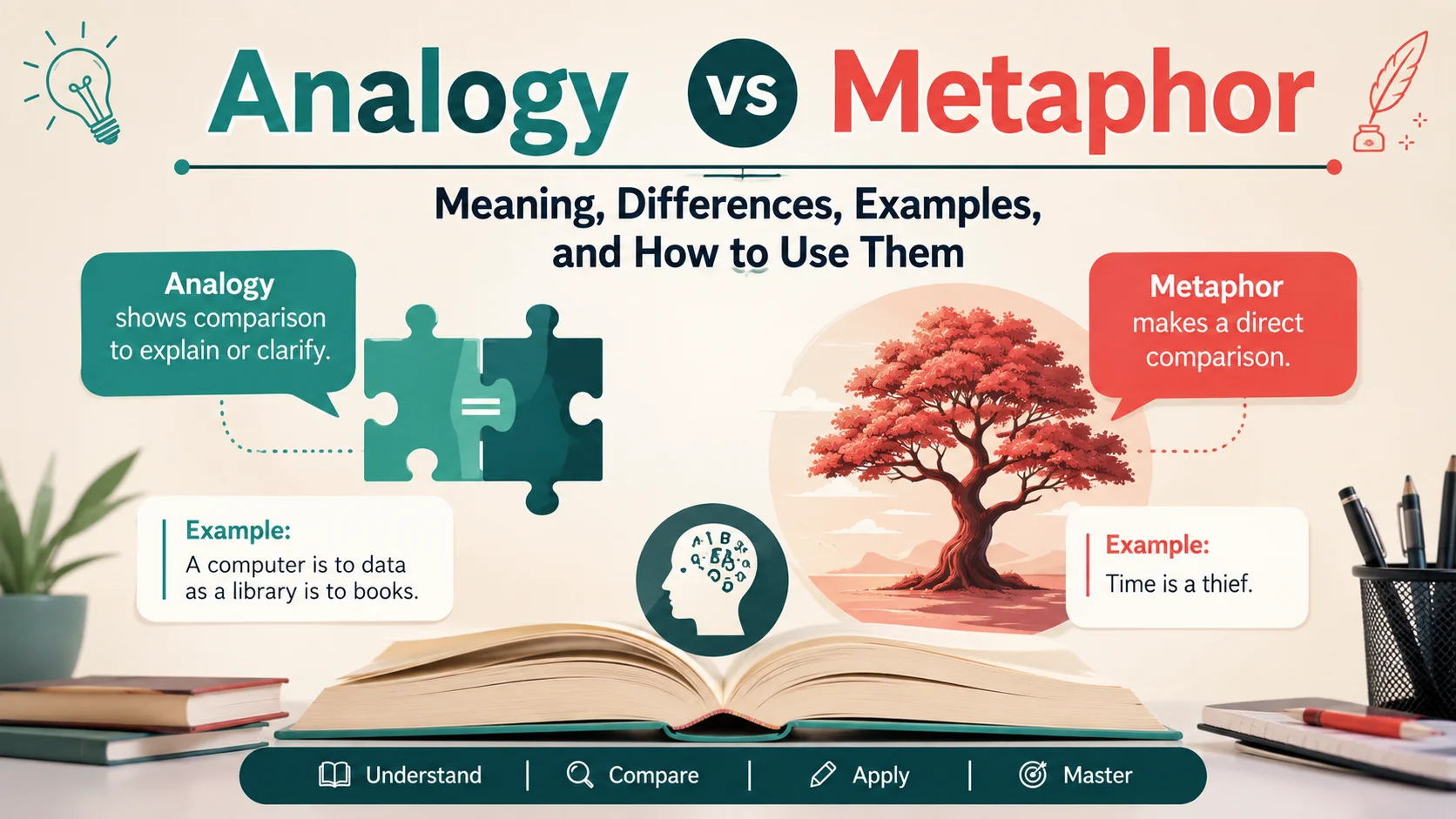
Analogy vs Metaphor becomes easier to understand when you see how both use comparison to explain ideas and create vivid meaning for readers.Writers use analogy and metaphor to make difficult ideas easier to understand and ordinary language more memorable. Both techniques compare things, which can make their meanings seem interchangeable. However, they serve different purposes. An analogy explains an idea by showing how two unlike things share a useful relationship. A metaphor creates a direct figurative comparison that gives an idea a stronger image or deeper meaning. For example, saying learning a language is like training a muscle explains that regular practice builds ability, while calling language learning a workout for the brain creates a more direct image.
The difference becomes clearer when you consider how language shapes communication. Words can act as tools for explaining information, yet they can also become paintbrushes that add vivid imagery to conversations, stories, and presentations. These techniques give ideas more creative force, allowing readers to understand concepts while also imagining or feeling them. Although analogy and metaphor share important roles in language arts, they aren’t identical. Think of them as cousins rather than twins: they have a family resemblance, but each has its own purpose and effect. Understanding that distinction helps you communicate with greater clarity and choose the right comparison for your message.
An analogy highlights a relationship or similarity between unlike things to make an unfamiliar idea clearer. For instance, saying learning a language is like unlocking a new world connects language learning with the familiar experience of discovering something new. A metaphor, however, directly presents one thing as another to create meaning or paint a picture in the reader’s mind. When someone says the classroom was a beehive of activity, the students aren’t literally bees. The metaphor suggests energy, movement, busyness, and organized chaos. In short, analogies explain through relationships, while metaphors create meaning through direct figurative comparison.
Analogy vs Metaphor: Quick Answer
An analogy compares two things, situations, or relationships to explain how something works or why two ideas are similar.
A metaphor describes one thing as another in a nonliteral way to create an image, emphasize a quality, or express an abstract idea.
| Feature | Analogy | Metaphor |
| Main purpose | Explain or clarify | Create imagery or meaning |
| Comparison | Usually developed | Usually compact |
| Focus | Relationship or similarity | Figurative association |
| Length | Can cover several sentences | Often a phrase or sentence |
| Example | “Learning is like building a house because each skill supports the next.” | “Knowledge is a foundation.” |
A useful way to remember the distinction is:
An analogy explains a comparison, while a metaphor creates a comparison.
The two can overlap. An analogy may contain a metaphor or simile, but that doesn’t make the terms identical.
What Is an Analogy?
An analogy is a comparison between two different things that share a relevant relationship, function, structure, or characteristic.
The comparison helps a reader understand something that might otherwise seem difficult or unfamiliar.
For example:
“Running a business is like steering a ship because both require constant decisions when conditions change.”
A business isn’t literally a ship. The comparison highlights decision-making, direction, changing conditions, and leadership.
That’s what makes it an analogy. The writer isn’t simply creating an interesting image. The writer is using the image to explain an idea.
How an Analogy Works
Most useful analogies have two sides:
- A familiar concept the reader already understands.
- A less familiar concept the writer wants to explain.
The familiar concept acts as a bridge.
Consider this example:
“A computer’s operating system is like a traffic controller. It helps direct different processes so they can use shared resources without interfering with one another.”
A reader who understands traffic control can use that knowledge as a starting point for understanding an operating system.
However, analogies always have limits. A computer isn’t literally a traffic system. The comparison only applies to certain aspects of how the two systems work.
Examples of Analogies
Education:
“Learning grammar is like building a house because vocabulary provides the materials while grammar provides the structure.”
Sports:
“Preparing for a marathon is like preparing for an exam because both require consistent practice rather than one last-minute effort.”
Business:
“Building a company is like planting a tree. Early growth takes patience, care, and consistent attention.”
Technology:
“A password manager is like a secure key cabinet because it organizes access credentials in one protected place.”
These comparisons don’t merely sound interesting. They help the reader understand the main concept.
What Is a Metaphor?
A metaphor is a figure of speech that describes one thing as another thing without meaning the statement literally.
Consider:
“The classroom was a zoo.”
The classroom isn’t actually a zoo. The metaphor suggests that it was noisy, chaotic, crowded, or difficult to control.
Metaphors work by transferring qualities from one thing to another. Readers recognize the intended connection through context.
Another common example is:
“Time is money.”
Time isn’t literally money. The metaphor suggests that time has value and can be spent, saved, wasted, or invested.
How Metaphors Work
A metaphor often takes an abstract idea and gives it a concrete image.
For example:
“Her words were daggers.”
Words can’t literally become daggers. The metaphor suggests that her words were painful, harsh, or emotionally damaging.
Compare that with a plain statement:
“Her words hurt him.”
The second sentence is clear. The metaphor is more vivid.
That’s one of the main strengths of metaphor. It allows readers to picture or feel an idea rather than simply receive information about it.
Common Metaphor Examples
- “He has a heart of stone.” — He appears emotionally cold.
- “The city never sleeps.” — The city remains active throughout the night.
- “She is the backbone of the team.” — She provides essential support.
- “The news was a punch in the stomach.” — The news caused intense emotional shock.
- “Life is a journey.” — Life involves movement, change, choices, and different stages.
Analogy vs Metaphor: Key Differences
The clearest way to understand analogy and metaphor is to examine what each comparison accomplishes.
Purpose
An analogy primarily explains.
“Managing a team is like conducting an orchestra because each person has a different role and everyone must work toward the same result.”
The comparison provides several points of explanation.
A metaphor primarily expresses.
“The manager is the conductor of the team.”
This creates an image of leadership without explaining every similarity.
Structure
Metaphors can be very short:
“The internet is a highway.”
An analogy usually develops the comparison:
“The internet is like a highway because data travels between locations, and congestion can slow down the flow of information.”
The second example tells the reader why the comparison matters.
Depth
A metaphor often focuses on one dominant quality.
“Her voice was thundering.”
The comparison emphasizes strength, loudness, or intensity.
An analogy can explore multiple relationships.
“A strong leader is like a captain because both must make decisions under pressure, guide others through changing conditions, and take responsibility for the direction of the group.”
The analogy has greater explanatory depth.
Analogy vs Metaphor Examples
The following examples show the difference more clearly:
| Subject | Analogy | Metaphor |
| Learning | “Learning a language is like training a muscle because regular practice improves performance.” | “Learning a language is a workout for the brain.” |
| Business | “Running a company is like steering a ship because conditions can change quickly.” | “The company is a ship in rough waters.” |
| Memory | “Memory works like a filing system because information is stored and retrieved.” | “Her memory is a vault.” |
| Relationships | “A relationship is like a garden because it needs regular care.” | “Their relationship is a garden.” |
| Time | “Managing time is like managing money because both are limited resources.” | “Time is currency.” |
The analogy generally gives more information about why the comparison works.
The metaphor gives the reader a stronger and more immediate image.
Analogy vs Simile vs Metaphor
A third term often causes confusion: simile.
A simile makes a comparison using words such as like or as.
For example:
“Her smile was like sunshine.”
A metaphor makes the comparison more directly:
“Her smile was sunshine.”
An analogy can use a simile as part of a longer explanation.
| Device | Main Function | Example |
| Analogy | Explains a relationship | “Learning to write is like learning an instrument because both require practice.” |
| Simile | Makes a direct comparison | “Her voice is like music.” |
| Metaphor | Creates a figurative comparison | “Her voice is music.” |
Not every simile is an analogy. A short comparison can simply create an image without explaining a larger relationship.
Can an Analogy Be a Metaphor?
An analogy can contain a metaphor, but the two terms still describe different functions.
Consider:
“The human brain is a library. Memories are books, and retrieving information is like searching through shelves.”
“The brain is a library” is a metaphor. The writer then develops that metaphor into a broader analogy.
This shows why the concepts sometimes overlap.
Think of a metaphor as a single powerful image and an analogy as a developed comparison. The metaphor can provide the central image while the analogy explains how that image connects to the subject.
Types of Analogies
Types of analogies explain the different ways two ideas, objects, or relationships can be compared to show their similarities
Relationship-Based Analogies
These compare relationships between two pairs of things.
“A teacher is to a classroom what a coach is to a team.”
The comparison focuses on guidance and development.
Functional Analogies
These compare things that perform similar functions.
“A thermostat works like a temperature regulator.”
The emphasis is on what each system does.
Cause-and-Effect Analogies
These compare situations with similar results.
“Ignoring a small problem is like ignoring a small leak in a boat. A minor issue can eventually create serious damage.”
Extended Analogies
An extended analogy continues over several sentences or paragraphs.
These comparisons can explain complicated ideas effectively. However, writers should avoid forcing similarities that no longer make sense.
Types of Metaphors
Metaphors come in several types, each using comparison in a different way to make ideas more vivid, meaningful, and memorable.
Direct Metaphors
A direct metaphor openly identifies one thing with another.
“The classroom was a battlefield.”
Implied Metaphors
An implied metaphor suggests the comparison indirectly.
“She sailed through the interview.”
The word sailed suggests ease and confidence without directly saying the interview was a voyage.
Extended Metaphors
An extended metaphor develops one image across a longer passage.
A writer might describe a career as a road and continue using ideas such as crossroads, detours, destinations, and obstacles.
Dead Metaphors
Some metaphors become so familiar that people rarely notice their figurative origins.
Expressions such as “the foot of the mountain” and “the hands of a clock” are common examples.
Mixed Metaphors
A mixed metaphor combines unrelated images.
“We’ll cross that bridge when the ball is in our court.”
The sentence combines two different metaphorical ideas. Mixed metaphors can create humor, but they often make formal writing less precise.
Common Mistakes With Analogy and Metaphor
Several mistakes appear repeatedly when people discuss these devices.
Treating Them as Synonyms
Although both involve comparison, analogy and metaphor don’t serve exactly the same purpose.
Assuming Every “Like” Statement Is an Analogy
The word like often introduces a simile.
“The baby slept like a log.”
That’s a simile. It doesn’t automatically qualify as an analogy.
Taking Metaphors Literally
If someone says:
“He broke her heart.”
The sentence normally describes emotional pain rather than physical damage.
Stretching an Analogy Too Far
An analogy should clarify an idea. If a writer keeps adding weak comparisons, the explanation can become more confusing than the original concept.
When Should You Use an Analogy?
Use an analogy when your reader needs help understanding something unfamiliar.
Analogies are particularly effective for:
- Teaching difficult concepts.
- Explaining technical subjects.
- Introducing abstract ideas.
- Clarifying complicated processes.
- Making arguments easier to follow.
- Connecting new information to familiar experiences.
A teacher explaining internet bandwidth might compare it to the width of a highway. A wider highway can handle more traffic, just as greater bandwidth can support more data transfer under suitable conditions.
The analogy gives beginners a mental model before they encounter technical details.
When Should You Use a Metaphor?
Use a metaphor when you want language to become more vivid, emotional, or memorable.
Metaphors work especially well in:
- Creative writing
- Speeches
- Storytelling
- Advertising
- Personal essays
- Persuasive writing
- Everyday conversation
Compare these two statements:
“The company experienced many difficulties.”
“The company was walking through a minefield.”
The metaphor communicates danger, uncertainty, and the possibility of sudden problems in a much more vivid way.
How to Write an Effective Analogy
A strong analogy starts with a clear purpose.
First, identify the difficult idea you want to explain. Then choose something familiar to your audience.
Next, identify meaningful similarities. Focus on function, structure, process, cause, effect, or relationships rather than superficial features.
Finally, explain the connection.
A useful analogy should illuminate the subject. It shouldn’t force the reader to solve another puzzle.
How to Create a Strong Metaphor
Start with the idea or emotion you want to communicate.
Then choose a concrete image that captures it.
For example:
“The future was a foggy road.”
This metaphor turns uncertainty into a visual experience.
A strong metaphor should be:
- Clear
- Relevant
- Memorable
- Appropriate for the audience
- Consistent with the surrounding context
Avoid complicated comparisons simply to sound creative. A simple metaphor that fits perfectly is usually stronger than an elaborate one that distracts the reader.
Conclusion
Understanding Analogy vs Metaphor makes it easier to choose the right comparison for your writing. An analogy explains an idea by connecting it to a familiar relationship, while a metaphor creates a direct figurative image that adds meaning, emotion, or depth. When you use them intentionally, both techniques can make writing clearer, more memorable, and more engaging. The simplest rule to remember is this: analogies usually explain, while metaphors usually paint a picture.
FAQs
Q1. What is the main difference between an analogy and a metaphor?
An analogy explains a relationship between two different things, while a metaphor directly compares one thing to another for figurative effect.
Q2. Is an analogy a type of metaphor?
Not exactly. Both are comparison techniques, but an analogy usually focuses on explaining a relationship, while a metaphor focuses on creating an image or deeper meaning.
Q3. What is an example of an analogy?
Learning a language is like training a muscle is an analogy because it explains that regular practice helps you improve.
Q4. What is an example of a metaphor?
The classroom was a beehive of activity is a metaphor. It compares the classroom to a beehive to suggest energy, movement, and organized chaos.
Q5. How can I remember the difference between analogy and metaphor?
Think of an analogy as an explanation and a metaphor as an image. If the comparison helps you understand a relationship, it’s likely an analogy. If it creates a vivid figurative picture, it’s likely a metaphor.
About the Author