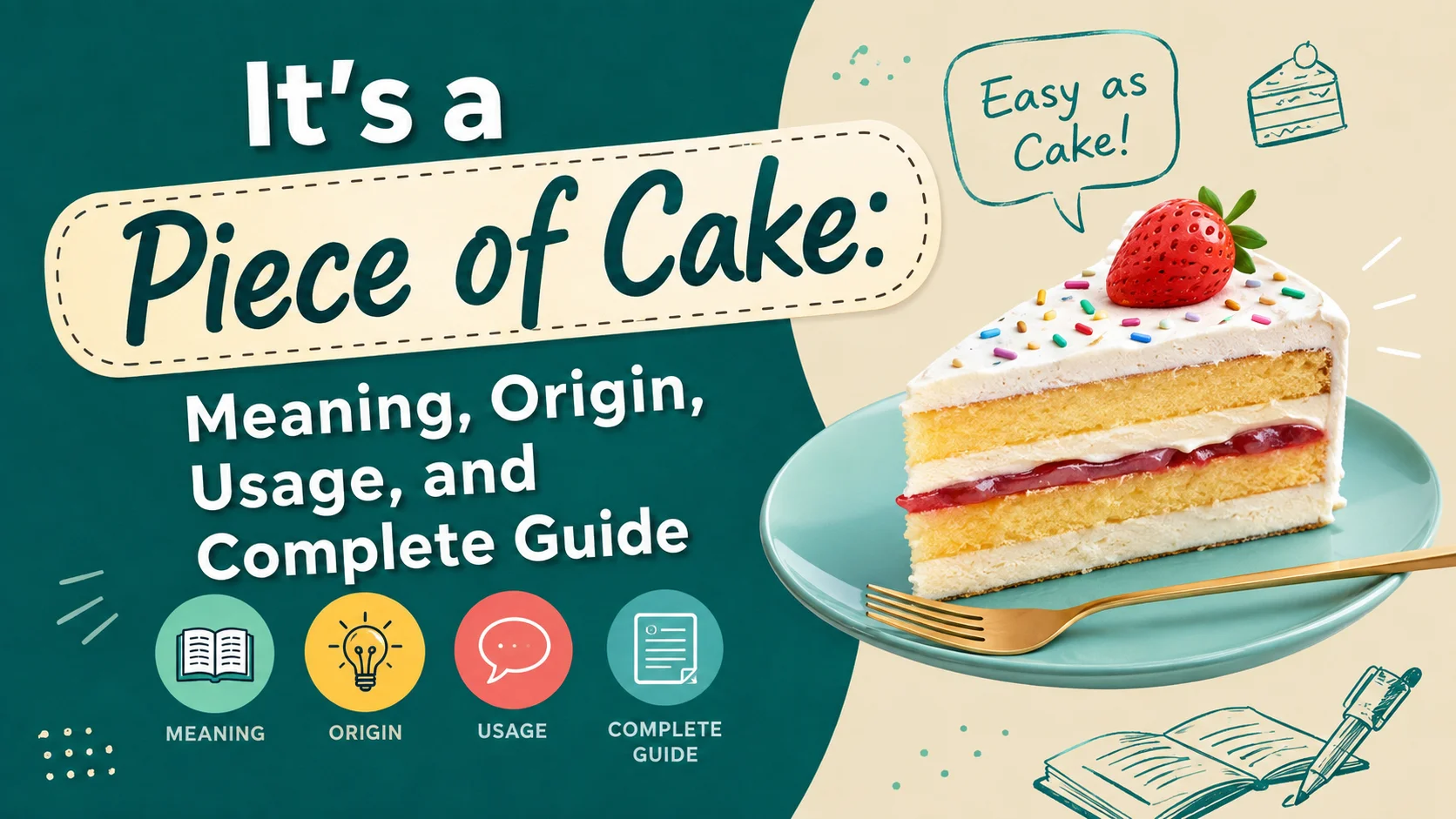
It’s a Piece of Cake is a common idiom in everyday English that tells someone a task is very easy and does not require much effort to complete. The expression has a cheerful tone and fits naturally into everyday language, especially in American English. When you use it in the right context, you can describe a familiar job, a simple activity, or a task that feels easier than expected. Its meaning is clear because a piece of cake suggests something pleasant and easy.
The history of this popular phrase is also interesting. The idiomatic expression was documented in print during the 1930s, while its possible origin has been linked to an older tradition involving cake, dessert, and sweets. The Royal Air Force is sometimes mentioned in discussions about its development, although there isn’t an exact path that proves one single source. Another possible connection is the cakewalk tradition, which helped associate cake with something that could be won or achieved with ease.
Today, the phrase remains useful for different situations, especially when a difficult-looking task turns out to be easy to do. You might use it after solving a problem, completing an exam, or finishing a job that seemed hard at first. Instead of simply saying simple, easy, or uncomplicated, the phrase adds a more cheerful and memorable tone to conversations. It works best in informal settings rather than formal writing, and with a little skill and practice, you can naturally use this phrase when describing a task that takes little effort.
Quick Answer: What Does “It’s a Piece of Cake” Mean?
“It’s a piece of cake” means that something is very easy to do.
It’s an informal English idiom that describes a task, activity, problem, or situation that requires little effort or skill.
For example:
The math test was a piece of cake.
This means:
The math test was very easy.
The expression can describe something that was easy in the past, is easy now, or will probably be easy in the future.
| Expression | Meaning |
| It’s a piece of cake. | It’s very easy. |
| That was a piece of cake. | That was very easy. |
| The test was a piece of cake. | The test wasn’t difficult. |
| It’ll be a piece of cake. | It will be easy. |
| For her, it’s a piece of cake. | She finds it very easy. |
Cambridge Dictionary classifies a piece of cake as an informal idiom meaning “something that is very easy to do.”
What Does “Piece of Cake” Mean?
The literal meaning of piece of cake is simply a portion cut from a cake.
However, English speakers often use the phrase figuratively. In that context, a piece of cake means an easy task or something that can be accomplished without much difficulty.
Consider these two sentences:
- I ate a piece of cake after dinner.
- The assignment was a piece of cake.
The first sentence refers to actual food. The second uses the phrase as an idiom.
That distinction matters because English frequently turns ordinary objects and activities into figurative expressions. A cake can be delicious in its literal sense while “a piece of cake” communicates ease in its idiomatic sense.
Simple Definition
The easiest way to remember the expression is:
A piece of cake = something very easy.
If someone tells you, “Don’t worry about the installation. It’s a piece of cake,” they’re reassuring you that the installation shouldn’t cause much trouble.
Why Is “Piece of Cake” an Idiom?
An idiom is an expression whose overall meaning differs from the literal meaning of its individual words.
Take the phrase “piece of cake.” Literally, it means a portion of a baked dessert. Yet when someone says, “The interview was a piece of cake,” they’re not suggesting that the interview consisted of chocolate sponge and frosting.
They’re saying the interview was very easy.
This figurative quality makes the expression an idiom.
English has many expressions that work in a similar way:
- Break the ice — make people feel more comfortable
- Hit the nail on the head — describe something exactly
- Under the weather — feel unwell
- A walk in the park — something very easy
- Piece of cake — something very easy
Idioms make everyday speech more vivid. Instead of saying “The task was extremely easy,” a speaker can say, “The task was a piece of cake.”
The second version has more personality.
The Origin of “It’s a Piece of Cake”
The history of “piece of cake” isn’t as neat as the expression itself.
The phrase is generally associated with American English in the 1930s. One frequently cited early printed example comes from Ogden Nash’s The Primrose Path, published in London in 1936. The cited line reads, “And life’s a piece of cake.”
That evidence is important because it gives researchers a documented use of the expression in its figurative sense.
However, the appearance of the phrase in print doesn’t necessarily prove that Nash invented it. Idioms often circulate in speech before writers record them. That’s why identifying the first printed example isn’t always the same thing as identifying the phrase’s true creator.
The Royal Air Force Theory
One commonly reported explanation connects “piece of cake” with the Royal Air Force in the late 1930s.
Dictionary.com describes the expression as originating in the Royal Air Force for an easy mission. It also notes that the precise reference remains uncertain.
The idea fits the phrase’s meaning neatly. If an aircrew described a mission as a piece of cake, they would be saying that the assignment looked easy to complete.
Later examples from the World War II period show the expression in military-related contexts. For instance, historical references cite British usage from the early 1940s.
Still, the RAF explanation should be treated as a proposed origin rather than an unquestionable fact.
The Cakewalk Theory
Another explanation connects the expression with the cakewalk, a dance and competition that developed in the United States during the nineteenth century.
In cakewalk competitions, cake could serve as a prize. The word cakewalk eventually became associated with something easy or effortless. That older association makes a connection with piece of cake tempting.
However, a plausible connection isn’t the same as conclusive proof.
There isn’t enough evidence to say with complete certainty that the modern idiom directly developed from the cakewalk tradition. A careful explanation therefore distinguishes between historical possibility and documented evidence.
What We Actually Know
The safest historical summary looks like this:
| Historical point | What the evidence shows |
| Language | American English association |
| Figurative meaning | Something easy or pleasant |
| Documented period | 1930s |
| Early literary citation | Ogden Nash, The Primrose Path, 1936 |
| RAF connection | Commonly cited explanation from the late 1930s |
| Cakewalk connection | Possible influence |
| Exact origin | Still uncertain |
In other words, the meaning is clear even though the origin story isn’t completely settled.
How to Use “It’s a Piece of Cake” Correctly
The phrase works best when you want to tell someone that a task is easy.
Basic Sentence Pattern
A common structure is:
Subject + be + a piece of cake
Examples:
- The test is a piece of cake.
- The assignment was a piece of cake.
- Learning the program will be a piece of cake.
- The repair turned out to be a piece of cake.
You can also use the phrase after a task has finished:
“How was the interview?”
“It was a piece of cake.”
Here, the speaker evaluates the interview as easy.
Using “Piece of Cake” With Different Tenses
The idiom itself doesn’t need to change when the time changes. Instead, the verb around it changes.
| Tense | Example |
| Present | The assignment is a piece of cake. |
| Past | The assignment was a piece of cake. |
| Future | The assignment will be a piece of cake. |
| Present perfect | The assignment has been a piece of cake. |
| Conditional | The assignment would be a piece of cake with better instructions. |
This makes the expression flexible in everyday conversation.
“A Piece of Cake for Someone”
You can also explain that something is easy for a particular person.
For example:
- For Maria, solving equations is a piece of cake.
- Driving in heavy traffic isn’t a piece of cake for everyone.
- For an experienced designer, creating the layout was a piece of cake.
This structure adds an important idea: difficulty depends on the person.
A task that’s effortless for an expert might feel overwhelming to a beginner.
Real-Life Examples of “It’s a Piece of Cake”
The expression appears naturally in many everyday situations.
At School
“Were you worried about the science quiz?”
“Not after studying. It was a piece of cake.”
Here, the speaker means the quiz was easier than expected.
At Work
“Can you update the spreadsheet?”
“Sure. It’s a piece of cake.”
The speaker has probably performed the same task many times.
With Technology
“Was the software difficult to install?”
“No. It was a piece of cake.”
The phrase emphasizes how little trouble the installation caused.
While Cooking
“Was that recipe difficult?”
“Not at all. It was a piece of cake.”
The expression can describe cooking even though the task itself has nothing to do with cake.
When Learning a Skill
“How did you learn the new keyboard shortcuts so quickly?”
“Once I practiced them a few times, they were a piece of cake.”
The idiom often appears after someone becomes comfortable with a new skill.
“Piece of Cake” vs. “Easy”
The two expressions communicate nearly the same basic idea. However, they don’t sound exactly the same.
| Feature | Piece of Cake | Easy |
| Meaning | Very easy | Not difficult |
| Word type | Idiomatic phrase | Adjective |
| Tone | Informal | Neutral |
| Conversation | Very natural | Very natural |
| Formal writing | Usually too casual | Usually appropriate |
| Expressiveness | More vivid | More direct |
Compare these sentences:
The assignment was easy.
The assignment was a piece of cake.
Both are correct. The first sounds neutral. The second sounds more relaxed and conversational.
That’s the key difference.
How formal is “Piece of Cake”?
“Piece of cake” is informal.
That doesn’t mean it’s incorrect. It simply means that the phrase fits casual communication better than highly formal writing. Cambridge explicitly labels the idiom as informal.
You can comfortably use it in:
- Conversations with friends
- Text messages
- Casual emails
- Informal blog posts
- Friendly workplace conversations
- Everyday storytelling
However, a formal report might benefit from a more neutral phrase.
Informal vs. Formal Examples
| Informal | More formal |
| The process was a piece of cake. | The process was straightforward. |
| The task was a piece of cake. | The task required minimal effort. |
| The procedure was a piece of cake. | The procedure was relatively simple. |
| Finishing the project was a piece of cake. | Finishing the project presented little difficulty. |
The goal isn’t to eliminate idioms from your English. Instead, choose language that matches your audience.
“Piece of Cake” vs. Similar Idioms
English has several colorful ways to describe an easy task.
| Idiom | Meaning | Tone |
| A piece of cake | Very easy | Informal |
| A walk in the park | Very easy | Informal |
| Easy as pie | Very easy | Informal |
| A breeze | Very easy | Informal |
| Child’s play | Extremely easy | Informal |
| No sweat | Requires little effort | Very casual |
| Easy as ABC | Extremely simple | Informal |
These expressions overlap, but their tone can differ.
For example, “No sweat” often sounds especially casual:
“Can you help me move this table?”
“No sweat.”
Meanwhile, “a piece of cake” often evaluates the difficulty of a particular task:
“Was assembling the desk difficult?”
“No, it was a piece of cake.”
“Piece of Cake” vs. “Easy as Pie”
These two idioms are almost twins.
Both communicate the idea that something requires very little effort.
| Expression | Meaning | Example |
| A piece of cake | Very easy | The exam was a piece of cake. |
| Easy as pie | Very easy | The repair was easy as pie. |
Neither expression automatically sounds more correct than the other.
Your choice usually comes down to personal style and context.
Interestingly, English has a long history of using cake and pie imagery in expressions related to pleasure, ease, or desirable situations.
Common Mistakes With “Piece of Cake”
Common Mistakes With “Piece of Cake” — Learn how to use this idiom correctly and avoid common mistakes with its meaning, spelling, grammar, and context.
Mistake: Thinking It Means “Delicious”
When someone says:
“The exam was a piece of cake.”
They aren’t saying the exam was enjoyable like dessert.
They mean:
The exam was very easy.
Context tells you whether the phrase is literal or idiomatic.
Mistake: Forgetting the Article “A”
The standard idiom is:
a piece of cake
Not:
piece of cake
For example:
- Correct: The test was a piece of cake.
- Less natural in a complete sentence: The test was piece of cake.
The article a belongs with the singular countable noun piece.
Mistake: Using It in Every Situation
Although the phrase is common, repetition can make your writing sound mechanical.
Instead of using piece of cake five times, vary your vocabulary:
- Easy
- Simple
- Straightforward
- Effortless
- A breeze
- Uncomplicated
- Manageable
Good writing isn’t about finding one colorful phrase and squeezing it into every paragraph.
Mistake: Assuming Everyone Finds It Easy
The idiom expresses the speaker’s assessment.
Consider:
For an experienced programmer, fixing the error was a piece of cake.
That doesn’t mean the error would be easy for everyone.
Difficulty depends on experience, knowledge, tools, time, and circumstances.
Is “It’s a Piece of Cake” Positive or Negative?
Usually, “it’s a piece of cake” has a positive or reassuring tone.
Someone might use it to calm another person:
“Don’t worry about the presentation. It’s a piece of cake.”
The speaker wants the listener to feel less anxious.
However, tone can change the meaning.
Imagine someone receives an unexpectedly difficult assignment and sarcastically says:
“Oh sure. This will be a piece of cake.”
The words still literally describe ease. The speaker’s tone suggests the opposite.
This is a good example of why idioms don’t exist in a vacuum. Context, facial expression, and voice can reshape the message.
Can You Use “Piece of Cake” in Professional English?
Yes, but context matters.
Imagine a coworker asks:
“Can you show me how to create this report?”
A natural response might be:
“Sure. It’s a piece of cake.”
That sounds friendly and relaxed.
Now imagine writing a formal business report:
“The implementation process was a piece of cake.”
That sentence sounds too casual for many formal settings.
A better choice would be:
“The implementation process was straightforward.”
The difference isn’t about grammar. It’s about registering.
Natural Ways Native Speakers Use “Piece of Cake”
The expression doesn’t always appear in a complete sentence.
Sometimes speakers simply say:
“Piece of cake!”
This works as a short response when everyone understands the context.
For example:
“Can you fix the printer?”
“Piece of cake.”
Other natural patterns include:
- It was a piece of cake.
- It’s a piece of cake.
- It’ll be a piece of cake.
- That should be a piece of cake.
- For me, it’s a piece of cake.
- The whole thing was a piece of cake.
- Don’t worry. It’ll be a piece of cake.
These patterns make the idiom especially useful in conversation.
Short Conversations Using “Piece of Cake”
This section provides short, natural conversations that show how to use “piece of cake” correctly in everyday English
Before an Exam
Alex: “How did you feel about the math exam?”
Jordan: “Honestly, it was a piece of cake.”
Alex: “Really? I thought question five was tricky.”
Jordan: “That one took me a minute, but the rest was easy.”
At Work
Manager: “Can you prepare the weekly report?”
Sam: “Sure. It’s a piece of cake.”
Manager: “Great. Please send it before lunch.”
Learning Technology
Nina: “Was the new app difficult to learn?”
Emma: “Not at all. Once I understood the basics, it was a piece of cake.”
These examples show something important: the idiom usually appears when the speaker evaluates difficulty.
Literal “Piece of Cake” vs. Idiomatic “Piece of Cake”
Context determines which meaning the reader should choose.
| Sentence | Meaning |
| I ate a piece of cake after dinner. | A portion of dessert |
| The exam was a piece of cake. | The exam was very easy |
| She saved a piece of cake for her brother. | A physical portion of dessert |
| Fixing the error was a piece of cake. | Fixing the error was very easy |
| He ordered another piece of cake. | A portion of food |
| Learning the software was a piece of cake. | Learning it was easy |
The grammar remains similar. The surrounding context changes the meaning.
That ability to shift between literal and figurative meanings is one reason English idioms can be challenging for language learners.
A Practical Case Study: When “Piece of Cake” Works Best
Imagine two coworkers discussing a new reporting system.
The first employee has used similar software for years. The second has never worked with a reporting platform before.
The experienced employee says:
“Don’t worry. Setting up the report is a piece of cake.”
For the experienced worker, that assessment makes sense.
But the beginner may struggle.
This illustrates a useful point about the idiom: “piece of cake” describes perceived difficulty rather than an objective measurement of difficulty.
The phrase doesn’t tell you how many steps a task contains. It tells you that the speaker believes those steps are easy.
Better Alternatives to “Piece of Cake”
Sometimes you need a different expression.
Casual Alternatives
- A breeze
- A walk in the park
- No sweat
- Child’s play
- Easy as pie
- Easy as ABC
Neutral Alternatives
- Very easy
- Simple
- Straightforward
- Uncomplicated
- Manageable
Formal Alternatives
- Easily accomplished
- Relatively straightforward
- Requires minimal effort
- Presents little difficulty
- Can be completed with minimal effort
Choosing the right alternative depends on your audience.
If you’re texting a friend, “piece of cake” sounds perfectly natural. If you’re writing a research report, “straightforward” usually fits better.
Grammar Breakdown of “A Piece of Cake”
The phrase has a simple grammatical structure.
In:
The exam was a piece of cake.
the parts work like this:
| Part | Function |
| The exam | Subject |
| was | Linking verb |
| a piece of cake | Subject complement |
Within the noun phrase a piece of cake:
- a = indefinite article
- piece = singular countable noun
- of = preposition
- cake = noun
The phrase becomes idiomatic because the complete noun phrase conveys the idea of ease rather than an actual portion of food.
Interesting Facts About “Piece of Cake”
Here are several useful facts worth remembering:
- “Piece of cake” is an idiom.
- Its idiomatic meaning is something very easy to do.
- Major dictionaries classify it as informal.
- The expression is associated with American English.
- Figurative uses are documented from the 1930s.
- Ogden Nash’s The Primrose Path is commonly cited for a 1936 printed example.
- The expression’s exact origin remains uncertain.
- The Royal Air Force theory is widely reported but doesn’t completely settle the question of origin.
- A connection with the cakewalk is another proposed explanation.
- The phrase can describe an easy task without referring to food at all.
Quick Reference: “It’s a Piece of Cake”
| Question | Answer |
| Meaning | Something very easy |
| Type | Idiom |
| Register | Informal |
| Common use | Everyday conversation |
| Literal meaning | A portion of cake |
| Figurative meaning | An easy task |
| Documented period | 1930s |
| Early cited example | Ogden Nash, 1936 |
| Exact origin | Uncertain |
| Formal alternative | Straightforward / very easy |
Conclusion
“It’s a Piece of Cake” is a simple and useful idiomatic expression for saying that something is very easy or requires little effort. It fits naturally in everyday English, especially in casual conversations and American English. Once you understand its meaning, usage, and informal tone, you can use this cheerful phrase naturally when describing an easy task, job, exam, or activity.
FAQs
Q1. What does “It’s a Piece of Cake” mean?
“It’s a Piece of Cake” means that something is very easy to do and requires little effort.
Q2. Is “It’s a Piece of Cake” an idiom?
Yes. “It’s a Piece of Cake” is an idiom because its meaning isn’t about an actual piece of cake. It describes something that is easy.
Q3. Is “It’s a Piece of Cake” formal or informal?
It is mainly informal and works well in everyday language and casual conversations. You generally wouldn’t use it in highly formal writing.
Q4. Can I use “It’s a Piece of Cake” for an exam?
Yes. You can say, “The exam was a piece of cake” when you mean the exam was easy or easier than expected.
Q5. What are some alternatives to “It’s a Piece of Cake”?
Common alternatives include easy, simple, uncomplicated, effortless, and a cakewalk. The best choice depends on the context and level of formality.
About the Author