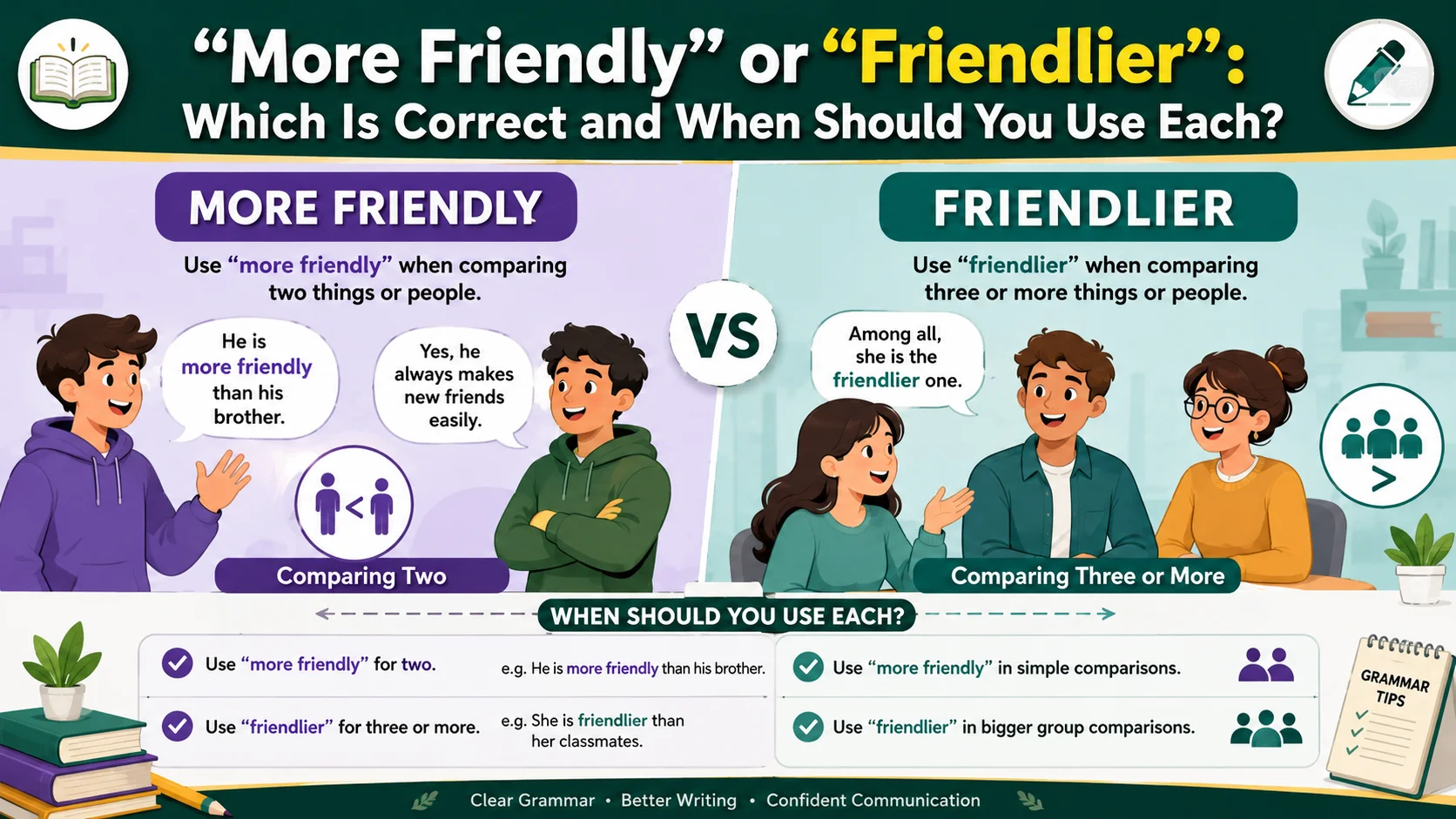
When choosing “More Friendly” Or “Friendlier”, both comparative forms can be correct, but context often decides which sounds more natural. Friendlier is commonly used in everyday language, casual speech, and direct comparisons, while more friendly can fit smoothly in formal writing, professional usage, and longer sentences. For example, “My cat is friendlier than my dog” clearly compares two people or things, while “She is more friendly than I expected” may sound more natural because of the surrounding sentence structure and sentence flow. From my experience helping English learners and writers, looking at real examples, conversations, articles, and reviews makes this grammar choice much easier.
The main difference isn’t correctness, but style, rhythm, and the way the sentence’s meaning develops. Friendlier often feels smooth and natural when the comparison is short and direct. More friendly, however, may work better in a professional email, technical writing, or a longer sentence where the extra word creates a better rhythm. This doesn’t mean one form is always better. Instead, the choice depends on the tone, personal style, professional context, and the qualities being compared. In modern English, both forms appear regularly, so reading guides, articles, and other real examples can help you understand their natural usage.
One important grammar rule remains clear: avoid more friendlier because more and -er both mark the comparative degree, creating a double comparative. A useful practical tip is to choose either friendlier or more friendly, never both together. This simple rule improves clarity, correctness, and effective writing in an email, essay, presentation, or social media post. When you compare two items, two people, or different qualities, consider the sentence structure, context, and what sounds natural. With regular practice, the difference between these accepted forms becomes easier to recognize, and your English can sound more confident, fluent, and natural.
Quick Answer: “More Friendly” or “Friendlier”?
Both “friendlier” and “more friendly” are grammatically correct.
Use friendlier when you want the compact comparative form:
“The new teacher is friendlier than the previous teacher.”
Use more friendly when that structure fits your sentence better:
“The new policy is more friendly to small businesses.”
Neither form is automatically more correct. Cambridge’s grammar guidance explains that comparative adjectives can use different formations depending on the adjective. It also specifically notes that two-syllable adjectives ending in -y commonly take -ier, while some two-syllable adjectives allow alternative patterns.
| Form | Correct? | Example |
| friendly | Yes | “She is friendly.” |
| friendlier | Yes | “She is friendlier now.” |
| more friendly | Yes | “She is more friendly now.” |
| more friendlier | No | “She is more friendlier now.” ❌ |
| friendliest | Yes | “She is the friendliest person here.” |
| most friendly | Yes | “She is the most friendly person here.” |
If you remember only one thing, remember this: choose either “friendlier” or “more friendly,” never “more friendlier.”
What Does “Friendly” Mean?
Before comparing friendlier and more friendly, it helps to understand what friendly actually describes.
Friendly is an adjective that generally refers to someone who behaves in a pleasant, kind, welcoming, or approachable way. It can describe people as well as places, organizations, services, products, and environments.
For example:
- “She gave me a friendly smile.”
- “The receptionist was very friendly.”
- “That dog looks friendly.”
- “It’s a friendly neighborhood.”
- “The website has a friendly design.”
Cambridge defines friendly as behaving toward someone in a pleasant and kind way. It also uses the word for places that feel pleasant and comfortable. In addition, friendly can work as a combining form in expressions such as user-friendly and family-friendly.
That broad meaning explains why the word appears in so many contexts.
A person can be friendly because they welcome others. A restaurant can be friendly because its staff make customers feel comfortable. A website can be user-friendly because people can navigate it without difficulty.
The basic idea changes slightly with context, but the central meaning remains pleasant, welcoming, or accommodating.
Why Are Both “Friendlier” and “More Friendly” Correct?
English comparative adjectives don’t follow one single rule.
Many short adjectives form their comparative by adding -er:
- tall → taller
- fast → faster
- small → smaller
- bright → brighter
Longer adjectives usually use more:
- expensive → more expensive
- interesting → more interesting
- complicated → more complicated
Two-syllable adjectives create a more interesting middle ground. Some use -er, some prefer more, and some can use either.
Cambridge notes that two-syllable adjectives ending in -y commonly change y to i and add -er or -est. Examples include easy → easier and happy → happier.
That gives us:
friendly → friendlier
However, English also allows:
friendly → more friendly
So there’s no contradiction. Both patterns can function as comparative forms.
The “-y” Spelling Rule
The spelling of friendlier follows a familiar pattern.
When many adjectives ending in -y take -er, the y changes to i:
| Base adjective | Comparative |
| happy | happier |
| easy | easier |
| busy | busier |
| funny | funnier |
| friendly | friendlier |
The same pattern appears in superlatives:
- happy → happiest
- easy → easiest
- busy → busiest
- friendly → friendliest
So friendlier isn’t an unusual spelling. It follows an established English pattern.
“Friendlier” vs. “More Friendly”: Side-by-Side Comparison
Now consider the two forms directly.
| Feature | Friendlier | More Friendly |
| Grammatical? | Yes | Yes |
| Comparative form? | Yes | Yes |
| Meaning | Greater degree of friendliness | Greater degree of friendliness |
| Common in simple comparisons? | Yes | Yes |
| Suitable for formal writing? | Yes | Yes |
| Suitable for conversation? | Yes | Yes |
| Can I follow “than”? | Yes | Yes |
| Can you describe people? | Yes | Yes |
| Can you describe places? | Yes | Yes |
| Can you describe services? | Yes | Yes |
Compare these sentences:
“The new manager is friendlier than the old manager.”
“The new manager is more friendly than the old manager.”
Both sentences communicate the same basic comparison.
The difference is mainly stylistic. Friendlier is more compact. More friendly gives you the longer comparative construction.
Neither deserves to be labeled wrong.
When Should You Use “Friendlier”?
For a simple comparison, friendlier often feels natural and direct.
Consider:
“My new neighbor is friendlier than my old neighbor.”
There’s nothing awkward about the sentence. The comparative adjective does its job quickly.
Here are more examples:
- “The new receptionist is friendlier than the previous one.”
- “This neighborhood feels friendlier now.”
- “Your dog seems friendlier today.”
- “The staff became friendlier after the training.”
- “The new teacher is friendlier with students.”
Because friendlier is a single compact word, it can make short sentences flow smoothly.
“Friendlier” in Everyday English
Imagine that you visit two coffee shops.
At the first one, the employees barely acknowledge customers. Second, they smile, answer questions, and remember regular customers.
You might naturally say:
“The staff at the second café are friendlier.”
That’s a straightforward comparison.
You don’t need to force the longer form into the sentence.
The same principle works when describing behavior:
“He became friendlier after moving to the new school.”
The sentence describes a change. His behavior became more welcoming than before.
When Should You Use “More Friendly”?
More friendly is also completely valid.
Sometimes the longer construction works especially well when friendly has additional words attached to it.
For example:
“The new policy is more friendly to small businesses.”
You could also say:
“The new policy is friendlier to small businesses.”
Both are correct.
The longer form may sound natural when the sentence contains a substantial complement after friendly.
Consider another example:
“The new system is more friendly to first-time users.”
The phrase more friendly to first-time users forms a clear unit.
Again, however, this doesn’t mean that friendlier to first-time users is incorrect.
Is “Friendlier” Informal?
No.
This is one of the most common misconceptions surrounding this comparison.
Because friendlier is shorter, some writers assume that it sounds too casual for professional or academic writing. That’s not a valid grammar rule.
A standard comparative adjective doesn’t become informal merely because it uses -er.
For example:
“The company has developed a friendlier approach to customer service.”
That sentence could appear in a business report without any grammatical problem.
You could also write:
“The revised policy creates a friendlier environment for employees.”
The form is standard English.
Is “More Friendly” More Formal?
Not necessarily.
A longer construction can sometimes sound more deliberate, but more friendly isn’t automatically more formal.
Compare:
“The company wants to create a friendlier workplace.”
and:
“The company wants to create a more friendly workplace.”
Both are grammatically sound.
The first is more compact. The second uses the more + adjective construction.
Good writing isn’t about forcing one into every formal sentence. Instead, choose the version that fits the surrounding language.
“Friendlier” or “More Friendly” With “Than”
Both forms can take more than when you explicitly name the person or thing being compared.
With “Friendlier”
“Sarah is friendlier than Emma.”
“This restaurant is friendlier than the one downtown.”
“The new software is friendlier than the previous version.”
With “More Friendly”
“Sarah is more friendly than Emma.”
“This restaurant is more friendly than the one downtown.”
“The new software is more friendly than the previous version.”
Both constructions work.
Cambridge explains that than introduces the second person or thing in a comparative construction.
So don’t fall into the trap of thinking that friendlier than is grammatical while more friendly than is somehow wrong.
Both are legitimate.
“Friendlier” or “More Friendly” When Comparing Several People
Another common misunderstanding concerns the number of people being compared.
Suppose there are four employees:
Anna, Ben, Carlos, and Dana.
You can write:
“Anna is friendlier than Ben, Carlos, and Dana.”
You can also write:
“Anna is more friendly than Ben, Carlos, and Dana.”
The fact that three people appear after than doesn’t force you to use more friendly.
The important distinction is between comparative and superlative forms.
A comparative focuses on a comparison between one item and another item or set of items. A superlative identifies the highest degree within a group. Cambridge makes this distinction clear in its explanation of comparative and superlative adjectives.
“Friendliest” vs. “Most Friendly”
Once you understand the comparative forms, the superlative forms become much easier.
You can use:
- friendliest
- most friendly
For example:
“Maria is the friendliest person in the office.”
or:
“Maria is the most friendly person in the office.”
The first uses the -est ending. The second uses most.
Comparative and Superlative Table
| Degree | -er/-est form | More/most form |
| Positive | friendly | friendly |
| Comparative | friendlier | more friendly |
| Superlative | friendliest | most friendly |
A comparative usually compares one person or thing with another:
“John is friendlier than Mark.”
A superlative identifies the highest degree in a group:
“John is the friendliest employee.”
Cambridge’s grammar guidance distinguishes these two functions clearly.
Why “More Friendlier” Is Wrong
Here’s the mistake worth avoiding above all others:
“She is more friendlier than her sister.” ❌
Why doesn’t it work?
Because more already creates the comparative construction, while -er also marks the comparative degree.
You’ve effectively marked the comparison twice.
The correct versions are:
“She is friendlier than her sister.” ✔
or:
“She is more friendly than her sister.” ✔
The same principle applies to superlatives.
Incorrect:
“She is the most friendliest person here.” ❌
Correct:
“She is the friendliest person here.” ✔
or:
“She is the most friendly person here.” ✔
Cambridge explicitly warns against combining more/most with adjectives that already carry -er/-est endings.
Friendly in Compound Adjectives
The word friendly appears in many compound adjectives.
Common examples include:
- user-friendly
- family-friendly
- child-friendly
- reader-friendly
- beginner-friendly
- business-friendly
- environmentally friendly
- mobile-friendly
Cambridge lists user-friendly and family-friendly as examples of friendly used as a combining form.
When you compare these expressions, more is often the natural choice:
“The new app is more user-friendly.”
“This restaurant is more family-friendly.”
“The new instructions are more reader-friendly.”
“This option is more environmentally friendly.”
Trying to create forms such as user-friendlier can occasionally occur, but more user-friendly is usually the clearer choice because you’re comparing the entire compound adjective.
This distinction matters. Don’t treat every word containing friendly as though it were simply the standalone adjective.
“More Friendly to” vs. “Friendlier to”
The adjective friendly commonly appears with to and toward.
For example:
“She wasn’t very friendly to me.”
“Our neighbors are friendly toward us.”
Cambridge records both patterns.
When you make the adjective comparative, both forms remain possible:
“The new policy is friendlier to small businesses.”
“The new policy is more friendly to small businesses.”
The meaning remains broadly the same: the policy treats or affects those businesses in a more favorable or accommodating way.
Real-World Examples of “Friendlier” and “More Friendly”
| Context | Example | Good choice |
| Everyday conversation | “Your new neighbor is friendlier.” | Friendlier |
| Workplace | “The office feels friendlier now.” | Friendlier |
| Customer service | “The process is more friendly to customers.” | More friendly |
| Technology | “The interface is more user-friendly.” | More user-friendly |
| Community | “The neighborhood feels friendlier.” | Friendlier |
| Business policy | “The new rules are more friendly to small businesses.” | More friendly |
| Animals | “The puppy is much friendlier now.” | Friendlier |
| Education | “The platform is more friendly for beginners.” | More friendly |
The examples above show tendencies rather than strict rules. In several cases, you could switch the forms without creating a grammatical error.
Case Study: Fixing a Common Sentence
Consider this sentence:
“Our new customer service system is more friendlier.”
Something immediately sounds wrong.
The problem is the double comparative.
There are two clean options:
“Our new customer service system is friendlier.”
or:
“Our new customer service system is more friendly.”
But suppose the company means that customers find the system easier to operate.
Then a more precise sentence might be:
“Our new customer service system is more user-friendly.”
That final version communicates a specific idea rather than simply saying the system has a pleasant personality.
This illustrates an important writing lesson: grammar and precision work together.
A sentence can be grammatically correct yet still use a less precise word.
How to Choose Between “Friendlier” and “More Friendly”
When you’re editing your sentence, use this simple process.
1. Start With “Friendlier” for a Simple Comparison
Try:
“The new manager is friendlier.”
“This neighborhood is friendlier.”
“The new employee seems friendlier.”
If the sentence sounds natural, you’re done.
2. Try “More Friendly” When It Fits the Structure
Use:
“The policy is more friendly to small businesses.”
The longer form may fit the sentence’s rhythm nicely.
3. Check for a Compound Adjective
If you’re dealing with user-friendly, family-friendly, or environmentally friendly, consider using more:
“The new app is more user-friendly.”
4. Never Use Both Comparative Markers
Don’t write:
“more friendlier” ❌
Choose:
“friendlier” ✔
or:
“more friendly” ✔
A Simple Memory Trick
Think of the comparison like a fork in the road.
You can take one route:
friendly → friendlier
Or the other:
friendly → more friendly
But don’t merge both routes:
friendly → more friendlier ❌
The same principle applies to many comparative adjectives. Cambridge specifically warns against constructions that combine more with an -er comparative.
Conclusion
Both friendlier and more friendly are correct comparative forms of the adjective friendly. In most everyday comparisons, friendlier sounds natural and concise, while more friendly can work better depending on the sentence structure, tone, and context. The key grammar rule is simple: use either friendlier or more friendly, but never more friendlier. With regular reading and practice, you can choose the form that makes your English sound clear and natural.
FAQs
Q1. Is “more friendly” grammatically correct?
Yes. More friendly is a correct comparative form of friendly. It can be used when the sentence sounds more natural with more rather than the -er ending.
Q2. Is “friendlier” correct English?
Yes. Friendlier is also a correct comparative form. It’s especially common in everyday language and direct comparisons, such as “This restaurant is friendlier than the other one.”
Q3. Which is better: “more friendly” or “friendlier”?
Neither is always better. Friendlier often sounds more concise, while more friendly may fit better depending on the context, rhythm, and sentence structure.
Q4. Can I say “more friendlier”?
No. More friendlier is considered incorrect because it uses two comparative markers: more and -er. Use more friendly or friendlier instead.
Q5. What is the comparative form of “friendly”?
The adjective friendly has two accepted comparative forms: friendlier and more friendly. Both can be used correctly when comparing people, animals, places, or things.
About the Author