
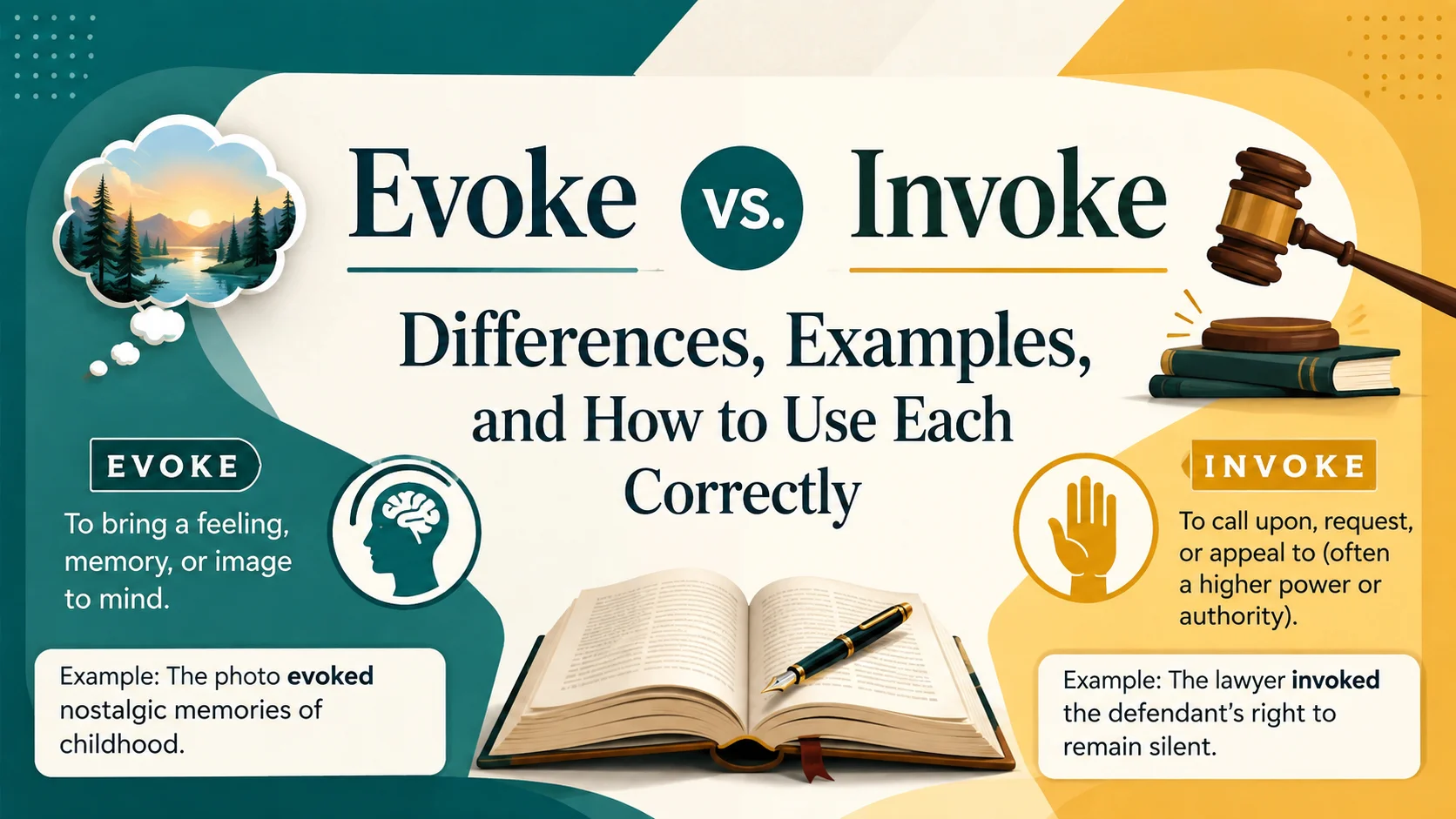
Evoke vs Invoke becomes easier when you focus on what you are trying to call or bring forward: an inner response or an outside source. Evoke usually connects with feelings, memories, images, ideas, and emotions, while invoke means to call on or appeal to an outside source, authority, law, rule, power, or spirit. A photograph can evoke nostalgia and bring a memory of childhood to your mind, while a lawyer may invoke a legal right for support. Both words share a Latin root, vocare, meaning to call, which explains their similar form and common confusion, but their meaning and usage remain distinct. In English language writing, a simple way to remember evoke is bringing up something already held in the mind or feelings.
Invoke, on the other hand, involves calling on something outside yourself for support, help, or effect. A judge may invoke a statute, while a senator may invoke the constitution during a debate. Someone can also invoke traditions, rights, formal powers, formal appeals, or the names of deities. Merriam-Webster recognizes meanings involving an appeal, calling upon something for help, or putting into effect a particular power. That makes invoke especially useful in legal contexts, academic writing, professional communication, and other situations involving an established authority or source. The main difference is straightforward: evoke brings a feeling, memory, or mental image into someone’s mind, whereas invoke calls upon something for support, effect, or authority.
A helpful memory trick is to connect evoke with bring to mind and invoke with calling on. If a photograph, smell, story, or expression causes an emotion or image to appear in your mind, choose evoke. If someone appeals to law, tradition, a higher power, legal authority, or external aid, choose invoke. This distinction makes a basic sentence more precise and helps it stand out and resonate with the reader. Although the words look nearly identical, their shared idea of calling forth can make them seem like distant cousins that blur together in conversations. Their broader meanings, essence, and perfect expression become clearer when you consider what is being called forth and why, rather than treating the difference as a simple vocabulary trick.
Quick Answer: Evoke vs. Invoke
The simplest distinction is this:
- Evoke means to bring a memory, feeling, image, reaction, or idea to mind.
- Invoke means to call upon, appeal to, cite, or put something into effect.
| Word | Main idea | Typical examples |
| Evoke | Bring something to mind or cause a response | evoke memories, evoke emotions, evoke nostalgia |
| Invoke | Call upon something for support, authority, protection, or effect | invoke a law, invoke a right, invoke authority |
Consider these two sentences:
The old photograph evoked memories of childhood.
The attorney invoked the defendant’s constitutional rights.
The photograph doesn’t deliberately appeal to childhood memories. Instead, it brings those memories back. The attorney, on the other hand, deliberately calls upon a legal right.
That’s the core difference.
Evoke brings something forth. Invoke calls upon something.
What Does “Evoke” Mean?
Evoke is a transitive verb that generally means to bring something to mind or cause a particular feeling, reaction, memory, or mental image.
Cambridge Dictionary defines evoke as making someone remember something or feel an emotion. Merriam-Webster similarly describes it as calling something forth or bringing it to mind.
The word often appears when one thing produces a response in another person.
For example:
The smell of fresh bread evoked memories of her grandmother’s kitchen.
The smell acts as the trigger. The memories arise because of it.
That relationship is important. Evoke often describes an effect produced by a person, object, sound, image, place, experience, or event.
Common Uses of Evoke
You will frequently see evoke paired with words connected to memory, emotion, imagination, and response.
Common combinations include:
- evoke memories
- evoke emotions
- evoke feelings
- evoke nostalgia
- evoke an image
- evoke a response
- evoke sympathy
- evoke fear
- evoke laughter
- evoke a sense of calm
- evoke a particular era
- evoke a familiar atmosphere
For example:
The song evoked memories of summer vacations.
The painting evokes a feeling of loneliness.
Her story evoked sympathy from the audience.
The old building evokes the atmosphere of another era.
Notice the pattern. Something causes another experience to surface.
Evoke in Everyday English
You don’t need a literary sentence to use evoke correctly.
Imagine walking into an old school after twenty years. The smell of chalk, the wooden desks, and the faded bulletin boards might evoke memories of childhood.
Similarly, a particular song can evoke sadness, while the smell of cinnamon can evoke memories of the holidays.
The word works especially well when the response feels almost automatic.
The familiar perfume evoked memories of her first apartment.
The perfume isn’t making an argument. It isn’t requesting anything. It simply brings something back.
What Does “Invoke” Mean?
Invoke has a more deliberate sense. It can mean to call upon something for help or support, appeal to an authority, cite a principle, or put a rule or power into effect.
Merriam-Webster lists several established meanings, including petitioning for help or support, appealing to authority, calling forth by incantation, making an earnest request, and putting something into effect or operation.
This gives invoke a wider range than many learners realize.
For example:
The lawyer invoked the defendant’s right to remain silent.
Here, the lawyer is deliberately relying on a recognized legal protection.
Another example:
The company invoked its emergency policy.
The company isn’t merely reminding people that the policy exists. It is putting the policy into operation.
Common Uses of Invoke
Some of the most useful combinations include:
- invoke a law
- invoke a right
- invoke authority
- invoke a principle
- invoke a rule
- invoke a clause
- invoke a tradition
- invoke a precedent
- invoke a privilege
- invoke an exception
- invoke a deity
- invoke someone’s name
For example:
The defendant invoked his constitutional rights.
The regulator invoked its legal authority.
The contract allows either party to invoke the termination clause.
The speaker invoked tradition to defend the decision.
In each case, someone calls upon something for a particular purpose.
Evoke vs. Invoke: The Core Meaning Difference
Here’s the easiest way to understand the contrast.
Evoke Brings Something Into the Mind
With evoke, something causes a mental, emotional, sensory, or psychological response.
Think of this pattern:
Something → evokes → a memory, emotion, image, or reaction
For example:
The photograph evoked memories of her childhood.
The photograph is the trigger. The memories are what come to mind.
Another example:
The music evoked a sense of nostalgia.
The music creates or awakens the feeling.
Invoke Calls Upon Something
With invoke, someone or something calls upon a source of authority, support, protection, power, or effect.
Think of this pattern:
Person or institution → invokes → a law, right, principle, authority, tradition, or power
For example:
The attorney invoked the First Amendment.
The attorney deliberately appealed to a legal authority.
Another example:
The organization invoked its emergency procedures.
The organization put those procedures into operation.
This distinction is subtle but powerful.
Evoke is often about what appears in the mind. Invoke is often about what someone deliberately calls upon.
Evoke vs. Invoke Side-by-Side
| Feature | Evoke | Invoke |
| Core meaning | Bring to mind or cause a response | Call upon or appeal to |
| Typical objects | Memories, emotions, images, reactions | Laws, rights, authority, rules, principles |
| Common purpose | Create or awaken a response | Gain support, authority, protection, or effect |
| Common tone | Descriptive, emotional, artistic | Formal, legal, deliberate |
| Typical subject | A song, smell, image, story, place | A person, lawyer, institution, government |
| Example | The song evoked memories. | The lawyer invoked the law. |
The table gives you the shortcut. However, context matters because invoke has some meanings that overlap with evoke.
Merriam-Webster specifically notes that the two words have considerable overlap. Still, their most common modern uses differ enough that replacing one with the other can make a sentence sound unnatural or change its meaning.
Evoke vs. Invoke in Real-World Contexts
The difference becomes clearer when you see the words working in different fields.
Evoke in Everyday Conversation
In casual English, evoke commonly describes memories and feelings.
That restaurant evokes memories of college.
Her voice evoked a strange feeling of familiarity.
The smell of rain evokes memories of home.
These sentences sound natural because each one describes something that triggers a response.
Evoke in Literature and Creative Writing
Writers use evoke frequently because good writing often creates an experience without stating every detail directly.
A novelist might describe an empty playground, fading sunlight, and a forgotten child’s shoe. Those details can evoke sadness without the writer explicitly saying, “This scene is sad.”
That is one reason evoke is valuable in literary analysis.
The sparse imagery evokes a sense of isolation.
The imagery produces an emotional effect.
Invoke in Legal English
Legal writing strongly favors invoke when someone relies on a law, right, privilege, rule, or authority.
For example:
The witness invoked the Fifth Amendment.
The defendant invoked his right to counsel.
The agency invoked its statutory authority.
Cambridge specifically gives legal examples involving invoking a law and invoking the Fifth Amendment.
In these situations, invoke has a deliberate and technical quality. A person isn’t simply reminding the reader about a law. They are calling upon that law or legal protection.
Invoke in Religious Contexts
Invoke can also mean calling upon a deity or supernatural power.
For example:
The ceremony invoked the protection of the ancient gods.
This usage has a long history. The noun invocation originally had strong religious associations involving petitions or prayers for divine aid.
The word can also appear in magical or supernatural contexts:
The ritual was intended to invoke a spirit.
Here, the meaning is closer to call forth or summon.
Common Collocations With Evoke and Invoke
Learning common word combinations is one of the fastest ways to stop confusing these verbs.
Common Collocations With Evoke
| Collocation | Example |
| evoke memories | The song evoked memories of school. |
| evoke emotions | The film evoked powerful emotions. |
| evoke nostalgia | The old photographs evoke nostalgia. |
| evoke an image | The description evokes an image of the countryside. |
| evoke sympathy | Her story evoked sympathy. |
| evoke fear | The warning evoked fear. |
| evoke laughter | His story evoked laughter. |
| evoke a response | The speech evoked a strong response. |
Common Collocations With Invoke
| Collocation | Example |
| invoke a law | The agency invoked the law. |
| invoke a right | She invoked her right to appeal. |
| invoke authority | The manager invoked his authority. |
| invoke a principle | The writer invoked a basic principle of fairness. |
| invoke a rule | The referee invoked the rule. |
| invoke a clause | The company invoked the contract clause. |
| invoke a privilege | The witness invoked a legal privilege. |
| invoke tradition | The leader invoked tradition to defend the practice. |
These collocations aren’t rigid mathematical formulas. English gives writers flexibility. Still, they reveal the natural habits of the language.
How to Use “Evoke” Correctly
The grammatical structure is usually straightforward.
Subject + evoke + object
The object is often a memory, feeling, image, or response.
The smell evoked memories of childhood.
The speech evoked strong emotions.
The painting evokes a feeling of peace.
The story evoked sympathy among readers.
You can use different tenses as needed:
- The song evokes memories.
- The song evoked memories.
- The song has evoked memories.
- The song may evoke memories.
The underlying meaning remains the same.
A Useful Test for Evoke
Ask:
“Does this thing bring a feeling, memory, image, or reaction to mind?”
If the answer is yes, evoke is probably the word you need.
How to Use “Invoke” Correctly
Invoke also commonly follows a direct-object pattern.
Subject + invoke + object
The object usually represents something being called upon.
The lawyer invoked the law.
She invoked her rights.
The company invoked the emergency clause.
The speaker invoked historical precedent.
The verb can also appear in technical contexts.
For example, in software development, a programmer may invoke a function. In that setting, invoke means to call or execute something.
So the word isn’t limited to courts and formal speeches.
A Useful Test for Invoke
Ask:
“Is someone calling upon a rule, authority, right, power, source, or mechanism?”
If yes, invoke is often the better choice.
Common Mistakes With Evoke and Invoke
The most common mistakes with evoke and invoke happen when writers use them interchangeably, even though they have different meanings and contexts.
Mistake: “Invoke Memories”
You may occasionally encounter this construction because the meanings overlap. However, evoke memories is the standard and more natural choice when you mean “bring memories to mind.”
Better:
The old house evoked memories of childhood.
Mistake: “Evoke a Legal Right”
When someone deliberately relies on a legal right, invoke is normally the appropriate word.
Better:
The defendant invoked her right to remain silent.
The right isn’t simply appearing in someone’s mind. The person is formally relying on it.
Mistake: Treating the Words as Perfect Synonyms
This is the biggest problem.
Because both words can carry the broad idea of calling something forth, they can look interchangeable. They aren’t.
Compare:
The photograph evoked memories.
The lawyer invoked the statute.
Replacing either verb with the other changes the natural meaning of the sentence.
Mistake: Ignoring the Deliberate-Action Difference
This is another useful clue.
A beautiful melody might evoke sadness without anyone intending it.
A lawyer invokes a statute intentionally.
That contrast between response and appeal will solve many usage questions.
Evoke vs. Invoke: Which Word Should You Choose?
When you’re unsure, run through this quick decision process.
Use evoke when you mean:
- bring back a memory
- create an emotional response
- suggest an image
- awaken nostalgia
- produce a reaction
- make something come to mind
Use invoke when you mean:
- appeal to a law
- claim a legal right
- rely on authority
- cite a principle
- use a rule
- activate a clause
- call upon a deity
- call upon a power or protection
- execute or call a technical mechanism
A simple rule works remarkably well:
Evoke affects the mind. Invoke appeals to something.
It’s not an absolute rule for every historical or specialized use. It is an excellent guide for ordinary modern English.
Why Are Evoke and Invoke So Similar?
The similarity isn’t accidental.
Both words ultimately trace back to the Latin verb vocare, meaning “to call.” Merriam-Webster gives invoke as coming from Latin invocare, meaning “to call upon.” Evoke comes from Latin evocare, meaning “to call out” or “call forth.”
The prefixes provide a useful historical clue:
- e-/ex- carries the sense of out
- in- can carry the sense of upon or in
So the historical contrast resembles:
evoke → call out / call forth
invoke → call upon
That distinction lines up surprisingly well with their modern uses.
Etymology of Evoke
Evoke entered English in the early seventeenth century. Etymonline traces it to French évoquer or directly to Latin evocare, from ex- meaning “out” plus vocare, meaning “to call.”
Its early sense involved calling or summoning forth. Over time, the verb developed its familiar figurative use involving memories, feelings, and mental images.
The connection makes sense.
If something evokes a memory, it figuratively calls that memory out from somewhere within your mind.
That doesn’t mean memory literally works like a filing cabinet. It’s simply a useful metaphor for understanding the word.
Etymology of Invoke
Invoke comes from Latin invocare, meaning “to call upon” or “implore.” Etymonline traces the English verb through Old French to Latin and dates its English use to the late fifteenth century.
The older sense fits many modern examples remarkably well.
When someone invokes a law, they call upon the law.
When someone invokes a deity, they call upon the deity.
When someone invokes a right, they call upon that right as a source of protection or authority.
The historical meaning therefore provides a useful memory aid rather than merely an interesting linguistic footnote.
A Note About Overlap Between Evoke and Invoke
English doesn’t always keep vocabulary inside neat little boxes.
Evoke has historically had meanings that overlap with invoke. Merriam-Webster includes a sense of evoke involving citing something for support or approval, with invoke listed in the definition.
Likewise, invoke can sometimes mean “bring about” or “cause,” which creates additional overlap with evoke.
This explains why you may encounter unusual constructions that aren’t simply grammatical errors.
Still, frequency and context matter. In contemporary general English:
Evoke memories.
Evoke emotions.
Invoke a law.
Invoke a right.
These are the safer and more natural combinations.
Evoke vs. Invoke in Technical Language
There’s another useful meaning of invoke that deserves attention.
In computing, a program can invoke a function, method, command, or process. Here, invoke means to call something so that it performs an operation.
For example:
The application invokes the function when the user clicks the button.
That usage follows the same conceptual idea: something is being called upon to act.
This is quite different from:
The interface evokes a feeling of simplicity.
The first sentence concerns execution. The second concerns perception and emotion.
That contrast shows how the distinction remains useful even outside traditional vocabulary examples.
A Practical Case Study: One Scene, Two Different Verbs
Imagine a lawyer standing before a judge while presenting a photograph of an old neighborhood.
The photograph evokes memories of the neighborhood for people who grew up there.
The lawyer then invokes a zoning law to support an argument about the property.
The same scene can therefore contain both words:
The photograph evoked memories of the neighborhood, while the attorney invoked a zoning law to support her case.
Why do the words differ?
Because the photograph creates a mental response. The attorney calls upon an authority.
That one sentence captures the distinction better than a page of definitions.
Memory Tricks for Evoke vs. Invoke
If you frequently mix these words up, use one of these shortcuts.
Think “Emotion” for Evoke
Both words aren’t connected by spelling to their meanings in a perfect mnemonic. Still, this association helps:
Evoke → emotion, experience, image
If something brings an emotion or memory to mind, think evoke.
Think “Involve Authority” for Invoke
For invoke, think about deliberately bringing something into a situation:
Invoke → law, right, authority, rule, principle
This isn’t a dictionary definition. It’s simply a practical writing aid.
Remember the Calling Metaphor
Imagine two doors.
Evoke: you open a door and something from your memory comes forward.
Invoke: you call someone or something over because you need its help or authority.
That mental picture can make the difference stick.
Evoke vs. Invoke Practice Quiz
Choose evoke or invoke in each sentence.
- The smell of pine trees ___ memories of family vacations.
- The defendant ___ his right to legal counsel.
- The painting ___ a strong sense of loneliness.
- The company ___ an emergency provision in the contract.
- Her speech ___ laughter from the audience.
- The lawyer ___ a constitutional principle.
- The old song ___ feelings of nostalgia.
- The ceremony was designed to ___ the protection of the gods.
Answers
- evoked
- invoked
- evoked
- invoked
- evoked
- invoked
- evoked
- invoke
The pattern should now be visible. Emotional or mental response? Evoke. Deliberate appeal or activation? Invoke.
Related Words and Better Alternatives
Sometimes another verb will make your sentence clearer.
Alternatives for Evoke
Depending on the context, you might use:
- elicit
- inspire
- arouse
- trigger
- conjure
- recall
- bring to mind
- prompt
For example:
The photograph evoked memories.
Could become:
The photograph brought back memories.
Or:
The photograph triggered memories.
However, these words don’t always carry exactly the same tone. Evoke often has a polished, descriptive quality that works especially well in analytical and creative writing.
Alternatives for Invoke
Depending on the context, possible alternatives include:
- appeal to
- cite
- call upon
- rely on
- reference
- exercise
- use
- activate
- implement
For example:
The lawyer invoked the statute.
Could become:
The lawyer cited the statute.
But the nuance changes slightly. Invoke can emphasize actively relying upon the law, while cite can simply mean referring to it.
Quick Reference: Evoke vs. Invoke
| If you mean… | Choose |
| Bring back a memory | Evoke |
| Create an emotion | Evoke |
| Produce a mental image | Evoke |
| Awaken nostalgia | Evoke |
| Cause a reaction | Evoke |
| Appeal to a law | Invoke |
| Claim a legal right | Invoke |
| Call upon authority | Invoke |
| Rely on a principle | Invoke |
| Use a contractual clause | Invoke |
| Call upon a deity | Invoke |
| Put a rule into effect | Invoke |
| Call a function in programming | Invoke |
Conclusion
Understanding Evoke vs Invoke becomes much easier when you focus on what each word calls forth. Evoke brings a feeling, memory, image, or emotion to mind, while invoke means calling on an outside authority, law, power, or source for support or effect. Remembering evoke = bring to mind and invoke = call on can help you choose the right word with confidence.
FAQs
Q1. What is the main difference between evoke and invoke?
Evoke means to bring a feeling, memory, image, or idea to mind. Invoke means to call upon an authority, law, power, tradition, or other source for help or support.
Q2. Is it correct to say “evoke a memory”?
Yes. Evoke a memory is a standard and natural expression. For example, “That old photograph evoked memories of childhood.”
Q3. Is it correct to say “invoke a law”?
Yes. Invoke a law is correct, especially when someone refers to or appeals to a law as a source of authority. For example, “The lawyer invoked the law during the case.”
Q4. What is an easy way to remember evoke and invoke?
Think of evoke as bring to mind and invoke as call on. A song can evoke an emotion, while a lawyer can invoke a legal right.
Q5. Are evoke and invoke interchangeable?
No. Although they share a related origin and both involve the idea of calling, they have different meanings and uses. Evoke generally concerns an internal response, while invoke involves calling upon an external source, authority, or power.
About the Author