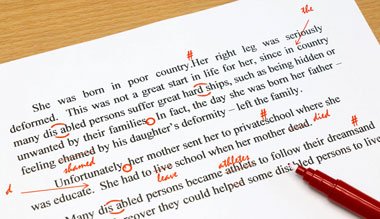

Grammar mistakes are responsible for more lost marks in IGCSE and IELTS English exams than most students ever realize.
It is not usually a lack of vocabulary. It is not usually a lack of ideas. It is the same handful of grammar errors appearing repeatedly across papers, errors that are completely fixable once you know what to look for. The frustrating part is that most of these mistakes happen in writing students have reviewed themselves. They read it back, it sounds fine, and they move on. The examiner sees it differently.
This guide covers the most damaging grammar mistakes in both IGCSE and IELTS English exams specifically, and exactly what to do about them before exam day.
Top 5 Grammar Mistakes in IGCSE English Papers
1. Tense Inconsistency
This is the single most common error in IGCSE English writing, and it costs marks in both Language and Literature papers.
Students begin a response in past tense, shift to present tense mid-paragraph when describing a character or scene, then drift back again. To an examiner, this signals a lack of control over written expression, one of the core assessment criteria.
The fix is simple but requires deliberate practice. Before you start writing, decide on your tense and commit to it. When reviewing your work, read only for tense — not for content or structure. A single tense-focused proofread catches most of these errors quickly.
2. Subject-Verb Agreement
Students frequently write sentences where the verb does not match the subject in number. Sentences like “The group of students were confused” or “Neither of them have arrived” appear regularly in IGCSE papers, and both contain agreement errors.
The confusion usually happens when there is a phrase between the subject and the verb. Students match the verb to the nearest noun rather than the actual subject. Training yourself to identify the true subject of every sentence before writing the verb eliminates this pattern completely.
3. Misuse of Articles – A, An, and The
This error is particularly common among students whose first language does not use articles. Phrases like “I went to hospital” versus “I went to the hospital” or “She is best student in class” instead of “She is the best student in the class” appear constantly in IGCSE English papers.
“The” refers to something specific and identifiable to both the writer and reader. “A” or “an” introduces something for the first time or refers to something non-specific. Practising article usage in short daily writing exercises — rather than memorizing rules — is the most effective way to internalise this.
4. Run-On Sentences
A run-on sentence occurs when two or more independent clauses are joined without appropriate punctuation or a conjunction. In IGCSE English papers, these typically appear as long, breathless sentences connected only by “and” or “but” repeated throughout a paragraph.
The solution is to read your writing aloud during review. Natural pause points reveal where a full stop or semicolon belongs. If a sentence takes more than one breath to read aloud, it almost certainly needs restructuring.
5. Incorrect Punctuation
Comma splices: using a comma to join two independent clauses without a conjunction, are penalized consistently in IGCSE marking. “The character felt alone, she did not know what to do” is a comma splice. It should either use a semicolon, a conjunction like “and” or “so,” or be split into two sentences.
Apostrophes are also frequently misused. “It’s” means “it is.” “Its” is possessive. This distinction alone accounts for a significant number of punctuation errors across IGCSE English papers every year.
Top 3 Grammar Mistakes in IELTS Writing Task 2
1. Complex Sentence Overuse
Many IELTS students believe that longer, more complex sentences always score higher. This is a misunderstanding of the assessment criteria. Grammatical Range and Accuracy rewards accurate use of a variety of sentence types — not complexity for its own sake.
A response built entirely from long subordinate clauses and embedded phrases is harder to write accurately and harder for the examiner to read clearly. A mix of simple, compound, and complex sentences, all written correctly, scores better than a series of ambitious but error-filled sentences.
2. Wrong Connector Usage
Discourse markers like “however,” “furthermore,” “on the other hand,” and “therefore” can genuinely strengthen a Task 2 response when used accurately. They become a problem when students insert them mechanically without understanding what each one signals.
“However” signals contrast. “Furthermore” signals addition to a point already made. “Therefore” signals a logical conclusion. Using “however” to introduce a point that is not actually contrasting with the previous one does not improve coherence — it undermines it. Learn what each connector means before using it, not just how it sounds.
3. Passive Voice Misuse
Passive voice is not wrong in IELTS writing. Overusing it – or using it where active voice is clearer. Students sometimes default to passive constructions to sound more academic, producing awkward sentences that lose marks for clarity and natural expression.
Use passive voice when the agent of the action is unknown, unimportant, or deliberately omitted. Use active voice when you want a clear, direct statement. In Task 2, most of your core arguments will be stronger in active voice.
How to Fix These Mistakes Before Exam Day
Knowing what the mistakes are is the first step. Building the habits that eliminate them is the second.
Write daily, even briefly. Grammar accuracy improves through consistent practice, not through reading grammar rules. Fifteen minutes of focused writing every day – a short paragraph, a practice Task 2 introduction, an IGCSE-style response to a single question – builds accuracy over time in a way that studying grammar tables never does.
Read model answers with a critical eye. Do not just read them for content. Look at how sentences are constructed, where punctuation appears, how tense is maintained, and how connectors are used. Annotate what you notice.
Get targeted feedback from someone who knows the exam. Self-review only catches so much. A student reading their own writing is processing meaning at the same time as checking for errors, which means errors get missed. Working with a qualified IGCSE tutor who marks your writing against the actual assessment criteria gives you the specific, exam-relevant feedback that self-review simply cannot replicate. The difference between being told “your grammar needs work” and being shown exactly which patterns are recurring in your writing and how to correct them is significant.
Final Exam Tips
Grammar improvement is not about perfection. It is about reducing the frequency and impact of the errors that are already costing you marks.
Start by identifying which category of mistakes appears most often in your own writing. Review past responses or practice papers with the errors in this article in mind. Circle every instance. When you have a clear picture of your specific pattern, target that pattern directly rather than trying to fix everything at once.
For IELTS candidates in particular, Task 2 grammar errors often cluster around one or two recurring patterns that, once identified and corrected, make a measurable difference to the band score. Structured online IELTS preparation with a tutor who knows Task 2 marking criteria inside out is one of the fastest ways to identify those patterns and eliminate them systematically before your exam date.
Grammar accuracy in IGCSE and IELTS English is not a talent, it is a skill. And like every skill, it responds to the right kind of deliberate, targeted practice.
Author Bio
This article was contributed by an English language education specialist with experience preparing students for IGCSE and IELTS examinations across international curricula.
About the Author