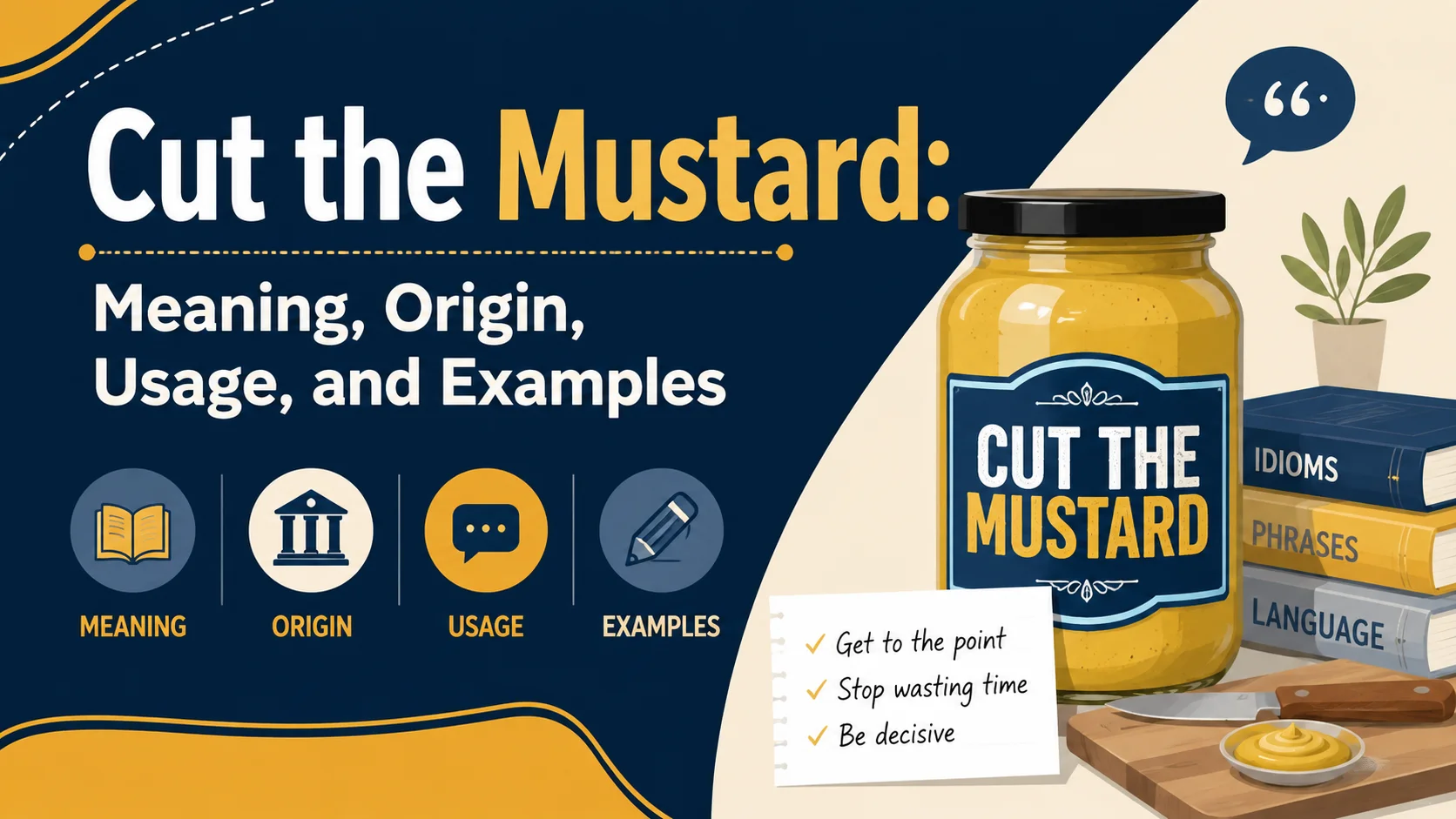
Cut the Mustard is an idiom that means someone or something can meet the standard and perform well enough to be effective and satisfactory. In everyday English, the phrase describes ability, quality, and performance. When someone cuts the mustard, they meet the mark and do what is expected. When they don’t cut the mustard, they fall short of the required standard. Although the phrase may sound strange the first time you hear it, its meaning isn’t connected to slicing mustard or preparing a condiment. It’s a colorful expression often heard in conversations about someone’s ability to succeed.
The expression has an interesting history in American English. It has been used for more than a century, with historical examples appearing in American newspapers in the late 1800s. The writer O. Henry later used the phrase in his fiction. Its exact origin remains uncertain, so it isn’t possible to say exactly where the phrase come[s] from or how mustard became connected with competence. Some people naturally think of the yellow condiment that we spread on hot dogs and burgers, but the idiom’s practical use has nothing to do with that literal meaning.
In modern everyday language, cut the mustard is still used to describe someone who has proven their ability to succeed. For example, a new employee who is doing a great job may be told that she really cuts the mustard because she is meeting or exceeding what is expected in her role. The phrase means meeting required standards or succeeding at something. Its intriguing origins may remain unclear, but its meaning is practical: a person or thing must be good enough to satisfy the standard being discussed.
Quick Answer: What Does “Cut the Mustard” Mean?
“Cut the mustard” means to meet the required standard, perform well enough, or have the ability needed for a particular purpose.
For example:
“This laptop cuts the mustard for everyday office work.”
That means the laptop performs well enough for the job.
In a negative sentence:
“This laptop doesn’t cut the mustard for professional video editing.”
The meaning changes to “This laptop isn’t good enough for professional video editing.”
The phrase can describe people, products, skills, plans, performances, and results.
| Expression | Meaning |
| Cut the mustard | Meet the required standard |
| Can’t cut the mustard | Lack the ability needed |
| Doesn’t cut the mustard | Fails to meet expectations |
| Didn’t cut the mustard | Failed to meet a past standard |
| Cuts the mustard | Meets the expected level |
The idiom is generally informal and conversational. It works naturally in everyday speech, reviews, sports discussions, workplace conversations, and informal writing.
What Does “Cut the Mustard” Mean Exactly?
At its heart, “cut the mustard” means “be good enough for the job.”
The phrase doesn’t necessarily suggest excellence. That’s an important detail.
If a product cuts the mustard, it doesn’t mean the product is the best available. It means the product performs at the level required for its intended purpose.
Imagine that someone needs a phone with a strong battery, a good camera, and reliable performance. After testing several models, they find one that meets those expectations.
They might say:
“This phone really cuts the mustard.”
The speaker is saying that the phone measures up.
“Cut the Mustard” in Plain English
Depending on the context, you can understand the idiom as:
- Meet the standard
- Be good enough
- Meet expectations
- Measure up
- Have what it takes
- Make the grade
- Perform adequately
- Reach the required level
- Satisfy the requirements
For example:
“The new employee really cuts the mustard.”
In plain English:
“The new employee performs well enough to meet the job’s expectations.”
The idiom simply makes the statement more colorful and conversational.
How “Cut the Mustard” Works in Different Sentences
The grammar of the expression is straightforward because “cut” changes according to tense and subject.
Present tense
“She cuts the mustard as a manager.”
She meets the expected standard.
Negative present
“He doesn’t cut the mustard under pressure.”
He doesn’t perform well enough when pressure increases.
Past tense
“The team’s defense didn’t cut the mustard.”
The defense failed to reach the necessary level.
Modal form
“I don’t think this computer can cut the mustard.”
The speaker doubts whether the computer can meet the required standard.
Continuous form
“The current system isn’t cutting the mustard.”
The system is currently failing to perform adequately.
These forms all preserve the same central idea: something is being judged against a particular standard.
Where Did “Cut the Mustard” Come From?
The origin of “cut the mustard” isn’t completely settled.
What historical evidence does establish is that the expression emerged in American English during the late 19th century. Examples appeared in American newspapers before O. Henry used the phrase in his fiction.
One documented example appeared in the Galveston Daily News in 1891. Other examples from the same period show the expression being used to describe people or groups that either succeeded or failed to meet expectations.
This evidence matters because some popular explanations claim that O. Henry invented the phrase. The historical record doesn’t support that conclusion.
Early Written Evidence of “Cut the Mustard”
Several newspaper examples from the 1890s show that the idiom was already understood by American readers.
An 1891 example from the Omaha World-Herald used the phrase while discussing baseball players who failed to meet the required level of performance. Another example from Texas that same year used the expression positively.
The surrounding context makes the meaning clear: to cut the mustard was to measure up.
That also tells us something useful about idioms.
When an expression appears in print without an explanation, readers probably already knew what it meant. Writers don’t usually stop to define common slang in the middle of an ordinary newspaper article.
Why Do We Say “Cut the Mustard”?
This is where the history becomes less certain.
Several theories attempt to explain why English speakers connected “cut” with “mustard.” Unfortunately, none has enough evidence to be accepted as the definitive origin.
One important clue comes from older figurative uses of mustard.
For centuries, English speakers have used mustard as a metaphor for something sharp, lively, spirited, or excellent. Expressions such as “keen as mustard” show that mustard had already developed figurative associations with energy and intensity.
Later American slang also used mustard in the sense of something that was genuine, effective, or excellent.
That background gives the idiom a plausible linguistic pathway:
Mustard → something excellent or effective → the required quality → cut the mustard
However, the exact meaning of “cut” in the original expression remains uncertain.
Did “Mustard” Literally Mean the Condiment?
Probably not.
There is no strong historical evidence showing that people originally meant physically cutting mustard with a knife. Several literal explanations have circulated over the years, including theories about cutting mustard plants or preparing mustard for food.
These explanations sound convincing because they create a neat story.
Unfortunately, a neat story isn’t the same thing as documented etymology.
The safest conclusion is that the phrase developed as American slang and acquired its figurative meaning before its exact origin was recorded clearly.
Was O. Henry Responsible for “Cut the Mustard”?
O. Henry played an important role in the phrase’s literary history, but he probably didn’t invent it.
The famous American short-story writer used the expression in The Heart of the West, a collection published in 1907.
His use shows that the phrase had already entered recognizable American vernacular. By that point, readers could understand “cut the mustard” as a statement about whether something met expectations.
That distinction is important:
O. Henry popularized the expression in literature, but earlier newspaper evidence shows that the phrase existed before his famous usage.
So saying that O. Henry coined “cut the mustard” goes further than the evidence allows.
How “Cut the Mustard” Is Used Today
Modern speakers use “cut the mustard” whenever they want to judge whether someone or something is good enough.
The standard can change from situation to situation.
A budget microphone might cut the mustard for casual podcasting but fail completely in a professional recording studio.
A student might cut the mustard in an introductory course but struggle in an advanced class.
A new employee might perform well in a junior role while lacking the experience needed for management.
The expression therefore doesn’t describe absolute quality. It describes suitability in relation to a particular expectation.
Using “Cut the Mustard” for People
The idiom works naturally when discussing someone’s ability.
“She has the experience to cut the mustard in a senior management position.”
“He looked promising during practice, but he couldn’t cut the mustard in the championship.”
“Several applicants were qualified, but only two really cut the mustard.”
The expression can describe professional skills, academic ability, athletic performance, leadership, creativity, or practical competence.
Using “Cut the Mustard” for Things
You can also use the idiom for objects and products.
“This camera cuts the mustard for casual photography.”
“The old computer doesn’t cut the mustard anymore.”
“That budget microphone won’t cut the mustard for studio recording.”
This use works because the product faces an implied test.
Does it perform well enough for the intended purpose?
If the answer is yes, it cuts the mustard.
“Cut the Mustard” Example Sentences
These “Cut the Mustard” example sentences show how the idiom is used naturally to describe someone or something that meets the required standard or performs well enough
Workplace Examples
- “The candidate has impressive qualifications, but her interview didn’t cut the mustard.”
- “Our current software doesn’t cut the mustard for large projects.”
- “He cut the mustard during his first six months at the company.”
- “The proposal sounded good, but the financial plan didn’t cut the mustard.”
School Examples
- “His first essay didn’t cut the mustard, so he rewrote the argument.”
- “The project needs stronger evidence if it’s going to cut the mustard.”
- “She studied hard and cut the mustard on the final exam.”
Sports Examples
- “The rookie has talent, but he hasn’t proved that he can cut the mustard professionally.”
- “The team’s defense didn’t cut the mustard against stronger opponents.”
Technology Examples
- “This tablet cuts the mustard for reading and browsing.”
- “That graphics card doesn’t cut the mustard for modern gaming.”
- “The cheaper camera cuts the mustard for social media content.”
Everyday Examples
- “The hotel looked impressive, but the service didn’t cut the mustard.”
- “I tested three vacuum cleaners before finding one that cut the mustard.”
- “Her homemade solution actually cuts the mustard.”
“Can’t Cut the Mustard” vs. “Doesn’t Cut the Mustard”
The negative forms appear frequently in everyday English.
| Form | What it emphasizes | Example |
| Can’t cut the mustard | Ability or capability | “He can’t cut the mustard at this level.” |
| Doesn’t cut the mustard | A specific failure to meet expectations | “This computer doesn’t cut the mustard.” |
| Didn’t cut the mustard | A past failure | “His performance didn’t cut the mustard.” |
| Isn’t cutting the mustard | An ongoing problem | “The current system isn’t cutting the mustard.” |
The difference is subtle rather than rigid.
“Can’t” often focuses on whether someone or something has the ability to succeed.
“Doesn’t” often focuses on the result.
For example:
“He can’t cut the mustard as a professional athlete.”
This focuses on his ability.
“His performance doesn’t cut the mustard.”
This focuses on the performance itself.
“Cut the Mustard” vs. Similar Expressions
English has several expressions that communicate a similar idea.
| Expression | Meaning | Typical Tone |
| Cut the mustard | Meet the required standard | Informal |
| Measure up | Meet expectations | Neutral |
| Make the grade | Reach the required level | Informal/neutral |
| Pass muster | Meet an accepted standard | Neutral |
| Cut it | Be good enough | Informal |
| Rise to the occasion | Perform successfully during a challenge | Neutral |
| Hold one’s own | Perform adequately among others | Informal |
“Cut the Mustard” vs. “Measure Up”
These expressions are close in meaning.
“She measured up to the company’s expectations.”
“She cut the mustard at the company.”
Both suggest adequate performance. “Measure up” sounds more neutral, while “cut the mustard” has a more colorful conversational tone.
“Cut the Mustard” vs. “Make the Grade”
“Make the grade” often suggests reaching a qualification or required level.
“He worked hard enough to make the grade.”
“Cut the mustard” has a broader range of uses.
“This software doesn’t cut the mustard.”
You can use the second expression for products, equipment, plans, and performance without implying a formal qualification.
“Cut the Mustard” vs. “Pass Muster”
These two expressions are often confused because they have similar meanings.
The correct forms are:
- Cut the mustard
- Pass muster
You shouldn’t normally replace mustard with muster in “cut the mustard.”
Likewise, “pass the mustard” isn’t the standard form.
Although both idioms involve meeting a standard, their histories aren’t proven to be the same. The idea that “cut the mustard” simply developed from “pass muster” remains a theory rather than an established fact.
Common Mistakes With “Cut the Mustard”
A common mistake with “cut the mustard” is using it literally instead of as an idiom meaning to meet the required standard or perform well enough.
Taking the Expression Literally
The phrase doesn’t normally refer to cutting mustard with a knife.
Its meaning is figurative.
“The new employee cuts the mustard.”
This sentence evaluates the employee’s performance. It doesn’t describe anything happening in a kitchen.
Assuming It Means “Be the Best”
The expression doesn’t necessarily mean excel.
If something cuts the mustard, it meets the necessary standard. It might be excellent, but excellence isn’t required by the idiom.
Confusing “Mustard” With “Muster”
Remember the standard combinations:
Cut the mustard.
Pass muster.
That small distinction prevents a common vocabulary mistake.
Using It in Very Formal Writing
The expression isn’t grammatically incorrect in formal writing. Still, it may sound too conversational in technical or academic contexts.
Instead of:
“The proposed system doesn’t cut the mustard.”
A formal report might say:
“The proposed system does not meet the required performance standard.”
The second version is more precise and leaves less room for interpretation.
Is “Cut the Mustard” Formal or Informal?
“Cut the mustard” is primarily informal.
It fits naturally into:
- Everyday conversation
- Sports discussions
- Informal workplace communication
- Reviews
- Opinion articles
- Casual journalism
- Personal writing
For formal documents, clearer alternatives usually work better.
Formal alternatives
Depending on the context, you can use:
- Meet the required standard
- Meet expectations
- Satisfy the requirements
- Meet the necessary criteria
- Perform adequately
- Reach the required level
- Demonstrate sufficient ability
- Fulfill the requirements
The advantage of these alternatives is precision. They tell the reader exactly what standard has been met.
A Simple Case Study: When Does a Product “Cut the Mustard”?
Consider a laptop designed for everyday office work.
It can handle email, spreadsheets, web browsing, video calls, and word processing without difficulty. For that purpose, it cuts the mustard.
Now place the same laptop in a professional 3D-rendering studio.
The workload changes. The required processing power changes. The performance standard becomes much higher.
Suddenly, the same laptop might not cut the mustard.
Nothing about the laptop itself changed.
The standard changed.
This is one of the most useful ways to understand the idiom. It doesn’t measure quality in isolation. It measures whether something is suitable for a particular purpose.
How to Remember “Cut the Mustard”
Use one simple question:
“Is it good enough?”
If the answer is yes:
It cuts the mustard.
If the answer is no:
It doesn’t cut the mustard.
Think of the idiom as an invisible test:
Requirement → Performance → Evaluation → Standard Met
That mental shortcut makes the meaning easy to remember.
When Should You Avoid “Cut the Mustard”?
The phrase works best when the audience understands conversational idioms.
Use it when you want your writing to sound natural and relaxed.
For example:
“This camera doesn’t cut the mustard for professional photography.”
That sentence works nicely in a casual review.
However, a technical report might say:
“This camera fails to meet the image-quality requirements for professional photography.”
The second version sounds more formal and specific.
Use “cut the mustard” when:
- You want a conversational tone.
- You’re discussing general performance.
- The audience knows common English idioms.
- You want the sentence to have some personality.
Choose a direct alternative when:
- You’re writing a formal report.
- You’re describing a technical requirement.
- The exact standard matters.
- Your audience may not know the expression.
Conclusion
“Cut the Mustard” is a useful idiom for describing ability, performance, and whether someone or something can meet the required standard. Although its exact origin remains uncertain, its modern meaning is clear. If someone cuts the mustard, they are good enough to succeed, perform well, or meet what is expected of them.
FAQs
Q1. What does “cut the mustard” mean?
“Cut the mustard” means to meet the required standard, perform well, or prove effective and satisfactory.
Q2. Is “cut the mustard” a literal expression?
No. It’s an idiom, so it doesn’t literally mean slicing mustard or preparing a condiment.
Q3. What does “don’t cut the mustard” mean?
“Don’t cut the mustard” means that someone or something falls short of the expected standard or isn’t good enough.
Q4. Is “cut the mustard” commonly used?
Yes. The phrase is still used in everyday English, especially when talking about performance, ability, or quality.
Q5. Where did “cut the mustard” come from?
The exact origin is uncertain, but historical examples of the expression appear in American newspapers from the late 1800s.
About the Author