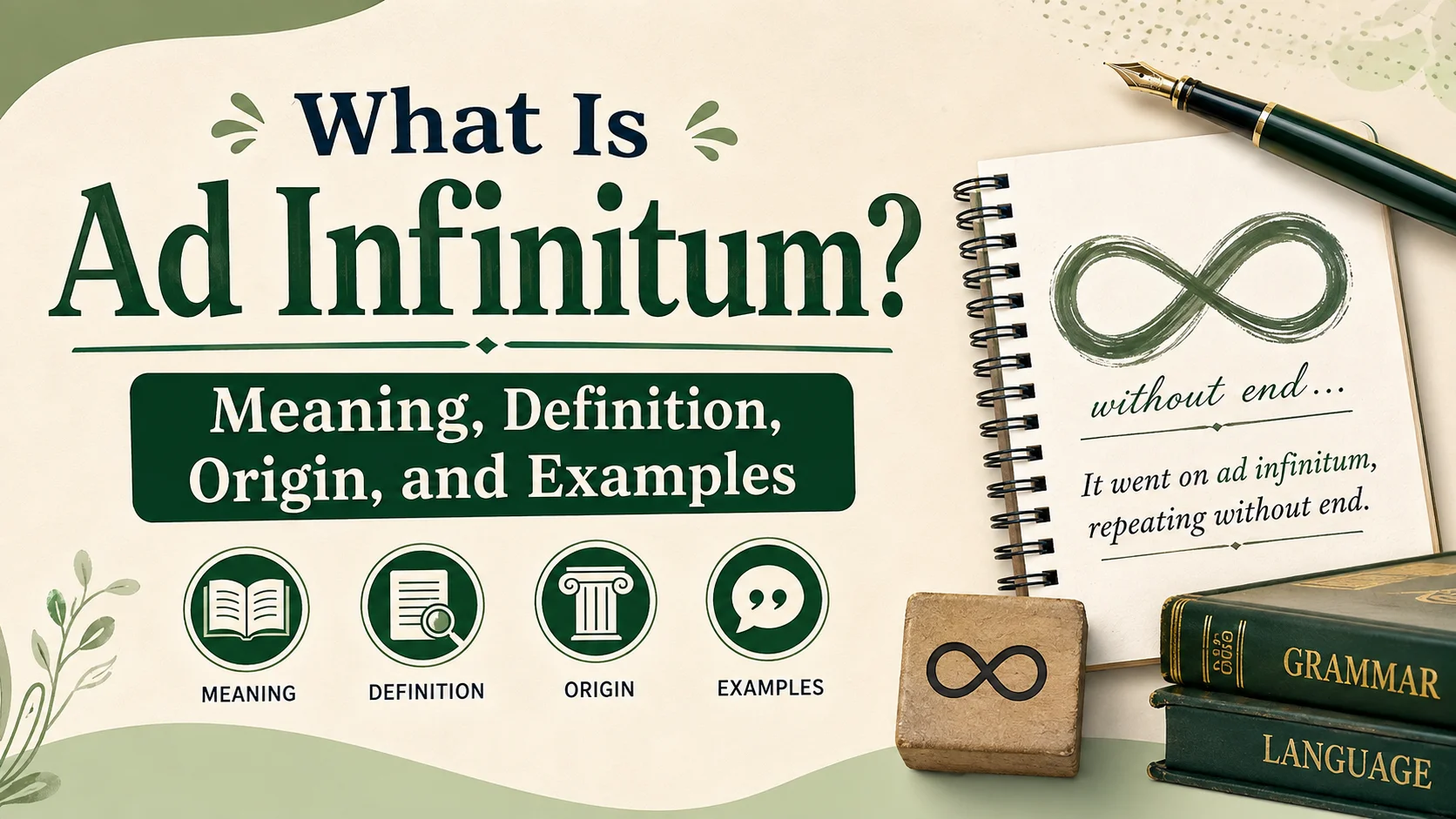
What Is Ad Infinitum? It is a Latin expression meaning without end, without limit, endlessly, or forever. The phrase describes something that can continue or go on without a definite stopping point. Although ad infinitum may look complicated or difficult because it comes from another language, its meaning is straightforward when you understand the context. It can describe an action, process, argument, pattern, or repetition that has no clear ending.
You can find ad infinitum in mathematics, philosophy, everyday writing, academic papers, books, articles, and debates. In mathematics, it can describe an infinite sequence, while in philosophy, it may describe an explanation that keeps generating another question or argument. In everyday conversations, someone might say that two people could argue ad infinitum, meaning they could continue indefinitely. The phrase can also describe something repetitive or continuing without a clear stopping point. For example, someone who loves chocolate might jokingly say they could eat it nonstop or ad infinitum.
The expression has been part of English for centuries, and Merriam-Webster records its first known English use in 1581. Today, in 2026, English speakers still use it in writing, academic discussions, and everyday speech to express frustration, exaggeration, or emphasis. It sounds somewhat formal and sometimes dramatic, but it remains simple, powerful, and useful when you want to express endlessness or infinity. Understanding its usage makes it easier to recognize when something is described as endless, and it also helps you know when the phrase sounds natural compared with similar expressions.
Quick Answer: What Does Ad Infinitum Mean?
Ad infinitum means “without end or limit,” “endlessly,” or “to infinity.”
It comes from Latin and literally means “to infinity.” In English, the phrase commonly describes something that continues or repeats indefinitely.
For example:
The cycle could continue ad infinitum.
This means the cycle could keep going without reaching a final stopping point.
Here are a few more examples:
- They could debate the issue ad infinitum.
- The pattern repeats ad infinitum.
- You can’t increase the budget ad infinitum.
- The same problem may occur ad infinitum.
Oxford defines ad infinitum as something happening without ever coming to an end or happening again and again.
Ad Infinitum at a Glance
| Feature | Information |
| Phrase | ad infinitum |
| Origin | Latin |
| Literal meaning | To infinity |
| English meaning | Without end or limit |
| Common function | Adverbial expression |
| Main idea | Endless continuation or repetition |
| Common contexts | Academic, mathematical, philosophical, literary, and formal writing |
| Abbreviation | ad inf. |
The easiest way to remember it is:
Ad infinitum = something keeps going with no end in sight.
What Does Ad Infinitum Literally Mean?
The phrase comes directly from Latin.
Ad generally means “to” or “toward.”
Infinitum relates to the idea of the infinite, the unlimited, or something without boundaries.
Put them together and the literal meaning becomes:
“To infinity.”
American Heritage gives the same basic breakdown, identifying ad as “to” and infinitum as the accusative form of infinitus, meaning “infinite.”
That literal meaning explains the modern English usage. If something continues to infinity, it has no finite endpoint.
However, ad infinitum doesn’t always refer to mathematical infinity.
Consider this sentence:
The two friends could talk ad infinitum.
The writer isn’t making a mathematical claim. The phrase simply emphasizes that their conversation could continue for an unlimited amount of time.
That distinction is important. In everyday English, ad infinitum often means “for as long as it could possibly continue” rather than making a precise claim about literal infinity.
The Origin and History of Ad Infinitum
Ad infinitum is a Latin expression that English borrowed without significantly changing its form.
Merriam-Webster records 1581 as its first known English use.
The phrase is connected to the Latin word infinitus, which carries meanings associated with being unbounded, unlimited, or endless. The word ultimately combines the negative prefix in- with a form related to finis, meaning “end” or “boundary.”
The English phrase “to infinity” appeared later. Etymological evidence dates its English use to the 1630s.
A Short Historical Timeline
| Period | Development |
| Latin period | Infinitus expresses the idea of something unbounded or unlimited |
| 16th century | Ad infinitum becomes established in English usage |
| 1581 | First known English use recorded by Merriam-Webster |
| 17th century | English expression “to infinity” becomes established |
| Modern English | Ad infinitum remains common in formal and technical contexts |
The phrase survived because Latin remained influential in European scholarship for centuries. Expressions borrowed from Latin often became useful shortcuts for ideas that would otherwise require longer English explanations.
How Do You Pronounce Ad Infinitum?
In American English, ad infinitum is commonly pronounced approximately:
ad in-fuh-NIGH-tum
Cambridge gives the US pronunciation as /ˌæd ɪn.fəˈnaɪ.t̬əm/ and lists a slightly different British pronunciation.
The strongest stress falls on the “nigh” sound in infinitum.
You don’t need to force a classical Latin pronunciation when speaking English. The phrase has become a recognized English expression, so the English pronunciation is perfectly appropriate.
How Is Ad Infinitum Used?
The central idea behind ad infinitum is unlimited continuation.
The phrase can describe something that happens repeatedly, continues for an indefinite period, or theoretically has no final stage.
Repeating Something Again and Again
One of the most common uses involves repetition.
The same argument was repeated ad infinitum.
This tells the reader that the argument wasn’t merely repeated twice or three times. The repetition could continue indefinitely.
Another example is:
The children asked questions ad infinitum.
The sentence emphasizes the seemingly endless stream of questions.
Collins specifically describes ad infinitum as something that is repeated again and again in the same way.
Describing Something That Continues Without an End
The phrase can describe an ongoing situation:
You can’t postpone the decision ad infinitum.
Here, ad infinitum suggests that postponement can’t continue forever because practical circumstances eventually force a decision.
This use appears frequently in discussions about money, business, politics, policy, and everyday responsibilities.
Describing an Infinite Sequence
Mathematics provides a more literal example.
Consider this sequence:
1, 2, 3, 4, 5, 6, 7, …
The sequence doesn’t stop at 7. The pattern can continue indefinitely.
You could say:
The sequence continues ad infinitum.
In this context, the phrase connects directly with the mathematical concept of infinity.
Describing an Endless Process
The expression can also describe a process that repeatedly generates another stage.
For example:
The process can be repeated ad infinitum.
This wording is useful when explaining recursive systems, repeating patterns, or theoretical processes.
Cambridge provides examples involving biological growth, philosophy, music, reasoning, and mathematical patterns
How to Use Ad Infinitum in a Sentence
The phrase is flexible and usually appears near the action or process that it modifies.
At the End of a Sentence
The cycle continues ad infinitum.
This is probably the simplest and clearest construction.
After a Verb
The machine repeats the process ad infinitum.
The phrase explains how long the repetition continues.
After a Clause
They returned to the same argument, ad infinitum.
This structure can give the sentence a slightly more literary or rhetorical feel.
With Modal Verbs
You can also use ad infinitum with words such as could, would, and might.
They could debate the question ad infinitum.
The pattern could continue ad infinitum.
The discussion might continue ad infinitum.
These structures are especially useful because they often describe a possibility of unlimited continuation rather than claiming that something literally continues forever.
Ad Infinitum as an Adverbial Expression
In most ordinary English uses, ad infinitum functions as an adverbial expression.
It modifies an action by explaining its extent or continuation.
Compare these two sentences:
The discussion continued.
and:
The discussion continued ad infinitum.
The first sentence simply says the discussion continued.
The second tells you that the discussion has no apparent endpoint.
This makes ad infinitum particularly useful with verbs such as:
- continue
- repeat
- recur
- expand
- extend
- debate
- argue
- increase
- reproduce
- iterate
- evolve
The phrase adds the idea of unlimited continuation.
Ad Infinitum Examples in Everyday English
Seeing the phrase in different situations makes its meaning much easier to recognize.
Everyday Examples
- We could talk about that movie ad infinitum.
- They could argue about politics ad infinitum.
- You can’t keep changing the rules ad infinitum.
- The children seemed able to ask questions ad infinitum.
- The discussion could continue ad infinitum.
Academic Examples
- The philosophical debate could continue ad infinitum.
- The researcher could modify the model ad infinitum.
- The question generates another question ad infinitum.
Business Examples
- A company can’t increase its expenses ad infinitum.
- Businesses can’t rely on temporary funding ad infinitum.
- Project requirements cannot expand ad infinitum.
Mathematical Examples
- The sequence continues ad infinitum.
- The operation can be repeated ad infinitum.
- The pattern extends ad infinitum.
Literary Examples
- The narrator returns to the same memory ad infinitum.
- The story’s central conflict could unfold ad infinitum.
- The recurring image appears throughout the poem, almost ad infinitum.
Ad Infinitum vs. Forever
At first glance, ad infinitum and forever seem interchangeable. Often they are. Yet their tone differs.
Forever is common in everyday English.
Ad infinitum sounds more formal, intellectual, or deliberate.
Compare:
We could discuss this forever.
with:
We could discuss this ad infinitum.
Both communicate unlimited continuation. The second has a more formal flavor.
| Expression | Meaning | Tone |
| ad infinitum | Without end or limit | Formal |
| forever | For all time | Everyday |
| endlessly | Without stopping | Neutral |
| indefinitely | Without a fixed endpoint | Formal/neutral |
| again and again | Repeatedly | Conversational |
| over and over | Repeatedly | Conversational |
The choice depends on your audience.
For a formal article, ad infinitum may fit naturally. For a casual text message, forever or over and over will usually sound more natural.
Ad Infinitum vs. “Etc.”
These expressions are not interchangeable.
Etc. indicates that a list continues with additional similar items.
For example:
The store sells apples, oranges, bananas, etc.
The writer has stopped listing items even though other examples exist.
Now consider:
The pattern can be repeated ad infinitum.
This isn’t an incomplete list. It describes a process that can keep going.
The difference
| Expression | Main meaning |
| etc. | More similar items exist |
| ad infinitum | Something can continue without an endpoint |
Here’s an easy way to remember the distinction:
Etc. stops the list. Ad infinitum keeps the process going.
Ad Infinitum vs. Ad Nauseam
Another Latin phrase often confused with ad infinitum is ad nauseam.
The two expressions can both involve repetition. Their emphasis is different.
Ad infinitum means something continues without end.
Ad nauseam means something has been repeated so much that it becomes annoying, tedious, or tiresome.
Compare:
The machine repeats the calculation ad infinitum.
This is a neutral description.
Now:
He repeated the same complaint ad nauseam.
This sentence clearly expresses irritation with the repetition.
| Phrase | Main focus |
| ad infinitum | Endless continuation |
| ad nauseam | Excessive and tiresome repetition |
A useful memory trick is simple:
Infinitum = infinity.
Nauseam = annoyance or sickness.
Is Ad Infinitum Formal?
Yes. Ad infinitum generally has a formal or learned tone.
You will often find it in:
- academic writing
- philosophy
- mathematics
- science
- literary criticism
- journalism
- analytical writing
- professional commentary
However, it isn’t restricted to formal writing.
A person might jokingly say:
I could talk about that subject ad infinitum.
The Latin phrase can actually add humor because it sounds more serious than the situation requires.
Still, don’t use it merely to make writing sound sophisticated. If forever communicates the idea more naturally, use forever.
Good writing isn’t a vocabulary contest.
Common Mistakes With Ad Infinitum
Common mistakes with “ad infinitum” often involve incorrect spelling, punctuation, pronunciation, or using the phrase in contexts where a simpler expression would be more natural
Mistake: Treating It as a Regular Noun
Avoid constructions such as:
an ad infinitum
In normal usage, ad infinitum functions as an adverbial expression rather than a countable noun.
Instead, write:
The argument continued ad infinitum.
Mistake: Thinking It Only Means “A Long Time”
This is too weak.
Something that lasts five hours may last a long time. That doesn’t necessarily make it ad infinitum.
The phrase emphasizes the absence of a definite endpoint.
Mistake: Using It Instead of “Etc.”
If you’re listing items, etc. is usually the appropriate choice.
If you’re describing an ongoing process, ad infinitum may fit.
Mistake: Confusing It With Ad Nauseam
Not every repeated action is ad nauseam.
Use ad infinitum when the important idea is endlessness.
Use ad nauseam when the important idea is tiresome repetition.
Mistake: Overusing the Phrase
A little Latin can add elegance. Too much can make ordinary writing feel unnecessarily formal.
Compare:
The meeting continued ad infinitum.
with:
The meeting seemed to go on forever.
Both work. The second may sound more natural in a casual article.
Does Ad Infinitum Need Italics?
Because ad infinitum is a Latin expression, many writers italicize it:
The cycle continues ad infinitum.
However, editorial styles don’t always handle foreign expressions identically. Some publications leave familiar Latin expressions in regular type.
The safest approach is to follow the style guide you’re using and remain consistent.
Is “Ad Infinitum” One Word or Two?
The standard form is:
ad infinitum
It contains two separate words.
Don’t normally write it as one word in English.
The phrase can also be abbreviated as ad inf. Dictionaries recognize this abbreviation.
For general readers, though, spelling out ad infinitum is usually clearer.
Real-World Uses of Ad Infinitum
The real-world uses of ad infinitum show how the phrase describes something that continues endlessly or is repeated without a clear stopping point
Mathematics
Mathematics provides one of the clearest examples of the phrase.
An infinite sequence has no final member. A writer can therefore describe its continuation as ad infinitum.
For example:
The sequence continues ad infinitum.
Here, the expression has a direct connection to infinity.
Science
Scientists may use the phrase when discussing theoretical limits.
For example:
Biological growth cannot continue ad infinitum.
This sentence points toward a practical limitation. Cambridge provides a similar example involving the biological limits of cell size.
Philosophy
Philosophical arguments often involve chains of causes, explanations, or questions.
Consider:
If every explanation requires another explanation, the reasoning could continue ad infinitum.
The phrase captures the idea of an endless chain of reasoning.
Technology
A computer process can theoretically repeat indefinitely if no stopping condition exists.
For example:
Without a stopping condition, the operation could continue ad infinitum.
This is a useful technical application because it distinguishes an endless theoretical process from a process that actually has a programmed stopping point.
Business
Business writing often uses ad infinitum to emphasize practical limits.
A company can’t increase spending ad infinitum.
The phrase makes the limitation clear: resources, time, and budgets eventually impose boundaries.
A Practical Case Study: How Context Changes the Meaning
Imagine a manager and employee discussing a project.
The employee keeps adding new features to the project.
First comes one feature.
Then another.
Then five more.
Eventually, the manager says:
We can’t keep expanding the project ad infinitum.
Here, ad infinitum means without a practical limit.
Now imagine a different situation. Two coworkers keep debating the same decision.
Someone says:
They could argue about the issue ad infinitum.
This time, the phrase describes an endless discussion.
Finally, suppose someone says:
They’ve discussed the same issue ad nauseam.
Now the emphasis changes. The speaker isn’t simply describing endless discussion. The speaker is suggesting that the repetition has become tedious or irritating.
The context changes the shade of meaning even though all three examples involve continuation.
How to Remember Ad Infinitum
Think of this simple pattern:
Start → Continue → Repeat → Continue → Repeat → ∞
The infinity symbol is the easiest memory aid.
When you see ad infinitum, ask yourself:
“Could this continue without reaching an endpoint?”
If yes, the phrase may be appropriate.
Simple memory definition
Ad infinitum means “endlessly or without limit.”
That short definition covers most ordinary uses.
Alternatives to Ad Infinitum
Sometimes a simpler English expression will work better.
Depending on the context, alternatives include:
- forever
- endlessly
- indefinitely
- without end
- without limit
- again and again
- over and over
- repeatedly
- continually
- perpetually
- to infinity
- without stopping
The best alternative depends on the sentence.
For example:
The cycle continues ad infinitum.
can become:
The cycle continues endlessly.
In casual conversation:
We could talk about this forever.
may sound more natural than either version.
Conclusion
Ad infinitum is a useful Latin expression that means without end, endlessly, or forever. It describes an action, process, argument, or repetition that continues without a definite stopping point. Although it can sound formal, its meaning is simple, and you can use it in academic writing, everyday speech, mathematics, philosophy, and other contexts when something seems to continue forever.
FAQs
Q1. What does ad infinitum mean?
Ad infinitum means without end, without limit, endlessly, or forever. It describes something that continues without reaching a final stopping point.
Q2. Is ad infinitum an English phrase?
Yes. Ad infinitum comes from Latin, but English speakers commonly use it in writing and speech, especially in formal, academic, and intellectual contexts.
Q3. How do you use ad infinitum in a sentence?
You can use ad infinitum to describe something that keeps happening. For example: The two sides could debate the same issue ad infinitum.
Q4. Is ad infinitum formal?
Yes, ad infinitum can sound formal or slightly dramatic. In casual conversation, simpler alternatives such as forever, endlessly, or over and over may sound more natural.
Q5. What is the difference between ad infinitum and forever?
Both can describe something that continues without end. However, ad infinitum often emphasizes an ongoing process, repetition, argument, or sequence, while forever is a more common everyday word.
About the Author