
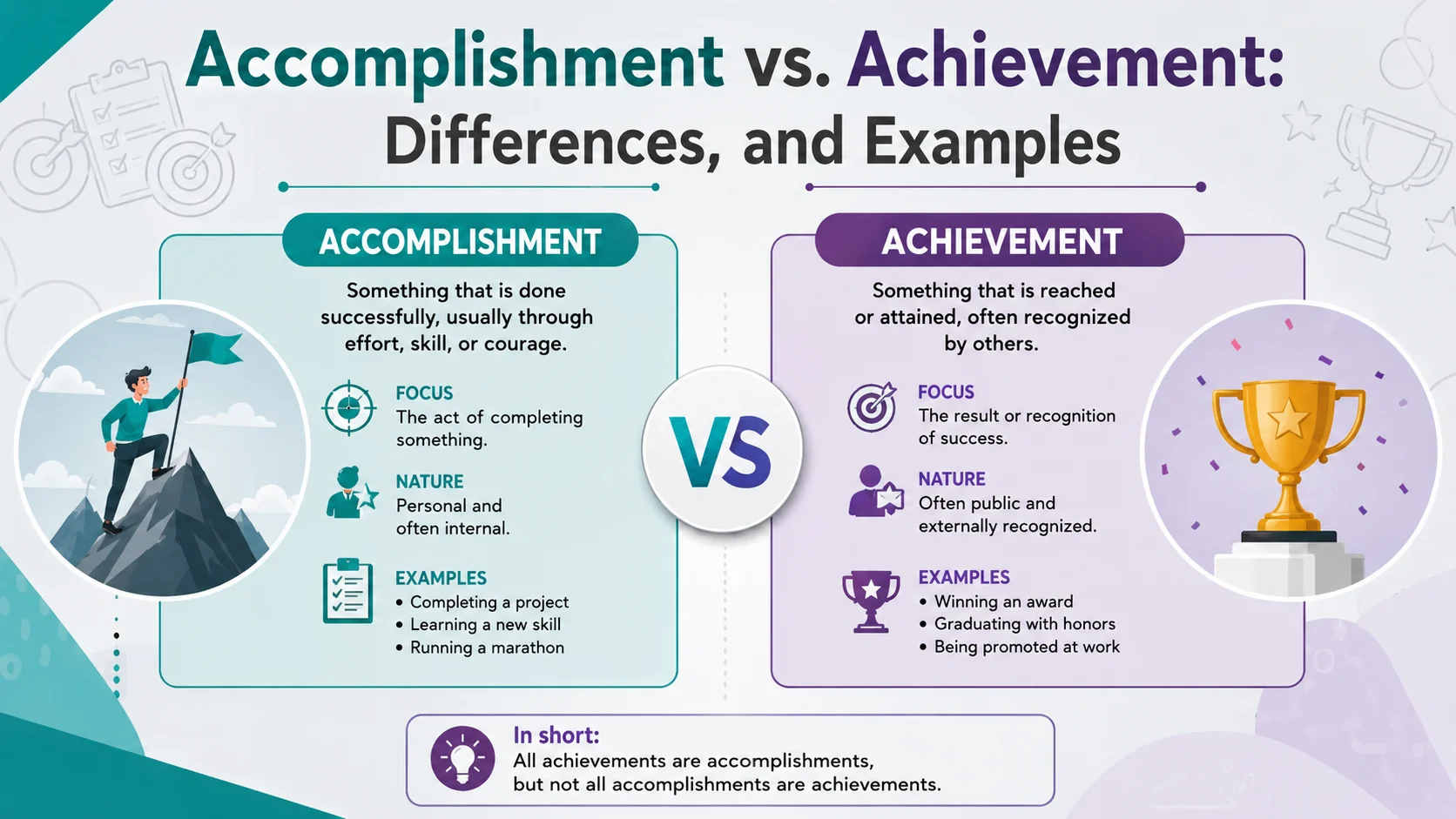
Accomplishment vs. Achievement becomes clearer when you look at what each word highlights in everyday success and personal progression. An accomplishment often describes something a person has done, completed, or worked toward through effort, skill, and persistence. It may involve specific tasks, projects, personal goals, or hobbies. For example, learning to play a new instrument can be an accomplishment because the focus rests on successfully completing a personal challenge. The word can also describe a demanding journey that required training, years of practice, and steady work. In these situations, the final result matters, but the process and ability involved can matter just as much.
An achievement, however, often points toward a goal, milestone, notable success, or recognized success. Winning a championship, earning a promotion, or succeeding in school or sports can be called an achievement because these results are often acknowledged by others. An achievement may therefore carry a stronger sense of public recognition, while an accomplishment can remain deeply personal. Still, this distinction isn’t a strict rule. Major dictionaries commonly treat the terms as synonyms in many contexts. Merriam-Webster connects achievement with a result gained through effort and relates accomplishment to something completed or achieved. This explains why you can often use either word without making a sentence grammatically wrong.
The difference also becomes useful when discussing a task, objective, or action linked to successful intentions and a person’s perceived mental direction. Both words can act as a positive indicator of progress, but the choice depends on which part of success you want to emphasize. Completing goals and experiencing success can describe both, yet their emphasis may differ. An accomplishment can represent personal completions, while an achievement can represent recognized successes. I find the apples to oranges comparison helpful: both are fruits, but their tastes, textures, and nutritional values differ. In the same way, these terms share a meaning but occupy unique places in our lives and conversations. This understanding can improve how you describe your victories, your perception of success, and what defines meaningful progress. Marc Prensky also explored this distinction from an educational standpoint, particularly in relation to education and the weight that achievement and accomplishment can carry.
Quick Answer: Accomplishment vs. Achievement
Achievement usually emphasizes reaching a goal, obtaining a result, or reaching an important milestone.
Accomplishment usually emphasizes successfully completing something, particularly when effort, skill, or difficulty matters.
Consider these two sentences:
- Winning the championship was her greatest achievement.
- Training for three years and completing the championship season was an incredible accomplishment.
The first sentence focuses on the result. The second focuses more strongly on the work and successful completion.
That doesn’t mean you can’t switch the words.
You could say:
- Winning the championship was her greatest accomplishment.
- Completing the demanding training program was a major achievement.
Both sentences work. English doesn’t draw a brick wall between these words.
A simple way to remember the difference is:
Achievement often points to the goal reached. Accomplishment often points to the work successfully completed.
Accomplishment vs. Achievement: Key Difference at a Glance
| Word | Main meaning | Common emphasis | Example |
| Achievement | Something successfully attained | Goal, result, milestone, recognition | Winning the award was a major achievement. |
| Accomplishment | Something successfully completed or achieved | Effort, completion, skill, ability | Finishing the difficult project was a major accomplishment. |
The two words overlap considerably. Cambridge lists achievement as a synonym of accomplishment and defines accomplishment as something successful or something achieved after substantial work or effort.
That overlap matters because many explanations make the mistake of presenting the words as if they have completely separate meanings. They don’t.
Instead, think of them as two ways of looking at success.
Imagine someone climbing a difficult mountain. Reaching the summit is an achievement. Completing the training, surviving difficult conditions, following the route, and successfully finishing the expedition can all be described as accomplishments.
One word emphasizes the destination. The other can emphasize the journey.
What Does “Achievement” Mean?
An achievement is something successfully attained or accomplished, usually through effort, planning, ability, or persistence.
Cambridge describes an achievement as something good and difficult that someone has succeeded in doing. Its American Dictionary also connects achievement with something gained after planning and working toward it.
Merriam-Webster gives achievement a closely related definition: a result gained through effort. It also uses the word for significant or heroic deeds and for academic performance.
The word therefore works particularly well when a person reaches something meaningful.
Examples of Achievements
An achievement can include:
- Earning a college degree
- Winning a championship
- Receiving an award
- Breaking a record
- Getting a promotion
- Reaching a professional milestone
- Publishing a successful book
- Completing an advanced certification
- Reaching a personal goal
- Making an important scientific discovery
For example:
Graduating at the top of her class was a remarkable achievement.
The sentence highlights the academic result.
Likewise:
Breaking the national record was an extraordinary achievement.
Here, the important point is the new standard the athlete reached.
Achievement Often Connects With Goals and Milestones
The word achievement naturally fits situations involving measurable progress.
Consider:
- She achieved her goal of running a marathon.
- He achieved the highest score in the competition.
- The company achieved record sales.
- The researcher achieved a major breakthrough.
In each example, something desired existed before the successful outcome. The person or organization then reached that outcome.
That’s one reason achievement frequently appears with words such as goal, award, record, milestone, success, and recognition.
What Does “Accomplishment” Mean?
An accomplishment is something successfully completed or achieved, often after significant work or effort.
Cambridge gives accomplishment several related meanings. It can refer to something successful, the completion of something, or a skill.
Merriam-Webster similarly defines accomplishment as the act or fact of accomplishing something, something that has been accomplished, and a special skill or ability gained through training or practice.
That last meaning creates an especially useful distinction.
For example:
Speaking three languages is one of her greatest accomplishments.
Here, accomplishment doesn’t describe one particular event. It describes a skill developed through learning and practice.
Examples of Accomplishments
An accomplishment might include:
- Completing a demanding project
- Learning a difficult skill
- Writing a book
- Organizing a large event
- Building a business
- Completing a difficult renovation
- Learning to play an instrument
- Developing a new system
- Solving a complicated problem
- Finishing a long-term project
Consider this sentence:
Completing the 500-page report while working full-time was a major accomplishment.
The finished report matters. Yet the sentence also makes you notice the difficulty and effort involved.
That’s where accomplishment often feels particularly natural.
Accomplishment vs. Achievement: The Main Difference
The most useful distinction between accomplishment vs. achievement is emphasis rather than strict definition.
An achievement often answers:
What did you reach or attain?
An accomplishment often answers:
What did you successfully complete or manage to do?
Those questions can describe the same event.
For example:
Winning the scholarship was a major achievement.
The focus is the scholarship and the success of receiving it.
Now look at this:
Completing the scholarship application while working two jobs was a major accomplishment.
The focus shifts toward the effort required to complete a demanding task.
Both words describe success. The camera simply points at a different part of the story.
When Accomplishment and Achievement Can Be Interchanged
In everyday American English, the words can often replace each other naturally.
For example:
- Getting promoted was a major achievement.
- Getting promoted was a major accomplishment.
Both sound correct.
You can also say:
- Finishing the marathon was a remarkable achievement.
- Finishing the marathon was a remarkable accomplishment.
Again, both work.
Dictionaries support this overlap rather than treating the words as strict opposites. Cambridge lists the two as synonyms, while Merriam-Webster lists accomplishment as a synonym and defines achievement partly in terms of accomplishment.
Examples Where Both Words Work
| Situation | Achievement | Accomplishment |
| Graduation | Graduating was a major achievement. | Graduating was a major accomplishment. |
| Promotion | Her promotion was a career achievement. | Her promotion was a career accomplishment. |
| Marathon | Finishing the marathon was an achievement. | Finishing the marathon was an accomplishment. |
| Business | Building the company was a remarkable achievement. | Building the company was a remarkable accomplishment. |
| Research | The discovery was a scientific achievement. | The discovery was a scientific accomplishment. |
When either word works, choose the one that best matches the emphasis of the surrounding sentence.
When “Achievement” Is the Better Choice
Some contexts naturally favor achievement.
Goals and Milestones
Use achievement when you want to emphasize reaching a target.
Reaching one million subscribers was a significant achievement.
The milestone is the star of the sentence.
Awards and Recognition
Achievement frequently appears when someone receives formal recognition.
Receiving the national award was one of her greatest achievements.
The award provides a visible marker of success.
Academic Success
The word is especially common in educational contexts.
Common phrases include:
- academic achievement
- educational achievement
- student achievement
- scholarly achievement
- scientific achievement
For example:
The discovery represented a major scientific achievement.
The sentence emphasizes the importance of the discovery.
Records and Competitive Success
Achievement also fits naturally when someone reaches a notable competitive result.
Breaking the school record was an impressive achievement.
The new record is the central point.
When “Accomplishment” Is the Better Choice
Accomplishment often sounds more natural when the difficulty of completing something matters.
Difficult Projects
Completing the renovation in six weeks was quite an accomplishment.
The sentence makes the reader think about how difficult the project was.
Skills Developed Through Practice
This is one of the clearest uses of accomplishment.
Mastering three musical instruments is one of her greatest accomplishments.
Merriam-Webster specifically recognizes accomplishment as a skill or ability acquired through training or practice.
Personal Effort
An accomplishment doesn’t need a public award.
Learning to manage the business independently was a personal accomplishment.
The value can be personal rather than publicly recognized.
Complex Tasks
Designing and building the website from scratch was a huge accomplishment.
The sentence celebrates the ability to complete something complex.
Accomplishment vs. Achievement on a Resume
Both words can appear in professional writing. However, the actual evidence of success matters much more than the label.
Compare:
Achieved success in sales.
with:
Increased quarterly sales by 25% within six months.
The second sentence is much stronger because it tells the reader exactly what happened.
Achievement-Focused Resume Examples
- Increased customer retention by 18%.
- Earned the company’s annual leadership award.
- Ranked among the top five sales representatives.
- Reduced operating costs by 12%.
- Completed a professional certification while working full-time.
Accomplishment-Focused Resume Examples
- Designed and implemented a new employee training program.
- Led the migration of 2,000 customer records.
- Developed a streamlined onboarding process.
- Completed a six-month software implementation.
- Built a reporting system used by three departments.
A powerful resume bullet usually follows a simple pattern:
Action + task + measurable result
Instead of writing “Major accomplishment: improved sales,” write:
Redesigned the sales process and increased quarterly revenue by 25%.
The evidence does the heavy lifting.
Achievement vs. Accomplishment in Academic Writing
Academic contexts often use achievement when discussing measurable educational success.
For example:
The scholarship recognizes outstanding academic achievement.
Here, achievement describes a recognized level of academic success.
However, accomplishment can highlight the work required to complete the academic task.
Completing the demanding research project was a significant academic accomplishment.
The first sentence highlights recognition. The second highlights completion and effort.
Compare the Difference
Achievement:
Publishing the study in a respected journal was a significant achievement.
Accomplishment:
Conducting the three-year study and analyzing thousands of observations was a major accomplishment.
The first focuses on the milestone.
The second focuses on the demanding work behind it.
Accomplishment vs. Achievement in Personal Life
Personal goals provide some of the clearest examples of how these words overlap.
Learning a language, completing a marathon, mastering an instrument, building a business, or finishing a difficult course can all qualify as either an achievement or an accomplishment.
Consider:
Learning Spanish was one of my greatest achievements.
This sentence emphasizes reaching the goal.
Now consider:
Becoming comfortable enough to speak Spanish every day was one of my proudest accomplishments.
This version emphasizes personal development and the work involved.
Neither sentence is wrong.
The choice simply changes the shade of meaning.
Accomplishment vs. Achievement: Grammar and Word Forms
Both words are nouns, but their related forms are different.
| Word | Noun | Verb | Related adjective |
| Achievement | achievement | achieve | achievable |
| Accomplishment | accomplishment | accomplish | accomplished |
Achievement
- She achieved her goal.
- Her achievement impressed the committee.
- The target is achievable.
Accomplishment
- He accomplished the task.
- Finishing it was a major accomplishment.
- She is an accomplished musician.
The adjective accomplished has a particularly useful meaning. It can describe someone who has developed a high level of skill.
She is an accomplished pianist.
That doesn’t simply mean she reached a goal. It suggests skill, ability, and proficiency.
Common Collocations With “Achievement”
Some combinations appear especially often in natural English.
Common phrases
- major achievement
- significant achievement
- remarkable achievement
- academic achievement
- professional achievement
- personal achievement
- scientific achievement
- outstanding achievement
- lifetime achievement
Examples:
Winning the award was a significant professional achievement.
The discovery was a major scientific achievement.
These phrases often connect achievement with recognition, results, and milestones.
Common Collocations With “Accomplishment”
Common combinations with accomplishment include:
- major accomplishment
- significant accomplishment
- personal accomplishment
- professional accomplishment
- remarkable accomplishment
- impressive accomplishment
- proud accomplishment
- notable accomplishment
For example:
Completing the project ahead of schedule was an impressive accomplishment.
The phrase naturally highlights successful completion.
Accomplishment vs. Achievement: Real-World Example
Imagine a manager leads a six-month software migration.
The project finishes successfully.
You could say:
Leading the six-month software migration was a major accomplishment.
This emphasizes the demanding project.
Now imagine that the migration reduces system errors by 40%.
You could say:
Reducing system errors by 40% was a significant achievement.
This emphasizes the measurable result.
Case Study: One Project, Two Perspectives
Situation: A manager replaces an outdated internal system.
Accomplishment perspective:
Leading the six-month migration was a major accomplishment.
Achievement perspective:
Reducing system errors by 40% after the migration was a major achievement.
The underlying story is the same. The focus changes.
That’s the heart of accomplishment vs. achievement.
Accomplishment vs. Achievement in Sports
Sports make the distinction easy to see.
Suppose a runner completes a marathon.
Finishing the marathon was a major accomplishment.
The sentence emphasizes successful completion.
Now suppose the runner finishes faster than anyone else in the event’s history.
Setting a new course record was a major achievement.
The sentence emphasizes the measurable result.
More examples include:
- Completing the season without an injury was an accomplishment.
- Winning the championship was an achievement.
- Training for four years was an incredible accomplishment.
- Breaking the national record was an extraordinary achievement.
Again, these aren’t strict grammatical categories. They are choices about focus.
Accomplishment vs. Achievement: Side-by-Side Examples
| Achievement | Accomplishment | Main focus |
| Winning the competition was a major achievement. | Preparing for the competition was a major accomplishment. | Result vs. preparation |
| Earning the degree was a significant achievement. | Completing the demanding program was a significant accomplishment. | Milestone vs. effort |
| Breaking the record was an extraordinary achievement. | Training for years was an extraordinary accomplishment. | Record vs. work |
| Getting promoted was a career achievement. | Building the skills for the promotion was an accomplishment. | Outcome vs. development |
| Publishing the book was an achievement. | Writing the entire manuscript was an accomplishment. | Publication vs. completion |
The pattern becomes clear.
Achievement often looks toward the result. Accomplishment often looks toward the successful work behind the result.
Related Words: Success, Attainment, Milestone, and Feat
Several related words can also appear in these contexts.
| Word | Main emphasis | Example |
| Achievement | Successful result or goal reached | Winning the award was an achievement. |
| Accomplishment | Successful completion or developed skill | Completing the project was an accomplishment. |
| Success | Favorable outcome generally | The campaign was a success. |
| Attainment | Reaching or obtaining something | The attainment of the target took years. |
| Milestone | Important point in progress | The first million users marked a milestone. |
| Feat | Remarkable or difficult act | Climbing the mountain was an impressive feat. |
These words overlap, but they aren’t interchangeable in every sentence.
A milestone, for instance, is an important point in progress. It doesn’t necessarily describe the entire accomplishment.
A feat usually carries a stronger sense of difficulty, skill, strength, or daring.
A Simple Test for Choosing the Right Word
When you’re uncertain about accomplishment vs. achievement, ask what the sentence wants to emphasize.
Choose “Achievement” When:
- You’re talking about reaching a goal.
- You’re describing an important milestone.
- You’re emphasizing a measurable result.
- You’re discussing an award or recognition.
- You’re talking about a record.
- You’re describing academic or scientific success.
Choose “Accomplishment” When:
- You’re emphasizing completion.
- The task required substantial effort.
- You’re describing a difficult project.
- You’re highlighting a developed skill.
- You’re discussing personal effort.
- You’re emphasizing what someone successfully managed to do.
Use Either When:
- You’re simply describing something successful.
- The context doesn’t require a specific emphasis.
- Both words sound natural in the sentence.
A useful shortcut is:
Goal reached? Think achievement. Difficult work completed? Think accomplishment.
It’s a practical guide rather than an absolute grammar rule.
Which Word Sounds More Positive?
Both achievement and accomplishment have positive meanings.
Neither word automatically represents a higher level of success.
Still, they can create slightly different impressions.
Achievement can sound more formal, measurable, or milestone-oriented:
Her scientific achievements earned international recognition.
Accomplishment can sound more personal or effort-oriented:
Finishing the project despite the setbacks was a tremendous accomplishment.
The modifiers also affect the tone:
- lifetime achievement
- major achievement
- personal achievement
- major accomplishment
- personal accomplishment
- proud accomplishment
So don’t choose based only on which word sounds more impressive. Choose based on the idea you want to communicate.
Conclusion
Understanding Accomplishment vs. Achievement becomes easier when you focus on what you want to highlight. An accomplishment usually emphasizes completing something through effort, skill, and persistence, while an achievement commonly highlights a goal, milestone, result, or recognized success. The two words overlap, so using one instead of the other isn’t always wrong. In simple terms, an accomplishment often feels more connected to the process or completion, while an achievement often draws attention to the result or recognition.
FAQs
Q1. What is the main difference between an accomplishment and an achievement?
An accomplishment usually focuses on successfully completing a task, project, or personal goal. An achievement often focuses on an important result, milestone, or success that receives recognition.
Q2. Are accomplishment and achievement synonyms?
Yes. Accomplishment and achievement are synonyms in many contexts. However, they can have slightly different emphasis depending on whether you want to highlight completion, effort, results, or recognition.
Q3. Is winning a championship an accomplishment or an achievement?
Winning a championship can be both. It is an achievement because it represents a significant and recognized result. It can also be an accomplishment because winning requires effort, skill, training, and persistence.
Q4. Is learning a new skill an accomplishment?
Yes. Learning a new skill can be an accomplishment, especially when you want to emphasize the effort and successful completion of a personal challenge. For example, learning to play an instrument can be described as an accomplishment.
Q5. Can I use accomplishment and achievement interchangeably?
In many sentences, yes. Both words describe success and something successfully completed or reached. Choose achievement when recognition or an important result matters most, and choose accomplishment when completion, effort, or personal progress deserves more attention.
About the Author