When you see ‘Ect.’ or ‘Etc.’, the correct choice is etc., the standard abbreviation of the Latin phrase et cetera, meaning other similar things. ECT is a common spelling confusion because the sounds may seem similar when spoken quickly, especially during typing in school, essays, emails, casual conversations, forums, and threads. The mistake can become a habit among learners and even native speakers, but the correct form is easy to remember: e-t-c. The original phrase connects directly to the standard form, while ECT. and Ect. are incorrect.
The professional form is etc., followed by a period, because it represents an abbreviation of the two words et cetera. The same spelling applies in British English and American English, so the rules remain straightforward. Learners sometimes mix up the expression because they learn it through hearing before seeing its written form. A simple memory trick is to remember the three letters in sequence: e-t-c. This makes learning easier for students, writers, professionals, friends, and colleagues, while helping them create precise texts for formal communication and casual communication.
The distinction becomes useful in daily writing, lists, documents, long texts, and sentences containing several items. A writer can use etc. to replace a longer list when the remaining information is clear from the context, avoiding unnecessary overloading for the reader. Unusual alternative spellings, including ec terrace and lingual francs, may create additional confusion, while medieval references and forgotten historical associations can distract from the established modern spelling. The ancient languages behind et cetera continue to shape English today, giving the abbreviation a small piece of history.
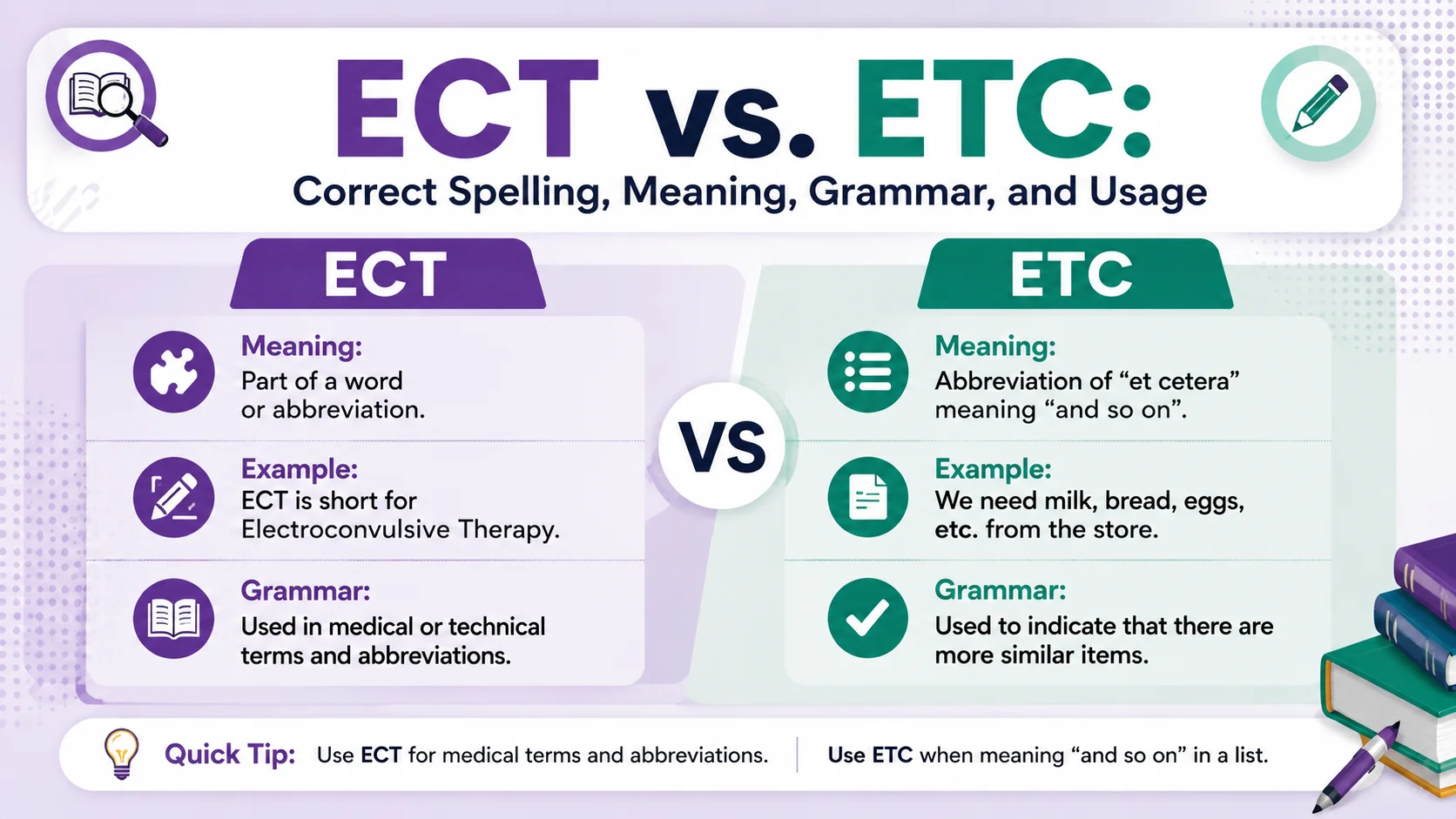
ECT vs. ETC: Quick Answer
ETC. is the correct abbreviation. ECT. is incorrect when you mean “et cetera.”
The full expression is et cetera, a Latin phrase meaning “and the rest,” “and other things,” or “and so forth.”
| Form | Correct? | Meaning | Example |
| etc. | Yes | And other things | Bring pens, paper, folders, etc. |
| ect. | No | Common misspelling | Bring pens, paper, folders, ect. |
| et cetera | Yes | And the rest | Bring pens, paper, folders, et cetera |
The easiest way to remember the spelling is to look at the original phrase:
ET CETERA → ETC.
The abbreviation keeps the t from et and the c from cetera. Switching those letters creates the common mistake ect.
What Does “Etc.” Mean?
Etc. is an abbreviation of the Latin expression et cetera. In everyday English, it generally means “and other things,” “and the rest,” or “and similar items.”
For example:
Please bring your notebook, calculator, pencils, etc.
The writer doesn’t need to name every possible school supply. The listed examples establish the category, while etc. tells the reader that other similar items are included.
You can use etc. for many kinds of lists:
- Objects
- Activities
- Foods
- Documents
- Places
- Materials
- Tasks
- General categories
For example:
The store sells shirts, jackets, shoes, hats, etc.
The reader understands that the store sells other types of clothing and accessories too.
What Does “Et Cetera” Literally Mean?
The expression comes from Latin.
- et means “and.”
- cetera refers to “the rest” or “the other things.”
Together, et cetera expresses the idea of “and the rest.”
That origin explains the abbreviation perfectly:
et + cetera = etc.
This is also the best defense against the ect. vs. etc. spelling mistake. Don’t memorize the abbreviation as a random group of letters. Connect it to et cetera.
Why Is “Etc.” Correct but “Ect.” Wrong?
The main issue in ECT vs. ETC is the order of the letters.
The standard abbreviation comes from et cetera, so the letters appear as:
E-T-C
The incorrect form changes the order to:
E-C-T
That may seem like a tiny difference, but spelling conventions don’t work by sound alone. The abbreviation represents the written Latin expression et cetera.
Why Do People Write “Ect.”?
Pronunciation plays a major role.
When people say et cetera quickly, the sounds can run together. Someone who has mostly heard the phrase in conversation may remember an approximate sound rather than its written structure.
That’s how ect. can become an accidental spelling.
The mistake isn’t unusual. Still, standard written English uses etc.
Compare these examples:
- ❌ The store sells shirts, pants, shoes, ect.
- ✅ The store sells shirts, pants, shoes, etc.
The second version is the correct choice.
A Simple Memory Trick
Use this formula:
ET + CETERA = ETC.
Another useful reminder is:
ETC. comes from ET CETERA.
Once you remember the first letters of those words, ect. becomes much easier to avoid.
How to Use “Etc.” Correctly in a Sentence
Etc. works best when you’re ending a list and the missing items are easy to understand.
For example:
We bought apples, oranges, bananas, etc.
The examples clearly belong to the category of fruit. The reader can easily imagine other items that could follow.
Now consider:
We discussed several things, etc.
This sentence feels weak because several things don’t establish a meaningful category. The reader has no useful clue about the omitted information.
A good use of etc. usually follows three principles:
- Give enough examples to establish the category.
- Use etc. only when the remaining items aren’t important to name individually.
- Make sure the reader can understand what the omitted items have in common.
Examples of Correct Usage
Objects:
Pack your shoes, jacket, toiletries, etc.
Activities:
She enjoys hiking, swimming, cycling, etc.
Documents:
Please submit your application, résumé, references, etc.
Food:
The restaurant serves burgers, sandwiches, salads, etc.
Work tasks:
Her responsibilities include scheduling, payroll, training, etc.
Each sentence, etc. has a clear job. It prevents the writer from creating an unnecessarily long list.
Grammar Rules for “Etc.”
The grammar surrounding etc. becomes simple once you understand its function. It signals that the list hasn’t ended even though the writer has stopped naming individual examples.
What Can “Etc.” Refer To?
Etc. commonly refers to additional things or activities.
For example:
The office needs paper, folders, envelopes, toner, etc.
It can also appear in broader contexts:
The course covers grammar, vocabulary, pronunciation, writing, etc.
The key is context. Readers should understand the general group represented by the examples.
Can “Etc.” Refer to People?
The answer requires some care.
Etc. can have a broad meaning that includes additional people in certain contexts. However, et al. is normally the better expression when you’re specifically referring to people, especially authors or researchers.
Compare:
Smith, Jones, Brown, et al.
Here, et al. means “and others” and refers to additional people.
By contrast:
Books, journals, reports, etc.
Here, etc. refers to things.
Keeping the distinction in mind will make academic and professional writing much cleaner.
Should You Write “And Etc.”?
You should generally avoid writing “and etc.” because etc. already means “and other similar things,” so adding and before it is redundant.
No. “And etc.” is redundant.
The word “et” already means “and.” Adding another and repeating the same meaning.
Incorrect:
She bought books, magazines, newspapers, and etc.
Correct:
She bought books, magazines, newspapers, etc.
You can also write:
She bought books, magazines, newspapers, and so on.
Both etc. and and so on communicate continuation without unnecessary repetition.
Punctuation Rules for “Etc.”
Punctuation is another important part of using etc. correctly.
Does “Etc.” Need a Period?
In standard abbreviation usage, etc. ends with a period.
Correct:
We sell books, magazines, newspapers, etc.
The period belongs to the abbreviation itself.
When etc. comes at the end of a sentence, don’t add a second period.
Incorrect:
We sell books, magazines, newspapers, etc..
Correct:
We sell books, magazines, newspapers, etc.
The single period performs both jobs.
Should You Put a Comma Before “Etc.”?
A comma commonly appears before etc. when it follows a series.
For example:
Bring pens, pencils, notebooks, folders, etc.
The comma separates the final listed item from the abbreviation.
Another example:
The program covers reading, writing, speaking, listening, etc.
This punctuation pattern is common in standard English writing.
Can a Comma Follow “Etc.”?
Yes. If the sentence continues after etc., a comma may follow the abbreviation when the grammar requires one.
For example:
The company sells laptops, tablets, monitors, etc., to schools across the country.
Here, etc. appears inside the sentence rather than at its end.
The structure looks like this:
List + etc. + comma + rest of sentence
Don’t confuse the comma with the period. The period belongs to the abbreviation, while the comma belongs to the sentence structure.
Capitalization of “Etc.”
In ordinary sentences, etc. is lowercase.
Correct:
We sell pens, pencils, notebooks, etc.
Incorrect:
We sell pens, pencils, notebooks, Etc.
You may see Etc. capitalized at the beginning of a sentence or in certain titles. However, ordinary body text normally uses lowercase etc.
For example:
Several supplies, including paper, folders, pens, etc., were delivered.
There is no reason to capitalize etc. simply because it appears after a comma.
When Should You Avoid Using “Etc.”?
Etc. is useful when the missing information doesn’t matter much. It becomes a problem when readers need to know exactly what you’re referring to.
Consider this instruction:
Bring your identification, medical records, financial documents, etc.
That sentence might create confusion. Which financial documents? Which medical records? Is proof of address required? Does the reader need a tax document?
When the details matter, list them.
A clearer version might say:
Bring your government-issued ID, proof of address, bank statement, and completed application.
The second sentence takes more space, but it gives the reader something much more valuable: certainty.
Avoid “Etc.” When the Category Is Unclear
Weak:
The company offers many services, etc.
Better:
The company offers website design, SEO, content writing, and social media management.
The first sentence tells the reader almost nothing. The second gives concrete information.
Avoid “Etc.” When Exact Information Matters
Don’t use etc. in instructions, requirements, specifications, or warnings when the omitted details could change what the reader does.
For example:
Applicants must submit identification, transcripts, test scores, etc.
This leaves too much room for interpretation.
Instead:
Applicants must submit a government-issued ID, official transcripts, test scores, and two recommendation letters.
Specific writing prevents mistakes.
Can You Use “Etc.” After “For Example”?
Using for example and etc. together is often unnecessary.
Consider:
You can eat fruits such as apples, oranges, bananas, etc.
The sentence already signals that the items are examples. Adding etc. doesn’t contribute much.
A cleaner version is:
You can eat fruits such as apples, oranges, and bananas.
Or:
You can eat fruits, including apples, oranges, and bananas.
The same principle applies to e.g. When one phrase already signals an incomplete set of examples, another marker may become redundant.
Can You Use “Etc.” After “Such As”?
It’s usually better to avoid combining such as with etc. when both serve the same purpose.
Instead of:
The shop sells products such as shirts, pants, shoes, etc.
Write:
The shop sells products such as shirts, pants, and shoes.
Or simply:
The shop sells shirts, pants, shoes, etc.
The second version works because etc. itself signals that the list continues.
“Etc.” in Everyday Writing
In casual communication, etc. can make your sentences shorter and more natural.
For example:
I need to clean the kitchen, wash the car, do laundry, etc.
Nobody expects the writer to list every household chore.
Similarly:
Bring snacks, drinks, blankets, etc.
The reader understands that these are examples of things needed for the outing.
In everyday writing, etc. is especially useful when the omitted items are obvious from the situation.
“Etc.” in Business Writing
Business writing demands more precision.
Etc. can work well when the additional items aren’t important:
Please bring your laptop, charger, notebook, etc.
However, don’t hide important requirements behind an abbreviation.
Weak:
The client needs the contract, invoices, reports, etc.
Better:
The client needs the signed contract, January invoices, quarterly reports, and payment records.
The improved sentence tells the recipient exactly what to prepare.
That’s the difference between brevity and ambiguity. Good business writing knows when to choose each one.
“Etc.” in Academic and Professional Writing
Academic writing usually values precision. As a result, etc. deserves more caution in research papers, reports, and scholarly discussions.
For example:
The study considered age, income, education, location, etc.
This may be acceptable if the omitted variables aren’t central to the argument. If those variables affect the study’s interpretation, however, they should be named.
Better:
The study considered age, income, education, geographic location, and employment status.
The reader can now understand the scope of the research without guessing.
When “Etc.” Can Still Work
There are situations where etc. remains useful in professional writing, particularly in:
- Tables
- Parenthetical lists
- Informal professional communication
- Lists where the remaining items aren’t relevant
- Contexts where the category is already obvious
The goal isn’t to eliminate etc. completely. The goal is to use it with judgment.
Correct “Etc.” Examples in Real Sentences
Using etc. correctly in real sentences helps you shorten a list without repeating every item, especially when the remaining examples are obvious or similar.
Everyday Writing
She enjoys reading, painting, gardening, etc.
We packed shirts, pants, socks, etc.
The children played games, watched movies, drew pictures, etc.
Business Writing
Please review the invoices, contracts, receipts, etc.
The meeting covered staffing, budgets, deadlines, etc.
The software supports spreadsheets, presentations, documents, etc.
Academic Writing
The survey examined age, income, education, location, etc.
The researchers analyzed cost, efficiency, reliability, etc.
However, if the exact factors matter to the research, list them instead of hiding them behind etc.
Common Mistakes With “Etc.”
Several mistakes appear repeatedly in writing.
| Mistake | Correct version | Explanation |
| ect. | etc. | The letters are in the wrong order |
| and etc. | etc. | Et already means “and” |
| etc.. | etc. | Don’t add a second period |
| for example … etc. | for example … | Often redundant |
| such as … etc. | such as … | Often redundant |
| etc. with unclear examples | Rewrite the sentence | The category isn’t obvious |
| etc. for exact requirements | Give the full list | Prevents ambiguity |
| Repeated etc. | Use specific wording | Improves readability |
The most common spelling error is still ect. If you remember et cetera, you’ll have a reliable way to avoid it.
Etc. vs. Et Al. vs. And So On
These expressions overlap in meaning, but they aren’t identical.
| Expression | Meaning | Typical use |
| etc. | And other things | Lists of things or examples |
| et al. | And others | People or authors |
| and so on | Continuing in the same way | General prose |
| and so forth | Continuing similarly | General prose |
For example:
The researcher cited Smith, Jones, Brown, et al.
Here, et al. refers to additional people.
Now consider:
The report includes charts, graphs, tables, etc.
Here, etc. refers to additional things.
And in conversational writing:
We discussed travel plans, hotels, transportation, and so on.
Choosing the right expression helps your writing sound precise rather than mechanical.
Better Alternatives to “Etc.”
Sometimes etc. isn’t the strongest choice. You can replace it with a phrase that tells the reader more.
“And So On”
Use and so on for relaxed, general prose.
We discussed travel costs, hotel prices, transportation, and so on.
“And So Forth”
This has a similar meaning but can sound slightly more formal.
The report covers costs, staffing, scheduling, and so forth.
“Among Others”
Use among others when referring to people, organizations, places, or examples.
The conference attracted researchers from several universities, among others.
Give the Complete List
When accuracy matters, the strongest alternative is often no abbreviation at all.
Instead of:
Bring your ID, forms, receipts, etc.
Write:
Bring your ID, completed application, payment receipt, and proof of address.
Specificity wins when the reader needs to take action.
Conclusion
Choosing etc. instead of ECT is a small detail that makes a big difference in clear, correct, and professional writing. Remember the Latin phrase et cetera and its letter order, e-t-c. Whether you’re writing essays, emails, lists, or everyday texts, etc. is the correct standard form. Once you remember this simple pattern, the spelling confusion between Ect. and Etc. becomes much easier to avoid.
FAQs
Q1. Is it Ect. or Etc.?
Etc. is the correct spelling. It’s the standard abbreviation of the Latin phrase et cetera.
Q2. What does etc. mean?
Etc. means “and other similar things.” It’s commonly used at the end of a list when you don’t need to mention every item.
Q3. Is ECT a correct abbreviation for et cetera?
No. ECT is an incorrect spelling of etc. The correct letter order is e-t-c.
Q4. Does etc. need a period?
Yes. Etc. traditionally takes a period because it’s an abbreviation of et cetera.
Q5. Is etc. used in British and American English?
Yes. Etc. is the standard form in both British English and American English.
About the Author