
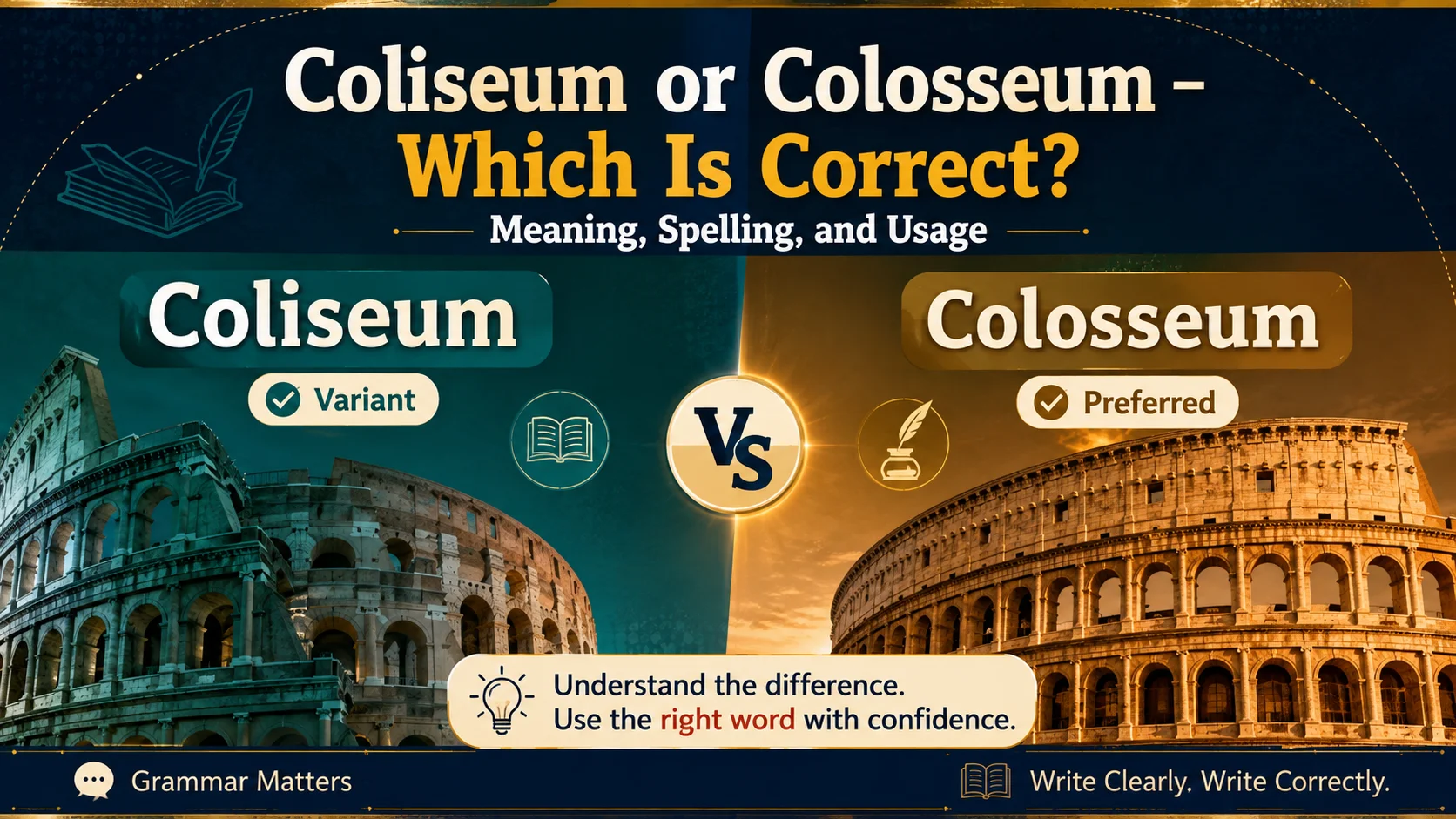
The Coliseum or Colosseum question often starts with two similar forms that have different uses. For the famous ancient amphitheater in Rome, Colosseum is the standard spelling and the clearest choice for this Roman landmark. Its spelling difference has a long history linked to the Flavian Amphitheatre, which became associated with a colossal statue and was eventually known by its present name. In English, however, Coliseum can function as a common noun for large arenas or similar buildings, creating a useful distinction between a proper name and a general noun.
The proper way to spell the Roman name may seem tricky, especially when these words appear in an age-old debate about historical landmarks. Writers, historians, and tourists regularly encounter both spellings, yet the iconic Roman amphitheater is normally called the Colosseum. The correct term reflects its Latin word history, while Coliseum remains an accepted English form that can refer to a large arena. A useful quick guide is simple: choose the Colosseum for the historic Roman structure and a coliseum for a large modern venue or similar public space.
The historic monument and a modern public entertainment venue may share related language, but their meanings depend on usage. Colosseum is preferred in modern references, particularly in academic and historical contexts, when discussing the Roman Colosseum. Meanwhile, Coliseum can describe large amphitheaters, stadiums, and other venues. This difference helps separate the specific Roman landmark from the broader meaning of the word without making the English language unnecessarily complicated.
Quick Answer: Coliseum or Colosseum?
Use Colosseum when you mean the ancient Roman amphitheater in Rome.
Use coliseum when you mean a large arena, stadium, or public entertainment building in a general sense.
| Word | Meaning | Example |
| Colosseum | The famous ancient amphitheater in Rome | We visited the Colosseum in Rome. |
| coliseum | A large arena or public entertainment venue | The concert took place in a local coliseum. |
| Coliseum | A capitalized part of a venue’s official name | The team played at the Coliseum. |
There is one important wrinkle: dictionaries recognize overlap between the two spellings. Coliseum can also refer to the Roman monument, while Colosseum can be used as a general noun in some contexts. Still, the Colosseum is the clearest and most established spelling for Rome’s ancient amphitheater.
Coliseum vs. Colosseum: The Basic Difference
At first glance, Coliseum and Colosseum appear to be spelling variants. In modern English, however, context helps determine which form makes the most sense.
Colosseum strongly points to the ancient structure in Rome. It functions as a proper name when referring to that particular landmark.
coliseum, on the other hand, commonly describes a large building used for sports, entertainment, exhibitions, meetings, or other public events. Cambridge specifically labels this use as mainly American English.
Consider these examples:
- Correct: We spent the afternoon exploring the Colosseum.
- Correct: Thousands of fans filled the local coliseum.
- Correct: The ancient Colosseum attracts visitors from around the world.
- Correct: The new coliseum hosts basketball games and concerts.
The easiest distinction is simple:
Colosseum = Rome’s famous ancient amphitheater.
coliseum = a large arena or entertainment building.
That rule won’t cover every dictionary entry or official venue name, but it works extremely well in ordinary writing.
Why Is the Roman Landmark Spelled Colosseum?
The spelling Colosseum has deep historical roots. The building wasn’t originally named the Colosseum at all.
The Historical Name of the Roman Colosseum
The monument was originally known as the Flavian Amphitheatre, or Amphitheatrum Flavium in Latin. Its construction began during the reign of Emperor Vespasian around AD 72. His son Titus inaugurated the completed amphitheater around AD 80.
The building belonged to the Flavian dynasty, which explains its original name.
It wasn’t merely a decorative monument. The amphitheater became a major venue for public spectacles, including gladiatorial contests, animal hunts, and other large-scale performances. The archaeological park describes it as the largest amphitheater in the world.
The structure also represented a major shift in Roman public architecture. Its enormous size, tiered seating, entrances, corridors, and underground facilities allowed huge crowds to enter, leave, and watch spectacles with remarkable efficiency.
Over time, however, Flavian Amphitheatre faded from everyday use. Another name took its place.
The Colossus of Nero and the Name Colosseum
The name Colosseum is traditionally connected with the enormous statue known as the Colossus of Nero, which stood near the amphitheater.
The official Colosseum archaeological site states that the building became known as the Colosseum because of a colossal statue that stood nearby.
The statue itself was associated with Emperor Nero and was later modified and moved during the Roman imperial period. Its presence near the amphitheater helped create the linguistic connection between the enormous statue and the building.
However, the exact history of the name isn’t completely straightforward. The official Colosseum site notes several theories surrounding the etymology. One connects the name to the nearby Colossus, while another interpretation relates it to the colossal size of the building itself.
So, it’s better to say that the name is traditionally associated with the nearby Colossus rather than treating one simplified explanation as the entire story.
What Does Coliseum Mean?
Unlike the Colosseum, the lowercase word coliseum can function as a general noun.
A coliseum is a large building designed for public entertainment, sports, meetings, exhibitions, or similar events. Merriam-Webster defines it as a large sports stadium or building modeled after the Roman Colosseum.
That broader meaning explains why you might see the word in modern American English.
For example:
- The university built a new coliseum for basketball games.
- The singer performed at a packed coliseum.
- The city renovated its aging coliseum.
- Thousands of spectators entered the coliseum before the championship game.
Here, nobody is talking about ancient Rome. The word describes a type of large public venue.
Examples of Coliseum in Modern English
The word often appears in contexts involving:
- Sports
- Concerts
- Exhibitions
- Public events
- Large meetings
- Entertainment
- Arena-style venues
For example, imagine a city has a 20,000-seat indoor arena. A writer might describe it as a coliseum because of its size and function.
That doesn’t turn the building into a historical replica of Rome. The word has simply developed a broader meaning.
Coliseum vs. Colosseum in American and British English
The distinction becomes slightly more interesting when you compare English varieties.
Cambridge identifies coliseum as mainly American when it means a large public building for entertainment, meetings, or sporting events.
British English also recognizes coliseum, particularly for a large building such as a stadium or theater. Collins likewise lists the word as a term for a large building used for entertainment or sports.
Meanwhile, Colosseum remains strongly associated with the ancient Roman amphitheater.
| Context | Preferred form |
| Ancient monument in Rome | the Colosseum |
| General large arena | a coliseum |
| Ancient Roman history | Colosseum |
| Modern American sports venue | coliseum is common |
| Official venue name | Follow the venue’s official spelling |
There isn’t a simple rule saying one spelling belongs exclusively to American English and the other belongs exclusively to British English. Dictionaries show considerable overlap. Context matters more than geography.
When Should You Use Colosseum?
The safest choice is Colosseum when you’re referring to Rome’s ancient amphitheater.
Referring to the Ancient Roman Landmark
Use Colosseum in sentences such as:
- The Colosseum is one of Rome’s most recognizable landmarks.
- Tourists gathered outside the Colosseum early in the morning.
- The Colosseum hosted public spectacles during the Roman Empire.
- Archaeologists continue to study the Colosseum and its surrounding area.
Notice the capitalization. Colosseum functions as a proper name because it identifies one specific monument.
You wouldn’t normally write:
We visited the coliseum in Rome.
The sentence isn’t necessarily incomprehensible. However, the Colosseum is the conventional form and immediately identifies the historic landmark.
Colosseum in Historical and Cultural Writing
Colosseum is especially appropriate in writing about:
- Ancient Rome
- Roman architecture
- Roman emperors
- Archaeology
- Ancient entertainment
- Gladiatorial games
- Roman engineering
- Tourism in Rome
- Classical history
The monument also has a fascinating physical history. Construction began under Vespasian and reached completion under Titus. Later centuries brought decline, reuse, and extensive material removal. The official archaeological park notes that parts of the structure were used as a source of building materials during the Middle Ages and Renaissance.
That history makes the spelling Colosseum more than a dictionary preference. It identifies a specific structure with a long historical identity.
When Should You Use Coliseum?
Use coliseum when you’re talking about a large public venue rather than specifically naming Rome’s ancient amphitheater.
Using Coliseum as a General Noun
Consider this sentence:
The basketball team played in a crowded coliseum.
Here, coliseum means a large arena. The sentence doesn’t identify a particular building by its official name.
Likewise:
The city plans to renovate its old coliseum.
The word describes the type of building.
This usage is especially common in American English. Cambridge gives coliseum as a term for a large public building used for entertainment, meetings, and sports.
Coliseum as Part of a Proper Name
Capitalization changes when Coliseum forms part of an official venue name.
For example, a building may officially be called Something Coliseum. In that case, the capital letter isn’t being used merely because the building is large. It’s capitalized because it’s part of the venue’s proper name.
This distinction matters:
- The city built a new coliseum. → General noun
- The team plays at Madison Coliseum. → Proper name
- We visited the Colosseum in Rome. → Specific ancient landmark
When writing about a particular modern venue, use its established official spelling instead of changing Coliseum to Colosseum.
Colosseum or Coliseum: Side-by-Side Comparison
| Feature | Colosseum | coliseum |
| Primary reference | Ancient Roman amphitheater | Large arena or public venue |
| Famous location | Rome, Italy | Any location |
| Typical capitalization | Capitalized for the Roman landmark | Lowercase when generic |
| Historical association | Ancient Rome | Derived from the Roman name |
| Modern use | Primarily the Roman monument | Sports, entertainment, exhibitions, and events |
| Example | “The Colosseum stands in Rome.” | “The coliseum holds 15,000 people.” |
One detail deserves emphasis: dictionaries don’t treat the words as perfectly separate categories. Coliseum can also be a spelling variant referring to the Roman monument. Likewise, colosseum can describe an arena in some dictionary definitions.
Still, writers usually benefit from maintaining the distinction because it makes the meaning immediately clear.
Common Mistakes With Coliseum and Colosseum
A few mistakes appear repeatedly.
Using “Coliseum” for the Roman Landmark
Less preferred:
We toured the Coliseum in Rome.
Preferred:
We toured the Colosseum in Rome.
The second version follows the standard spelling associated with the ancient monument.
Assuming “Colosseum” Is Always the Correct Form
Not necessarily.
If you’re describing a modern arena, coliseum may be the better choice:
The new coliseum will host concerts and sporting events.
Using Colosseum here could make the reader think you’re talking about ancient Rome.
Capitalizing Every Use of “Coliseum”
A common noun doesn’t need capitalization simply because it’s an impressive building.
Correct:
The city opened a new coliseum.
Different situation:
The concert took place at Lincoln Coliseum.
The second example treats Coliseum as part of a proper venue name.
Treating the Words as Completely Interchangeable
Dictionaries show overlap, but practical writing benefits from precision.
If you write the Colosseum, readers immediately picture the ancient Roman landmark.
If you write a coliseum, readers can reasonably picture a large arena.
That distinction saves readers from having to decode your meaning.
Easy Ways to Remember the Correct Spelling
Grammar and spelling rules become easier when you attach them to a mental image.
Use Colosseum for Rome
Think:
Rome → Roman Empire → Colosseum
If you’re writing about the famous amphitheater in Rome, choose Colosseum.
Use Coliseum for a General Arena
Think:
coliseum → large public venue
If you’re describing a sports arena, entertainment center, or large event building in general, coliseum may fit naturally.
A simple memory trick is:
The Colosseum is one specific place. A coliseum can be many places.
That distinction is short enough to remember when you’re writing quickly.
Colosseum or Coliseum in a Sentence
Seeing the forms in context makes the difference clearer.
Historical Context
The Colosseum became a major center for public spectacles in ancient Rome.
Travel Context
Visitors often include the Colosseum on their Rome itinerary.
Sports Context
The university’s new coliseum can accommodate thousands of fans.
Entertainment Context
The band sold out the local coliseum within hours.
Generic Description
The enormous coliseum was designed to accommodate large crowds.
Proper Venue Name
The championship game will take place at Riverfront Coliseum.
The last example demonstrates an important point. Coliseum can be capitalized when it belongs to a specific proper name.
A Real-World Case Study: The Roman Monument vs. Modern Arenas
Consider two sentences:
Tourists entered the Colosseum before noon.
Fans entered the coliseum before the championship game.
The grammatical structure looks almost identical. The meaning changes dramatically.
In the first sentence, Colosseum identifies a particular ancient structure in Rome.
In the second, coliseum describes a modern public venue.
This is a useful example of how capitalization and context work together. The spelling itself provides a clue, while the surrounding words confirm the intended meaning.
The historical building is officially recognized as the Flavian Amphitheatre, and its later name became connected with the nearby colossal statue.
Facts About the Colosseum
A few concrete facts help put the spelling into perspective:
- The Colosseum was built in Rome during the first century CE.
- Construction began under Emperor Vespasian around AD 72.
- Titus completed the main structure around AD 80.
- Its original name was the Flavian Amphitheatre.
- It hosted large public spectacles, including gladiatorial contests and animal hunts.
- Its later name became associated with a colossal statue near the amphitheater.
- The structure remains one of Rome’s defining archaeological landmarks.
- The official archaeological park describes it as the largest amphitheater in the world.
These facts also explain why Colosseum has such a strong identity in modern English. It’s not simply a word for an arena. It’s the established name of a specific monument.
Conclusion
The difference between Coliseum or Colosseum becomes clear once you focus on context. Use Colosseum when referring to the ancient Roman amphitheater in Rome, especially in historical, academic, or cultural writing. Coliseum can describe a large arena, stadium, or public entertainment venue in a broader sense. Although dictionaries recognize some overlap between the terms, choosing Colosseum for the Roman landmark is the safest and most precise option.
FAQs
Q1. Is Colosseum or Coliseum correct?
Both Colosseum and Coliseum are recognized English forms, but Colosseum is the standard choice for the ancient Roman landmark.
Q2. Is the Roman Colosseum spelled with two O’s?
Yes. The standard spelling is Colosseum, with two o’s in the middle.
Q3. Can Coliseum refer to a stadium?
Yes. Coliseum can refer to a large stadium, arena, or public entertainment venue, especially when used as a common noun.
Q4. Should Colosseum be capitalized?
Yes. When you mean the specific ancient monument in Rome, write the Colosseum with a capital C.
Q5. Why are Coliseum and Colosseum spelled differently?
The two forms developed through the history of English usage. Colosseum became closely associated with the Roman monument, while Coliseum developed a broader meaning connected with large arenas and public venues.
About the Author