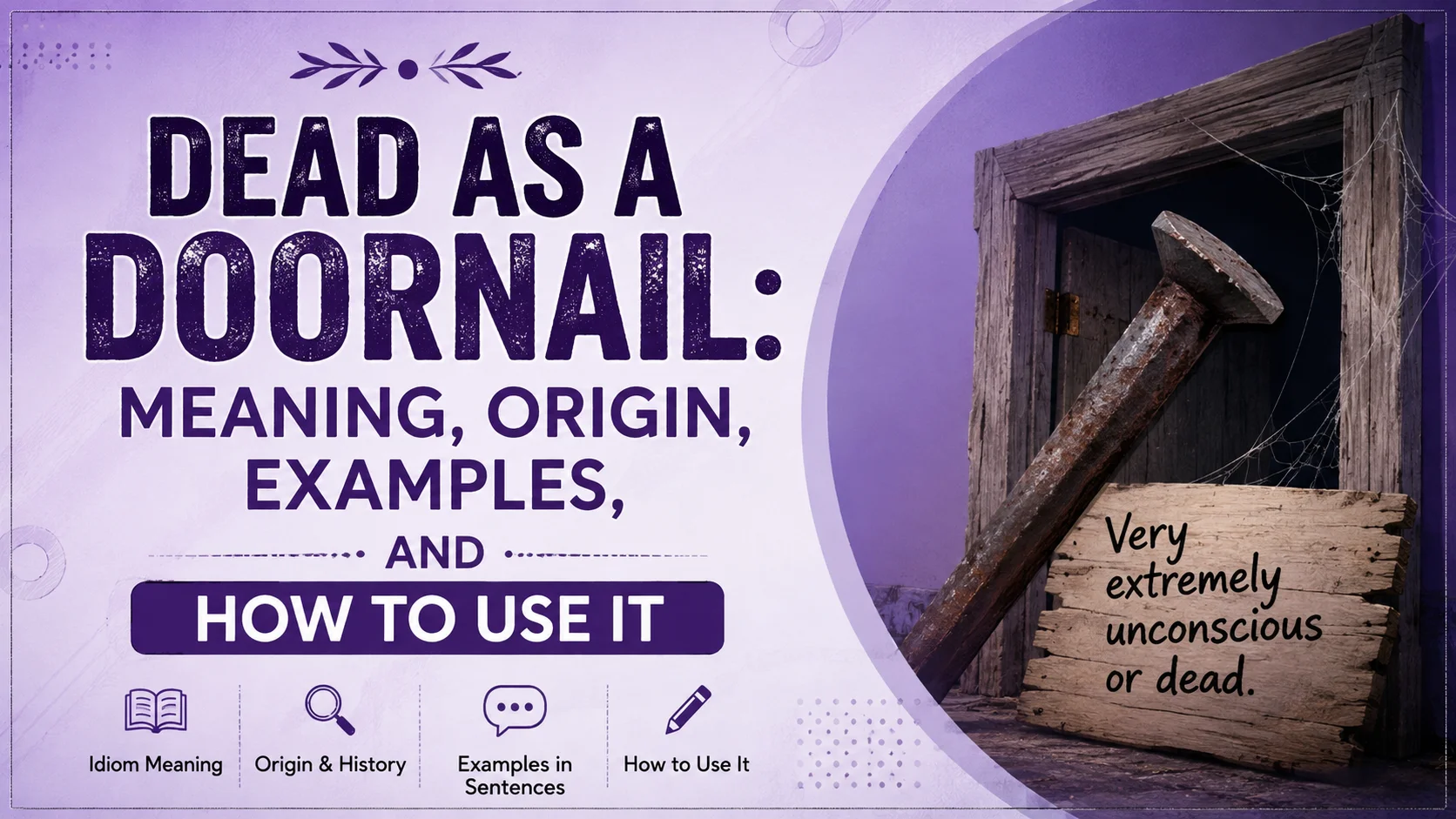
“Dead as a Doornail” describes something that is completely dead, finished, or no longer functioning, with no realistic chance to revive it. The expression is a memorable English idiom used when someone or something is beyond recovery. In everyday conversations, it can describe a dead battery, a failed plan, or an abandoned project. The meaning depends on the context, but the central idea is always that nothing is left to restore or bring back to life.
The phrase has an unusually long history, with evidence showing its use as far back as the 14th century. Later writers, including Shakespeare and Charles Dickens, helped preserve it in literary English. The strange comparison between something dead and a doornail helped make the old saying memorable. Today, the phrase still appears in movies, books, and everyday conversations, showing how an expression from hundreds of years ago can remain part of modern language.
A common example is an old car that won’t start and is beyond repair. If the car is old, broken, worn out, or badly damaged, someone may say it is dead as a doornail because it cannot be used anymore. The image comes from a nail that has been hammered flat into a door and cannot be used again. Like such a nail, the car has no chance of revival, making the phrase a strong way to describe something completely lifeless and finished.
Quick Answer: What Does “Dead as a Doornail” Mean?
“Dead as a doornail” means completely or unquestionably dead. It can also mean that something has completely stopped working, ended, or lost its usefulness.
For example:
My old laptop is dead as a doornail.
Here, “dead” doesn’t mean the laptop was ever alive. It means the computer doesn’t work at all.
The expression can also describe literal death:
The animal was dead as a doornail.
Cambridge Dictionary defines the idiom as meaning “completely dead,” while Merriam-Webster describes it as an informal expression that emphasizes that someone or something is dead. Merriam-Webster also gives figurative examples involving negotiations and deals.
| Expression | Meaning | Tone |
| Dead | No longer alive or functioning | Neutral |
| Dead as a doornail | Completely dead or finished | Informal and emphatic |
| Completely dead | Totally dead | Neutral |
| No longer functioning | Not working anymore | Formal |
| Finished | Completely ended | Neutral |
The phrase’s real strength comes from emphasis. Saying something is “dead” gives information. Saying it’s “dead as a doornail” makes that information much more vivid.
What Is a Doornail?
A doornail is a large-headed nail traditionally used in doors. Merriam-Webster records the word from the 14th century and defines it as a large-headed nail.
Older doors could contain large iron nails that helped hold wooden boards together. Some also served a decorative purpose. These weren’t necessarily the small nails familiar from modern household repairs.
The word doornail itself is old enough to appear around the same period as the idiom. Etymonline dates the word to the late 14th century and notes that the figurative expression “dead as a doornail” is attested very early as well.
That historical connection helps explain why the phrase sounds so unusual today. Modern speakers rarely encounter an actual doornail, but the expression survived long after the object stopped being familiar.
Is “Dead as a Doornail” an Idiom or a Simile?
“Dead as a doornail” is an idiomatic simile.
A simile makes a comparison using words such as as or like. The structure here is:
dead + as + a doornail
The expression doesn’t mean that a doornail experiences biological death. Instead, the phrase uses an unusual comparison to emphasize absolute lifelessness or inactivity.
Consider these three sentences:
- The battery is dead.
- The battery is completely dead.
- The battery is dead as a doornail.
The first is plain. The second adds emphasis. The third adds color and personality.
That’s why idioms are useful. They can turn a flat statement into something people remember.
Where Did “Dead as a Doornail” Come From?
The expression is remarkably old. Sources trace examples back to the 14th century, including a version dating to around 1350. It also appears in Piers Plowman, a major Middle English work associated with William Langland.
An early form appeared as:
“I am ded as dore-nail.”
The spelling looks strange because this was Middle English, not modern English. The basic idea, however, is recognizable.
Another early example appears in Piers Plowman in the form “ded as a dore-nayl.” The expression was therefore already established long before modern dictionaries or contemporary English existed.
Did Shakespeare Invent “Dead as a Doornail”?
No.
Shakespeare used the expression, but he didn’t invent it. The phrase had already been circulating for centuries before Shakespeare wrote his plays.
Its presence in Shakespeare’s works helped maintain its visibility in literary English. That kind of literary repetition can give an old expression a second life.
The important distinction is simple:
Shakespeare popularized an existing expression; he didn’t create it.
Why Is It “Dead as a Doornail”?
This is the part of the story where certainty disappears.
Several explanations have been proposed for the connection between death and doornails. One widely discussed theory involves the construction of old wooden doors.
Large nails could be driven through boards and then bent or clinched over on the other side. Once secured in that manner, the nail couldn’t easily be pulled out and reused. Some explanations connect this permanently fixed state with the old use of dead to describe something firmly fixed or immovable.
Another theory connects the expression with heavily hammered decorative door nails or nails associated with door knockers.
However, there’s an important caveat: the exact origin isn’t proven.
The phrase is unquestionably old. The precise reason someone first compared death with a doornail remains uncertain. A good explanation should separate documented history from attractive theories.
Charles Dickens and “Dead as a Doornail”
If one writer deserves special credit for making “dead as a doornail” memorable to generations of readers, it’s Charles Dickens.
Dickens famously used the expression at the beginning of A Christmas Carol when describing Jacob Marley. The phrase appears in the opening discussion of Marley’s death. Dickens then stops to question the logic of the comparison.
Why a doornail?
Why not a coffin nail?
The joke works because Dickens knows his readers already understand the idiom. He can poke fun at the expression without losing its meaning.
This is a clever example of how writers can use an old cliché creatively. Dickens doesn’t merely repeat the phrase. He turns the phrase itself into part of the joke.
How Is “Dead as a Doornail” Used Today?
Modern English has stretched the word dead far beyond biological death. Something can be “dead” when it stops operating, loses activity, or becomes completely unsuccessful.
That makes the idiom surprisingly flexible.
Describing a Person
The literal meaning is straightforward:
The old man was dead as a doornail.
The phrase emphasizes that the person was unquestionably dead.
However, this doesn’t automatically make it the best choice. Because the idiom is informal and can sound humorous, it may seem insensitive when discussing someone’s real death.
In a serious situation, “had died” or “was deceased” may be more appropriate.
Describing an Animal
The same literal meaning applies to animals:
The fox was dead as a doornail.
Cambridge uses a fox as an example of the idiom’s literal meaning.
Describing a Phone or Battery
This is a very natural modern use:
My phone is dead as a doornail.
Nobody thinks the phone was alive. Instead, the phrase means that the phone won’t turn on or function.
You can use it for:
- A phone
- A laptop
- A car battery
- A television
- A remote control
- An old appliance
For example:
I tried charging the tablet, but it was dead as a doornail.
Describing an Idea or Project
The expression can also describe something abstract:
That business idea is dead as a doornail.
Here, the idea has no realistic future.
Similarly:
The project is dead as a doornail after the company canceled its funding.
In this context, dead means finished or abandoned.
Merriam-Webster specifically records figurative uses involving things such as negotiations and deals.
Describing a Place or Atmosphere
Sometimes dead means extremely quiet or inactive:
The town was dead as a doornail after midnight.
The town isn’t literally dead. There’s simply very little activity.
This use fits the broader English habit of describing quiet places as dead.
Examples of “Dead as a Doornail”
Here are examples across several contexts:
Everyday Examples
- My old phone is dead as a doornail.
- The television is dead as a doornail.
- That plan is dead as a doornail.
- The party was dead as a doornail after midnight.
Work and Business Examples
- The proposal is dead as a doornail after the investors rejected it.
- The partnership was dead as a doornail before negotiations even started.
- That business idea is dead as a doornail.
Technology Examples
- My laptop is dead as a doornail.
- The car battery is dead as a doornail.
- The old printer looks dead as a doornail.
Literal Examples
- The animal was dead as a doornail.
- The character was dead as a doornail when the detective arrived.
The context tells you whether dead is literal or figurative.
“Dead as a Doornail” vs. “Dead”
These expressions share the same basic meaning, but they don’t have the same impact.
Dead is direct and neutral.
Dead as a doornail is emphatic, colorful, and informal.
| Sentence | Effect |
| The battery is dead. | Simple and neutral |
| The battery is completely dead. | Stronger emphasis |
| The battery is dead as a doornail. | Strong, vivid, conversational |
If you’re writing a technical report, the first or second sentence will usually work better.
If you’re writing dialogue or telling a story, the third can add personality.
Similar Expressions to “Dead as a Doornail”
English has several expressions that communicate a similar idea.
| Expression | Meaning | Tone |
| Dead as a doornail | Completely dead | Informal |
| Dead as a dodo | Completely finished or dead | Informal, humorous |
| Stone-dead | Completely dead | Strong |
| Dead and buried | Completely finished or forgotten | Figurative |
| No longer functioning | Not working | Formal |
| No longer viable | No longer practical | Formal |
| Finished | Completely ended | Neutral |
“Dead as a dodo” is another established idiom, although Merriam-Webster identifies it as chiefly British.
Is “Dead as a Doornail” Formal or Informal?
It’s informal.
Cambridge labels the expression informal, and Merriam-Webster also identifies it as an informal expression.
It’s well suited to:
- Casual conversation
- Fiction
- Dialogue
- Informal articles
- Humor
- Personal storytelling
It’s less suitable for:
- Medical records
- Academic papers
- Legal documents
- Technical reports
- Formal business documents
The problem isn’t correctness. It’s tone.
For example, a technical report might say:
The device is no longer functioning.
A friend might say:
This thing is dead as a doornail.
Both sentences communicate failure. They simply belong to different situations.
Common Mistakes With “Dead as a Doornail”
“Dead as a Doornail” is often misunderstood or used incorrectly because its figurative meaning and informal tone can be easy to overlook.
Assuming Shakespeare Invented It
He didn’t. The phrase existed centuries before Shakespeare.
Writing “Door Nail”
The standard modern spelling is doornail, written as one word. Older texts may show forms such as door-nail.
Taking the Phrase Literally
A phone can be “dead.” A business can be “dead.” An idea can be “dead.”
English uses dead figuratively all the time.
Using It in Sensitive Situations
The phrase can sound humorous or blunt. That makes it a poor choice for some discussions about real deaths.
Treating the Origin Theory as Certain
The history of the expression is well documented. The exact reason for the doornail comparison is not.
Is “Dead as a Doornail” Still Used Today?
Yes. The phrase remains an established part of English vocabulary.
Modern dictionary sources continue to document it and provide examples of both literal and figurative usage. Cambridge lists modern examples involving political and social subjects, while Merriam-Webster gives examples involving negotiations and deals.
Its survival is particularly interesting because doornail isn’t a common everyday word anymore.
That’s the magic of idioms.
A phrase can preserve an old object long after the object itself becomes unfamiliar. The original image may fade, but the meaning remains useful.
Conclusion
The idiom dead as a doornail is a vivid way to describe something that is completely dead, lifeless, finished, or no longer useful. Its unusual wording has helped it remain memorable in English for centuries. Whether used for a broken object, a failed idea, or something that cannot be revived, the phrase clearly suggests that there is nothing left to restore.
FAQs
Q1. What does “dead as a doornail” mean?
Dead as a doornail means completely dead, lifeless, finished, or no longer functioning. It can describe both people and things, depending on the context.
Q2. Why do people say “dead as a doornail”?
The phrase uses a doornail as a comparison to emphasize complete lifelessness. A doornail is fixed firmly into a door and cannot function as a living thing, making it a memorable image.
Q3. Is “dead as a doornail” an idiom?
Yes. Dead as a doornail is a well-known English idiom. It is usually used figuratively to stress that something is completely finished, useless, or beyond revival.
Q4. Can “dead as a doornail” describe a broken object?
Yes. For example, you could say, “My old phone is dead as a doornail.” This means the phone no longer works and is unlikely to function again.
Q5. Is “dead as a doornail” still used today?
Yes. The expression remains recognizable in modern English and can appear in books, movies, conversations, and informal speech. It is especially useful when someone wants to strongly emphasize that something is completely finished.
About the Author