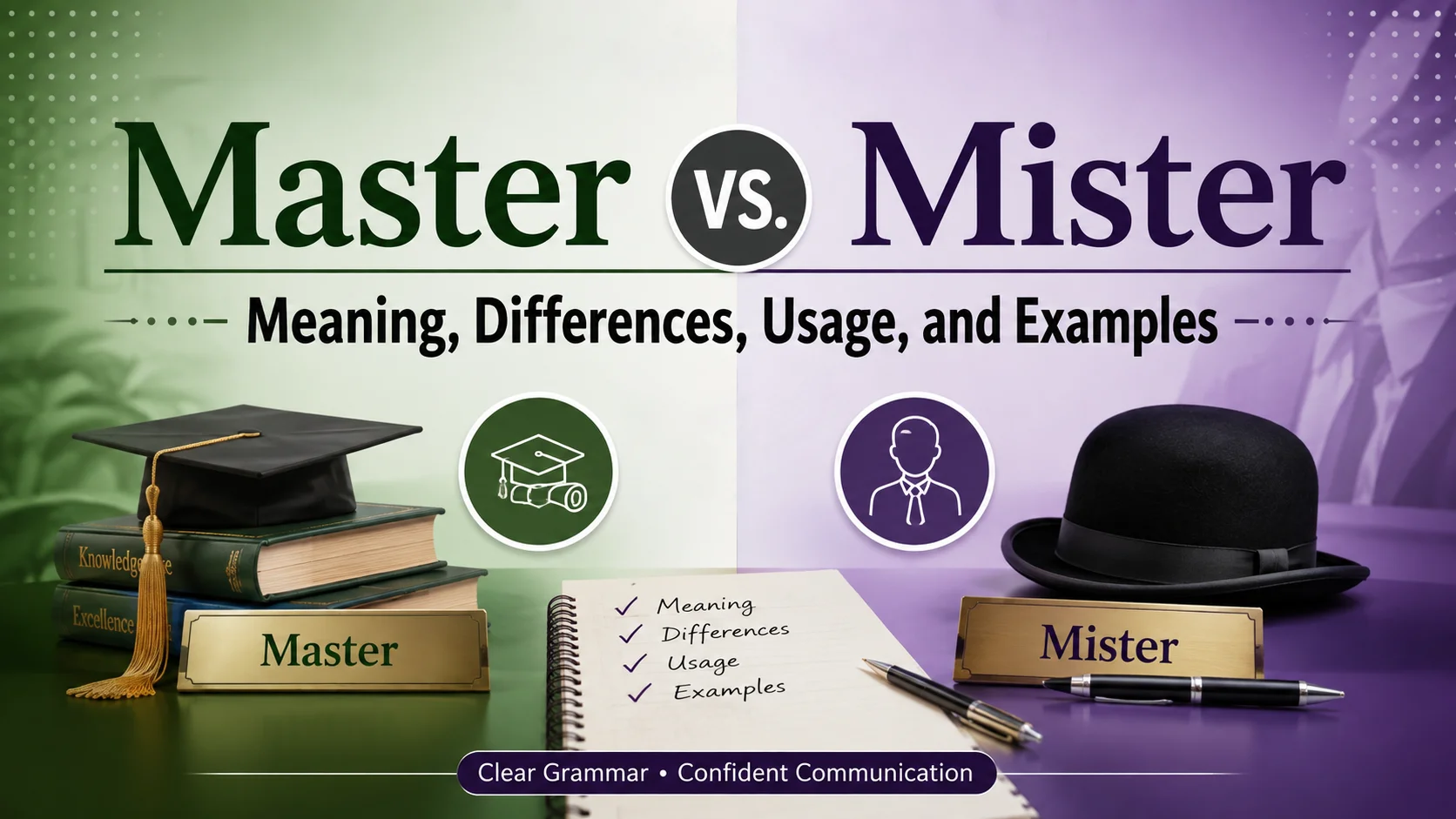
Master vs Mister can be confusing because both are titles for men, but their meanings and usage are different in modern English. Mister is the usual courtesy title for an adult man and is commonly written as Mr. before a man’s name, such as Mr. Johnson or Mr. Smith. It does not normally depend on age, status, marital status, or job, making it the standard choice in formal situations.
Master has a wider range of meanings. It can describe an expert, a person with authority, someone who has gained complete control of a skill, or someone who has people working for him. In traditional usage, Master was also used as a boy’s title. For example, a young boy could be called Master Smith, while the same person might later be addressed as Mister Smith or Mr. Smith when he grows up.
The difference between these commonly confused terms comes from their history, origins, and social changes. Although the words have a similar sound and a historical connection, they are not interchangeable today. From my experience with formal English, using Mister or Mr. for an adult man is the safest choice, while Master should be used when its specific meaning fits the context. This prevents awkward sentences and helps you choose the right word correctly.
Quick Answer: Master vs. Mister
The simplest distinction is this:
Mister means Mr. and is used as a courtesy title for a man.
Master usually refers to skill, expertise, authority, control, or mastery. It can also serve as a traditional title for a boy.
| Word | Meaning | Common Use | Example |
| Master | Expert, person with control, or traditional title for a boy | Skills, authority, professions, education | She is a master of chess. |
| Mister | Courtesy title for a man | Names and direct address | Mr. Carter is here. |
| Mr. | Abbreviation of mister | Formal writing | Mr. Carter is here. |
A quick memory trick makes the difference easy:
Master = mastery, skill, or control.
Mister = Mr., a title for a man.
Although the words are historically related, they aren’t interchangeable in modern English.
What Does “Master” Mean?
The word master has several meanings. Unlike mister, it can work as a noun or verb and appears in many expressions.
The central idea behind many uses of master is control or exceptional ability.
Master as an Expert
When you call someone a master, you often mean that person has reached an unusually high level of skill.
For example:
- She is a master of classical music.
- He became a master carpenter.
- The artist was a master of portrait painting.
- She is a master negotiator.
In these examples, master describes expertise. It doesn’t function as a title equivalent to Mr.
Compare these two sentences:
Mr. Brown teaches chess.
This tells you who Brown is.
Mr. Brown is a master of chess.
This tells you how skilled Brown is.
That small distinction changes the entire meaning.
Master as Someone With Authority
Master can also describe someone who has authority, control, or command.
Examples include:
- He was master of the estate.
- The captain was master of the ship.
- She remained master of the situation.
- The dog obeyed its master.
Some of these uses are strongly connected with historical language. Modern English still retains them in specific expressions, professional titles, literature, and formal contexts.
Master as a Verb
One of the most useful modern meanings of master appears as a verb.
To master something means to learn it thoroughly or become highly skilled at it.
For example:
- She mastered the piano after years of practice.
- He mastered the new software quickly.
- You need to master the basics before moving on.
- The students worked hard to master English grammar.
This use is extremely common in educational and professional writing.
If you master something, you don’t merely understand it. You develop a strong level of control or skill.
Master in Education
The word master also appears in academic terminology.
A master’s degree is an advanced academic qualification that generally follows a bachelor’s degree. Examples include:
- Master of Arts
- Master of Science
- Master of Education
- Master of Business Administration
For example:
She earned a master’s degree in English.
The word master in master’s degree has nothing to do with mister. It’s a separate historical and academic use of the word.
Master as a Traditional Title for a Boy
Here’s where the difference between master vs. mister becomes particularly interesting.
Historically, Master could appear before a boy’s name. It was traditionally used for a boy who was considered too young to be addressed as Mister.
For example:
Master William has arrived.
This usage is grammatically valid in the right context. However, it sounds formal, traditional, or old-fashioned to most modern American readers.
You might encounter it in historical novels, older documents, period dramas, or traditional correspondence.
In everyday modern American English, there’s usually no need to address a boy as Master + name.
What Does “Mister” Mean?
Mister has a much narrower meaning than master.
Its primary use is as the complete form of Mr., a courtesy title for a man.
For example:
- Mr. Smith
- Mr. Johnson
- Mr. Davis
- Mister Wilson
In formal American writing, Mr. is much more common than spelling out mister.
Mister as a Courtesy Title
When placed before a man’s name, mister shows a conventional form of respect or courtesy.
For example:
Mr. Anderson will attend the meeting.
You could write:
Mister Anderson will attend the meeting.
The second version isn’t necessarily incorrect. However, it sounds less conventional in most formal American writing.
That’s why you’ll normally see Mr. on:
- Business letters
- Official forms
- Invitations
- Professional documents
- School records
- Legal documents
- Formal correspondence
Mister as Direct Address
Mister can also be used when addressing a man directly, especially when you don’t know his name.
For example:
Excuse me, mister. You dropped your wallet.
The tone depends heavily on context.
Compare:
Excuse me, mister. Is this your wallet?
with:
Listen, mister. That’s enough.
The first can sound casual or polite. The second can sound angry or confrontational.
This is an important point because mister isn’t always a neutral word when used by itself.
Master vs. Mister: Main Differences
The clearest way to understand master vs. mister is to compare their functions.
| Feature | Master | Mister |
| Means an expert | Yes | No |
| Means control or authority | Yes | No |
| Can be a verb | Yes | No |
| Used in “master’s degree” | Yes | No |
| Traditional title for a boy | Yes | No |
| Standard title for an adult man | No | Yes |
| Full form of Mr. | No | Yes |
| Can address an unknown man | Uncommon | Yes |
| Common in modern American English | Yes | Yes |
The biggest difference is simple: master carries several meanings, while mister primarily serves as a title or form of address.
Why Are Master and Mister Confused?
There is a very good reason people confuse these words: they actually come from the same linguistic family.
Mister developed historically from master. The older word traces back through Old French to Latin magister, a word associated with a chief, teacher, or person of authority.
Over time, English speakers shortened and changed the title. Eventually, mister became established as a separate form.
That history explains why the two words look like close relatives.
Think of them as two branches from the same tree. Their roots are connected, but their modern meanings have grown in different directions.
Master retained many meanings connected with expertise and authority.
Mister developed into the familiar courtesy title Mr.
Master vs. Mister in American English
For American English readers, the distinction is especially practical.
If you’re addressing an adult man by his surname, use Mr.
Mr. Thompson will arrive at noon.
Don’t normally write:
Master Thompson will arrive at noon.
The second sentence could be understood if Thompson is a boy or if the context is deliberately traditional. For an adult, however, it sounds unusual.
At the same time, master remains a very common English word in other contexts.
You can say:
- master a language
- master a skill
- master craftsman
- master of ceremonies
- master’s degree
- master of the vessel
So American English hasn’t abandoned master. It has simply moved away from using Master as an everyday personal title.
When Should You Use “Master”?
Use master when the sentence involves expertise, control, achievement, or a specific traditional meaning.
For Exceptional Skill
She is a master of watercolor painting.
For Learning Something Thoroughly
He mastered the complicated technique.
For Authority
The captain was master of the vessel.
For Academic Degrees
She completed her master’s degree.
For Traditional Titles
Master Edward entered the room.
The last example requires special attention. It can be correct, but modern readers may find it old-fashioned.
When Should You Use “Mister” or “Mr.”?
Use Mr. when you’re giving an adult man his standard courtesy title.
Examples:
- Mr. Wilson signed the contract.
- Mr. Harris called this morning.
- I spoke with Mr. Davis yesterday.
Use mister in full when the context naturally calls for the complete word.
Examples:
- Excuse me, mister.
- Mister Johnson, your table is ready.
- Listen, mister, we need to talk.
For most formal American writing, Mr. is the better choice before a surname.
Common Mistakes With Master and Mister
The most common mistakes with “Master” and “Mister” involve confusing their meanings, titles, and appropriate contexts
Using Master Instead of Mr.
A common mistake is assuming that master is simply an older form of mister.
It isn’t.
For an adult man, write:
Mr. Brown
rather than:
Master Brown
unless the context specifically requires the traditional title.
Assuming Mister Means an Expert
The word mister says nothing about someone’s skill.
Compare:
Mr. Lee is a musician.
with:
Mr. Lee is a master musician.
The second sentence adds information about his exceptional ability.
Thinking Master Is Only a Title
Master has many modern uses that have nothing to do with personal titles.
It can be a:
- Noun
- Verb
- Professional term
- Academic term
- Description of expertise
- Description of authority
Using Mister Instead of Master in Expressions
You wouldn’t say:
She is a mister of chess.
The correct expression is:
She is a master of chess.
Likewise, you wouldn’t say:
He mistered the technique.
The correct verb is:
He mastered the technique.
Master vs. Mister: Examples in Real Sentences
Seeing the words in context makes the distinction much easier.
Examples With “Master”
- She became a master of classical piano.
- He mastered the difficult grammar rules.
- The chef is a master of French cuisine.
- The captain served as master of the ship.
- She earned a Master of Science degree.
- The historical novel refers to the young character as Master James.
Examples With “Mister”
- Mr. Davis is waiting outside.
- I sent the letter to Mr. Miller.
- Mister Johnson, your appointment is ready.
- Excuse me, mister. Is this your umbrella?
- Listen, mister, we need to settle this.
Notice how master usually contributes meaning about skill, authority, or a specific role. Mister primarily identifies or addresses a man.
Is “Master” Still Used for Boys?
Yes, but its use is limited.
Historically, Master served as a title for boys. Modern American English rarely requires this distinction in ordinary conversation or writing.
You might still see it in:
- Historical fiction
- Period dramas
- Old letters
- Traditional etiquette
- Historical records
- Deliberately formal writing
For example:
Master Charles waited beside the carriage.
That sentence sounds perfectly at home in a historical story. In a modern email, however, it would sound unusual.
Is “Mister” the Same as “Mr.”?
Yes. Mister is the full form of Mr.
For example:
Mr. Jackson
and
Mister Jackson
refer to the same title.
However, Mr. Jackson is the normal form in most American formal writing.
The abbreviation is especially useful because titles before names are usually abbreviated in professional and official contexts.
A Simple Memory Trick for Master vs. Mister
Here’s an easy way to remember the difference:
Master = mastery.
If you’re talking about becoming highly skilled at something, master is the word you need.
- Master a language
- Master a skill
- Master a technique
- Master of chess
Mister = Mr.
If you’re talking about the standard courtesy title for a man, use Mr. or mister.
- Mr. Smith
- Mister Smith
- Mr. Johnson
This two-word association eliminates most confusion.
Master vs. Mister: Quick Decision Guide
When you’re writing, ask yourself one question:
Am I describing a man’s title or someone’s skill and control?
If you’re referring to a man’s title:
Mr. / Mister
If you’re describing exceptional skill:
Master
If you’re talking about learning something thoroughly:
Master
If you’re referring to a traditional title for a boy:
Master
That simple test works in most everyday situations.
Interesting Facts About Master and Mister
- Mister and master are historically related.
- Mister developed from an older form of master.
- Mr. is the standard abbreviation of mister in American English.
- Master has noun and verb uses.
- Master can describe exceptional skill.
- Master can describe authority or control.
- Master’s degree uses the word in an academic sense.
- Master was traditionally used as a title for boys.
- That boy’s-title usage is now uncommon in everyday American English.
- Mister can be used as a direct form of address.
- The tone of mister can become sharp or confrontational depending on context.
Conclusion
The main difference between Master and Mister is their meaning and usage. Mister, usually written as Mr., is a standard title for an adult man, while Master has several meanings and can refer to a skilled person, someone with authority, or traditionally a young boy. Knowing this difference helps you choose the right word and avoid confusion in formal English.
FAQs
Q1. What is the main difference between Master and Mister?
Mister is a courtesy title for an adult man, while Master has several meanings and can also be a traditional title for a boy.
Q2. Is Mister the same as Mr.?
Yes. Mister is the full form of Mr., which is commonly placed before a man’s name.
Q3. Is Master used for boys?
Traditionally, yes. Master could be used as a title for a young boy, such as Master Smith, although this usage is less common today.
Q4. Can Master mean an expert?
Yes. Master can describe someone who has developed a very high level of skill or complete control over something.
Q5. Should I use Master or Mister for an adult man?
Use Mister or Mr. when addressing or referring to an adult man by title. Master should be used only when its specific meaning fits the context.
About the Author