
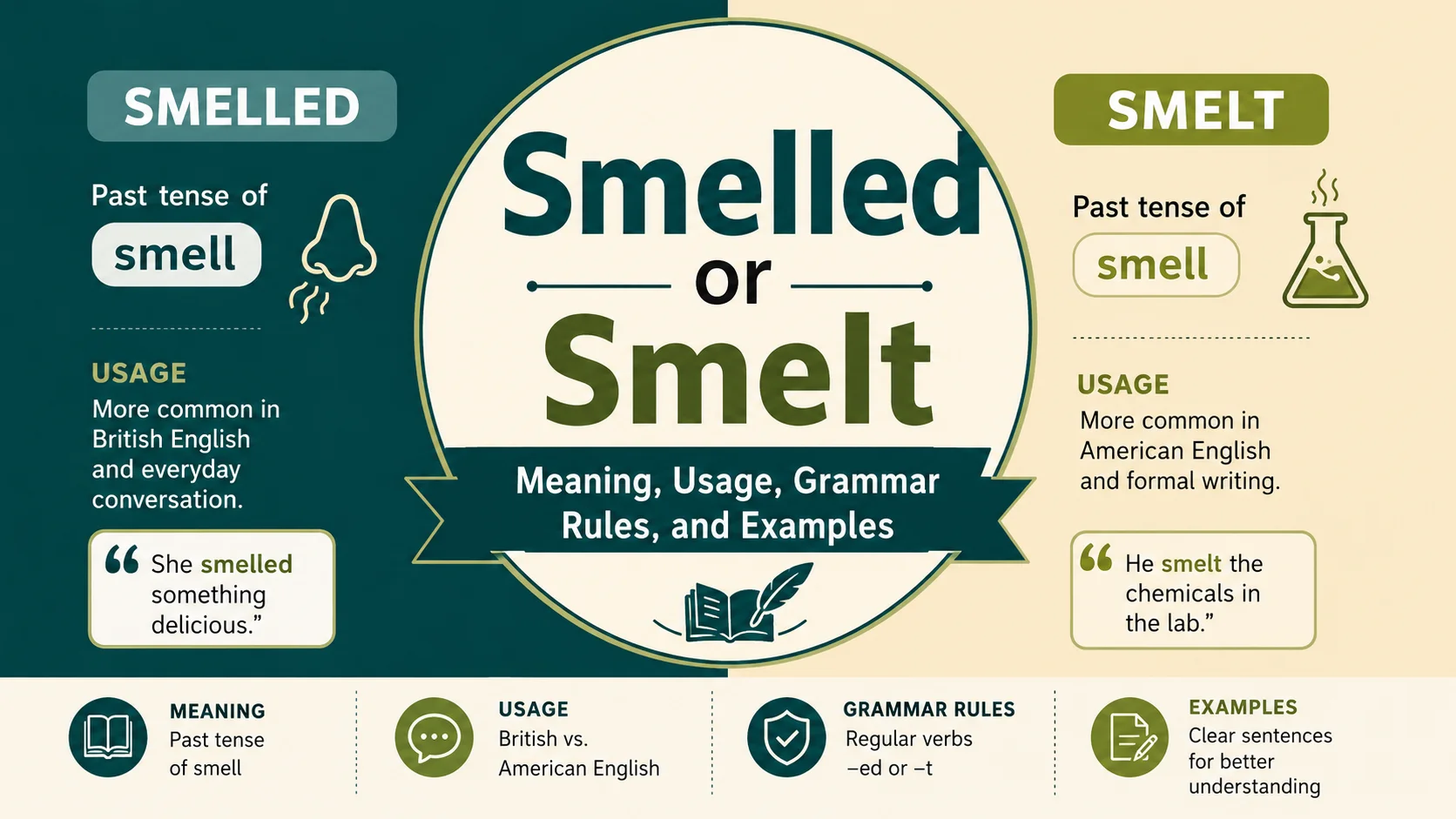
Smelled or Smelt can both be correct when you talk about noticing an odor, but the preferred form depends on the variety of English you use. In American English, smelled is the more common past tense form, while British English often uses smelt as well. For example, an American writer would naturally say, “I smelled something strange,” while a British speaker might say, “I smelt something strange.” Both forms have the same basic meaning, so the difference is mainly about regional usage, style, and what sounds natural to your audience.
The word smelt can also have a completely different meaning, which makes the context especially important. As a verb, to smelt means extracting metal from ore through an industrial process. This meaning has nothing to do with detecting an odor. Smelt can also refer to a small fish, so readers must look at the surrounding sentence to understand which meaning is intended. When you’re writing a formal document, technical report, email, or other professional material, choosing the correct form and meaning helps prevent confusion and makes your writing clearer.
For English language learners, the easiest approach is to remember the common usage trends without treating them as strict, isolated rules. Smelled is usually the safest choice for readers in the United States, while smelt is widely accepted in British English and other varieties. In my experience, checking the context, location, and expected audience is more useful than simply memorizing one form as universally correct. In everyday conversations, social media posts, and general writing, choose the form that matches your variety of English and keep your usage consistent.
Smelled or Smelt: Quick Answer
Smelled and smelt are both correct past-tense and past-participle forms of the verb smell.
The main difference is regional:
| Form | Main usage | Example |
| Smelled | Standard American English and also used in British English | She smelled the roses. |
| Smelt | Common in British English | She smelt the roses. |
| Smelt | A small fish | We caught several smelt. |
| Smelt | To extract metal from ore | The company smelted the ore. |
Major dictionaries recognize smelled as the regular form and smelt as a chiefly British alternative for the verb smell. Merriam-Webster specifically lists smelled and “chiefly British” smelt. Cambridge likewise gives smelled with smelt as a UK alternative.
So, if the goal is standard US English, choose smelled.
If you’re writing British English, smelt is perfectly natural.
What Does “Smelled” Mean?
Smelled is the past tense and past participle of smell. It describes an action or state connected with the sense of smell.
You can use it when someone detects an odor, notices a particular scent, or describes the odor something gives off.
For example:
- I smelled fresh bread when I entered the bakery.
- She smelled the perfume before buying it.
- The kitchen smelled wonderful after dinner.
- We smelled smoke coming from the garage.
- He smelled something strange in the refrigerator.
The word doesn’t necessarily describe a pleasant odor. It can refer to anything detectable through the nose.
The room smelled of fresh paint.
Here, smelled tells you what the room was like at a particular point in the past.
The verb can also have a figurative meaning. Someone can smell trouble, for example. That doesn’t mean the person literally detects an odor. Instead, the person senses that something is wrong or likely to go badly. Merriam-Webster includes this figurative use among the meanings of smell.
Examples of “Smelled” in Everyday English
Context determines what smelled means.
Food:
The soup smelled delicious after the spices were added.
Smoke:
They smelled smoke before they saw the fire.
Perfume:
She smelled the fragrance and immediately recognized the floral notes.
Unpleasant odor:
The garbage smelled terrible in the summer heat.
Figurative meaning:
The deal smelled suspicious from the beginning.
Notice how the final sentence doesn’t involve an actual scent. The speaker means that the situation seemed suspicious.
What Does “Smelt” Mean?
When smelt functions as a form of smell, it has essentially the same meaning as smelled.
For example:
The room smelt of fresh coffee.
The American-English version would normally be:
The room smelled of fresh coffee.
Nothing about the underlying event changes. Only the preferred verb form changes.
Cambridge lists smelled or UK also smelt for the verb smell, confirming that the two forms can function as alternatives when describing odor or the sense of smell.
Smelt in British English
British English has a long-established preference for smelt in many contexts.
Consider these sentences:
- I smelt something burning.
- The flowers smelt wonderful.
- She smelt smoke in the hallway.
- The old house smelt damp.
- He smelt the milk to see whether it was still fresh.
These sentences are grammatically normal in British English.
However, that doesn’t mean British English rejects smelled. The regular form also occurs in British usage. The important point is that smelt is especially associated with British English, while smelled is the safer default for American English.
Smelled vs. Smelt in American and British English
The difference between smelled and smelt is primarily one of usage rather than meaning.
American English generally favors the regular -ed form:
She smelled the flowers.
British English commonly allows the traditional irregular form:
She smelt the flowers.
Both sentences describe the same action.
Regional Preferences for Smelled and Smelt
| Situation | Preferred form |
| American English | smelled |
| British English | smelt or smelled |
| Formal US writing | smelled |
| British literary writing | smelt is common |
| International content aimed at US readers | smelled |
| Historical quotation | Preserve the original form |
Regional vocabulary differences aren’t errors. English has developed multiple accepted forms because it has evolved across different countries and communities.
The same principle appears with other words such as learned/learnt, burned/burnt, and dreamed/dreamt. Regional preferences can influence which form sounds most natural without changing the basic grammar.
Is “Smelt” Correct in American English?
Smelt can be understood as a past form of smell, but it isn’t the usual choice in standard American English.
For an American audience, smelled is the better choice.
For example:
US English:
I smelled something strange.
British English:
I smelt something strange.
Using smelt in an American context won’t necessarily prevent readers from understanding the sentence. It may simply sound British or less typical to them.
For professional American writing, consistency matters more than trying to force an unusual form.
Is “Smelled” Correct in British English?
Yes.
Smelled is grammatically correct in British English. The important distinction is that smelt is also widely established in British usage.
Therefore, this sentence isn’t grammatically wrong:
The kitchen smelled of garlic.
A British writer may instead choose:
The kitchen smelt of garlic.
The difference is mainly stylistic and regional.
Why Do “Smelled” and “Smelt” Both Exist?
The answer lies in the way English forms past-tense verbs.
Some verbs normally take -ed:
- walk → walked
- clean → cleaned
- smell → smelled
Others developed irregular past forms:
- sing → sang
- take → took
- write → wrote
- smell → smelt
The verb smell has retained both patterns in modern English.
Merriam-Webster records the basic pattern as smelled or chiefly British smelt, with smelling as the present participle.
“Smell” as a Regular Verb
The regular pattern is:
smell → smelled → smelled
For example:
- I smell smoke.
- I smelled smoke.
- I have smelled smoke before.
The past tense and past participle both use smelled.
This form is especially natural in American English.
“Smell” as an Irregular Verb
The alternative pattern is:
smell → smelt → smelt
For example:
- I smell smoke.
- I smelt smoke.
- I have smelt smoke before.
The second and third forms don’t use -ed.
That doesn’t make smelt incorrect. It simply reflects a different verb-form tradition.
Smelled or Smelt in Different Sentence Structures
The difference becomes easier to understand when you see the forms inside complete grammatical structures.
| Grammar structure | American English | British English |
| Simple present | I smell smoke. | I smell smoke. |
| Simple past | I smelled smoke. | I smelt smoke. |
| Present perfect | I have smelled smoke. | I have smelt smoke. |
| Past perfect | I had smelled smoke. | I had smelt smoke. |
| Third-person past | She smelled flowers. | She smelt flowers. |
The important point is that the difference doesn’t change the tense itself.
Compare:
She smelled the roses.
and:
She smelt the roses.
Both use the simple past.
Now compare:
She had smelled the roses.
with:
She had smelt the roses.
Both use the past participle after had.
This distinction matters because writers sometimes assume that smelt can only appear in the simple past. When smelt functions as the past participle of smell, it can also appear after have, has, or had.
Smelt Has Two Other Important Meanings
Here’s where things get more interesting.
Not every smelt refers to the past tense of smell. The word has independent dictionary entries for a fish and a metallurgical process.
Those meanings have nothing to do with whether someone detected an odor.
Smelt as a Small Fish
A smelt is a small fish belonging to the family Osmeridae.
Merriam-Webster describes smelts as small bony fish that resemble trout. They can live along coasts, move into rivers to spawn, or live in landlocked waters.
For example:
The fishermen caught several smelt near the shoreline.
Here, smelt is a noun.
It isn’t a verb.
You could also see the plural written as smelts or smelt, depending on the variety and context. Merriam-Webster records both plural forms.
The fish meaning can appear in:
- Fishing reports
- Seafood writing
- Biology
- Environmental science
- Wildlife conservation
- Regional food traditions
Smelt as a Fish vs. Smelt as a Verb
Compare these two sentences:
We caught a smelt in the lake.
We smelt smoke near the lake.
The first sentence uses smelt as a noun for a fish.
The second uses smelt as a past-tense verb meaning smelled.
Context does all the heavy lifting.
Smelt as a Metallurgy Term
Smelt also works as a technical verb in metallurgy.
In this sense, to smelt means to process ore, often using heat and chemical reactions, to separate or extract metal. Merriam-Webster defines the verb in terms of melting or fusing substances such as ore, often with a chemical change, usually to separate the metal.
For example:
The furnace was used to smelt iron ore.
The related forms are:
- smelt — base verb
- smelted — past tense and past participle
- smelting — present participle
- smelter — a facility or person involved in smelting
Notice something important here:
The past tense of the metallurgy verb is smelted, not smelt.
So:
The company smelted the ore.
is correct.
Not:
The company smelt the ore.
The second sentence could be interpreted as the past form of smell rather than the metallurgy verb.
Smelt vs. Melt: A Common Vocabulary Confusion
The words smelt and melt look similar because their meanings overlap in certain technical contexts. However, they aren’t interchangeable.
Melt generally means that a solid changes into a liquid because of heat.
Smelt refers to a metallurgical process used to extract or refine metal from ore.
For example:
The ice melted in the sun.
But:
The furnace smelted the ore.
The first describes a physical change.
The second describes a process used to obtain metal.
A useful way to remember it is:
Melt changes the state of a material. Smelt helps extract metal from ore.
Merriam-Webster traces the metallurgy sense of smelt to the sixteenth century and connects its etymology with words related to melting.
Smelled or Smelt: Examples by Context
Seeing the words in different situations makes the distinction much clearer.
Food and Cooking
American English:
The kitchen smelled like freshly baked bread.
British English:
The kitchen smelt of freshly baked bread.
Both describe the same sensory experience.
Smoke and Fire
She smelled smoke coming from the basement.
or:
She smelt smoke coming from the basement.
Again, the regional preference changes while the meaning stays intact.
Perfume
He smelled the perfume before purchasing it.
In British English:
He smelt the perfume before purchasing it.
Nature
The forest smelled fresh after the rain.
A British writer could naturally write:
The forest smelt fresh after the rain.
Figurative Use
Something about the proposal smelled wrong.
Here, smelled means seemed suspicious or questionable rather than producing an actual odor.
Merriam-Webster recognizes this figurative extension of smell, including expressions where something “smells” of a particular quality or appears suspicious.
Common Mistakes With Smelled and Smelt
Several errors appear when writers treat the two words as completely separate rules.
Assuming “Smelt” Is Wrong
It isn’t.
Smelt is a legitimate past form of smell, particularly associated with British English.
Assuming “Smelled” Is Wrong in British English
It isn’t wrong either.
British English uses smelt frequently, but smelled is also an accepted form.
Using “Smelt” as the Metallurgy Past Tense
This creates a different problem.
The metallurgy verb follows:
smelt → smelted → smelted
Therefore:
The workers smelted the copper ore.
is correct.
Confusing the Fish With the Verb
We caught three smelt.
Here, smelt means fish.
We smelt something burning.
Here, smelt means detected an odor.
The spelling is identical. The grammar and context reveal the meaning.
Confusing Smelt With Melt
The metal melted.
means the metal changed from solid to liquid.
The workers smelted the ore.
means they processed the ore to extract metal.
Those are related industrial concepts, but they aren’t the same action.
How to Choose Between Smelled and Smelt
Choosing the right form doesn’t need to be difficult.
Use this practical guide:
| If you are… | Best choice |
| Writing standard American English | smelled |
| Writing traditional British English | smelt is common |
| Writing for a US publication | smelled |
| Quoting British dialogue | Keep smelt if it reflects the original |
| Talking about a small fish | smelt |
| Talking about metal extraction | smelt as the base verb |
| Describing the past of metal extraction | smelted |
The safest rule for US English is simple:
When “smell” refers to an odor or the sense of smell, use “smelled” in standard American writing.
That choice sounds natural to American readers and avoids unnecessary regional variation.
Smelled or Smelt: Side-by-Side Examples
| Meaning | American English | British English |
| Detect an odor | I smelled smoke. | I smelt smoke. |
| Notice a fragrance | She smelled the roses. | She smelt the roses. |
| Describe an odor | The room smelled damp. | The room smelt damp. |
| Detect something suspicious | He smelled trouble. | He smelt trouble. |
| Past participle | We had smelled the gas. | We had smelt the gas. |
| Fish | We caught a smelt. | We caught a smelt. |
| Metal extraction | They smelt the ore. | They smelt the ore. |
| Metal extraction in the past | They smelted the ore. | They smelted the ore. |
The table reveals the key point: the same spelling can represent different words or grammatical functions.
A Practical Case Study: Choosing the Right Form
Imagine an American writer describing a camping trip.
The original sentence says:
We smelt smoke near the campsite.
The sentence is understandable. However, if the article follows standard American English, a more natural version would be:
We smelled smoke near the campsite.
Now imagine a British travel writer describing exactly the same event:
We smelt smoke near the campsite.
That version fits the writer’s regional variety.
Now change the context completely:
The factory smelted the ore to recover valuable metal.
Here, neither smelled nor smelt would work. The correct past form is smelted because the verb is the metallurgy term smelt.
This small example shows why context matters more than spelling alone.
Quick Memory Trick for Smelled vs. Smelt
A simple three-part rule can keep the forms straight:
Smelled = standard US past form of smell.
Smelt = common British past form of smell.
Smelt = also a fish or a metallurgy verb.
Then remember one additional detail:
Smelted = past tense of the metallurgy verb.
So:
I smelled smoke.
but:
I smelt smoke.
and:
The factory smelted the ore.
The first two sentences describe smell. The third describes metal processing.
Conclusion
Smelled and smelt are both correct past forms of smell when they describe detecting an odor. Smelled is more common in American English, while smelt is widely used in British English. However, remember that smelt can also mean extracting metal from ore or refer to a small fish. The right choice depends on context, audience, and the variety of English you’re using.
FAQs
Q1. Is smelled or smelt correct?
Both are correct when they are used as the past tense of smell to describe detecting an odor.
Q2. Is smelled more common in American English?
Yes. Smelled is the more common past tense form in American English.
Q3. Is smelt correct in British English?
Yes. Smelt is widely used in British English, although smelled is also accepted.
Q4. Does smelt have another meaning?
Yes. Smelt can mean extracting metal from ore through an industrial process. It can also refer to a small fish.
Q5. Should I use smelled or smelt in my writing?
Use the form that matches your variety of English and your audience. For American readers, smelled is usually the natural choice; for British readers, smelt may sound more natural.
About the Author