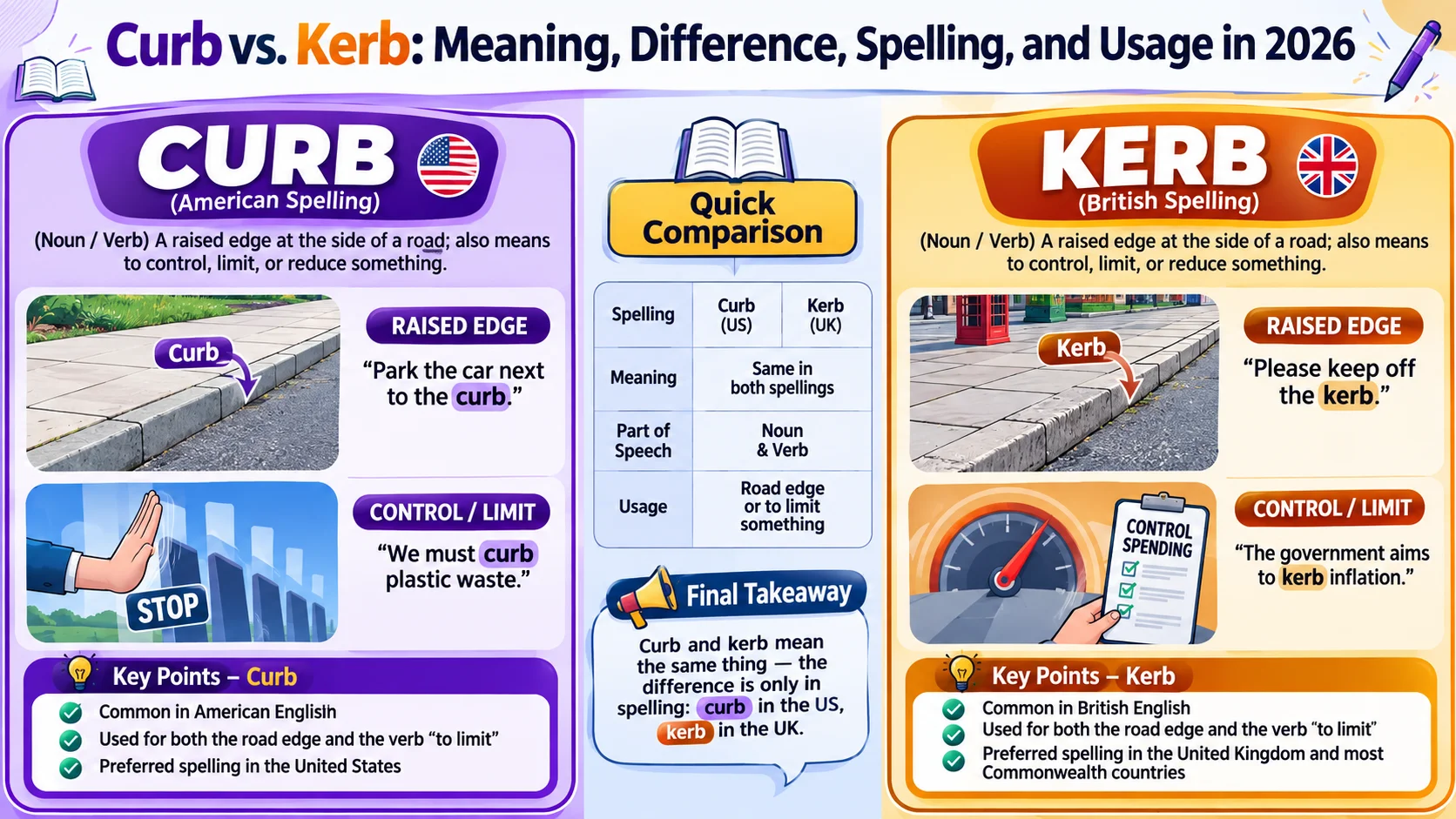
Curb vs. Kerb can be confusing, but the difference is simple: curb is standard in American English, while kerb is used in British English.Both words describe the raised edge beside a road that separates the street from the pavement or walkway.
In American English, curb is the usual standard spelling, while British English uses kerb. The pronunciation is essentially the same, so the main difference appears in writing. From my experience explaining this distinction, linking each spelling to its regional variety makes it much easier to remember.
There is one important extra point: curb can also be used as a verb meaning to control, restrict, or limit something, and as a noun it can refer to a restriction or limit. That meaning is always curb, not kerb. For the road-related meaning, both terms identify the same boundary between a road and a walkway, where pedestrians move alongside cars on a raised surface for safety. This small spelling issue often causes confusion, but it reflects how English has evolved and adapted across different continents and regions.
Quick Answer: Curb vs. Kerb
The easiest rule is this:
- Curb = American English spelling for the raised edge beside a road.
- Kerb = British English spelling for the same road feature.
- Curb = also means to control, limit, or restrain.
- Kerb isn’t the standard British replacement for the verb curb when it means “control.”
- Both forms are generally pronounced the same.
| Feature | Curb | Kerb |
| American English | Standard | Not standard |
| British English | Not used for the road-edge meaning | Standard |
| Raised edge beside a road | Yes | Yes |
| Meaning “control or limit” | Yes | No |
| Verb meaning “restrain” | Yes | No |
| Pronunciation | Generally /kɝːb/ in American English | Generally /kɜːb/ in British English |
| Example | “She stood at the curb.” | “She stood at the kerb.” |
The key point is simple: curb and kerb refer to the same roadside feature, but the spelling depends on the variety of English.
What Does Curb Mean?
Curb has several related uses, and context tells you which meaning applies. The most familiar meanings involve either a road edge or an act of control.
Curb as a Noun
In American English, a curb is the raised edge along the side of a street. It commonly separates the roadway from the sidewalk.
For example:
- “The taxi stopped at the curb.”
- “She waited at the curb before crossing.”
- “The delivery driver parked near the curb.”
- “Water flowed along the curb after the storm.”
A curb isn’t simply the entire sidewalk. It refers specifically to the raised boundary at the edge of the roadway.
Think of it as the thin dividing line between street space and pedestrian space.
Curb as a Verb
The verb curb means to control, restrain, or limit something, particularly something undesirable.
For example:
- The city introduced new rules to curb pollution.
- She tried to curb her spending.
- The campaign aims to curb crime.
- He needs to curb his temper.
- New measures could curb inflation.
This meaning has nothing to do with the spelling kerb. Even British English uses curb as the verb meaning “control or limit.”
That distinction matters because a sentence such as “The government wants to curb inflation” doesn’t suddenly become “The government wants to kerb inflation” in British English.
Curb as a Noun Meaning a Limit
Curb can also work as a noun meaning a restriction or limit.
For example:
The government placed a curb on spending.
Here, curb doesn’t describe a piece of concrete beside a road. It describes a measure designed to limit something.
Other examples include:
- a curb on advertising
- a curb on spending
- a curb on imports
- a curb on excessive development
This meaning often appears in news reports, business writing, government discussions, and formal conversations.
For example:
Rising prices prompted the company to place a curb on unnecessary spending.
The word suggests deliberate restraint. Something is being held back rather than completely stopped.
What Does Kerb Mean?
Kerb is the standard British English spelling for the raised edge beside a road.
For example:
- “The car stopped at the kerb.”
- “She stepped off the kerb.”
- “The bus mounted the kerb.”
- “He parked close to the kerb.”
If you’re writing for readers in the United Kingdom, kerb is the natural choice when referring to the edge of a road.
The word is also common in other varieties of English that follow British spelling conventions.
Is Kerb a Verb?
This is where the distinction gets interesting.
The everyday verb meaning “to control or limit” is spelled curb, including in British English.
You should write:
The new law aims to curb pollution.
Not:
The new law aims to kerb pollution.
The word kerb primarily serves as the British noun for the road feature. When the meaning involves restraint, limitation, or control, curb is the correct form.
Curb vs. Kerb: The Main Difference
The central difference is regional spelling, not a different physical object.
If an American says curb and a British speaker says kerb, they’re generally referring to the same raised edge beside a road.
The important difference appears when curb takes on its figurative meaning.
| Meaning | American English | British English |
| Raised edge beside a road | curb | kerb |
| Control or limit something | curb | curb |
| A restriction or limit | curb | curb |
| Roadside appearance | curb appeal | kerb appeal |
This makes the rule easier than it first appears. The road-related noun changes spelling. The control-related meanings don’t.
Curb vs. Kerb Examples
Seeing the words in context makes the distinction much easier to remember.
American English Examples
American writers use curb for the road edge:
- “The driver pulled over to the curb.”
- “A cyclist stopped beside the curb.”
- “The children waited at the curb.”
- “The city repaired several damaged curbs.”
- “Don’t park too close to the curb.”
American English also uses curb when the word means control:
- “The government wants to curb inflation.”
- “Try to curb your spending.”
- “The policy could curb pollution.”
British English Examples
British writers use kerb for the road edge:
- “The driver pulled over to the kerb.”
- “She stood at the kerb.”
- “The car was parked beside the kerb.”
- “The council repaired several damaged kerbs.”
- “He stepped off the kerb carefully.”
However, British English still uses curb when the meaning is “control”:
- “The government wants to curb inflation.”
- “The campaign aims to curb pollution.”
- “He struggled to curb his anger.”
That last group is the key point many learners miss.
Curb vs. Kerb in American and British English
Regional spelling differences appear throughout English. Curb and kerb belong to the same family of differences as color and colour, center and centre, and traveler and traveller.
Neither curb nor kerb is automatically wrong. The right spelling depends on the variety of English you’re using.
If You’re Writing American English
Use:
- curb
- curb appeal
- curbside
- curbs
- curbing
If You’re Writing British English
Use:
- kerb
- kerb appeal
- kerbside
- kerbs
- kerbing
But retain curb for the verb meaning control or limit.
This consistency matters in professional writing. If an article follows American English throughout, suddenly switching from curb to kerb for a road feature can make the text look inconsistent.
Curb Appeal vs. Kerb Appeal
One of the most recognizable examples is curb appeal.
Curb appeal refers to how attractive a property looks from the street. Realtors, homeowners, architects, and property websites commonly use the phrase when discussing a home’s exterior appearance.
For example:
The fresh landscaping gave the house excellent curb appeal.
British English typically writes the same expression as:
The fresh landscaping gave the house excellent kerb appeal.
The meaning doesn’t change. Only the regional spelling does.
Examples of Curb Appeal
In American English, you might read:
- “New landscaping improved the home’s curb appeal.”
- “A fresh coat of paint can boost curb appeal.”
- “The house has strong curb appeal.”
In British English:
- “The new garden improved the property’s kerb appeal.”
- “The owners wanted to increase its kerb appeal.”
This example shows how the spelling difference extends into compound expressions, not just the standalone noun.
Curbside vs. Kerbside
The same regional pattern appears in curbside and kerbside.
In American English, curbside is common in expressions such as:
- curbside pickup
- curbside service
- curbside parking
- curbside delivery
For example:
The store offers curbside pickup for online orders.
British English commonly uses kerbside:
- kerbside collection
- kerbside parking
- kerbside delivery
The underlying idea remains the same. The spelling follows the regional variety of English.
Curb vs. Kerb Pronunciation
Despite their different spellings, curb and kerb generally sound the same within the relevant English varieties.
The exact vowel sound can vary according to the speaker’s accent. American English commonly uses a rhotic vowel sound, while British pronunciation typically uses a non-rhotic vowel.
The spelling difference doesn’t create a major pronunciation difference between the two words.
That means you usually can’t tell whether someone intends curb or kerb simply by hearing the word. Context does the heavy lifting.
For example, if someone says:
“The car stopped at the ___.”
You need the speaker’s regional English or the written context to know whether the expected spelling is curb or kerb.
Curb vs. Kerb Word Origin
The history of these words explains part of their close relationship.
Curb traces back to older forms connected with the idea of bending. Its history includes the Old French courber, meaning “bend” or “bow,” along with Latin roots associated with something bent or curved.
The modern road-related sense developed from the idea of a raised border or frame.
Kerb developed as a variant spelling and became established in British English.
So these aren’t two unrelated words that simply happen to describe similar things. They’re historically connected forms that developed different spelling conventions in different varieties of English.
Common Curb vs. Kerb Mistakes
A few errors appear repeatedly when writers aren’t sure which form to choose.
Using Kerb in American English
If you’re writing standard American English, use curb for the roadside feature.
Incorrect for standard US usage:
She waited at the kerb.
Better:
She waited at the curb.
Using Kerb for the Meaning “Control”
This is an even more important distinction.
Incorrect:
The government wants to kerb inflation.
Correct:
The government wants to curb inflation.
The verb curb means to limit or control something, and that spelling remains standard in both American and British English.
Mixing Regional Spellings
A document can become distracting when it mixes American and British spellings without a reason.
For example, an article written entirely in American English should normally use curb appeal, not switch to kerb appeal halfway through.
Choose your variety first. Then stay consistent.
Easy Trick to Remember Curb vs. Kerb
Here’s the simplest memory trick:
US → CURB
UK → KERB
For the physical road feature:
American English → CURB → road edge
British English → KERB → road edge
For the meaning control or limit:
American English → CURB
British English → CURB
A second trick can help with phrases. If you’re writing curb appeal for an American audience, think curb = US property language. If you’re writing for a British audience, kerb appeal fits the local spelling.
Curb vs. Kerb: Quick Comparison
| Question | Answer |
| Is curb correct? | Yes. It’s the standard US spelling for the road edge. |
| Is kerb correct? | Yes. It’s the standard UK spelling for the road edge. |
| Do they describe the same road feature? | Yes. |
| Do they usually sound the same? | Yes, within their respective accents. |
| Can curb be a verb? | Yes. It means to control, limit, or restrain. |
| Does British English use kerb for “control”? | No. The verb remains curb. |
| Is curb appeal American? | Yes. |
| Is kerb appeal British? | Yes. |
| Should you mix the spellings? | No. Match the spelling to your chosen variety of English. |
Conclusion
Understanding Curb vs. Kerb is easy once you remember the regional difference. Curb is the standard spelling in American English, while kerb is preferred in British English when referring to the raised edge beside a road. The word curb also has separate meanings related to controlling or limiting something, and those meanings do not change to kerb. Knowing this small spelling difference can help you write more accurately for different English-speaking audiences.
FAQs
Q1. What is the difference between curb and kerb?
Curb is the American English spelling, while kerb is the British English spelling for the raised edge beside a road.
Q2. Is curb American or British English?
Curb is the standard spelling in American English.
Q3. Is kerb British English?
Yes, kerb is the standard British English spelling when referring to the raised edge between a road and pavement.
Q4. Do curb and kerb sound the same?
Yes. Curb and kerb generally have the same pronunciation; the main difference is their spelling.
Q5. Can curb have another meaning?
Yes. As a verb, curb means to control, restrict, or limit something. This meaning is spelled curb in both American and British English.
About the Author