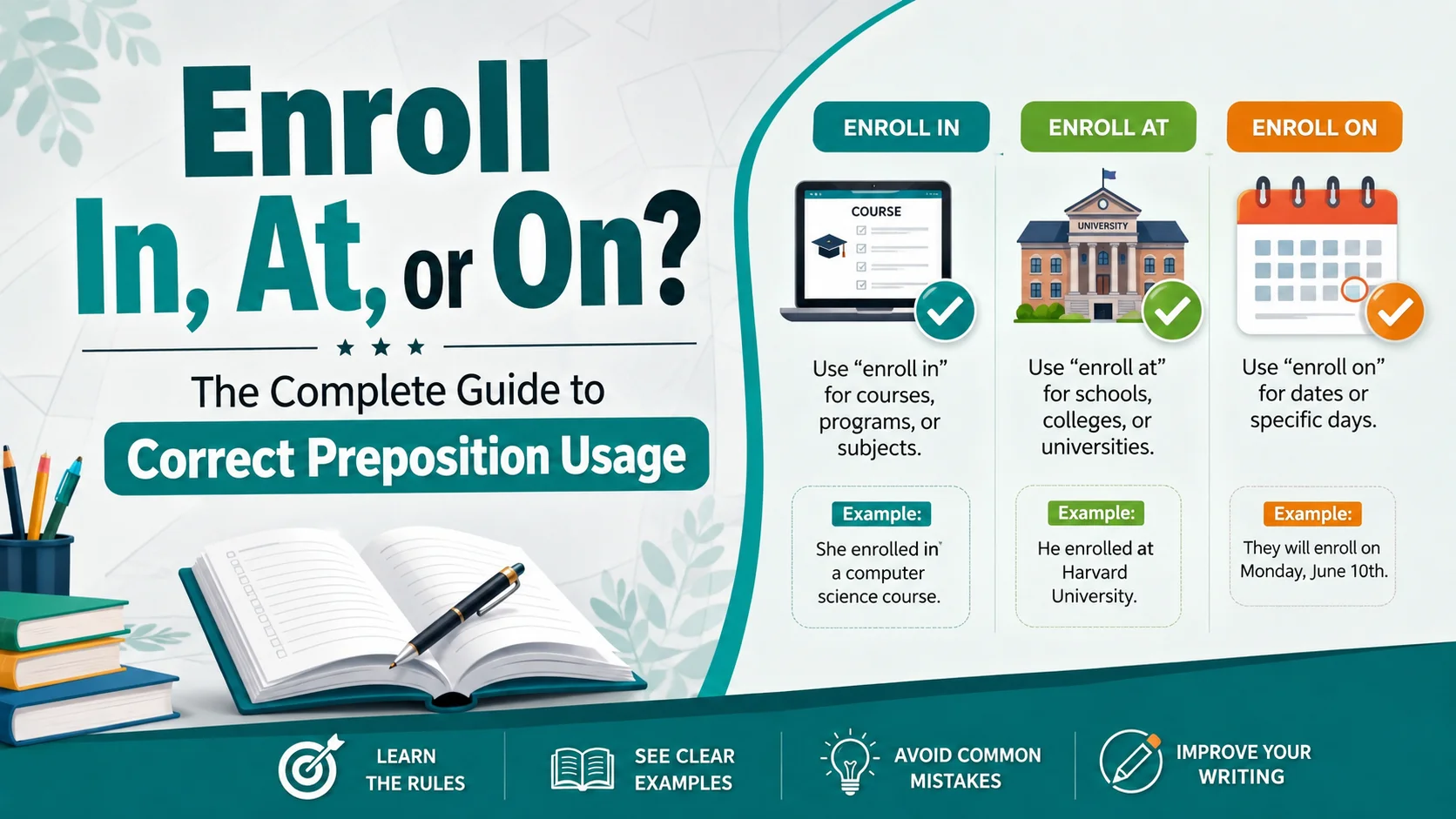
When English grammar feels confusing, prepositions can make a small difference with a big punch, especially with enroll in, enroll at, and enroll on. The main grammar issue is knowing which preposition matches the situation. As a basic rule, use enroll in for a course, class, subject, or program, and use enroll at for a school, college, university, or institution. For example, you can say, “I enrolled in an English class,” or “I enrolled at Harvard University.” In British English, enroll on is commonly used when referring to a course. These varieties of English give the language some regional flavor, which can make the choice feel like a moving target.
To understand the meaning and emphasis, think about what you are joining. Enroll and sign up have similar meanings, but the preposition describes the angle of your sentence. When enrolling in something specific, use in, such as “She enrolled in an online course.” When you mean the place where you study, use at, such as “He enrolled at a specific school.” With online courses, an online learning platform, or different platforms, on may be used, particularly in British English. The right one becomes easier to identify when you consider the actions and locations in the sentence. This simple approach makes a tricky word choice clearer and supports clear communication when discussing complex ideas.
The correct preposition follows the context, so don’t treat these words as interchangeable every time. The commonly used forms may differ between American English and British English, but a few simple rules can reduce confusion. Enrolling in a course, class, subject, or program generally takes place, while enrolling at a school, college, university, or institution focuses on the location. On is typically used with courses in British usage. Once this choice is considered from the right angle, it becomes easier to use, understand, and head toward the right preposition with greater ease. When referring to learning options, remembering this preference can make everyday English much more natural.
Quick Answer: Enroll In, At, or On?
If you’re writing in American English, use these patterns as your main guide:
| Expression | Usually Used For | Example |
| Enroll in | Courses, classes, programs, subjects, and activities | I enrolled in an English course. |
| Enroll at | Schools, colleges, universities, and institutions | She enrolled at the university. |
| Enroll on | Courses and programs, especially in British English | He enrolled on a training course. |
| Enroll with | An organization or provider | They enrolled with the training provider. |
| Enroll as | A role or status | She enrolled as a full-time student. |
| Enroll for | Some regional or specific contexts | They enrolled for the course. |
The easiest American English rule to remember is:
Enroll in the thing you join. Enroll at the institution you attend.
For example:
- I enrolled in a nursing program.
- I enrolled at State University.
- I enrolled in a nursing program at State University.
That final example shows why these prepositions aren’t really competing with one another. Each one can describe a different part of the enrollment.
Understanding the Verb “Enroll” in American English
The verb enroll means to officially enter someone’s name on a list or register someone as a participant, member, or student.
Today, the word commonly appears in education:
- Students enroll in courses.
- Parents enroll their children in schools.
- Adults enroll in training programs.
- Students enroll at universities.
- Organizations enroll employees in professional programs.
You can also use enroll without a preposition when someone or something performs the enrollment.
For example:
The university enrolled 2,000 new students this year.
Here, the university performs the action.
Now compare it with:
The students enrolled in the program.
In this sentence, the students join the program themselves.
That difference helps explain why prepositions become important when you talk about what someone joins or where they join it.
When to Use “Enroll In”
Enroll in is the most common choice in American English when you name the course, class, program, subject, or activity that someone joins.
Think of in as connecting the person with the educational activity.
Enroll In a Course, Class, or Program
Use enroll in with things such as:
- a course
- a class
- a degree program
- a training program
- a certification program
- a subject
- an online course
- a workshop
- a language course
- a summer program
For example:
- I enrolled in an advanced grammar course.
- Sarah enrolled in a biology class.
- They enrolled in an online marketing program.
- He enrolled in a professional training course.
- We enrolled in the summer program.
These sentences all describe the educational activity the person has joined.
Real-World Examples of “Enroll In”
The expression appears in many everyday situations.
Education:
Maya enrolled in a biology course before the semester began.
Professional training:
The company encouraged its employees to enroll in a leadership program.
Online learning:
Thousands of students enrolled in the online course.
Family decisions:
Her parents enrolled her in a language class.
Community education:
Local residents can enroll in the weekend workshop.
Notice how the noun following in identifies the actual course, class, or program.
Why “Enroll In” Is So Common
The preposition in often suggests participation within something.
When you say:
She enrolled in a nursing program.
you’re focusing on the program she joined.
You’re not primarily talking about the physical location. You’re identifying the educational experience in which she will participate.
That’s why enroll in work naturally with courses and programs.
“Enroll At” for Institutions
Use enroll at when the noun identifies the institution where someone becomes a student.
Common examples include:
- school
- college
- university
- academy
- institute
- educational center
- training institution
For example:
- She enrolled at Stanford University.
- He enrolled at a community college.
- They enrolled at the academy last fall.
- My brother enrolled at a local high school.
Here, it focuses on the institution.
“Enroll At” vs. “Enroll In”
Consider these two sentences:
Alex enrolled at State University.
The focus is the university.
Now look at:
Alex enrolled in the engineering program.
The focus is the program.
You can combine both ideas:
Alex enrolled in the engineering program at State University.
That’s often the clearest sentence because in and at perform different jobs.
| Sentence | Main Focus |
| She enrolled in the nursing program. | The program |
| She enrolled at the university. | The institution |
| She enrolled in the nursing program at the university. | Both |
Enroll In College vs. Enroll At a College
This distinction can cause confusion because college can describe education generally or a specific institution.
Consider:
She plans to enroll in college after high school.
Here, college refers broadly to entering higher education.
Now compare:
She enrolled at a college in California.
This sentence points to a particular institution.
A useful guideline is:
- General higher education → enroll in college
- Specific institution → enroll at a college
Context can affect the choice, so this isn’t an absolute rule. Still, it’s a reliable starting point for American English.
Is “Enroll On” Correct?
Yes, but regional English makes a difference.
In British English, enrol on a course is a normal construction. American English generally uses enroll in a course instead.
For example:
British English:
She enrolled on a professional training course.
American English:
She enrolled in a professional training course.
Neither sentence needs to be treated as universally wrong. They reflect different regional conventions.
“Enroll On” in British English
British speakers commonly use enrol on when talking about courses and training.
You may encounter sentences such as:
He enrolled in a computer course.
She enrolled on a teacher-training program.
They enrolled in an evening class.
American readers will usually expect enroll in instead.
When “Enroll On” Sounds Unnatural in American English
If your audience is primarily American, enroll in is the safer choice for courses.
For example:
Less natural in US English:
I enrolled in an English course.
Natural in US English:
I enrolled in an English course.
The second version fits standard American usage more comfortably.
Enroll In, At, or On: A Clear Comparison
| Preposition | Main Use | Example |
| In | Course, class, program, subject, or activity | She enrolled in a chemistry course. |
| At | School, college, university, or institution | He enrolled at the university. |
| On | Course or training program, especially British English | She enrolled on a training course. |
| With | Provider or organization | They enrolled with the training company. |
| As | Role or status | He enrolled as a full-time student. |
| For | Certain regional or context-specific uses | She enrolled for the program. |
The important point is that these prepositions aren’t perfect substitutes for each other.
The noun and intended meaning should guide your choice.
Other Prepositions Used With “Enroll”
Although in and at handle most American English situations, other prepositions can appear with enroll.
They usually express a different relationship.
“Enroll For” and Its Specific Uses
Enroll for appears in some varieties of English and particular contexts. However, American English usually favors enroll in when talking about joining a course or program.
Compare:
I enrolled in the photography course.
with:
I registered for the photography course.
The second sentence is especially natural when the focus is on completing the registration process.
That’s why register for often works better than enroll for in American English.
“Enroll With” and the Organization Providing the Program
Enroll with can identify the organization or provider through which someone registers.
For example:
The company enrolled with a professional training provider.
Here, with points toward the organization involved in the enrollment.
You can also combine different prepositions:
She enrolled in an accounting course with an online training provider.
The course is what she joins. The provider is the organization delivering or administering it.
“Enroll As” and a Person’s Role
Use enroll as when you want to describe someone’s status or role.
Examples include:
- enroll as a full-time student
- enroll as a part-time student
- enroll as a graduate student
- enroll as a new member
For example:
He enrolled as a full-time student.
The preposition as answers a different question from in or at.
- In what? A degree program.
- Where? A university.
- As what? A full-time student.
That simple question-and-answer method can make the grammar much easier.
Enroll vs. Register vs. Sign Up
These three verbs often overlap. Still, they aren’t identical in tone or emphasis.
Enroll usually suggests officially becoming a participant, student, or member.
Register often focuses on recording your name or completing an administrative process.
Sign up is more casual and conversational.
| Verb | Typical Tone | Example |
| Enroll | Formal or neutral | I enrolled in the program. |
| Register | Neutral or formal | I registered for the class. |
| Sign up | Informal | I signed up for the workshop. |
Imagine someone talking about the same course in three different ways:
I enrolled in the course.
This sounds official.
I registered for the course.
This emphasizes registration.
I signed up for the course.
This sounds relaxed and conversational.
All three can work. The best choice depends on what you want to emphasize.
How to Use “Enroll” Correctly in Sentences
A few basic patterns cover most situations.
Enroll In + Course or Program
Pattern:
Subject + enroll + in + course/program
Examples:
- She enrolled in a history class.
- We enrolled in the certificate program.
- They enrolled in an online course.
- I enrolled in a writing workshop.
Enroll At + Institution
Pattern:
Subject + enroll + at + institution
Examples:
- He enrolled at the university.
- Sarah enrolled at the academy.
- They enrolled at a local college.
- My daughter enrolled at the school.
Enroll As + Status
Pattern:
Subject + enroll + as + role/status
Examples:
- She enrolled as a full-time student.
- He enrolled as a graduate student.
- They enrolled as part-time learners.
Enroll With + Organization
Pattern:
Subject + enroll + with + provider/organization
Example:
- The company enrolled with the training provider.
These patterns aren’t strict mathematical formulas. They’re practical guides that help you choose a natural preposition.
Enroll In vs. Enroll At: A Practical Case Study
Consider a student named Jordan.
Jordan has selected a university and a degree program.
You could write:
Jordan enrolled at Western State University.
This tells readers where Jordan became a student.
Now consider:
Jordan enrolled in the university’s computer science program.
This tells readers what Jordan joined.
Combine the two:
Jordan enrolled in the computer science program at Western State University.
Now the sentence gives both pieces of information.
This is the key lesson: in and at aren’t necessarily competing choices. They often describe different relationships.
Common Mistakes With “Enroll”
“I Enrolled at a Course”
A course isn’t an institution. Therefore, at doesn’t normally fit here.
❌ I enrolled at a course.
✅ I enrolled in a course.
“She Enrolled in Harvard”
When Harvard refers to the university itself, at is generally more natural.
✅ She enrolled at Harvard.
But if you name a specific program:
✅ She enrolled in Harvard’s law program.
The noun after the preposition changes the construction.
“He Enrolled on a Class” in American English
American English normally prefers:
He enrolled in a class.
British English can use enrol on with courses and training.
So don’t confuse regional variation with grammatical error.
Treating Every Preposition as Interchangeable
You shouldn’t randomly replace in with at or on.
For example:
She enrolled in a master’s program at the university.
Both prepositions are correct because they connect different ideas.
In identifies the program.
At identifies the institution.
A Five-Second Trick for Choosing the Right Preposition
When you’re unsure, look at the noun after the preposition.
Ask yourself one simple question:
What is the person joining?
If the answer is a course, class, program, subject, or activity, use in.
enroll in a course
If the answer is a school, college, university, or institution, use at.
enroll at a university
If you’re writing British English and talking about a course, on may be appropriate.
enrol on a course
If you’re describing someone’s role or status, use as.
enroll as a full-time student
If you’re identifying the organization involved, with may work.
enroll with the provider
This quick check handles most everyday cases.
Conclusion
Understanding enroll in, enroll at, and enroll on becomes easier when you focus on what follows the verb. Use enroll in for a course, class, subject, or program. Use enroll at when talking about a school, college, university, or institution. In British English, enroll on is commonly used for courses. Learning these simple rules can reduce confusion and help you choose the right preposition with confidence.
FAQs
Q1. What does “enroll in” mean?
Enroll in means to officially join a course, class, subject, or program.
Q2. When should I use “enroll at”?
Use enroll at when you are talking about the school, college, university, or institution where you study.
Q3. Is “enroll on” grammatically correct?
Yes. Enroll on is grammatically correct and is especially common in British English when talking about a course.
Q4. Is “enroll in” or “enroll on” more common in American English?
Enroll in is the standard and more commonly used form in American English.
Q5. Can I say “enroll in a class”?
Yes. Enroll in a class is a natural and commonly used expression.
Q6. Can I say “enroll at Harvard University”?
Yes. Enroll at Harvard University correctly focuses on the institution where someone studies.
Q7. What preposition should I use with an online course?
Enroll in an online course is standard in American English. Enroll on an online course is also common in British English.
Q8. What is the difference between “enroll” and “sign up”?
Both can mean joining something officially. Enroll often sounds more formal, while sign up is more casual.
Q9. How can I remember these prepositions?
Think of in as joining a learning activity and as identifying the institution. For British English courses, remember.
Q10. Are “enroll in,” “enroll at,” and “enroll on” interchangeable?
No. Their use depends on the context, the thing being joined, and sometimes the variety of English being used.
About the Author