
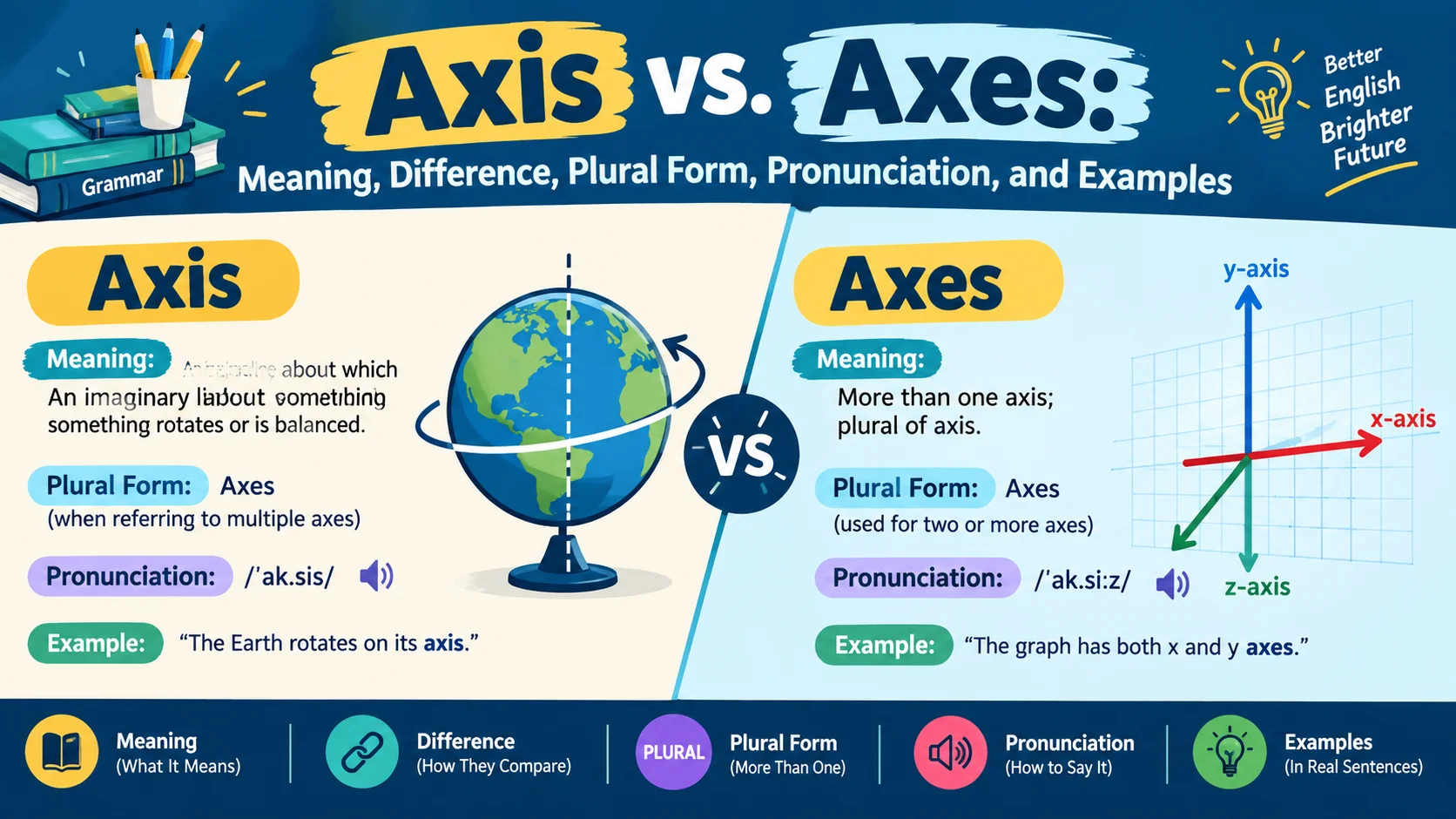
Axis vs. Axes can cause confusing moments because these words have different meanings but a similar sound and same spelling in some forms. An axis is a single line, usually an imaginary line through an object that rotates, or a central line used as a reference line in a graph. In mathematics, science, astronomy, and anatomy, an axis helps explain the structure, rotation, or central principle of something. The plural form is axes, meaning two or more lines. Understanding this basic difference makes the words easier to use correctly and improves clear communication in English.
The word axes has another meaning because it can also be the plural form of ax or axe, a tool with a heavy bladed head used for cutting wood. This creates a common pair with distinct definitions, so the context is important when describing what a word means. A simple way to remember the difference is to check the number of things being discussed: one reference or imaginary line is an axis, several are axes, while several cutting tools are also axes. This small wrinkle explains why the words can create surprising confusion in everyday writing, especially when the surrounding words do not immediately make the meaning clear.
The key to distinguishing these terms is to focus on their uses, definitions, and contextually relevant meaning. Axis is singularly connected with a line, while axes can refer to multiple lines or multiple cutting tools. The standard plural, plural form, and organization of a sentence can help readers understand the intended meaning. When comparing axis, axes, ax, and axe, it is useful to remember that they may describe completely different things, even when they appear closely related. This approach helps break down the word, its meanings, and its use without unnecessary confusion.
Axis vs. Axes: Quick Answer
Axis is the singular form. Axes is the standard plural form when you’re talking about more than one axis.
| Word | Number | Meaning | Example |
| axis | Singular | One central or reference line | The Earth rotates on its axis. |
| axes | Plural | Two or more axes | The graph has two axes. |
| ax/axe | Singular | A cutting tool | He picked up an axe. |
| axes | Plural | Two or more cutting tools | The workers carried several axes. |
There’s another important detail: axes has two different meanings because it can represent the plural of two different words.
- axis → axes = multiple reference or central lines
- ax/axe → axes = multiple cutting tools
The pronunciation can also change depending on the meaning. The plural of axis is commonly pronounced “AK-seez,” while the plural of ax or axe is pronounced “AK-siz.”
What Does Axis Mean?
Axis is a singular noun that generally refers to a central line, reference line, or line around which something rotates or is arranged.
The idea becomes easier if you picture a spinning wheel. Imagine pushing a pencil through the center of a toy wheel. The wheel spins around that central line. That imaginary line represents an axis.
The word has several established uses in mathematics, geometry, science, astronomy, anatomy, and general descriptions of central lines or structures.
Axis in Mathematics and Geometry
In mathematics, axis often refers to one of the reference lines used to locate points on a graph.
A standard two-dimensional coordinate plane contains two main axes:
- x-axis — usually the horizontal reference line
- y-axis — usually the vertical reference line
The point where these two axes meet is called the origin.
For example:
The point lies on the x-axis.
Here, axis is correct because the sentence identifies one specific reference line.
If you discuss both lines, the plural becomes necessary:
The graph contains two coordinate axes.
That small change from axis to axes reflects a change from one reference line to multiple reference lines.
Axis in Three-Dimensional Geometry
Three-dimensional coordinate systems add another reference line:
- x-axis
- y-axis
- z-axis
Together, these are called the coordinate axes.
For example:
The object is positioned along the x-, y-, and z-axes.
Notice the plural. You’re referring to several reference lines rather than one.
Three-dimensional geometry relies on these axes to describe positions within space. A point can be identified by three coordinates, such as (2, 4, 6), where each value corresponds to a particular axis.
Axis in Science and Astronomy
The word axis also plays an important role in science.
The Earth’s axis is an imaginary line extending through the planet from the North Pole toward the South Pole. Earth rotates around this axis.
You might write:
Earth rotates around its axis.
If you’re comparing several planets, however, you may need the plural:
Scientists studied the rotational axes of several planets.
The underlying rule doesn’t change. One is axis. More than one is axes.
Axis as a Line of Symmetry
An axis doesn’t always describe rotation.
In geometry, an axis of symmetry is a line that divides a shape into matching or symmetrical parts.
For example:
The vertical line is an axis of symmetry.
If a shape has several such lines, you can say:
The figure has multiple axes of symmetry.
A circle provides a useful example. Because every diameter can function as a line of symmetry, a circle has infinitely many axes of symmetry.
What Does Axes Mean?
Axes has two major noun meanings.
First, it’s the plural of axis. Second, it’s the plural of ax or axe.
That coincidence creates most of the confusion.
Axes as the Plural of Axis
When axes means more than one axis, it refers to multiple central, reference, rotational, or symmetry lines.
For example:
- The graph has two axes.
- The model rotates around several axes.
- The shape has three axes of symmetry.
- The coordinates are measured along different axes.
- Researchers compared the rotational axes of the machines.
In mathematics, you’ll encounter axes constantly because graphs commonly contain more than one reference line.
Axes as the Plural of Ax or Axe
Now comes the curveball.
Ax and axe are two spellings for the same cutting tool. Their plural is axes.
For example:
The lumberjacks carried several axes.
Here, axes doesn’t mean mathematical lines. It means multiple cutting tools.
The surrounding words make the meaning obvious. A sentence about graphs, coordinates, or symmetry points toward axes as the plural of axis. A sentence about wood, tools, chopping, or firefighters points toward axes as the plural of axe.
For example:
The workers sharpened their axes before cutting the fallen trees.
The context clearly indicates cutting tools.
Axis vs. Axes Pronunciation
Spelling alone doesn’t tell the entire story.
The singular axis is pronounced roughly like “AK-sis.”
The plural axes, when it means more than one axis, is pronounced roughly like “AK-seez.”
When axes means more than one ax or axe, the pronunciation changes to roughly “AK-siz.”
| Word | Meaning | Approximate Pronunciation |
| axis | One central/reference line | AK-sis |
| axes | More than one axis | AK-seez |
| axes | More than one ax/axe | AK-siz |
This is one of those cases where English spelling gives you only half the story. Context and pronunciation finish the job.
If you’re speaking about a graph, saying “AK-seez” makes sense when referring to multiple axes. If you’re talking about chopping wood, “AK-siz” is the appropriate pronunciation.
Why Is the Plural of Axis Axes?
You might naturally expect axis + es = axises.
English, however, has inherited several plural patterns that don’t follow the ordinary “add -s” rule. Words ending in -is often change their endings when they form their plural.
Consider these examples:
| Singular | Plural |
| axis | axes |
| analysis | analyses |
| crisis | crises |
| hypothesis | hypotheses |
| thesis | theses |
| diagnosis | diagnoses |
These plural forms have historical roots in Latin and Greek. You don’t need to memorize the ancient language behind the pattern to use them correctly.
The practical rule is enough:
One axis. Two or more axes.
This pattern becomes easier to remember once you connect axis with words such as analysis, crisis, and hypothesis. Their endings change rather than simply taking a regular plural -s.
Axis vs. Axes in Mathematics
Mathematics provides some of the clearest examples of the difference.
A coordinate graph uses reference lines to identify the position of points. In a basic two-dimensional graph, the horizontal line is the x-axis, while the vertical line is the y-axis.
When you refer to both, use axes.
Singular Examples
- The point crosses the x-axis.
- The y-axis shows the measured value.
- The line intersects the x-axis at zero.
- The graph uses a horizontal axis.
- The curve touches the y-axis at one point.
Plural Examples
- The graph contains two axes.
- Label both axes before plotting the data.
- The values are shown along the x- and y-axes.
- The two axes intersect at the origin.
- The coordinate system contains three axes.
The distinction is straightforward: one reference line is an axis, while multiple reference lines are axes.
A Simple Graph Example
Think of a standard coordinate plane.
Vertical line = y-axis
Horizontal line = x-axis
Together, they form the coordinate axes.
That’s the distinction in a nutshell: each individual line is an axis, while the collection of two or more lines is axes.
Axis vs. Axes in Science and Anatomy
The word axis isn’t limited to graphs.
In anatomy, the axis is the second cervical vertebra in the neck. It plays an important role in head movement because the first cervical vertebra, called the atlas, rotates around it.
For example:
The axis supports rotational movement of the head.
The word also appears throughout scientific terminology.
You might encounter terms such as:
- axis of rotation
- axis of symmetry
- principal axis
- central axis
- coordinate axes
- rotational axes
The exact meaning depends on the field, but the grammar remains straightforward.
In biology and anatomy, context becomes especially important because axis can describe a physical structure, an imaginary line, or a directional reference.
Axis vs. Axes in Everyday and Academic Writing
The difference becomes especially important in academic writing because technical subjects often use these words repeatedly.
A student writing about a graph might say:
The axis represents temperature.
That’s correct if the sentence refers to one line.
However:
The axes represent temperature and time.
That’s correct because the sentence refers to two lines.
The same principle applies outside mathematics.
Correct Examples With Axis
- The Earth rotates on its axis.
- The machine turns around a central axis.
- The vertical axis represents distance.
- The shape has one clear axis of symmetry.
- The wheel rotates around its central axis.
- The point lies directly on the x-axis.
Correct Examples With Axes
- The graph contains two axes.
- The researchers compared the rotational axes of the objects.
- The shape has several axes of symmetry.
- Label both coordinate axes.
- The measurements were plotted along different axes.
- The model uses three coordinate axes.
Examples With Axes Meaning Cutting Tools
- The firefighters carried several axes.
- The workers stored their axes in the equipment shed.
- The museum displayed medieval axes.
- Several axes were used to cut through the fallen branches.
- The campers packed two axes for preparing firewood.
Context keeps these meanings apart.
Axis vs. Axes: Common Mistakes to Avoid
A handful of mistakes appear again and again.
Using Axis for Multiple Lines
Incorrect:
The graph has two axis.
Correct:
The graph has two axes.
The noun must agree with the number being described.
Using Axes for One Line
Incorrect:
The vertical axes represents temperature.
Correct:
The vertical axis represents temperature.
You’re describing one line, so axis is required.
Using Axises as the Plural of Axis
The standard plural for the ordinary noun axis is:
axis → axes
Not:
axis → axises
For normal academic, scientific, mathematical, and general writing, axes is the form to use.
Confusing the Two Meanings of Axes
Consider this sentence:
The axes were placed beside the graph.
Without context, axes could initially sound ambiguous.
Are they graph lines? Cutting tools?
The rest of the sentence usually settles the matter. If the discussion involves coordinate planes, axes means reference lines. If the discussion involves chopping wood, axes means tools.
Axis vs. Axes: Practical Examples
Here are several examples that show the distinction in real sentences.
| Sentence | Correct Word | Reason |
| The Earth rotates around its axis. | Axis | One rotational line |
| The graph has two axes. | Axes | Two reference lines |
| The machine rotates around a central axis. | Axis | One central line |
| The researchers compared several rotational axes. | Axes | Multiple rotational lines |
| The figure has an axis of symmetry. | Axis | One symmetry line |
| The figure has three axes of symmetry. | Axes | Three symmetry lines |
| The workers carried several axes. | Axes | Multiple cutting tools |
| The point lies on the x-axis. | Axis | One graph line |
| The model uses three coordinate axes. | Axes | Multiple coordinate lines |
Notice the pattern. You don’t need to guess based on spelling. Count the objects or lines being discussed.
Axis vs. Axes: A Simple Memory Trick
Here’s an easy way to lock the difference into memory:
One axis, several axes.
Think of a graph.
One line? Axis.
Two lines? Axes.
Three lines? Still axes.
You can also remember the related pattern:
- analysis → analyses
- crisis → crises
- hypothesis → hypotheses
- axis → axes
These words don’t simply take a regular plural ending. Their spelling changes.
For the other meaning:
- one axe → two axes
The spelling looks identical, but the pronunciation and meaning depend on context.
Axis vs. Axes: Quick Case Study
Imagine you’re writing a science report about planetary motion.
Your first sentence says:
Earth rotates around its axis.
That’s singular because you’re discussing Earth’s one rotational axis.
Next, you compare Earth with Mars:
The study compares the rotational axes of Earth and Mars.
Now the plural is necessary because you’re discussing more than one axis.
Later, you describe a coordinate model:
The model uses three coordinate axes.
Again, plural.
Finally, you switch topics and describe equipment used during an outdoor experiment:
The researchers carried two axes for clearing fallen branches.
The spelling hasn’t changed. The meaning has.
This example shows how context controls meaning in English. The same spelling can represent different words with different meanings and pronunciations.
Axis vs. Axes: Key Differences at a Glance
| Feature | Axis | Axes |
| Number | Singular | Plural |
| Refers to | One central/reference line or structure | Two or more central/reference lines or structures |
| Mathematical use | One x-, y-, or z-axis | Multiple coordinate axes |
| Scientific use | One rotational axis | Multiple rotational axes |
| Symmetry | One axis of symmetry | Multiple axes of symmetry |
| Pronunciation | “AK-sis” | “AK-seez” when plural of axis |
| Alternate meaning | — | Plural of ax/axe |
| Example | The Earth has an axis. | The graph has two axes. |
Is Axises a Correct Word?
For the ordinary noun axis, the standard plural is axes.
So write:
The graph has several axes.
Avoid:
The graph has several axises.
The reason is historical rather than logical. English inherited this plural pattern from older forms of the language. Similar changes appear in analysis → analyses and crisis → crises.
There are specialized uses of Axis where other plural forms may appear, particularly when Axis is used as a taxonomic name. However, that specialized usage doesn’t change the standard rule for the mathematical, scientific, and general noun.
For ordinary writing, remember:
axis → axes
Conclusion
Understanding Axis vs. Axes becomes much easier when you focus on meaning and context. Axis refers to one central or imaginary line, while axes is its plural form and can also mean more than one ax or axe. Knowing these different meanings helps you choose the correct word in mathematics, science, astronomy, anatomy, and everyday English, making your writing more accurate and clear.
FAQs
Q1. What is the difference between axis and axes?
Axis is singular and usually means one central or imaginary line. Axes is the plural form of axis, meaning two or more such lines.
Q2. Can axes mean more than one axe?
Yes. Axes can be the plural of axe or ax, meaning two or more tools used for cutting wood.
Q3. What is the plural of axis?
The standard plural of axis is axes.
Q4. How is axis used in mathematics?
In mathematics, an axis is a reference line on a graph, such as the x-axis or y-axis. Two or more are called axes.
Q5. How can I remember axis and axes?
Remember axis = one line and axes = two or more lines. Also, axes can mean multiple cutting tools, so the context tells you the meaning.
About the Author