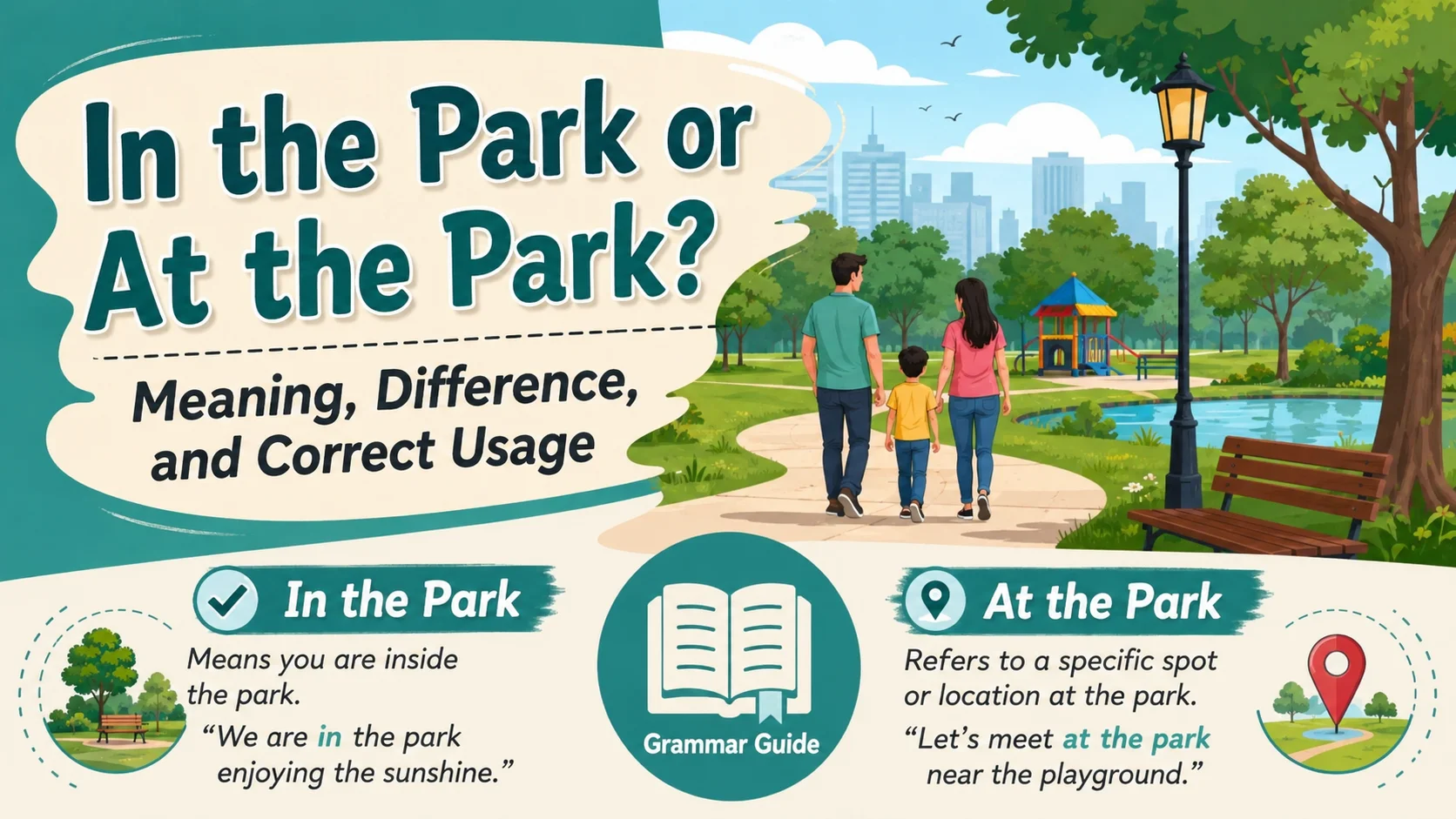
The choice between “In The Park” or “At The Park” depends on whether you mean an exact place inside the park or a general location in English. Prepositions such as in and at are tiny words, yet they can change how clearly you describe a location. In my experience, English learners often find this small detail tricky because both phrases can be correct English phrases. When you say “in the park,” you usually mean you’re inside the park area, within the boundaries, perhaps surrounded by trees, sitting on a bench, or walking along its paths. The phrase “at the park” gives a more general idea of your presence there.
The right preposition depends on the context and the level of detail you want to communicate. At the park can point to the entrance, a nearby spot, or the park as a destination or meeting place, while in the park focuses on your physical location within that space. This subtle difference can help you describe a location precisely without making the sentence complicated. If a friend calling asks where you are, saying “I’m at the park” gives a general location, while “I’m in the park” puts more focus on your presence inside it. Neither sentence is automatically wrong. The key is to consider whether you’re treating the park as an area or a general location.
As you continue learning English, noticing this distinction can boost your confidence and help you sound more natural to a native speaker. On the other hand, choosing in simply because you can physically enter a place doesn’t always capture the intended meaning. English grammar often relies on context rather than rigid one-to-one rules, so the specific situation matters. Think of in as highlighting your position within a place and at as identifying your broader position at that place. This approach makes the phrase easier to remember and gives you a clearer sense of the spatial relationship between you and the location.
Quick Answer: In the Park or At the Park?
Both “in the park” and “at the park” are grammatically correct.
Use in the park when you want to emphasize that someone or something is within the park’s area.
- The children are playing in the park.
- We had lunch in the park.
- I left my jacket in the park.
- There’s a beautiful fountain in the park.
Use at the park when you want to identify the park as a general location, destination, or meeting point.
- I’ll meet you at the park.
- She’s at the park with her friends.
- We arrived at the park around noon.
- They’re at the park today.
The Easiest Rule to Remember
| Phrase | Main Idea | Example |
| In the park | Within the park’s area | We walked in the park. |
| At the park | The park as a general location | We met at the park. |
Think of it this way:
IN = inside the area
AT = the location as a point or destination
However, this isn’t an absolute rule. Natural English allows some overlap between the two expressions.
What Does “In the Park” Mean?
In the park means that someone or something is located within the physical area of a park.
The park doesn’t need to have walls or a roof. English uses in for many open areas when the speaker views them as spaces or areas. For example, we say in the garden, in the forest, in the city, and in the park.
The expression focuses on the park as a space that contains people, objects, or activities.
Examples of “In the Park”
Consider these sentences:
- The children are playing in the park.
- We saw a deer in the park.
- She was reading in the park.
- They went jogging in the park.
- There’s a small pond in the park.
- I found my keys in the park.
- We had a picnic in the park.
- He was sitting in the park near the fountain.
Each sentence treats the park as an area that contains the person, activity, or object.
“In the Park” Focuses on Physical Space
Suppose someone tells you:
“I left my backpack in the park.”
The phrase suggests that the backpack is somewhere within the park’s area. The listener may still need more information to find it, but the general physical location is clear.
Likewise:
“There are several playgrounds in the park.”
The playgrounds exist within the park’s boundaries or general area.
This is one reason in feels especially natural when you’re describing the physical position of something.
What Does “At the Park” Mean?
At the park identifies the park as a location where someone is present, where something happens, or where people plan to meet.
The emphasis isn’t necessarily on the person’s exact position inside the park. Instead, the park works more like a location marker.
For example:
“I’m at the park.”
This tells someone your general whereabouts. You could be walking along a path, sitting near the entrance, standing beside the playground, or waiting somewhere else in the park.
The sentence doesn’t specify your exact position.
Examples of “At the Park”
- I’ll meet you at the park.
- She’s at the park with her children.
- We spent the afternoon at the park.
- They’re at the park right now.
- We arrived at the park before lunch.
- Are you still at the park?
- The kids are at the park today.
Here, the speaker isn’t necessarily interested in describing the exact physical position inside the park.
In the Park vs. At the Park: The Main Difference
The difference becomes easier when you focus on perspective.
In the park views the park as an area.
At the park views the park as a location.
That may sound like a tiny distinction. In practice, it helps explain many everyday choices.
| Feature | In the Park | At the Park |
| Basic focus | Physical area | General location |
| Suggests being within the park | Strongly | Usually, but not necessarily specifically |
| Useful for describing objects | Very natural | Less common |
| Useful for activities | Very natural | Also natural |
| Useful for meeting plans | Possible | Very common |
| Gives an exact position | More spatial | More general |
| Example | She is walking in the park. | She is at the park. |
The distinction isn’t a strict grammatical wall. Native speakers can choose either expression when the context allows both.
In the Park vs. At the Park Examples
Examples make this distinction much easier to see.
“I’m in the Park”
This sentence emphasizes physical presence within the park.
Imagine someone asks:
“Where are you?”
You answer:
“I’m in the park, near the lake.”
The second part gives an even more precise location.
“I’m at the Park”
This version gives a general location.
“Where are you?”
“I’m at the park.”
The listener now knows the general place but doesn’t know exactly where you are.
You might be:
- near the entrance
- beside the playground
- on a walking path
- sitting on a bench
- near a parking area
- somewhere else around the park
That’s the practical difference.
When to Use “In the Park”
There are several situations where in the park is the more natural choice.
Talking About an Activity Inside the Park
Use in the park when you want to emphasize that an activity takes place within the park.
Examples include:
- We went running in the park.
- The children played soccer in the park.
- She was reading in the park.
- They were walking in the park.
- We ate lunch in the park.
The phrase works especially well when the activity has a clear physical relationship with the park.
Describing Something Located Within the Park
In is particularly natural when you’re describing the position of an object or feature.
- There’s a lake in the park.
- A statue stands in the park.
- We found a playground in the park.
- There are several benches in the park.
- The café is in the park.
The phrase clearly places the object or feature within the park’s physical area.
Describing Where Something Happened
When the physical setting matters, in the park works naturally.
“I saw Sarah in the park yesterday.”
This tells the reader where the sighting occurred.
Compare that with:
“I saw Sarah at the park yesterday.”
Both can work. The second one treats the park more generally as the place where the encounter occurred.
When to Use “At the Park”
At the park is especially useful when you’re treating the park as a destination or general location.
Giving Your General Location
If someone texts:
“Where are you?”
You can simply say:
“I’m at the park.”
That’s perfectly natural.
You don’t need to explain whether you’re standing beside a tree or sitting on a bench.
Making Plans to Meet
At the park sounds very natural when you’re arranging a meeting.
“I’ll meet you at the park.”
Here, the park functions as the destination.
You could also say:
“I’ll meet you in the park.”
That version may suggest that the meeting will happen somewhere inside the park rather than simply at the park as a destination.
Talking About a Day Out
You can also use at the park to describe spending time at that location:
“We spent the afternoon at the park.”
This sentence focuses on the park as the setting for the outing.
You could also say:
“We spent the afternoon in the park.”
That version gives more emphasis to actually being within the park.
Both are natural. Context decides the nuance.
“I Am in the Park” vs. “I Am at the Park”
This is one of the most common points of confusion.
“I Am in the Park”
I am in the park means:
I am physically within the park’s area.
For example:
“I’m in the park, sitting near the fountain.”
The speaker provides a spatial description.
“I Am at the Park”
I am at the park means:
The park is my current general location.
For example:
“I’m at the park with the kids.”
The exact position isn’t important.
Can Both Sentences Describe the Same Situation?
Absolutely.
Imagine someone is sitting on a bench inside a city park.
They could truthfully say:
“I’m in the park.”
They could also say:
“I’m at the park.”
The physical situation hasn’t changed. The focus has changed.
This is an important point because English prepositions don’t always divide reality into neat little boxes.
“Meet Me in the Park” vs. “Meet Me at the Park”
These two sentences are both correct, but they can create slightly different expectations.
Meet Me in the Park
“Meet me in the park.”
This suggests that the meeting will occur inside the park.
You might expect the person to walk into the park and find you somewhere among the paths, trees, benches, or playgrounds.
Meet Me at the Park
“Meet me at the park.”
This presents the park as the meeting location.
Depending on the context, you might meet:
- at the entrance
- near the parking lot
- outside the gate
- somewhere inside
- at a commonly understood meeting spot
If precision matters, add the exact location.
“Meet me at the park entrance.”
Or:
“Meet me in the park near the fountain.”
That removes almost all ambiguity.
Why “At the Park” Doesn’t Necessarily Mean Outside
A common misconception is that at the park means you’re standing outside the park.
That’s not necessarily true.
At often gives a general location rather than an exact physical position.
So this sentence is completely natural:
“The kids are at the park.”
They could be playing on the swings inside the park.
Similarly:
“She’s at the library.”
That doesn’t mean she’s standing outside the library building. The phrase simply identifies the library as the relevant location.
Common Mistakes With “In the Park” and “At the Park”
Mistake: Thinking Only “In the Park” Is Correct
That’s incorrect.
At the park is also standard English.
The mistake usually comes from learning the simplified rule that in = inside and assuming every open place must therefore use in.
English doesn’t work that mechanically.
Mistake: Assuming “At the Park” Means Outside
It doesn’t.
At can describe a general location without specifying the exact physical position.
“I’m at the park.”
The person may be completely inside the park.
Mistake: Assuming “In” Only Works With Enclosed Spaces
It doesn’t.
English commonly uses in with open or geographical areas.
Examples include:
- in the park
- in the garden
- in the forest
- in the city
- in the countryside
- in the valley
- in the mountains
Mistake: Memorizing One Rule and Ignoring Context
Rules help you get started. Context finishes the job.
Instead of asking only, “Which preposition goes with park?” ask:
“How am I viewing the park in this sentence?”
If you’re describing something within its physical area, in often fits best.
If you’re identifying it as a general destination or location, at often sounds more natural.
A Simple Trick for Choosing “In” or “At”
Use this quick mental test.
Choose “In” When You Mean Within the Area
Ask:
Am I emphasizing the inside or physical area of the park?
If yes, choose in.
- walking in the park
- sitting in the park
- playing in the park
- a fountain in the park
- a restaurant in the park
Choose “At” When You Mean the Location
Ask:
Am I simply identifying the park as the place or destination?
If yes, choose at.
- meet me at the park
- I’m at the park
- we’re at the park today
- they arrived at the park
- I’ll see you at the park
Quick Memory Rule
IN → within the area
AT → general location or destination
It’s a useful shortcut, not an inflexible law.
In the Park or At the Park in Everyday American English
In everyday American English, both expressions appear naturally.
Consider this short conversation:
Alex: Where are you?
Jordan: I’m at the park.
Alex: Which part?
Jordan: I’m in the park, near the playground.
Notice how naturally the two phrases work together.
The first answer gives a general location. The second provides a more specific physical location.
That’s a practical way to understand the distinction.
Another Everyday Example
Parent: Where are the kids?
Other parent: They’re at the park.
Parent: Are they near the playground?
Other parent: Yes. They’re in the park by the swings.
Again, neither phrase contradicts the other.
The second statement simply zooms in.
Case Study: Choosing the Right Preposition in Context
Imagine three friends plan to meet on Saturday.
One friend says:
“I’ll see you at the park at 4 p.m.”
The park functions as the destination.
Later, another friend asks:
“Where are you?”
The answer:
“I’m in the park, near the fountain.”
Now the speaker emphasizes their physical position within the park.
A third friend says:
“We spent three hours at the park.”
This describes the outing as a whole.
Finally:
“We had a picnic in the park.”
This emphasizes the physical setting of the picnic.
What This Case Shows
| Sentence | Main Focus |
| I’ll see you at the park. | Destination/meeting location |
| I’m in the park near the fountain. | Physical position |
| We spent three hours at the park. | General setting |
| We had a picnic in the park. | Activity within the area |
The same park can take either preposition because the speaker’s perspective changes.
In the Park vs. At the Park: More Examples
| Context | Natural Choice | Example |
| Physical activity | in | We went jogging in the park. |
| Object inside the park | in | There’s a statue in the park. |
| General location | at | She’s at the park. |
| Meeting destination | at | Meet me at the park. |
| Exact area | in | He’s in the park near the lake. |
| Day spent at a location | at | We spent the afternoon at the park. |
| Picnic setting | in | We had lunch in the park. |
| Arrival destination | at | We arrived at the park at noon. |
In the Park, At the Park, and Other Useful Prepositions
English gives you several ways to describe a park’s location.
| Expression | Meaning | Example |
| in the park | Within the park | We walked in the park. |
| at the park | General location | We met at the park. |
| near the park | Close to the park | The hotel is near the park. |
| by the park | Beside or close to the park | There’s a café by the park. |
| outside the park | Not within the park | He waited outside the park. |
| around the park | In the surrounding area or along its perimeter | We walked around the park. |
| through the park | From one side or point to another within it | We walked through the park. |
The preposition through is especially useful when movement across the park matters.
“Arrive at the Park” or “Arrive in the Park”?
This is another useful distinction.
The standard expression is:
We arrived at the park.
Here, at treats the park as the destination.
However, arrived in the park can also occur when the sentence specifically emphasizes entering or being within the park.
Compare:
We arrived at the park at noon.
This focuses on reaching the destination.
We walked through the gate and arrived in the park.
This focuses more strongly on reaching the interior area.
The context does the heavy lifting.
Is “At the Park” More Natural Than “In the Park”?
There isn’t a universal winner.
In the park is often the clearer choice when the sentence describes an activity or object physically located within the park.
At the park is often convenient when you’re identifying the park as a general location or destination.
For example:
“The children are playing in the park.”
Sounds very natural because the activity occurs within the park.
Meanwhile:
“I’ll meet you at the park.”
Sounds natural because the park functions as the meeting destination.
Still, context can make either phrase work.
Practice Quiz: In the Park or At the Park?
Choose in or at in each sentence.
- The children are ___ the park.
- I’ll meet you ___ the park at five.
- There’s a beautiful lake ___ the park.
- She’s ___ the park with her friends.
- We had a picnic ___ the park.
- We arrived ___ the park before noon.
- I found my wallet ___ the park.
- Are you still ___ the park?
- They were walking ___ the park.
- Let’s meet ___ the park entrance.
Answer Key
- in — The activity takes place within the park.
- at — The park functions as the meeting destination.
- in — The lake is located within the park.
- at — The sentence gives a general location.
- in — The picnic takes place within the park.
- at — Arrive at commonly treats the destination as a point.
- in — The wallet was located within the park.
- at — The speaker asks about the person’s general location.
- in — The walking occurs within the park.
- at — The entrance is a specific meeting point.
Conclusion
Choosing between “in the park” and “at the park” becomes easier when you focus on the location you want to describe. Use “in the park” when you mean you’re physically inside the park, such as walking along its paths or sitting on a bench. Use “at the park” when you mean the park as a general location, destination, or meeting place. Both phrases are grammatically correct, so the best choice depends on the context and the level of detail you want to give.
Frequently Asked Questions
Q1. Is “in the park” grammatically correct?
Yes, “in the park” is grammatically correct. It usually means that someone is physically inside the park or within its boundaries.
Q2. Is “at the park” grammatically correct?
Yes. “At the park” is also correct. It usually identifies the park as a general location without focusing on the exact position inside it.
Q3. Should I say “I’m in the park” or “I’m at the park”?
Both are correct. Say “I’m in the park” when you want to emphasize that you’re inside the park. Say “I’m at the park” when you’re simply giving your general location.
Q4. Can “at the park” refer to the entrance?
Yes. “At the park” can refer to the entrance, a meeting point, or another nearby spot associated with the park. The phrase gives a broader sense of location.
Q5. Which phrase should English learners use?
Use “in the park” for a location physically inside the park and “at the park” for a broader location or meeting place. Paying attention to context will help you choose naturally.
About the Author