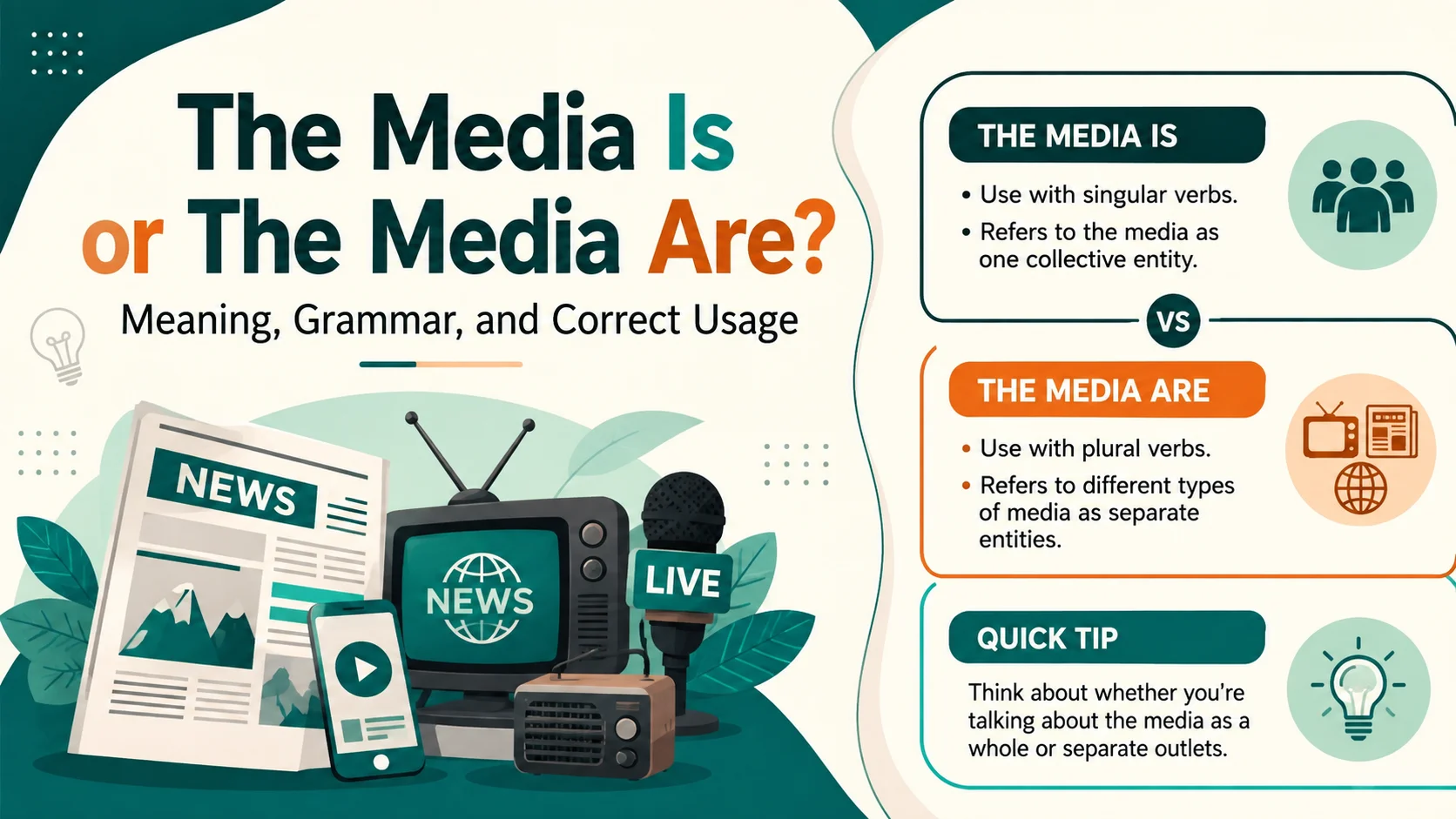
The question the media is or the media are depends on whether you see media as one group or several separate outlets. In traditional grammar, media is the plural of medium, so the media are follows the usual plural agreement rule. However, modern English often treats the media as a collective noun or group noun for mass media as one broad institution. This makes the media is acceptable in many forms of American English.
Think about what the media is doing in your sentence. When you mean the mass media as a single entity or whole unit, is can work naturally. For example, “The media is covering the election.” Here, news, reporting, and covering describe one broad activity. But when you mean separate entities, individuals, outlets, or channels, are may fit better: “The media are reporting different stories about the event.” This can include newspapers, television, websites, journalists, TV, and radio working independently.
Both forms can therefore be grammatically acceptable, although usage varies between American English and British English. American English commonly uses the media is when referring to the media as one group, while British English often favors the media are. Merriam-Webster and Cambridge recognize both singular and plural usage. The best choice depends on the media meaning, the sentence, the construction, and the style you’re following. This collective noun dilemma may seem like a linguistic conundrum, but the basic distinction is simple: use is for one unified group and are for separate parts acting individually.
Quick Answer: Is It “The Media Is” or “The Media Are”?
In US English, both “the media is” and “the media are” can be correct.
Use “the media is” when you treat the media as one collective force, industry, or institution:
The media is covering the election closely.
Use “the media are” when you emphasize separate outlets, organizations, journalists, or media entities:
The media are competing to publish the story first.
The distinction becomes clearer when you consider the meaning behind the noun.
| Form | Basic idea | Example |
| The media is | Media viewed as one collective entity | The media is shaping public discussion. |
| The media are | Media viewed as separate entities | The media are reporting different versions of the event. |
The MLA Style Center follows Merriam-Webster’s approach and states that media can be treated as singular or plural when it refers to mass media. It also emphasizes consistency within a piece of writing.
For most everyday American writing, “the media is” is perfectly acceptable when the sentence treats mass media as a unified concept.
What Does “Media” Mean?
Before choosing is or are, it helps to understand what media actually refers to.
In its mass-communication sense, media describes channels and organizations that communicate information to large audiences. That can include newspapers, magazines, television, radio, websites, and other forms of public communication. Cambridge defines the media as communication channels such as the internet, newspapers, magazines, and television considered as a group.
For example:
- The media is following the story.
- The media are reporting on the investigation.
- The media has given the issue considerable attention.
- The media have published several reports.
Notice something important: the word itself doesn’t change. What changes is the grammatical treatment of the word.
That distinction matters because English often allows collective nouns to shift between a group-as-one interpretation and a group-as-individuals interpretation.
Why Is “Media” So Confusing?
The root of the confusion goes back to medium.
Traditionally, medium is the singular form and media is the plural. Merriam-Webster still lists media as a plural of medium, particularly for meanings involving channels of communication, artistic forms, and other systems.
For example:
One communication medium can reach a specific audience.
Several communication media can reach different audiences.
That traditional relationship is still important. However, language doesn’t remain frozen in its historical form.
As media became increasingly associated with the mass communication industry, English speakers began treating it as a collective mass noun. Merriam-Webster notes this development and specifically records singular use in expressions such as “the media is.”
In other words, the Latin background explains why “media are” exists. Modern English usage explains why “media is” also exists.
The History of “Media” and “Medium”
The traditional singular-plural relationship is straightforward:
- medium → singular
- media → plural
A newspaper can be described as a medium of communication. Newspapers, television, and radio together can be described as media.
The same pattern appears in artistic contexts:
- Painting is one medium.
- Painting, sculpture, and photography are different media.
Merriam-Webster continues to list media as the traditional plural of medium.
However, the modern mass-communication meaning developed its own grammatical behavior. That’s why insisting that media must always take a plural verb oversimplifies actual English usage.
Etymology Does Not Always Control Modern Grammar
A common argument goes like this:
“Media is plural in Latin, so it must always take a plural verb in English.”
That conclusion doesn’t hold up well.
English regularly absorbs words from other languages and then reshapes them. Once a borrowed word becomes established in everyday English, speakers may treat it according to English grammatical patterns rather than preserving every feature of its original language.
That’s exactly what has happened with several borrowed terms.
The important lesson is simple:
A word’s historical origin can explain its grammar, but current usage determines how English speakers actually use it.
When to Use “The Media Is”
The singular form works naturally when the media represents one broad institution, industry, or collective force.
Consider this sentence:
The media is influencing public opinion.
The sentence doesn’t focus on individual newspapers or television stations. Instead, it discusses mass communication as a broad social force.
Here are more examples:
- The media is covering the trial.
- The media is paying close attention to the announcement.
- The media is playing an important role in public debate.
- The media is changing rapidly because of digital technology.
- The media is interested in the company’s response.
In each example, the media behaves like one broad concept.
Why “The Media Is” Is Natural in American English
American English frequently treats collective concepts as singular when the group functions as one unit.
That’s why sentences such as these sound ordinary:
The company is expanding.
The government is investigating the issue.
The public is concerned.
Likewise:
The media is investigating the story.
The singular verb highlights the collective function rather than the individual members.
Current dictionary evidence supports this usage. Merriam-Webster explicitly describes mass-media media as singular or plural in construction.
When to Use “The Media Are”
The plural form works when you want to emphasize individual media organizations, outlets, journalists, or groups.
For example:
The media are competing for exclusive access.
Here, the sentence naturally suggests multiple organizations or representatives acting separately.
Consider these examples:
- The media are reporting different versions of the story.
- The media are gathering outside the courthouse.
- The media are competing for exclusive interviews.
- The media are asking candidates difficult questions.
- The media are divided over the significance of the announcement.
The plural verb makes the separate members of the group more noticeable.
Why “The Media Are” Remains Common
Traditional grammar treats media as the plural of medium. That pattern remains established, particularly in formal writing and in varieties of English that favor plural agreement with collective nouns.
It also appears naturally when the sentence describes actions performed by separate organizations.
Compare:
The media is covering the event.
This sounds like one collective industry is covering it.
Now compare:
The media are covering the event from different locations.
This version draws attention to multiple outlets or teams working independently.
Neither sentence needs to be automatically labeled wrong.
The intended meaning changes the emphasis.
“The Media Is” vs. “The Media Are”: A Side-by-Side Comparison
The easiest way to understand the difference is to look at the complete construction.
| Sentence | Interpretation |
| The media is influential. | Media as one broad social force |
| The media are influential. | Multiple media organizations or outlets |
| The media is covering the event. | Collective coverage |
| The media are covering the event. | Separate outlets are covering it |
| The media is divided. | The media industry viewed collectively |
| The media are divided. | Individual outlets or participants hold different positions |
| The media has changed dramatically. | The media landscape as one system |
| The media have changed their strategies. | Multiple media organizations |
The distinction isn’t always sharp. In many sentences, either version can communicate essentially the same idea.
That’s why style and consistency matter.
Subject-Verb Agreement With “Media”
Once you choose is or are, other parts of the sentence should follow the same grammatical interpretation.
If you choose singular agreement, continue with singular forms:
The media is influential because it has enormous reach.
The media is covering the story because it wants more information.
If you choose plural agreement, continue with plural forms:
The media are influential because they have enormous reach.
The media are covering the story because they want more information.
Avoid Mixing Singular and Plural Agreement
One of the clearest mistakes occurs when a writer begins with singular agreement and suddenly switches to plural pronouns.
For example:
❌ The media is divided because they have different opinions.
The sentence starts with a singular interpretation and then switches to plural.
You could write:
The media is divided because it has different opinions.
Or:
The media are divided because they have different opinions.
The second version emphasizes the individual organizations or participants.
Consistency is more important than mechanically choosing one form every time.
American English vs. British English
Regional usage adds another layer to the question.
American English commonly accepts singular agreement with collective nouns and mass concepts. Therefore, “the media is” appears naturally in US writing.
British English has traditionally used plural agreement more often with collective nouns. As a result, “the media are” can sound particularly natural in British formal writing.
However, this isn’t an absolute geographic rule.
Modern dictionaries recognize variation. Cambridge, for example, marks the media as capable of taking either singular or plural verbs.
So it would be misleading to claim:
“Americans always say the media is.”
Or:
“British writers always say the media are.”
Real usage is more flexible than that.
If you’re writing specifically for an American audience, “the media is” is a safe and established choice when you’re treating media as one collective entity.
If a publication or institution has a house style, however, follow that style consistently.
Why “The Media Are” Isn’t Always Better
Some writers assume that are must be correct because media is historically plural.
That rule is too rigid for modern English.
Consider:
The media is changing rapidly.
This sentence treats the entire media landscape as one evolving system. It sounds natural to many American readers.
Calling it incorrect simply because media originated as a plural ignores the word’s modern development.
The same principle applies to other borrowed words. English speakers don’t always preserve the original grammar of every word borrowed from Latin, Greek, French, Italian, or other languages.
Grammar describes living language. It isn’t a museum display.
Why “The Media Is” Isn’t Always the Best Choice
The opposite mistake is assuming that singular agreement works in every context.
Sometimes are communicates the intended meaning more precisely.
Imagine a sentence describing several news organizations:
The media are competing for the interview.
The plural verb makes the competition between separate organizations clear.
Compare that with:
The media is competing for the interview.
The second sentence can still be understood. However, the singular form makes the media industry sound more like one collective entity.
When individual actors matter, plural agreement can sharpen the picture.
“Media” as a Collective Noun
A collective noun refers to a group considered as a unit.
Common examples include:
- team
- committee
- family
- staff
- government
- audience
- media
Collective nouns can create agreement questions because a group can be viewed in two ways.
You can focus on the group as one unit:
The team is winning.
Or emphasize its members:
The team are arguing among themselves.
The exact patterns vary across English varieties and individual nouns.
Media has a similar tension. When you view it as one mass-communication system, singular agreement makes sense. When you focus on separate outlets or members, plural agreement can make more sense.
“Media” vs. “Medium”
The relationship between these two words remains useful.
Medium can mean one channel or form of communication:
Television is a powerful medium.
Media traditionally refers to multiple channels or forms:
Television and radio are important media.
Merriam-Webster lists medium with both mediums and media as plural forms, depending on the sense.
There is another interesting distinction. When medium refers to a person who claims to communicate with spirits, the usual plural is mediums, not media.
So context matters even when you’re dealing with the singular form.
What About “Social Media Is”?
The phrase social media creates another common grammar question.
In American English, this is extremely natural:
Social media is changing how people communicate.
Here, social media refers to the broad phenomenon as one concept.
You can also write:
Social media platforms are changing how people communicate.
This second version removes any uncertainty because platforms is clearly plural.
That can be useful when precision matters.
Compare:
| Sentence | Focus |
| Social media is changing communication. | Social media as a broad phenomenon |
| Social media platforms are changing communication. | Individual platforms |
| Social media is becoming more influential. | The overall medium |
| Social media companies are changing their policies. | Separate companies |
This illustrates a broader writing principle: a specific noun can often eliminate a grammar ambiguity more effectively than a complicated rule can.
What About “Different Media”?
Not every use of media refers to journalism.
Artists, designers, educators, scientists, and technology professionals also use the word.
For example:
The artist works in several media.
Here, media refers to forms or materials of artistic expression.
Another example:
The exhibition combines several media.
In these cases, the traditional plural meaning is more obvious.
The singular is medium:
Oil paint is one medium.
The plural is:
Oil paint, charcoal, and sculpture represent different media.
This is an important distinction because the flexible singular treatment of media in the media doesn’t mean every occurrence of media should automatically take a singular verb.
What About “Media Is” in Technology?
Technology uses media in several ways.
For example:
Stored media is kept on the server.
Here, media can refer to stored videos, photographs, audio files, or other digital content as a mass category.
Cambridge specifically lists media as a noun for videos, music, and photographs stored as particular file types. It also identifies the term as capable of different grammatical constructions depending on meaning.
This demonstrates why context matters so much.
The word media doesn’t carry one permanent grammatical setting in every sentence.
Common Mistakes With “Media”
Common mistakes with “media” often involve misunderstanding whether it takes a singular or plural verb and using it incorrectly when referring to different forms of communication.
Assuming “Media” Must Always Be Plural
The traditional rule has some historical basis, but modern mass-media usage has expanded beyond that simple pattern.
Merriam-Webster explicitly records singular and plural construction for media meaning mass media.
Assuming “Media” Must Always Be Singular
That goes too far in the opposite direction.
Traditional plural usage remains correct in many contexts.
For example:
Several media are represented in the exhibition.
Here, the plural meaning is clear.
Mixing Singular and Plural Agreement
Avoid constructions such as:
❌ The media is reporting because they want more information.
Choose one grammatical pattern:
The media is reporting because it wants more information.
Or:
The media are reporting because they want more information.
Assuming “Medias” Is Always Wrong
In most general writing, media remains the expected plural of medium. However, Merriam-Webster records medias in specialized advertising usage and as a plural referring to members of the mass media.
That doesn’t mean medias should become the default choice. In ordinary writing, media is usually the appropriate form.
Ignoring the Meaning
This is the biggest practical mistake.
Instead of asking only:
“Is media singular or plural?”
Ask:
“What does media mean here?”
That question usually makes the answer much easier.
How to Choose Between “Is” and “Are”
Use this quick decision process when editing your sentence.
First, identify the meaning. Is media describing the mass-media industry as one broad force?
If yes, is works naturally in US English.
Next, consider the individual participants. Are you talking about separate news outlets, journalists, broadcasters, or organizations?
If so, are may communicate the meaning better.
Then, check the rest of the sentence. If you choose is, use singular pronouns such as it. If you choose are, use plural pronouns such as they.
Finally, check your style guide. Academic institutions, newspapers, businesses, and publishers may have their own preferences.
A Simple Decision Guide
| If you mean… | Prefer |
| Mass media as one industry | The media is |
| Mass media as one social force | The media is |
| Several news outlets | The media are |
| Separate journalists or organizations | The media are |
| Multiple artistic forms | media as a traditional plural |
| One artistic or communication form | medium |
| Multiple social-media platforms | platforms are |
Real-World Examples
This section provides practical examples showing how the topic is used naturally in everyday conversations and real-life situations.
News Reporting
The media is closely following the investigation.
The sentence treats the media as a broad industry.
The media are publishing different accounts of the investigation.
The sentence emphasizes separate outlets.
Politics
The media is focusing heavily on the campaign.
The focus is the overall media environment.
The media are questioning the candidates about their policies.
The plural form emphasizes journalists and outlets acting individually.
Business
The media is important to the company’s public image.
The media functions as one broad communication industry.
The media are reporting different reactions from investors.
The sentence emphasizes multiple organizations or reporters.
Entertainment
The media is paying attention to the actor’s new film.
The focus is collective media attention.
The media are interviewing the cast at separate events.
The individual outlets or journalists become more prominent.
How Specific Nouns Can Make Your Writing Stronger
Sometimes the easiest solution is to replace media with a more precise noun.
Instead of:
The media are divided over the issue.
You could write:
News outlets are divided over the issue.
Instead of:
The media is covering the announcement.
You might write:
News organizations are covering the announcement.
Useful alternatives include:
- news outlets
- news organizations
- journalists
- reporters
- broadcasters
- media companies
- publications
- the press
This isn’t merely a trick for avoiding grammar questions. Specific nouns often produce clearer writing.
If you mean journalists, say journalists. If you mean newspapers and websites, say news outlets. If you mean the entire communication industry, the media may be exactly right.
A Practical Editing Checklist
Before publishing a sentence containing media, ask:
- What does “media” mean in this sentence?
- Am I treating it as one collective force?
- Am I referring to separate outlets or people?
- Does the verb match that interpretation?
- Does the pronoun match the verb?
- Have I switched between singular and plural agreement?
- Does the surrounding paragraph maintain the same interpretation?
- Does my publication have a preferred style?
- Would a more specific noun make the sentence clearer?
These checks take only a few seconds.
They can also prevent awkward agreement problems throughout an article.
Quick Reference: Correct Examples
| Sentence | Correct? | Explanation |
| The media is covering the story. | Yes | Collective interpretation |
| The media are covering the story. | Yes | Plural interpretation |
| The media is influential. | Yes | Media as one social force |
| The media are influential. | Yes | Multiple outlets or organizations |
| The media has changed rapidly. | Yes | Singular collective construction |
| The media have changed their strategies. | Yes | Plural construction |
| The media is divided because it has different priorities. | Yes | Consistent singular agreement |
| The media are divided because they have different priorities. | Yes | Consistent plural agreement |
| The medias are reporting the story. | Usually avoid | Not the normal general-English plural |
The Best Rule for American English
For US English, the most useful rule is this:
Treat “the media” as singular when you mean mass media as one collective entity. Treat it as plural when you want to emphasize separate media organizations or members.
This approach matches current dictionary evidence rather than forcing every sentence into an old-fashioned singular-or-plural box. Merriam-Webster explicitly recognizes both singular and plural constructions for mass-media media.
The MLA Style Center also allows both forms and recommends consistency.
So if you’re writing:
The media is shaping public opinion.
That is acceptable.
If you’re writing:
The media are competing for exclusive interviews.
That is acceptable too.
The crucial point is that your verb should reflect the meaning you intend.
Conclusion
Choosing between the media is and the media are depends on how you use the word media. Use the media is when you treat the media as one unified group, institution, or source of mass communication. Use the media are when you’re thinking about separate outlets, journalists, or organizations. Both forms can be correct, but your choice should match the meaning of your sentence and the variety of English you’re using.
FAQs
Q1. Is “the media is” grammatically correct?
Yes. The media is is grammatically acceptable when media refers to mass communication as one unified group or institution.
Q2. Is “the media are” grammatically correct?
Yes. The media are is also correct, especially when media refers to several separate outlets, organizations, or journalists.
Q3. Which is more common: “the media is” or “the media are”?
The media is is generally more common in American English, while the media are is more common in British English.
Q4. Why can “media” take both “is” and “are”?
Historically, media is the plural of medium. However, modern English often treats the media as a collective noun, allowing singular agreement in some contexts.
Q5. Should I use “the media is” or “the media are” in formal writing?
Follow the style and variety of English required by your publication. If you mean the media as one institution, the media is works; if you mean separate media outlets, the media are is clearer.
About the Author