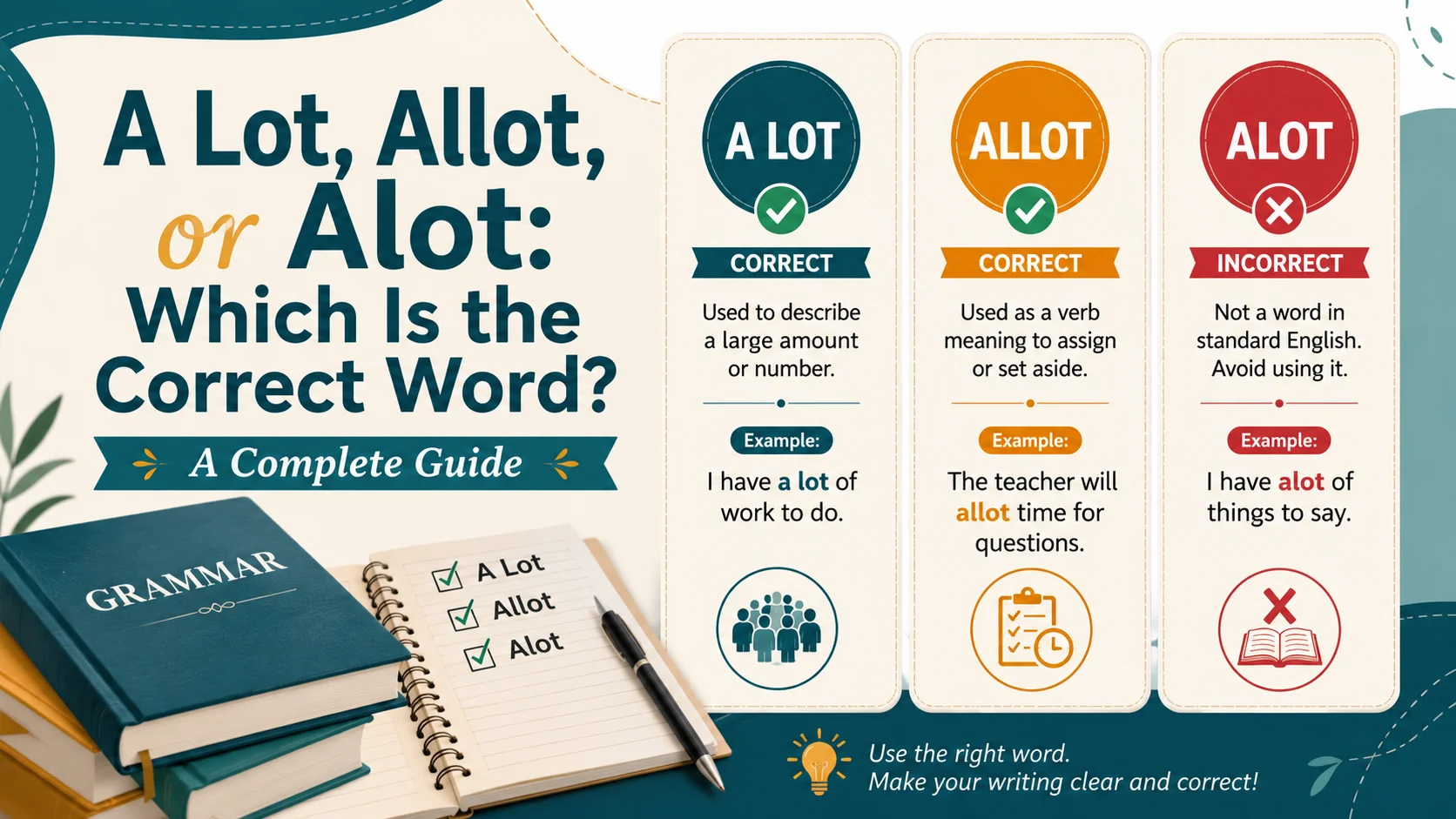
A Lot, Allot, or Alot can confuse readers, but a lot is the standard form, while allot means to assign and alot is incorrect. The difference between these terms becomes easier to understand when you look at their meanings and grammatical roles.
A lot works as a phrase that describes a large amount or something happening frequently, depending on the sentence. Allot is a verb that means to distribute, assign, or give someone a particular share of something. Alot isn’t a standard English word, so you should avoid it in both formal and informal writing.
Using the correct form keeps your writing clear, natural, and professional. For example, “I have a lot of work” refers to quantity, while “She studies a lot” means frequently. In contrast, “The manager will allot two hours to each team member” shows that something is being assigned. Remembering these simple distinctions can help you avoid common spelling mistakes and create reader-focused, SEO-friendly content that remains easy to understand.
Quick Answer: A Lot, Allot, or Alot?
The correct form depends on the meaning.
| Form | Correct? | Meaning | Example |
| a lot | Yes | A large amount, large number, very much, or very often | She reads a lot. |
| allot | Yes | To assign, distribute, or give a particular share | The teacher will allot ten minutes to each student. |
| alot | No in standard English | A common misspelling of a lot | I have alot of work. ❌ |
Here’s the easiest way to remember the difference:
- A lot means much, many, very much, or very often.
- Allot means to assign or distribute something.
- Alot isn’t the standard spelling of a lot.
Compare these sentences:
I have a lot of homework tonight.
The teacher will allot twenty minutes for the exercise.
The first sentence describes quantity. The second describes the assignment.
That one distinction solves most a lot vs. allot questions.
What Does “A Lot” Mean?
A lot is a common English expression used to describe a large quantity, number, degree, or frequency.
You can use it before a noun with of, or you can use it by itself after a verb.
For example:
- There are a lot of students in the classroom.
- She has a lot of experience.
- We need a lot of information.
- He studies a lot.
- They travel a lot.
When a lot describes a noun, it usually appears as a lot of.
A Lot With Countable Nouns
Use a lot of plural countable nouns when you’re talking about a large number.
Examples include:
- There are a lot of books on the shelf.
- She has a lot of friends.
- We received a lot of emails today.
- The store attracts a lot of customers.
In each example, you can count the individual items.
You can count books, friends, emails, and customers. That’s why the nouns appear in plural form.
A Lot With Uncountable Nouns
A lot of also works with uncountable nouns.
For example:
- I need a lot of time.
- She has a lot of patience.
- The project requires a lot of money.
- We gathered a lot of information.
You don’t normally count these nouns as individual units in their ordinary meanings. You don’t usually say three pieces of information or five patiences. Instead, a lot of it gives you a natural way to express a large amount.
A Lot Without “Of”
You don’t always need it.
When no noun follows, a lot can stand alone.
- I exercise a lot.
- She smiles a lot.
- He talks a lot.
- We travel a lot.
- The situation has changed a lot.
Here, a lot tells the reader about the degree or frequency of an action.
Consider the difference:
She has a lot of books.
She reads a lot.
The first sentence describes the number of books. The second describes how frequently she reads.
What Does “Allot” Mean?
Allot is a verb that means to assign, distribute, or give a particular share of something to someone or something.
Unlike a lot, it doesn’t describe a large quantity by itself.
Instead, allot describes an action.
For example:
- The manager will allot each employee two days off.
- The committee allotted funds to the project.
- The teacher allotted ten minutes for the activity.
- The organizers allotted seats to each group.
In each sentence, someone is deciding how something should be distributed.
That something could be time, money, space, resources, responsibilities, seats, land, or tasks.
Common Things You Can Allot
You can allot many different kinds of resources or responsibilities.
| Thing | Example |
| Time | The teacher allotted ten minutes for discussion. |
| Money | The board allotted money to the project. |
| Space | Each department was allotted office space. |
| Seats | The organizers allotted seats to each group. |
| Tasks | The manager allotted tasks to the team. |
| Resources | The company allotted resources to research. |
| Responsibilities | The supervisor allotted responsibilities among the staff. |
The central idea remains the same: something gets assigned or divided for a particular purpose.
A Lot vs. Allot: Key Differences
The difference between a lot and allot becomes clear when you compare their grammatical roles.
| Feature | A lot | Allot |
| Form | Two words | One word |
| Function | Expression or phrase | Verb |
| Main meaning | A large amount, number, degree, or frequency | Assign or distribute |
| Usually followed by | of + noun when expressing quantity | An object or recipient |
| Example | We have a lot of work. | We allotted work to each employee. |
| Related word | lots | allotted, allotting, allotment |
Here’s another useful comparison:
A lot tells you how much.
Allot tells you who gets a share.
For example:
The company has a lot of money.
This sentence tells you about quantity.
The company will allot money to several departments.
This sentence tells you about distribution.
The two ideas can even appear in the same sentence:
The company raised a lot of money and allotted it to several departments.
That’s a perfect example of how different their meanings are.
Why Is “Alot” Incorrect?
Alot is generally considered a misspelling when someone intends to write a lot.
The mistake is easy to understand. When people speak naturally, a lot often sounds like one connected unit. That can make writers assume the expression should also appear as one written word.
Standard English doesn’t work that way here.
The accepted spelling remains a lot when the expression means a large amount, large number, very much, or very often.
Common Examples of the “Alot” Mistake
Incorrect:
- I have alot of homework.
- She talks alot.
- There are alot of choices.
- He likes sports alot.
Correct:
- I have a lot of homework.
- She talks a lot.
- There are a lot of choices.
- He likes sports a lot.
If you’re writing a school assignment, professional email, article, résumé, application, or formal document, always use a lot.
How to Use “A Lot” in a Sentence
Learning a few common sentence patterns can make a lot much easier to use naturally.
A Lot of + Noun
This is one of the most common structures.
- We have a lot of work today.
- She bought a lot of clothes.
- There are a lot of people outside.
- He needs a lot of practice.
Verb + A Lot
Use a lot after a verb when you’re describing frequency or degree.
- She studies a lot.
- They argue a lot.
- He travels a lot.
- I think about that a lot.
A Lot With Adjectives
A lot can also strengthen comparisons.
- This book is a lot better.
- The new computer is a lot faster.
- She feels a lot happier now.
- The second option is a lot cheaper.
In these examples, a lot adds emphasis to the comparison.
How to Use “Allot” in a Sentence
Because allot is a verb, it needs to fit naturally into a sentence as an action.
A common structure is:
allot + something + to + someone
For example:
- The manager allotted extra time to the team.
- The committee allotted funds to the charity.
- The school allotted rooms to different departments.
Another common structure places the recipient directly after the verb:
allot + someone + something
For example:
- The teacher allotted each student ten minutes.
- The manager allotted each employee a specific task.
- The organizers allotted every participant a seat.
Forms of Allot
The verb changes depending on the sentence.
| Form | Example |
| allot | They allot resources carefully. |
| allots | The manager allots tasks every morning. |
| allotted | The teacher allotted ten minutes. |
| allotting | The committee is allotting funds. |
| allotment | Each department received an allotment. |
Notice the spelling in allotted and allotting.
The final t doubles before these endings:
- allot → allotted
- allot → allotting
That spelling pattern is worth remembering because alloted and alotting are common mistakes.
A Lot vs. Allot Examples
Sometimes the clearest explanation comes from comparing similar situations.
School Example
The school has a lot of students.
Here, a lot of means a large number.
The school will allot each class a classroom.
Here, allot means assign.
Time Example
We have a lot of time.
The sentence describes quantity.
The instructor allotted thirty minutes for the test.
The sentence describes an assigned amount.
Money Example
The organization received a lot of money.
The phrase describes the amount received.
The organization allotted the money to several programs.
The verb describes how the money was distributed.
Work Example
I have a lot of work today.
The sentence describes the amount of work.
My manager allotted different tasks to each employee.
The verb describes the distribution of work.
This gives you a useful mental picture: a lot describes the size of the pile, while allot describes dividing the pile.
Common Mistakes With A Lot, Allot, and Alot
The spelling confusion usually comes from using the wrong form for the intended meaning.
Mistake: Writing “Alot”
❌ I have alot of questions.
✅ I have a lot of questions.
The expression must remain two words.
Mistake: Using “Allot” for Quantity
❌ I have allot of homework.
✅ I have a lot of homework.
The sentence describes a large amount of homework. It doesn’t describe an assignment or distribution.
Mistake: Using “A Lot” Instead of “Allot”
❌ The manager will a lot each employee two hours.
✅ The manager will allot each employee two hours.
The sentence needs a verb meaning assigned.
Mistake: Writing “Alloted”
❌ Each student was alloted ten minutes.
✅ Each student was allotted ten minutes.
The correct past form contains two t’s.
Mistake: Confusing Allot With Allow
These words may look somewhat similar, but they have different meanings.
Allot means to assign or distribute.
The committee allotted $10,000 to the project.
Allow means to permit.
The teacher allowed students to leave early.
One word concerns distribution. The other concerns permission.
Synonyms and Similar Expressions
English gives you several alternatives to a lot, although the best choice depends on the sentence.
Alternatives for A Lot
- many
- much
- plenty
- numerous
- greatly
- frequently
- often
- considerably
Consider these examples:
She visits her grandparents a lot.
She visits her grandparents frequently.
Both express frequency.
Now compare:
She has a lot of books.
She has numerous books.
Both describe quantity, although numerous sounds more formal.
Alternatives for Allot
Depending on the context, you could use:
- assign
- allocate
- distribute
- apportion
- designate
- set aside
These words overlap, but they aren’t identical.
Assign often relates to tasks or responsibilities.
The manager assigned three tasks to Maria.
Allocate commonly refers to distributing resources.
The company allocated more money to research.
Allot emphasizes giving someone or something a particular share.
The instructor allotted each student ten minutes.
Choosing the right synonym makes your sentence more precise.
The Origin and History of “Allot”
The history of allot connects closely with the older idea of a lot, meaning a share or portion.
The word entered English through French and ultimately traces back to a Germanic source associated with a portion or share. Over time, allot developed the sense of assigning someone a particular portion.
That meaning remains remarkably clear today.
When you allot something, you divide or assign part of an available amount.
This connection also appears in allotment, which refers to an amount or share assigned to someone.
For example:
Each department received an equal allotment of funds.
The historical meaning and the modern meaning therefore fit together neatly.
The Origin and History of “A Lot”
The expression a lot developed from the noun lot, a word with a long history and several meanings.
Historically, a lot could refer to a share, portion, or something used to determine an outcome. The idea of a portion eventually contributed to the modern expression a lot, which came to indicate a large amount or number.
The noun lot still has several meanings today.
For example:
- They bought a vacant lot.
- The auction included a valuable lot.
- She owns a lot of books.
- We have a lot to discuss.
These meanings may seem unrelated at first, but the word has developed several distinct uses over centuries.
A Lot vs. Many vs. Much
Another useful distinction involves a lot, many, and much.
A Lot
A lot of can work with both plural countable nouns and uncountable nouns.
- a lot of books
- a lot of water
- a lot of students
- a lot of information
Many
Many normally modify plural countable nouns.
- many books
- many students
- many questions
Much
Much normally modifies uncountable nouns.
- much time
- much money
- much information
Compare:
| Expression | Correct Example |
| a lot of + countable noun | a lot of books |
| a lot of + uncountable noun | a lot of water |
| many + plural countable noun | many books |
| much + uncountable noun | much water |
This distinction becomes especially useful when you’re writing formal or academic English.
Is “A Lot” Formal or Informal?
A lot is standard English and appears frequently in everyday communication. However, it can sound more conversational than alternatives such as many, numerous, considerably, or frequently.
That doesn’t make a lot incorrect.
For example:
A lot of people use smartphones every day.
This is completely natural.
In a more formal report, you might choose:
Many people use smartphones every day.
The second sentence sounds slightly more formal and direct.
The best choice depends on your audience and purpose. Don’t replace a lot automatically just because another word sounds more sophisticated. Clear writing usually beats fancy writing.
Quick Reference: A Lot, Allot, and Alot
| Form | Meaning | Example | Correct Standard English? |
| a lot | Much, many, very much, or very often | She studies a lot. | ✅ Yes |
| a lot of | A large amount or number | He has a lot of books. | ✅ Yes |
| allot | Assign or distribute | They allot funds annually. | ✅ Yes |
| allotted | Assigned or distributed | We used the allotted time. | ✅ Yes |
| allotting | Assigning or distributing | They are allotting resources. | ✅ Yes |
| alot | Common misspelling of a lot | I have alot of work. | ❌ No |
How to Remember the Difference
A simple memory trick can save you from repeated spelling mistakes.
Remember “A Lot” as Quantity
If you could replace the expression with much, many, very much, or often, use a lot.
She reads a lot.
She reads often.
There are a lot of students.
There are many students.
Remember “Allot” as Assignment
If you could replace the word with assign, allocate, or distribute, use allot.
The teacher will allot ten minutes.
The teacher will assign ten minutes.
Remember “Alot” as the Mistake
If you’re tempted to write alot, stop and separate the words:
a + lot = a lot
A useful mental shortcut is:
A lot measures the amount. Allot divides the amount.
Once you remember that contrast, the spelling becomes much easier.
Conclusion
Choosing between a lot, allot, or alot becomes simple once you understand their meanings. A lot is the correct standard form for expressing a large amount or frequent action. Allot is a verb meaning to assign or distribute something, while alot is a misspelling that you should avoid. Using the right form makes your writing more accurate, professional, and natural, whether you’re writing an email, article, school assignment, or everyday message.
FAQs
Q1. Is a lot or alot correct?
A lot is the correct and standard form. Alot is a common misspelling and should be avoided in standard English.
Q2. Is a lot one word or two words?
A lot is written as two separate words. Writing it as alot is incorrect in standard English.
Q3. What does a lot mean?
A lot can mean a large amount or frequently, depending on the context. For example, “I have a lot of books” describes quantity.
Q4. What does allot mean?
Allot is a verb meaning to assign, distribute, or give a specific share of something. For example, “The teacher will allot ten minutes for the activity.”
Q5. Can I use alot in formal writing?
No. Alot isn’t considered the standard spelling of the phrase. Use a lot instead, especially in professional, academic, and formal writing.
Q6. What is the difference between a lot and allot?
A lot describes a large amount or frequent action, while allot means to assign or distribute something. Their meanings and grammatical functions are different.
Q7. Is a lot acceptable in formal writing?
Yes. A lot is a standard English expression, although more precise alternatives such as many, much, or frequently may sometimes create a more formal style.
About the Author